Idempotent integration: Prevent duplicate business effects when requests repeat
A manufacturer's integration retries an uncertain request while the receiver may already have performed the business effect.

Source review:
START HERE · NO PRIOR TOPIC KNOWLEDGE NEEDED
What it is. Why it matters.
Idempotency means repeating the same request does not cause an extra business effect. Integrations need an agreed identity for the operation so retries do not create duplicates.
Completely new to SAP?
Manufacturers use SAP to connect work such as buying components, recording inventory, planning production, shipping equipment and accounting for costs. SAP S/4HANA is an enterprise resource planning system: it connects these activities through shared business data.
Integration connects applications so they can exchange information. A delivered message still needs the receiving application to understand and accept its business meaning.
A transaction code, or t-code, is a shortcut to a task in classic SAP GUI. Fiori apps provide another way to work. Names and screens depend on the product and release; you do not need a live system to learn the concepts in this guide.

Scope and source-review notes
Scope and evidence
Source review by FAST SAP SOLUTIONS® editorial. This badge describes our editorial review; it does not represent SAP certification or independent endorsement.
Business-operation idempotency with SAP Cloud Integration Idempotent Process Call and a receiver-contract worked example. Step-instance history, retention and uncertain external commits limit middleware-only guarantees.
Documentation review on 14 November 2026 using official SAP sources and indexed official excerpts where full Help text was unavailable. Scope and service or release differences are explained in the lesson. All datasets, requests and checks are illustrative; no customer SAP runtime execution or measured results are claimed.
A MANUFACTURING EXAMPLE
Avoid a repeated component reservation
A retry should not create twice
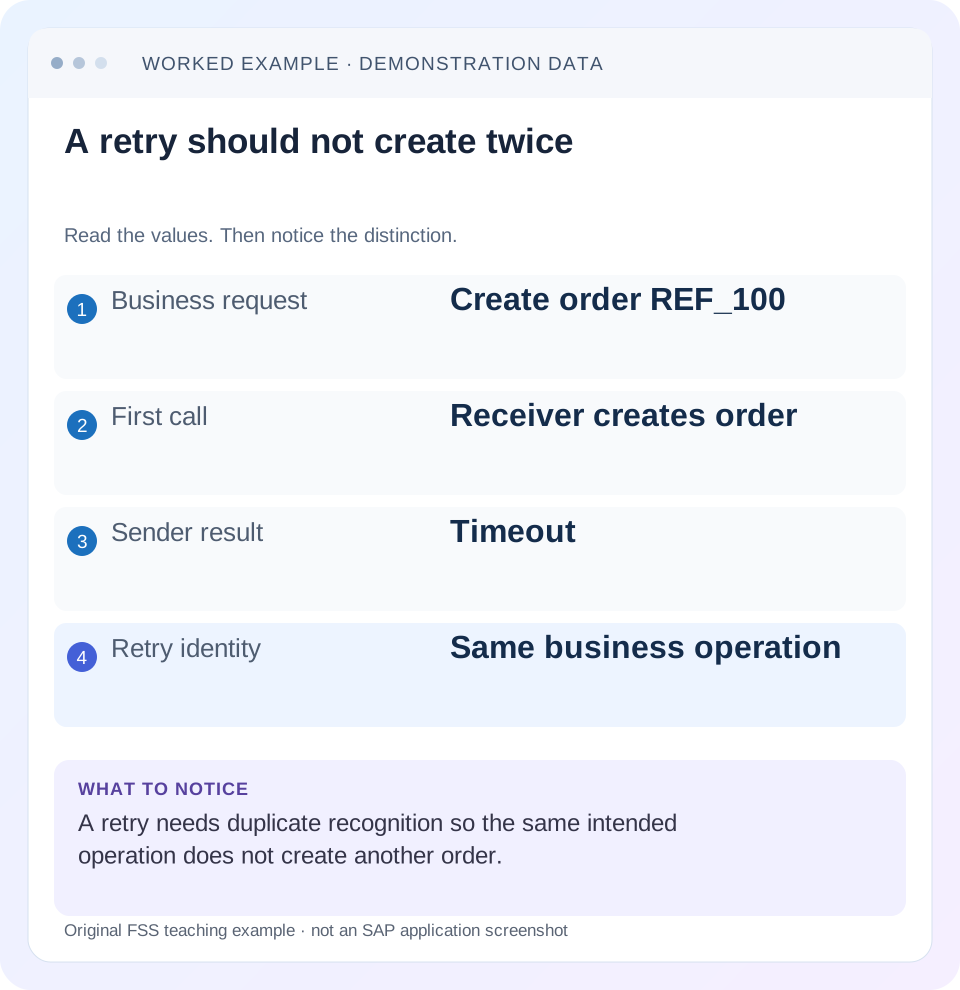
Read the example values
- Business request
- Create order REF_100
- First call
- Receiver creates order
- Sender result
- Timeout
- Retry identity
- Same business operation
Words you’ll meet in this guide
- Message
- A package of information sent between systems.
- Payload
- The business content carried in a request or message.
- API
- A defined interface for another program to use.
- Receiver
- The system to which a message or request is sent.
- HTTP
- The request-and-response protocol used by web applications and APIs.
- JMS
- Java Message Service: a standard messaging API used with supported queue services.
Preview the practical steps
SEE THE CONNECTION
See it in a simple example.
A small example to make the idea concrete.
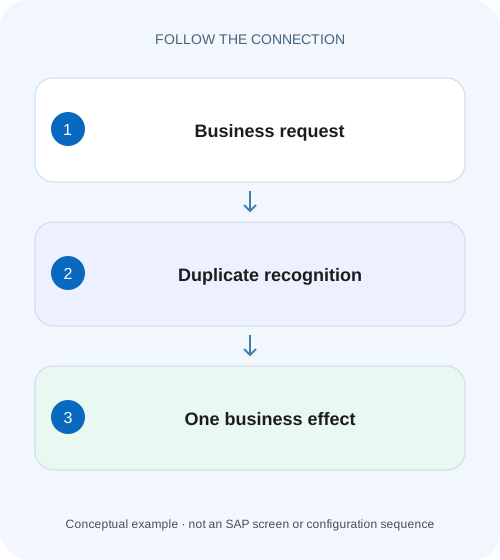
Avoid a repeated component reservation
A manufacturer's integration retries an uncertain request while the receiver may already have performed the business effect.
Define one business operation before defining its duplicate key
Idempotency means repeating the same intended operation does not produce an extra business effect under the agreed contract.
Distinguish duplicate delivery from a second legitimate operation
A transport can deliver the same instruction again because an acknowledgment was lost.
Worked case: REF_100 is created, but the sender times out
Imagine a sender requests creation of order REF_100 for 250 EUR.
Avoid a repeated component reservation
A manufacturer's integration retries an uncertain request while the receiver may already have performed the business effect.
Identify the agreed business key and receiver deduplication contract before treating a network retry as harmless.
| Reader | Business question | Evidence to carry forward |
|---|---|---|
| SAP developers and application teams supporting manufacturers | Avoid a repeated component reservation | Identify the agreed business key and receiver deduplication contract before treating a network retry as harmless. |
01 Define one business operation before defining its duplicate key
Idempotency means repeating the same intended operation does not produce an extra business effect under the agreed contract. A retry after a lost response must remain recognizable as the same operation. SAP Cloud Integration’s Idempotent Process Call can detect a successfully processed message ID within its documented scope, but end-to-end duplicate protection also depends on the receiver and uncertain-outcome handling. [1] [3]
This tutorial is for integration architects and developers designing create/update flows with retries. You need the sender’s retry policy, a stable business identity, receiver behavior and the actual Cloud Integration step version where used. The authored order example illustrates design choices; it does not claim a universal SAP idempotency header or database API.
02 Distinguish duplicate delivery from a second legitimate operation
A transport can deliver the same instruction again because an acknowledgment was lost. A user can also intentionally create another order with similar content. Payload similarity alone cannot decide which is a duplicate. The contract needs an operation identity, its namespace and the circumstances under which a new identity is allowed.
An update to order REF_100 revision 2 may be legitimate new work even though revision 1 was processed. Conversely, generating a fresh UUID for every retry makes the same create instruction look new. Define whether the key identifies a create command, an object version, an event or a batch item. Those choices determine what should be suppressed and what must still execute.
03 Worked case: REF_100 is created, but the sender times out
Imagine a sender requests creation of order REF_100 for 250 EUR. The receiver commits document SO-9001, but the response is lost before the sender receives it. The sender retries. Without duplicate recognition, the receiver can create SO-9002 for the same intended order. A network timeout therefore says the caller lacks a response, not that the business effect did not happen.
Use a stable illustrative operation key ERP100|CreateOrder|REF_100. The system/client namespace and operation type distinguish this create from the same reference in another context. The retry reuses that key and the same business content. A separate legitimate new create must receive its own agreed identity rather than bypassing a duplicate warning arbitrarily.
| Step | Sender evidence | Receiver state |
|---|---|---|
| First request | Create REF_100, 250 EUR | No order initially |
| Commit | Response not yet received | SO-9001 created |
| Response lost | Timeout | SO-9001 still exists |
| Retry with same operation key | Repeat of original intent | Return/reconcile SO-9001 under contract |
04 Choose a key with the right namespace and granularity
Include every context needed to make the identity unique: source system or tenant, operation type and stable reference or version. Avoid embedding mutable fields such as amount into a key unless the contract intentionally treats a changed amount as a new operation. A retry timestamp is usually a poor identity because it changes precisely when recognition is needed.
For a split order, define item-level keys if each item produces an independent receiver effect. Reusing one parent key for several child creates can suppress valid work. Generating unrelated random child IDs on every retry can duplicate it. A repeatable mapping from parent identity plus stable item identity is easier to reconcile. Check the receiver’s permitted ID format and length without silently truncating distinct identities into collisions.
Reject or explicitly handle a missing operation key before the protected effect. Treating every missing key as the same empty identity can suppress unrelated work, while generating a new random key silently can defeat retry recognition.
05 Understand the Cloud Integration step’s actual scope
SAP documents Idempotent Process Call as recording successful completion for a message ID and either skipping duplicate calls or marking them for handling. Its uniqueness history belongs to the specific flow-step instance. Deleting and remodeling that step creates a new instance with empty history. Another step using the same text ID does not automatically share the first step’s recognition. [1]
The documentation also states a default retention of 90 days for stored IDs. Treat that as a documented default to verify for the current setup, not an indefinite business guarantee. If an order can be replayed after a year, a short-lived middleware history alone cannot protect that retention requirement. Include deployment lifecycle and business replay horizon in the design review. [1]
06 Keep success recording aligned with receiver effects
The step marks the subprocess successful only when the complete subprocess succeeds. SAP warns that a later subprocess error can cause preceding steps to repeat on retry. Keep the protected scope simple and understand every side effect within it. A receiver call followed by a failing unrelated enrichment step can leave a committed order but no successful middleware completion record. [1]
This is the central uncertainty gap in REF_100. If the receiver committed SO-9001 and the integration timed out, middleware may not know success. It cannot safely infer “no effect” from its own failed run. SAP explicitly identifies an idempotent receiver as necessary for robust exactly-once scenarios; the process-call step alone cannot rule out every duplicate after a lost acknowledgment. [1] [3]
07 Design a receiver contract that recognizes repeated intent
Where the receiver supports idempotency, use its documented operation key or business uniqueness mechanism. A useful contract can return the original document identity for an identical repeat and reject the same key with conflicting content. The illustrative state machine below is a design explanation, not a built-in Cloud Integration repository schema.
Concurrency matters: two identical requests can arrive together. A non-atomic “look up key, then create order” sequence can let both see no record and create twice. The receiver implementation needs a supported atomic uniqueness/transaction design or equivalent control. Do not promise safety from a cache lookup alone. Business document creation and the key/result record must have the consistency guarantees the design relies on.
| Existing key state | Incoming content | Intended outcome |
|---|---|---|
| Absent | Valid new command | Create once and record result consistently |
| Completed | Same business content | Return original document/result |
| Completed | Conflicting amount or recipient | Reject conflict; do not create another order |
| In progress or uncertain | Same operation | Return documented pending/reconciliation behavior |
08 Handle duplicates with a useful sender response
If Cloud Integration skips a duplicate subprocess, decide what response the sender receives. A generic empty response can make the caller retry again because it still lacks the business outcome. SAP’s alternative-response example lets the local process run for duplicates and uses CamelDuplicateMessage to choose the duplicate branch. That flag is reset before each idempotent process call. [2]
Use the documented Skip Process Call for Duplicates option and duplicate property behavior for the selected design. A duplicate branch should avoid repeating the receiver effect and provide the agreed response, lookup reference or pending status. It should not claim SO-9001 was created now when it merely recognized a prior operation. Preserve status meaning and business identity. [1] [2]
09 Separate business rejection from uncertain delivery
An explicit rejection before creation can be corrected and retried under the contract. A timeout after submission is uncertain and needs receiver lookup or idempotent repeat behavior. A duplicate conflict indicates the same operation key was reused for different intent. Those are three different recovery cases.
For REF_100, query the receiver by the agreed external reference and context when uncertainty remains. If SO-9001 exists, compare amount 250 EUR, recipient and state. Do not merely check that some order uses the same reference in another tenant. If no authoritative result can be established, retain an owned uncertain state instead of generating a new key and hoping it is safe.
10 Troubleshoot duplicate protection by the failed assumption
A duplicate incident can arise from unstable keys, scope changes, retention expiry, concurrent requests or a receiver commit outside the middleware success record. Identify the first assumption that failed rather than adding another deduplication step blindly.
| Observation | Question | Next evidence |
|---|---|---|
| Every retry creates a new key | Is identity generated per delivery? | Original operation key and mapper behavior |
| Valid second item suppressed | Is the key too broad? | Parent/item identity and operation granularity |
| Replay after deployment not recognized | Did the step instance/history change? | Flow-step lifecycle and repository scope |
| Old replay processed again | Did retention expire? | Business replay horizon and configured history |
| Two simultaneous creates | Is uniqueness atomic at receiver? | Concurrent receiver contract and transaction design |
| Flow failed, order exists | Was there an uncertain commit/ack gap? | Receiver lookup and subprocess failure point |
11 Verify identical repeats, conflicts and concurrency
For the positive fixture, submit REF_100 with the stable key and verify one order. Repeat the same instruction and verify the receiver still has one intended order and the sender receives the agreed prior-result or duplicate response. Assert document identity and content, not just the number of successful HTTP responses.
For a negative fixture, reuse the same key with 300 EUR instead of 250. The design should reject or explicitly reconcile conflicting intent according to contract, not silently claim that a 250 EUR order satisfies the new amount. For a boundary fixture, send two identical requests concurrently through the supported test harness and inspect receiver effects.
Also test an error before the receiver call, a lost response after commit, a failure after the receiver effect and a replay beyond middleware retention. Use controlled development fixtures and label unexecuted cases as proposed checks. These boundaries reveal gaps hidden by two sequential happy-path requests.
12 Keep durable delivery and business reconciliation connected
A queue improves the ability to retain and redeliver work, which can increase repeated delivery after temporary failures. Duplicate handling complements durability; it is not a replacement for it. Define what happens to unresolved work, how long identity is retained and who reconciles ambiguous outcomes.
What closes an idempotency design? A specific business effect, stable namespaced key, receiver uniqueness/result contract, middleware scope and retention, duplicate response and failure-boundary tests. Avoid claiming universal exactly-once behavior from a diagram symbol. The related JMS and synchronous/asynchronous lessons explain why acknowledgments, retries and business completion must remain distinct.
Related services and next steps
Primary sources
Found this useful?
Share this guide with your network, or leave a like.
Your like is saved in this browser.