SAP movement 103 versus 105: Why a provisional receipt is not available inventory
A receiving dock records 100 incoming components, but the materials planner cannot yet treat the provisional receipt as available stock.

Source review:
START HERE · NO PRIOR TOPIC KNOWLEDGE NEEDED
What it is. Why it matters.
A goods movement records an inventory-related event. Movement 103 records a provisional receipt into goods-receipt blocked stock; 105 releases that receipt in the corresponding supported process.
Completely new to SAP?
Manufacturers use SAP to connect work such as buying components, recording inventory, planning production, shipping equipment and accounting for costs. SAP S/4HANA is an enterprise resource planning system: it connects these activities through shared business data.
Materials Management supports purchasing and inventory. A request, order, goods receipt and supplier invoice describe separate events, each with its own record and status.
A transaction code, or t-code, is a shortcut to a task in classic SAP GUI. Fiori apps provide another way to work. Names and screens depend on the product and release; you do not need a live system to learn the concepts in this guide.

Scope and source-review notes
Scope and evidence
Source review by FAST SAP SOLUTIONS® editorial. This badge describes our editorial review; it does not represent SAP certification or independent endorsement.
Classic nonvaluated Inventory Management GR blocked stock with 103/105 in ERP and supported S/4HANA. Ordinary blocked inventory, valuated blocked stock, EWM and parallel-quantity behavior are separate scope.
Reviewed the cited official SAP indexed documentation excerpts on 14 November 2026. Direct Help Portal opens did not consistently expose readable page text. This is documentation-based teaching, not customer-system execution. All document identifiers, quantities and outcomes in the worked case are illustrative; installed release, edition, configuration and authorizations require local verification.
A MANUFACTURING EXAMPLE
Explain a provisional plant receipt
Arrival versus accepted receipt
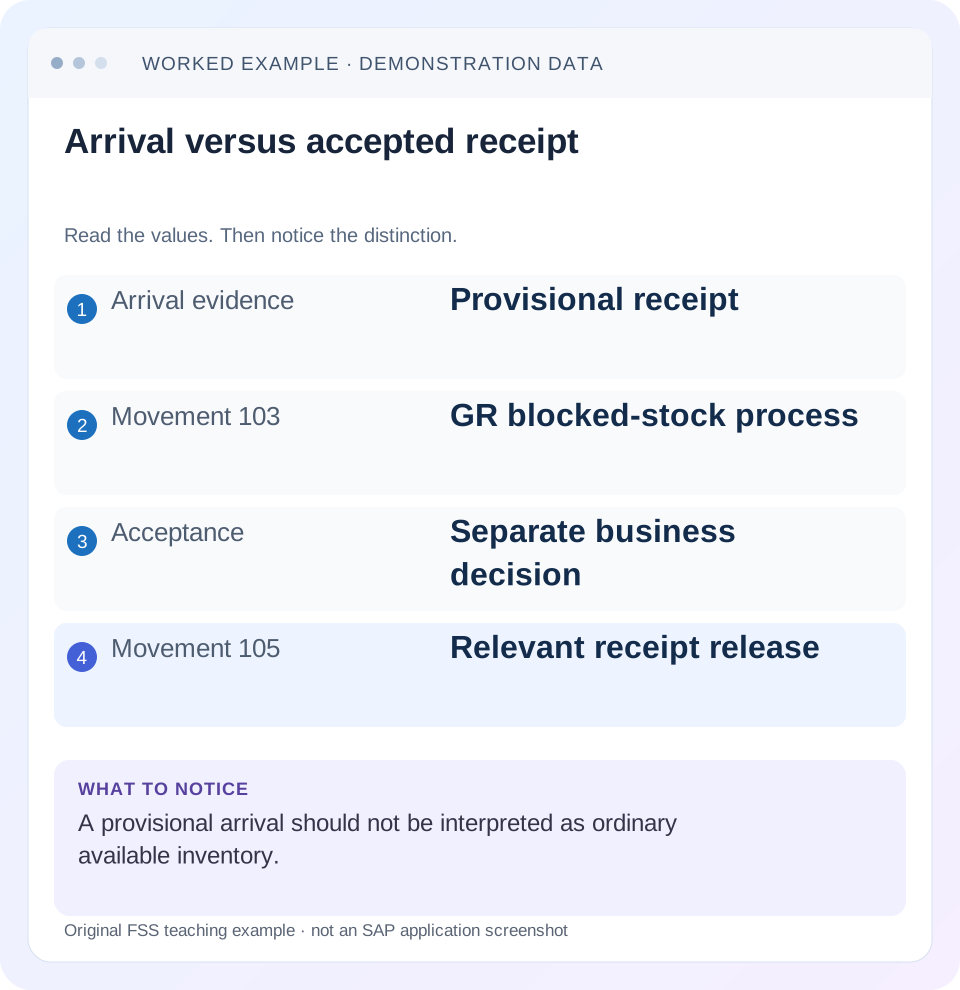
Read the example values
- Arrival evidence
- Provisional receipt
- Movement 103
- GR blocked-stock process
- Acceptance
- Separate business decision
- Movement 105
- Relevant receipt release
Words you’ll meet in this guide
- Material
- A product or supply item managed in SAP.
- Plant
- An organizational unit for relevant logistics operations.
- Goods receipt
- A recorded receipt of goods in a business process.
- Purchase order
- A purchasing document requesting goods or services from a supplier or supplying plant.
- Invoice
- A supplier’s bill for goods or services.
- HANA
- SAP’s database platform.
- EWM
- Extended Warehouse Management: SAP’s application for warehouse processes.
Preview the practical steps
SEE THE CONNECTION
See it in a simple example.
A small example to make the idea concrete.
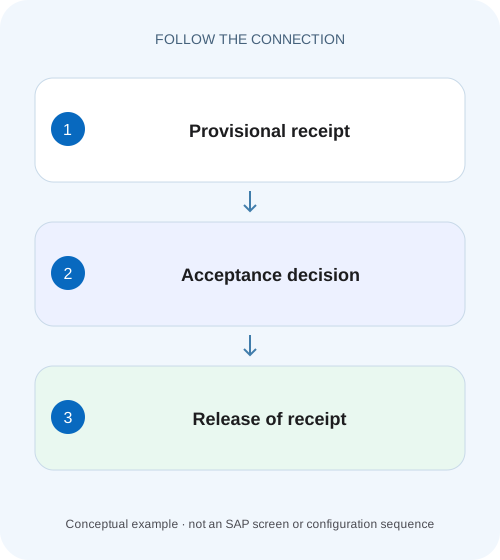
Explain a provisional plant receipt
A receiving dock records 100 incoming components, but the materials planner cannot yet treat the provisional receipt as available stock.
A 103 receipt records conditional arrival
In the classic nonvaluated GR blocked-stock process, movement 103 records a conditional receipt against the purchase order.
Scope and prerequisites
The tutorial concerns the classic 103/105 nonvaluated goods-receipt blocked-stock process in ERP and supported S/4HANA Inventory Management.
What changes at provisional receipt
SAP documents that a 103 material document can serve as an arrival log without adding the quantity to inventory or creating accounting-relevant posting lines for those GR blocked-stock items.
Explain a provisional plant receipt
A receiving dock records 100 incoming components, but the materials planner cannot yet treat the provisional receipt as available stock.
Distinguish the documented 103 and 105 steps, stock state and accepted quantity before promising the components to assembly.
| Reader | Business question | Evidence to carry forward |
|---|---|---|
| Plant stores, warehouse and materials teams | Explain a provisional plant receipt | Distinguish the documented 103 and 105 steps, stock state and accepted quantity before promising the components to assembly. |
01 A 103 receipt records conditional arrival
In the classic nonvaluated GR blocked-stock process, movement 103 records a conditional receipt against the purchase order. The quantity is not yet added to normal inventory. Movement 105 releases the relevant quantity from that provisional receipt into the supported subsequent receipt process. Physical arrival and accepted inventory are therefore separate events. [1] [2]
This explains why a receiving document can exist while the expected unrestricted stock is absent. Before posting another receipt, inspect the movement type and purchase-order history. The word “blocked” is insufficient: ordinary blocked inventory, quality-inspection stock, nonvaluated GR blocked stock and valuated blocked-stock processes are different contexts.
02 Scope and prerequisites
The tutorial concerns the classic 103/105 nonvaluated goods-receipt blocked-stock process in ERP and supported S/4HANA Inventory Management. It does not prescribe EWM receiving or valuated blocked-stock behavior. Catch-weight/parallel-quantity scenarios require additional controls and are explicitly outside the fixed-piece worked case.
Collect the PO/item, material, plant, 103 document, quantities/units, acceptance evidence and any releases, returns or reversals. Obtain display access to purchase-order history, material documents and relevant stock/accounting evidence. Proposed posting checks require an approved training process and a business acceptance decision. A release should represent actual acceptance, not an attempt to make a stock report look complete.
03 What changes at provisional receipt
SAP documents that a 103 material document can serve as an arrival log without adding the quantity to inventory or creating accounting-relevant posting lines for those GR blocked-stock items. The provisional quantity is recorded in purchase-order history. The documentation also distinguishes the effect on open purchasing quantity from an ordinary accepted receipt. [1] [2]
This is different from receiving into quality-inspection or blocked stock, where the material is already managed as inventory in the relevant stock type. Asking “why is it not in blocked inventory?” can therefore be based on the wrong stock model. Read the actual document purpose before choosing a stock display.
A physical pallet waiting for a certificate may be real and under operational control even though it is not yet part of the normal inventory quantity. The provisional document helps account for that arrival without representing completed acceptance.
04 Worked case: one hundred arrive, sixty are accepted
Fictional PO item 10 orders 100 PC of PART-Q. A delivery of all hundred arrives, but acceptance evidence is incomplete. Receiving records 100 PC through the approved 103 process, creating provisional reference GR103-A. There is no initial normal inventory for the material in this simplified case.
Later, sixty pieces meet the acceptance conditions. An authorized partial 105 release for sixty is posted with the supported reference to the provisional receipt. Forty remain unresolved in GR blocked stock. The accepted sixty move into the configured subsequent receipt destination, which must be inspected rather than assumed to be unrestricted in every process.
The example is a quantity bridge: 100 provisionally recorded, sixty released, forty still provisional. It does not mean the company received 160 pieces. The two document stages refer to the same physical delivery population.
| Stage | Quantity | Interpretation |
|---|---|---|
| GR103-A | 100 PC | Conditional arrival; not ordinary inventory |
| Release105-A | 60 PC | Accepted part of original arrival |
| Still provisional | 40 PC | Requires acceptance or other disposition |
| Total physical arrival | 100 PC | Do not add 103 and 105 as separate arrivals |
05 Why receipt history and stock displays differ
After GR103-A, purchase-order history can show the hundred-unit provisional event while a normal inventory stock display does not show those hundred units. These observations are consistent in the documented process. A material-document number proves an event was posted, not that every movement updates the same inventory category. [1]
After the partial release, inspect both the sixty-unit accepted destination and the forty-unit provisional balance. A report that reads only normal stock answers a different question from a report of all supplier deliveries awaiting acceptance. State that distinction in the worklist title and handover.
Do not reconstruct accepted inventory by summing every positive quantity in purchasing history. A provisional receipt and its release are different stages. Categorize them by movement purpose and reference before calculating.
06 Investigate before releasing
Follow the original provisional reference and acceptance population. This keeps a partial release from accidentally becoming a second receipt of the same goods.
Identify the provisional item
Display GR103-A and PO item 10. Confirm material, plant, 100 PC and actual movement purpose.
Expected observation: The arrival is documented in the nonvaluated GR blocked-stock process.
Establish eligible acceptance
Match the approved sixty-piece acceptance evidence to the physically identified goods. Check batch/serial context if relevant.
Expected observation: The released population is known, not merely a convenient quantity.
Inspect existing follow-on events
Read releases, returns and reversals against the same chain and align units.
Expected observation: The remaining forty is not already released or otherwise disposed of.
Verify the authorized result
After the training 105 process, inspect the new material document, PO history, destination stock and applicable accounting evidence.
Expected observation: Sixty accepted and forty provisional can be explained through references.
07 Keep acceptance separate from the final stock category
A release from GR blocked stock is an acceptance-stage event. The subsequent stock category, quality processing and usability follow the actual item/process design. Do not promise that every 105 makes material immediately allocatable to production or sales. Check the resulting document and stock type.
For the worked case, suppose the approved training destination is unrestricted-use stock. Then sixty PC should be interpretable in that context, with forty still provisional. If the actual destination is quality inspection, the quantity may be inventory while remaining subject to quality controls. That is a different observation from the pre-release GR blocked balance.
This distinction helps explain an incident that moves from “not in inventory” to “in inventory but unavailable.” The first question can concern provisional acceptance, while the second concerns the accepted stock’s allowed use.
08 Returns, reversals and valuation boundaries
If acceptance fails for the remaining forty, use the supported return or correction process with the original context. Do not post a release merely to enable an ordinary return path without reviewing the documented alternative. The cited process describes returning goods directly from GR blocked stock when appropriate. [2] [3]
For an erroneous sixty-unit release, preserve the release and its supported reversal relationship. A reversal changes the quantity/state chain; it does not erase the original posting from history. Reconcile the current provisional and accepted quantities after the actual correction.
Valuated blocked stock uses a different movement/process design. SAP’s current documentation distinguishes those movements from 103/105. If accounting evidence exists at a stage expected to be nonvaluated, first confirm which actual process and item is being inspected rather than assuming an accounting error.
09 Troubleshooting decisions
The following table focuses on the first wrong assumption. A new normal receipt is rarely a sound first response to an unexplained provisional quantity.
| Observation | Question | Next evidence |
|---|---|---|
| 103 exists, normal stock absent | Is this conditional rather than accepted receipt? | 103 document and PO history |
| 100 provisional and 60 released look like 160 | Are process stages being added? | Original/release relationship |
| Forty still awaiting acceptance | Was only sixty eligible and released? | Acceptance evidence and partial-release chain |
| 105 exists, stock unusable | What accepted destination/category resulted? | Release document and stock/quality context |
| Accounting appears at unexpected stage | Is it actually valuated blocked stock? | Movement type and full document context |
| Return required before acceptance | Which supported provisional return applies? | Original receipt and installed return procedure |
10 Common mistakes in provisional receiving
Do not post an additional 101 receipt simply because MMBE does not show the provisional hundred units. That can duplicate accepted quantity while leaving the original provisional chain unresolved. Reconcile existing events first. [3]
Do not describe every blocked quantity as nonvaluated. Ordinary inventory held in a blocked category is different from this specific GR blocked-stock process. Valuation depends on the actual process and document, not the English label.
Do not release an entire provisional receipt because only part of the delivery passed inspection. Keep the physically identified accepted and unresolved populations aligned with the quantities and references. If batches or serials apply, include those identities in the acceptance evidence.
Avoid applying fixed-unit arithmetic to parallel-quantity cases. SAP documents additional constraints when base and parallel quantities are handled together. A sixty-piece release can require independent actual-weight reasoning in a catch-weight design.
11 Positive, negative and boundary exercises
For the positive worksheet check, start with no ordinary stock, record 100 provisionally, release sixty and reconcile forty still provisional. In an authorized training system, inspect the actual material, purchasing and accounting evidence for each stage and the configured accepted destination.
For the negative check, add the 100 and sixty as though they were separate physical deliveries. Explain why 160 is wrong and identify the shared reference population. Separately create a worksheet with an ordinary blocked-stock receipt and explain why its inventory treatment differs.
For boundary checks, consider a full 100-unit release, no acceptance at all and an approved reversal of part of a release. Test the remaining-quantity controls in the installed process. Do not use a training outcome for simple pieces as proof that catch-weight or EWM processes behave identically.
12 Questions and the investigation handover
Does 103 mean no document was created? No. It records the provisional arrival; inspect that material document and the PO history. Does 105 prove unrestricted availability? Inspect the actual accepted destination and downstream controls. Can the provisional amount be ignored because it is not normal inventory? No. It represents real goods awaiting a supported disposition.
A useful handover states: “GR103-A records 100 PC conditionally received for item 10. Release105-A accepts sixty into the documented destination. Forty remain provisional. The original arrival is 100, not 160; remaining acceptance/return action is owned by the designated receiving/quality process.”
Continue with movement types, PO history and stock overview to verify the document’s meaning, reference chain and final quantity context. Those lessons complement the provisional-receipt model rather than replacing it.
Related services and next steps
Primary sources
Found this useful?
Share this guide with your network, or leave a like.
Your like is saved in this browser.