SAP movement types: More than a label on a goods movement
A component store receives 100 pieces and production consumes 30; an analyst must explain the resulting stock effects from the recorded movements.

Source review:
START HERE · NO PRIOR TOPIC KNOWLEDGE NEEDED
What it is. Why it matters.
A movement type classifies an inventory event and controls relevant processing. It tells SAP whether goods are being received, issued or moved under a particular process.
Completely new to SAP?
Manufacturers use SAP to connect work such as buying components, recording inventory, planning production, shipping equipment and accounting for costs. SAP S/4HANA is an enterprise resource planning system: it connects these activities through shared business data.
Materials Management supports purchasing and inventory. A request, order, goods receipt and supplier invoice describe separate events, each with its own record and status.
A transaction code, or t-code, is a shortcut to a task in classic SAP GUI. Fiori apps provide another way to work. Names and screens depend on the product and release; you do not need a live system to learn the concepts in this guide.

Scope and source-review notes
Scope and evidence
Source review by FAST SAP SOLUTIONS® editorial. This badge describes our editorial review; it does not represent SAP certification or independent endorsement.
Inventory Management movement-type concepts in ERP and supported S/4HANA. Standard examples illustrate purposes; customer configuration, allowed applications, account determination, special stock and warehouse integration require local verification.
Reviewed the cited official SAP indexed documentation excerpts on 14 November 2026. Direct Help Portal opens did not consistently expose readable page text. This is documentation-based teaching, not customer-system execution. All document identifiers, quantities and outcomes in the worked case are illustrative; installed release, edition, configuration and authorizations require local verification.
A MANUFACTURING EXAMPLE
Explain receipts and production consumption
Explain why stock changed
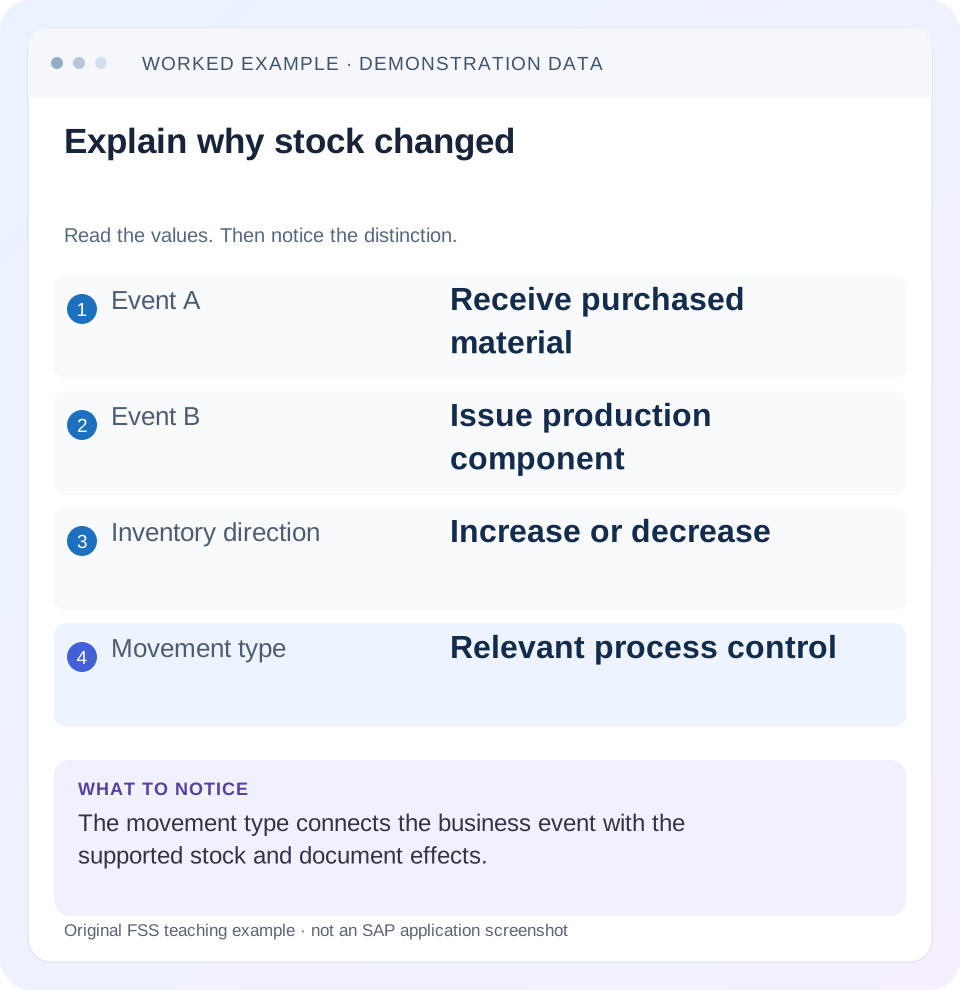
Read the example values
- Event A
- Receive purchased material
- Event B
- Issue production component
- Inventory direction
- Increase or decrease
- Movement type
- Relevant process control
Words you’ll meet in this guide
- Material
- A product or supply item managed in SAP.
- Plant
- An organizational unit for relevant logistics operations.
- Goods receipt
- A recorded receipt of goods in a business process.
- Purchase order
- A purchasing document requesting goods or services from a supplier or supplying plant.
- Invoice
- A supplier’s bill for goods or services.
- HANA
- SAP’s database platform.
- EWM
- Extended Warehouse Management: SAP’s application for warehouse processes.
- WM
- Warehouse Management: the warehouse application or component in the relevant SAP product.
Preview the practical steps
SEE THE CONNECTION
See it in a simple example.
A small example to make the idea concrete.
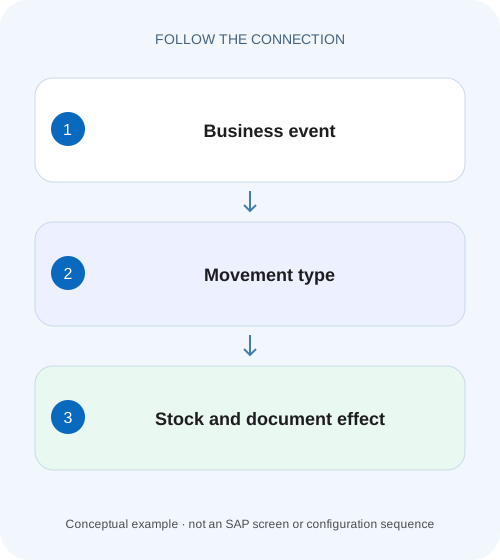
Explain receipts and production consumption
A component store receives 100 pieces and production consumes 30; an analyst must explain the resulting stock effects from the recorded movements.
The movement type describes the business event and controls its effect
A movement type is a three-digit key identifying the business purpose of a goods movement.
Scope and prerequisites
The guide explains Inventory Management movement-type concepts in ERP and supported S/4HANA, using current Cloud and on-premise documentation.
Separate purpose, direction and destination
A receipt can increase the relevant inventory context, an issue can reduce it and a transfer can change location or category without the same overall quantity effect.
Explain receipts and production consumption
A component store receives 100 pieces and production consumes 30; an analyst must explain the resulting stock effects from the recorded movements.
Read the movement type with its document, quantity, stock context and any reversal instead of inferring the posting from its description.
| Reader | Business question | Evidence to carry forward |
|---|---|---|
| Plant stores, warehouse and materials teams | Explain receipts and production consumption | Read the movement type with its document, quantity, stock context and any reversal instead of inferring the posting from its description. |
01 The movement type describes the business event and controls its effect
A movement type is a three-digit key identifying the business purpose of a goods movement. SAP documents that it participates in quantity, stock, valuation, account and follow-on-document control. It is therefore more than the text label beside a quantity. Choosing a movement is choosing a process meaning. [1]
The same material can be received, issued, reclassified or corrected with different consequences. A final stock total that looks plausible does not prove the intended reference and accounting effects occurred. This tutorial follows a receipt and consumption event, then compares a correction with a stock-category transfer.
02 Scope and prerequisites
The guide explains Inventory Management movement-type concepts in ERP and supported S/4HANA, using current Cloud and on-premise documentation. The examples use documented standard purposes, not a universal list of customer movement configuration. EWM warehouse tasks and classic WM transfer orders have different execution objects even when linked to an Inventory Management movement.
Obtain the actual business event, material, plant/storage location, unit, stock category, ownership/special-stock context, reference document and intended account recipient if applicable. Authorized material-document and stock display is needed for investigation. Proposed postings belong in a training system with the approved process.
Do not try alternative movement types in production until one passes validation. An accepted posting can be semantically wrong and create downstream documents that a stock-only comparison misses.
03 Separate purpose, direction and destination
A receipt can increase the relevant inventory context, an issue can reduce it and a transfer can change location or category without the same overall quantity effect. The movement type helps define the purpose, while material, reference and organizational data determine the full posting context. [1]
SAP gives standard examples such as 101 for a PO receipt, 201 for a cost-center issue and 321 for release from quality-inspection stock. These examples show different purposes, not a promise that every installed application permits direct entry of each code in every situation.
A movement number alone is also insufficient for valuation. The material’s accounting data, valuation context, stock ownership and relevant configuration matter. Inspect actual material and accounting documents before claiming that a movement always posts one fixed G/L pattern.
04 Worked case: receive one hundred, consume thirty
The fictional material PART-M is held at P100/S100 in PC. There is no opening quantity in this deliberately simplified case. An authorized purchase-order receipt records 100 PC, and a later approved cost-center issue consumes thirty PC for recipient CC100. No other relevant movements occur.
The remaining physical quantity in the defined context is 100 − 30 = 70 PC. The receipt has purchasing evidence; the issue has consumption-recipient evidence. Both movements concern PART-M but explain different business events and accounting questions.
Assume a simple illustrative inventory-value basis of 10 currency units per piece only to reason about the fixture: 1,000 received basis, 300 consumed basis and 700 remaining basis. Actual valuation can differ with price control, invoice effects and other accounting factors. The movement type does not eliminate those dependencies.
| Event | Quantity effect | Reference/context to verify |
|---|---|---|
| PO receipt | +100 PC | Actual purchasing item and receipt document |
| Cost-center consumption | −30 PC | CC100 and goods-issue document |
| Defined remaining quantity | 70 PC | Only under stated no-other-events scope |
| Illustrative value bridge | 1,000 − 300 = 700 | Fixed ten-per-piece assumption; not universal valuation |
05 Choose the event before entering the code
Ask what actually happened. Were new goods delivered, existing goods consumed, a prior posting entered incorrectly or stock moved between categories? These are not interchangeable ways to make a quantity increase or decrease.
If ten pieces of the receipt were entered in error, investigate the supported reversal/correction of that receipt and preserve its original reference. Issuing ten to an unrelated cost center might produce the desired seventy-to-sixty stock number while falsely recording consumption.
If stock moves from quality inspection to unrestricted, the business event is a status/category change under the approved quality process. It is not another supplier receipt. Choose the supported process and then verify the movement/reference it generates or requires.
06 Inspect a goods movement in sequence
The following procedure supports both preposting review in training and read-only investigation of an existing document.
State the business event
For the fixture, identify receipt against PO-A or consumption by CC100. Distinguish correction and stock-category transfer.
Expected observation: The intended purpose is explicit before selecting movement.
Read the proposed full context
Check material, plant/location, quantity/unit, category, special stock, recipient and reference document.
Expected observation: The movement belongs to the intended stock identity and process.
Review expected effects
Name which quantity/context should change and which purchasing/accounting/follow-on evidence should exist in this scenario.
Expected observation: Acceptance is broader than a final stock total.
Verify posted documents
After the authorized training action, display the material document and applicable accounting/purchasing/warehouse relationships.
Expected observation: The recorded event matches its purpose and references.
Reconcile before retry
If the response was unclear, search existing documents using the actual business reference before another posting.
Expected observation: A communication symptom does not become a duplicate movement.
07 Reversal is a relationship, not just a negative number
A reversal references and corrects an earlier event through the supported process. Keep the original and reversing document identities. A negative quantity elsewhere can have a different business purpose, such as a genuine issue or return.
For a worksheet variation, reverse ten from the 100-piece receipt before the thirty-piece issue. The simplified remaining quantity becomes sixty. If instead ten are legitimately consumed by CC100, the quantity can also become sixty, but the business explanation and accounting/recipient evidence differ.
This demonstrates why matching stock totals are insufficient. Two histories can yield the same balance while one says the supplier receipt was overstated and the other says the department consumed more. Support must establish which history reflects reality.
08 Stock-category and ownership transfers need their own interpretation
A transfer from inspection to unrestricted can reduce one category and increase another while leaving the simplified combined physical total unchanged. A transfer between storage locations can have a similar source/destination pattern at plant level. Read both sides and the actual timing.
Ownership transfer is another distinction. Supplier consignment may be physically present before becoming company-owned through the relevant process. Treating that event as a new physical arrival would confuse ownership with location.
Two-step processes add intermediate states such as goods in transit. Do not assume every transfer is instantaneous or that one document proves both endpoints completed. Follow the actual document flow, especially when warehouse execution or delivery processing is involved.
A further worksheet comparison moves ten pieces from unrestricted stock to another permitted category without removing them from the defined combined physical population. The total can remain seventy while the unrestricted branch falls to sixty. Calling this consumption would misdescribe the event. Compare that history with the ten-piece issue and with a ten-piece receipt correction: identical branch numbers can arise from three different purposes, which only document context can distinguish.
09 Troubleshooting decisions
The useful diagnostic branch starts from the event that should have occurred. A familiar movement description is not enough to establish correct processing.
| Observation | Question | Next evidence |
|---|---|---|
| Quantity correct, cost charged incorrectly | Was issue purpose/recipient correct? | Material/accounting document and CC100 assignment |
| Stock reduced but receipt error remains | Was consumption used instead of correction? | Original receipt and supported reversal relationship |
| No normal stock after provisional receipt | Was 103 GR blocked process used? | Actual movement and PO history |
| Category changed, total unchanged | Is this a posting/category transfer? | Source/destination stock contexts |
| Same movement has different value outcome | Which material/valuation/reference differs? | Accounting data and actual posting lines |
| Timeout followed by duplicate quantity | Did first posting already commit? | Existing document references before retry |
10 Common mistakes with movement codes
Do not infer a reversal code by arithmetic or memorize a code pair without verifying the installed supported process. Customer movement types and process restrictions exist, and references can determine what the system proposes. Use the documented correction function and inspect the generated result.
Do not regard movement type as the only account-determination input. A stock material and a direct-consumption purchase can need different reasoning. The full material, account-assignment and valuation context must be considered.
Do not bypass quality or ownership decisions with a convenient stock transfer. A system accepting a quantity does not prove the business approval or physical event occurred. The document should faithfully record the event and its authorized state change.
11 Verification exercises
For the positive worksheet check, reconcile the hundred-piece receipt and thirty-piece consumption to seventy. Then verify receipt-to-PO and issue-to-CC100 evidence separately. Under the explicit fixed-value assumption, explain the 1,000/300/700 bridge without generalizing it to all price controls.
For the negative check, reduce stock by ten through unrelated consumption to conceal an overstated receipt. Explain why the resulting sixty-piece quantity can look correct while the document history is wrong.
For boundary checks, compare a full reversal, a partial correction, a category transfer with unchanged combined quantity and a transfer crossing periods. In an authorized training system, capture actual movement codes, messages, stock contexts and accounting/follow-on documents. Proposed checks here are not runtime claims.
12 Questions and a useful movement explanation
Can I identify the full accounting result from the movement number alone? No. The number participates in control, but the actual context and configuration determine the supported posting. Does every material document change normal inventory? No; provisional and other processes must be interpreted by their documented purpose.
Is a warehouse task the same as an IM movement? No. Warehouse execution has its own objects and states, linked through the installed integration. Does a negative quantity always reverse a receipt? No. Establish the actual event and reference.
A useful result names the movement purpose, material/location/category/unit, quantity, source/recipient, original or reversing relationship and verified material/accounting/follow-on references. Continue with 103/105, transfers and price control when those are the specific process distinctions under investigation.
Related services and next steps
Primary sources
Found this useful?
Share this guide with your network, or leave a like.
Your like is saved in this browser.