SAP standard price versus moving average price: Explain the inventory-value difference
A plant receives another batch of bought-in components at a different purchase price, and finance needs to explain why the inventory value changes differently under two price controls.

Source review:
START HERE · NO PRIOR TOPIC KNOWLEDGE NEEDED
What it is. Why it matters.
Standard-price control uses a defined valuation price with relevant differences handled separately. Moving-average control can update inventory value and its average unit price through supported transactions.
Completely new to SAP?
Manufacturers use SAP to connect work such as buying components, recording inventory, planning production, shipping equipment and accounting for costs. SAP S/4HANA is an enterprise resource planning system: it connects these activities through shared business data.
Materials Management supports purchasing and inventory. A request, order, goods receipt and supplier invoice describe separate events, each with its own record and status.
A transaction code, or t-code, is a shortcut to a task in classic SAP GUI. Fiori apps provide another way to work. Names and screens depend on the product and release; you do not need a live system to learn the concepts in this guide.

Scope and source-review notes
Scope and evidence
Source review by FAST SAP SOLUTIONS® editorial. This badge describes our editorial review; it does not represent SAP certification or independent endorsement.
ERP/S/4HANA price-control concepts. The positive-stock receipt fixtures exclude tax, currency effects and other events; stock coverage, split valuation, negative stock, Material Ledger/actual costing and periods require their own documented treatment.
Reviewed the cited official SAP indexed documentation excerpts on 14 November 2026. Direct Help Portal opens did not consistently expose readable page text. This is documentation-based teaching, not customer-system execution. All document identifiers, quantities and outcomes in the worked case are illustrative; installed release, edition, configuration and authorizations require local verification.
A MANUFACTURING EXAMPLE
Explain a component receipt valuation
A simple weighted receipt average
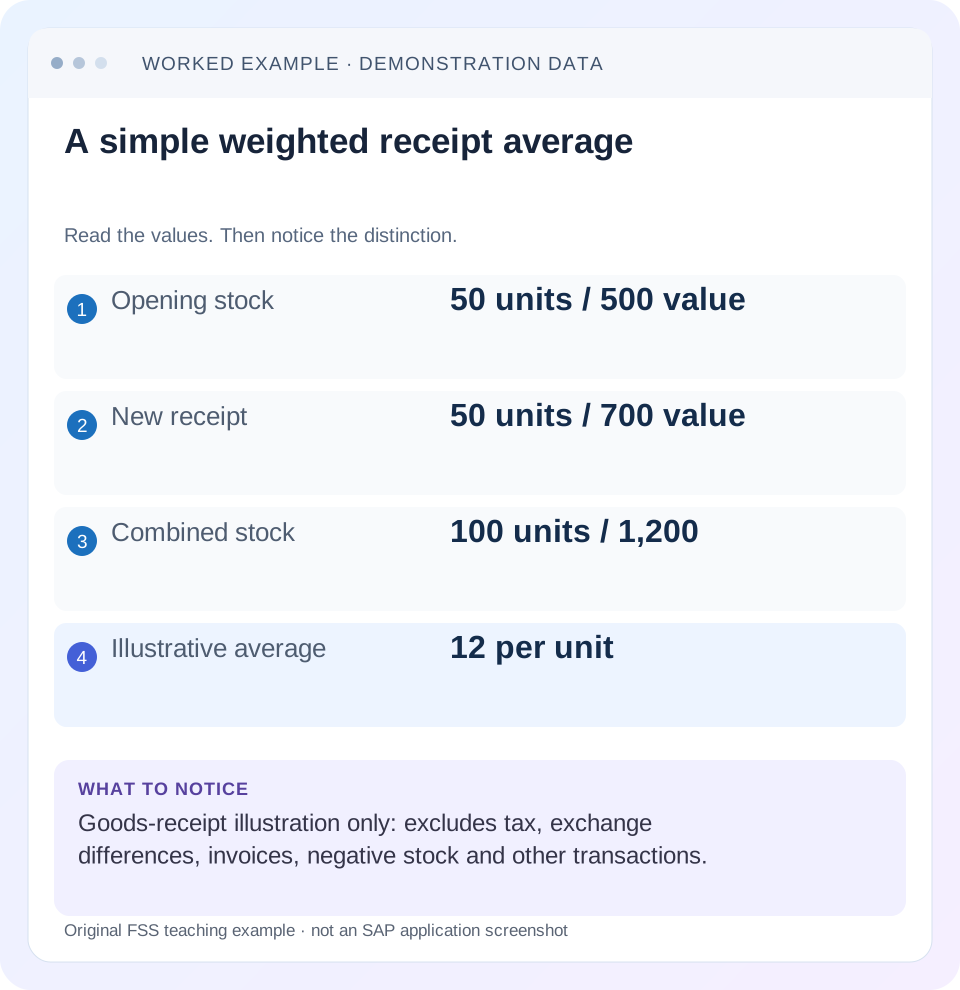
Read the example values
- Opening stock
- 50 units / 500 value
- New receipt
- 50 units / 700 value
- Combined stock
- 100 units / 1,200
- Illustrative average
- 12 per unit
Words you’ll meet in this guide
- Material
- A product or supply item managed in SAP.
- Plant
- An organizational unit for relevant logistics operations.
- Goods receipt
- A recorded receipt of goods in a business process.
- Purchase order
- A purchasing document requesting goods or services from a supplier or supplying plant.
- Invoice
- A supplier’s bill for goods or services.
- HANA
- SAP’s database platform.
Preview the practical steps
SEE THE CONNECTION
See it in a simple example.
A small example to make the idea concrete.
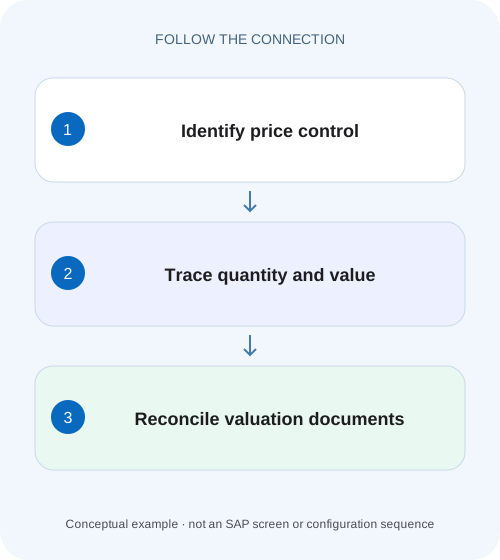
Explain a component receipt valuation
A plant receives another batch of bought-in components at a different purchase price, and finance needs to explain why the inventory value changes differently under two price controls.
Read price control before interpreting a value difference
Standard-price control and moving-average-price control handle relevant price differences differently.
Scope and prerequisites
The guide concerns ERP/S/4HANA inventory price-control concepts.
Separate unit price, inventory value and invoice amount
A displayed material price can be quoted per one, ten or another price-unit quantity.
Explain a component receipt valuation
A plant receives another batch of bought-in components at a different purchase price, and finance needs to explain why the inventory value changes differently under two price controls.
Work through the stated quantities and values, then compare the actual price control and posting evidence before explaining a variance.
| Reader | Business question | Evidence to carry forward |
|---|---|---|
| Plant stores, warehouse and materials teams | Explain a component receipt valuation | Work through the stated quantities and values, then compare the actual price control and posting evidence before explaining a variance. |
01 Read price control before interpreting a value difference
Standard-price control and moving-average-price control handle relevant price differences differently. With standard price, inventory valuation uses the defined standard basis and relevant variances follow difference-posting treatment. With moving average, supported transactions can change inventory value and the average price. SAP documents S and V as the respective indicators. [1]
The correct first response to an unfamiliar inventory value is therefore to establish price control, valuation area, price unit, currency and document sequence. Changing a material price merely to match the last supplier invoice can conceal a legitimate valuation method or create a new error. This tutorial works through the existing fifty-plus-fifty receipt example and then adds invoice timing and stock coverage.
02 Scope and prerequisites
The guide concerns ERP/S/4HANA inventory price-control concepts. Material Ledger, actual costing, parallel currencies/valuations, split valuation, negative stock and period-end revaluation add separate rules. The calculations below are explicitly simple receipt fixtures and not a complete SAP posting algorithm.
Collect material and valuation area/type, S/V indicator, price determination context where relevant, price unit, base quantity, currency and the receipt/invoice/accounting documents. Display access to material accounting data and financial evidence is required. Proposed postings or price changes belong in an approved training/accounting process.
Use a chronological worksheet. A later invoice after consumption is not economically or technically identical to a receipt into an untouched quantity. The sequence is often the explanation.
03 Separate unit price, inventory value and invoice amount
A displayed material price can be quoted per one, ten or another price-unit quantity. Normalize that basis before multiplying by stock. The invoice amount also includes its own quantity and price basis, with taxes, freight and exchange effects potentially separate. [1]
Stock quantity times a rounded displayed price may not reproduce an exact stock value. SAP documents that the moving-average display is rounded while valuation calculations use the exact value/quantity basis. Retain actual value and quantity evidence instead of treating a display rounding difference as a posting error.
The supplier liability is another amount. Its existence and payment state should be traced through the invoice/accounting chain; it should not be inferred from the material’s current stock value.
04 Worked receipt case: fifty worth five hundred plus fifty worth seven hundred
The fictional opening stock is 50 PC worth 500 in one stated valuation context. A receipt adds 50 PC at an illustrative 14 per piece, giving a receipt basis of 700. Exclude tax, freight, exchange differences, invoice variances and other movements. Under the simple moving-average fixture, the combined quantity is 100 and combined value 1,200.
The weighted average is 1,200 ÷ 100 = 12 per PC. It is not the simple average of arbitrary price labels unless their quantity weights justify that result. Here the two fifty-piece quantities happen to be equal, but quantity weighting is the actual reasoning.
For a comparison fixture using standard price 10 per PC, the combined 100-piece inventory basis remains 1,000 under the stated standard-price assumptions, with the 200 difference from the 700 receipt cost handled through the applicable difference treatment. Both quantities are 100; the valuation method explains the different stock-value result.
| Measure | Moving-average fixture | Standard-price fixture |
|---|---|---|
| Opening | 50 PC / 500 | 50 PC / 500 at standard 10 |
| New receipt cost basis | 50 PC / 700 | 50 PC / 700 commercial basis |
| Inventory increase | 700 under simple assumptions | 500 at standard 10 |
| Resulting inventory | 100 PC / 1,200 | 100 PC / 1,000 |
| Relevant difference | Average becomes 12 | 200 difference treatment; standard remains 10 |
05 Reconcile the material and documents in sequence
The following sequence establishes whether a value difference comes from price control, unit basis or a later event.
Confirm the valuation identity
Read material, area/type, currency, price control and full price-unit basis.
Expected observation: The comparison concerns one accounting population.
Establish the opening boundary
Record fifty pieces and 500 value with the relevant observation/period basis.
Expected observation: The receipt calculation has a defined starting state.
Read the receipt evidence
Inspect the fifty-piece receipt, its 700 cost basis and actual material/accounting lines.
Expected observation: Quantity and value effects are supported by documents.
Compare the price-control result
Under the fixture, explain 1,200/100 = 12 for V versus the standard-ten inventory/difference treatment for S.
Expected observation: Different values are explained before any correction is proposed.
Add later events chronologically
Include issues, invoices, corrections and period-end effects before comparing with today’s master display.
Expected observation: A current price is not attributed to one old receipt without evidence.
06 A later invoice introduces a second value question
Continue the moving-average fixture with no consumption. Suppose the invoice for the new fifty pieces uses 15 rather than the receipt’s 14 per piece. Its simplified amount is 750, fifty above the 700 receipt basis. Establish whether the installed process has sufficient stock coverage and the relevant matching/accounting context. [2]
Under the expressly sufficient-coverage illustration and no other effects, adding fifty to the 1,200 inventory value gives 1,250 for 100 pieces, or 12.50 per piece. This is a conditional teaching calculation, not a rule that every invoice variance always capitalizes fully.
Under standard-price control, the invoice difference has the applicable difference-posting treatment rather than simply forcing the standard price from ten to fifteen. The supplier’s invoice amount and the material’s valuation basis remain different measures.
07 Stock coverage makes invoice timing important
Now change the timeline so much of the stock is consumed before the invoice arrives. SAP documents that insufficient stock coverage can prevent the full invoice variance from being included in inventory, with remaining amounts following the relevant difference treatment. Read the actual remaining quantity and accounting lines. [2] [3]
Do not apply a universal “invoice difference divided by current stock” formula. The relevant invoice quantity, valuation context, transaction order and installed rules matter. Repeated invoices can also affect a remaining stock population in ways that a single-receipt worksheet does not capture.
For investigation, write the issue before the invoice on the timeline and compare the actual stock and value immediately before invoice posting. This identifies the boundary at which the sufficient-coverage receipt fixture stopped being applicable.
Retain the invoice reference as well as its fifty-piece quantity when testing coverage. Two different invoices for fifty each are not one hundred pieces of new physical receipt. Their value adjustments must be traced in chronological order against the stock context at each posting. The number of invoice rows does not replenish stock consumed earlier.
08 Material Ledger and actual costing are separate dimensions
A material can use standard price for preliminary current-period valuation while Material Ledger/actual costing calculates period-related prices under its supported design. A moving-average or periodic figure visible for information is not automatically the price used for every current-period posting. [4]
SAP documents the relationship between price control and material price determination. Establish the active indicators, period and valuation view before comparing a period-end price with a goods issue posted earlier. A later closing calculation does not mean that the original posting should have used a future price.
This tutorial does not prescribe a Material Ledger close or revaluation procedure. Use the actual accounting design to reconcile preliminary, periodic and informational values, retaining their dates and currencies.
09 Troubleshooting decisions
Use the first mismatched basis to guide the investigation. A manual price update is a business/accounting decision after explanation, not a substitute for it.
| Observation | Question | Next evidence |
|---|---|---|
| Receipt quantity correct, inventory value unexpected | S or V, and what price unit? | Material accounting data and actual receipt lines |
| Last invoice price differs from standard | Is variance treatment intended? | Standard basis and difference postings |
| MAP does not absorb all invoice difference | Was stock coverage sufficient? | Pre-invoice quantity and accounting split |
| Quantity × displayed MAP differs slightly | Is price rounded or quoted per multiple units? | Exact stock value/quantity and price unit |
| Period-end price differs from earlier issue | Which price determination/period applies? | Material Ledger context and posting dates |
| Different batch prices expected | Is split valuation configured? | Valuation category/type and batch relationship |
10 Common mistakes that distort valuation explanations
Do not average 10 and 14 without considering quantity. If the receipt were only ten pieces at fourteen, the opening fifty at ten would give 640 divided by sixty, approximately 10.6667 under the simplified fixture, not twelve. This variation exposes a common unweighted-average error.
Do not change price control just because one method produces a value closer to a recent invoice. The choice affects future transactions and reporting, with supported change restrictions and accounting consequences.
Do not omit reversals or subsequent debits/credits from the timeline. A correct first receipt can be followed by events that legitimately change value. Similarly, do not compare values from different currencies or valuation types without the approved conversion/context.
11 Verification exercises
For the positive worksheet check, reproduce 50/500 plus 50/700 to 100/1,200 and twelve. Compare the standard-ten fixture’s 1,000 inventory and 200 difference basis. Under the conditional sufficient-coverage invoice variation, explain 1,250/100 = 12.50.
For the negative check, use only ten new pieces at fourteen and show why twelve is wrong. Then divide a later invoice variance by whatever stock happens to remain without reviewing coverage, and identify which assumptions are missing.
For boundary checks, test exact price-unit normalization, rounded display, invoice after heavy consumption, a receipt reversal and a Material Ledger period boundary in an authorized training design. Negative stock needs its own documented scenario; it is not validated by this positive-stock arithmetic.
12 Questions and the accounting handover
Is moving average always the last purchase price? No. The receipt fixture combines the opening population and new value. Does standard price ignore variances? It records relevant differences through their supported accounting treatment rather than simply incorporating them into the standard inventory basis.
Does V mean every invoice difference increases stock? Coverage and other process rules matter. Does a visible informational price prove the posting basis? Read the indicators, period and actual accounting document.
A useful handover names the material/area/type, S/V and price unit, opening 50/500, receipt 50/700, subsequent events and actual inventory/difference lines. Continue with split valuation, invoice display and delivery costs when those add the unexplained value component.
Related services and next steps
Primary sources
Found this useful?
Share this guide with your network, or leave a like.
Your like is saved in this browser.