SAP planned versus unplanned delivery costs: Trace the invoice allocation
A machinery manufacturer buys two component items and receives freight charges whose treatment depends on whether the cost was planned in purchasing.

Source review:
START HERE · NO PRIOR TOPIC KNOWLEDGE NEEDED
What it is. Why it matters.
Delivery costs include charges such as freight. Planned costs are anticipated in purchasing conditions; unplanned costs arise during invoice entry and follow their supported allocation rules.
Completely new to SAP?
Manufacturers use SAP to connect work such as buying components, recording inventory, planning production, shipping equipment and accounting for costs. SAP S/4HANA is an enterprise resource planning system: it connects these activities through shared business data.
Materials Management supports purchasing and inventory. A request, order, goods receipt and supplier invoice describe separate events, each with its own record and status.
A transaction code, or t-code, is a shortcut to a task in classic SAP GUI. Fiori apps provide another way to work. Names and screens depend on the product and release; you do not need a live system to learn the concepts in this guide.

Scope and source-review notes
Scope and evidence
Source review by FAST SAP SOLUTIONS® editorial. This badge describes our editorial review; it does not represent SAP certification or independent endorsement.
Classic Purchasing/LIV planned and unplanned delivery-cost concepts, including current S/4HANA 2025 FPS01 examples. Allocation, prior-invoice basis, tax, price control and account treatment are configuration/process dependent.
Reviewed the cited official SAP indexed documentation excerpts on 14 November 2026. Direct Help Portal opens did not consistently expose readable page text. This is documentation-based teaching, not customer-system execution. All document identifiers, quantities and outcomes in the worked case are illustrative; installed release, edition, configuration and authorizations require local verification.
A MANUFACTURING EXAMPLE
Reconcile freight on incoming components
Which cost was anticipated?
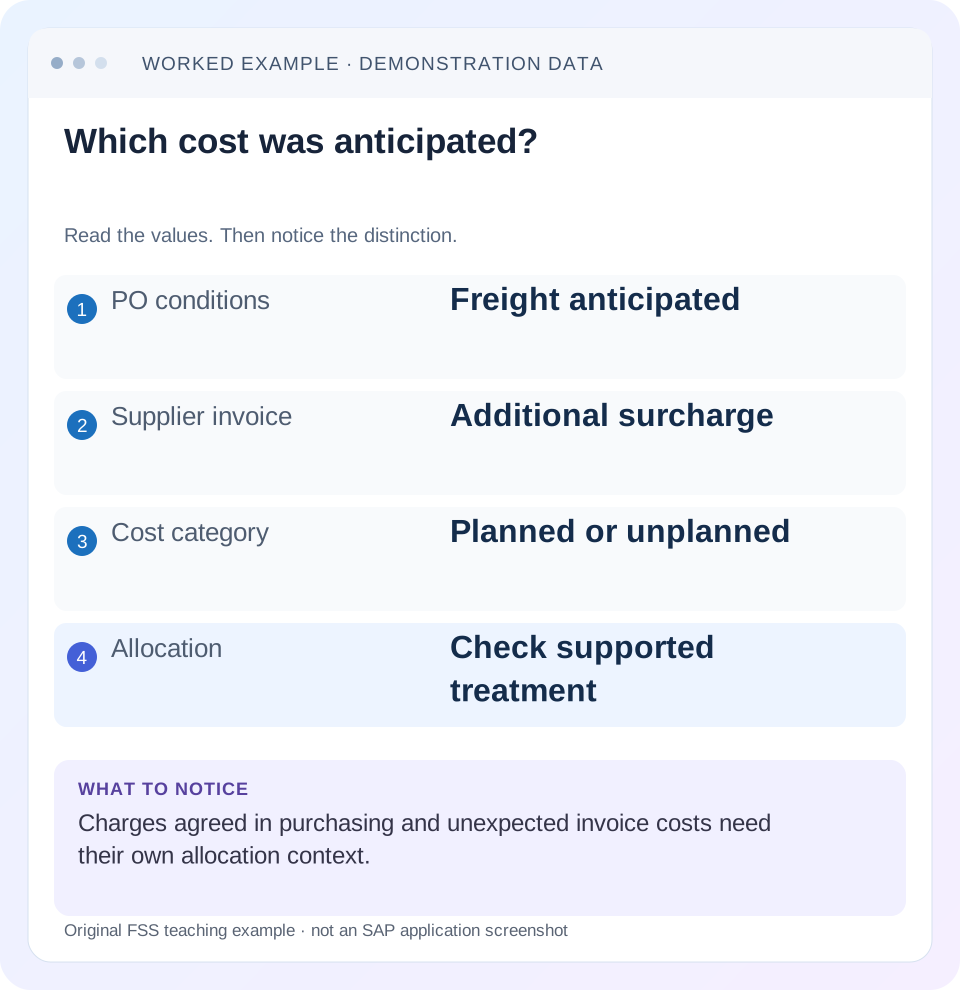
Read the example values
- PO conditions
- Freight anticipated
- Supplier invoice
- Additional surcharge
- Cost category
- Planned or unplanned
- Allocation
- Check supported treatment
Words you’ll meet in this guide
- Material
- A product or supply item managed in SAP.
- Plant
- An organizational unit for relevant logistics operations.
- Goods receipt
- A recorded receipt of goods in a business process.
- Purchase order
- A purchasing document requesting goods or services from a supplier or supplying plant.
- Invoice
- A supplier’s bill for goods or services.
- HANA
- SAP’s database platform.
Preview the practical steps
SEE THE CONNECTION
See it in a simple example.
A small example to make the idea concrete.
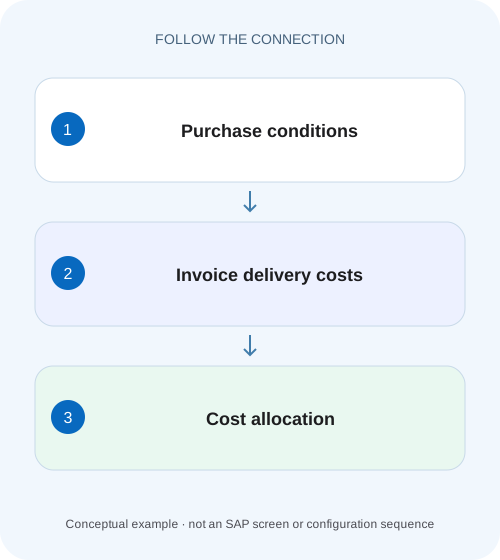
Reconcile freight on incoming components
A machinery manufacturer buys two component items and receives freight charges whose treatment depends on whether the cost was planned in purchasing.
Classify the charge by its document path
Planned delivery costs are incidental procurement costs agreed before the purchase order and entered in its conditions.
Scope and prerequisites
The scope is classic Purchasing and Logistics Invoice Verification delivery-cost concepts in ERP and supported S/4HANA.
Understand planned conditions and the freight supplier
SAP documents planned delivery costs at PO item level, with calculations such as fixed amount, quantity-dependent amount or percentage of goods value.
Reconcile freight on incoming components
A machinery manufacturer buys two component items and receives freight charges whose treatment depends on whether the cost was planned in purchasing.
Compare the PO conditions and invoice allocation before attributing the freight to a material cost or a variance.
| Reader | Business question | Evidence to carry forward |
|---|---|---|
| Manufacturing buyers and purchasing managers | Reconcile freight on incoming components | Compare the PO conditions and invoice allocation before attributing the freight to a material cost or a variance. |
01 Classify the charge by its document path
Planned delivery costs are incidental procurement costs agreed before the purchase order and entered in its conditions. Unplanned delivery costs enter the invoice process without that planned PO condition context. The difference concerns how the cost is represented and processed, not whether someone informally expected the carrier to charge freight. [1] [2]
Before interpreting an invoice, identify the purchase-order conditions, relevant goods receipt, invoicing party and delivery-cost entry. A correct invoice header total can conceal an incorrect allocation or reference. This tutorial explains both a planned carrier charge and an additional unplanned surcharge, then reconciles item shares and accounting evidence.
02 Scope and prerequisites
The scope is classic Purchasing and Logistics Invoice Verification delivery-cost concepts in ERP and supported S/4HANA. The installed pricing procedure, invoice application, tax setup, valuation and enhancement logic determine actual outcomes. Transportation Management settlement and service-specific freight processes need their own document model.
Collect PO/item, relevant conditions and vendors, receipts, invoice/year, currency, quantity/price units and the actual cost-entry method. Display access to purchasing conditions, invoice allocations and accounting/valuation documents is required. Proposed postings and configuration tests belong in an approved training process.
The illustrative amounts below exclude tax, exchange differences and rounding beyond whole currency units. They show allocation reasoning under an expressly stated configuration, not a universal freight-accounting rule.
03 Understand planned conditions and the freight supplier
SAP documents planned delivery costs at PO item level, with calculations such as fixed amount, quantity-dependent amount or percentage of goods value. A fixed freight amount does not behave like a rate per piece, so retain the condition basis and unit alongside its amount. [1]
The goods supplier and freight supplier can differ. The planned condition identifies the relevant invoicing party in the documented process. An invoice from the carrier should be investigated against that planned-cost context rather than treated as another invoice for the goods themselves.
Goods receipt and planned-cost invoicing have their own prerequisites and accrual/valuation relationships. Inspect the applicable receipt and condition evidence before assuming a missing charge should simply be entered as unplanned. The original agreement may require a supported correction to planned data.
04 Worked case: two goods items and a planned carrier charge
Fictional PO-A contains item 10 with a simplified goods value of 900 and item 20 with a goods value of 300. Goods supplier S100 provides both. The approved PO conditions also contain a planned freight amount payable to carrier C200, under the actual installed calculation and allocation design.
The first task is to establish whether the carrier invoice refers to those planned costs. Capture its vendor, references and amount and compare the relevant condition/receipt history. Do not enter the carrier amount again as unplanned merely because the goods invoice was already processed. That could duplicate the economic charge.
Now introduce a separate, genuinely additional unplanned surcharge of 120 for the two goods items. For the following worksheet only, assume the supported configured basis distributes it by the stated invoice values 900 and 300, and no other historical/current values affect that allocation. Their ratio is 3:1, so the illustrative shares are ninety and thirty.
| Item | Allocation basis | Share of 120 |
|---|---|---|
| PO-A / 10 | 900 / 1,200 = 75% | 90 |
| PO-A / 20 | 300 / 1,200 = 25% | 30 |
| Total | 1,200 = 100% | 120 |
| Planned carrier amount | Separate existing PO condition | Must not be duplicated as this surcharge |
05 Unplanned does not imply equal allocation
SAP documents configured options for distributing unplanned costs to invoice items, including value-proportional approaches, or posting them to separate G/L accounts. The actual installed configuration and any enhancement must be checked before predicting item or account outcomes. [2] [3]
In the 900/300 fixture, equal allocation would give sixty to each item, while the stated value basis gives ninety/thirty. Both sum to 120, so header-total agreement cannot distinguish them. The business requirement and supported configuration decide which result is intended.
SAP’s documentation also discusses previously invoiced and current values in applicable allocation contexts. Therefore the worksheet explicitly assumes a clean basis; for a real later invoice or subsequent debit, inspect prior invoice history instead of applying 900/300 mechanically.
06 Reconstruct the invoice path in sequence
Separate the planned carrier invoice and the additional surcharge before comparing totals. Each should have an explainable relationship to its document basis.
Read the PO conditions
Identify planned freight, calculation basis, currency and intended freight vendor C200 for each relevant item.
Expected observation: The agreed cost is distinguished from a later additional charge.
Check receipt and invoice references
Trace the relevant receipt and existing goods/planned-cost invoices. Compare the supplier/carrier reference.
Expected observation: The planned amount is not missing, misreferenced or already invoiced.
Identify unplanned configuration
Establish whether this surcharge is distributed and on which basis, or posted separately. Include prior invoice context where required.
Expected observation: The allocation expectation is explicit before posting.
Reconcile the item shares
For the isolated 900/300 worksheet, verify ninety plus thirty equals 120; compare actual invoice details.
Expected observation: A correct header total is supported by intended line allocation.
Inspect accounting and valuation
After an authorized training posting, review the resulting documents and stock/expense/clearing treatment in the actual setup.
Expected observation: Financial effects are verified independently of the entry field.
07 Delivery-cost value and inventory value are not synonyms
Planned costs can participate in goods-receipt valuation and provisions in the documented process. A later invoice can settle or differ from those expectations. Unplanned costs enter later and their configured handling can affect stock, assignments or separate accounts differently. Do not infer a single account pattern from the word freight. [3] [4]
Material price control, available stock coverage and prior consumption can influence valuation of invoice differences. The stock-value question should therefore include the relevant material and accounting documents, not just the invoice amount.
For the worked surcharge, ninety and thirty are allocation shares. They are not a guarantee that both amounts increase current inventory by exactly those values. Inspect the actual configuration and transaction timeline before making that accounting conclusion.
08 Partial invoices and later charges need a complete basis
Suppose the first invoice covered only part of item 10 while item 20 was not yet invoiced. A later surcharge cannot automatically use the complete PO target values as though they were the documented invoice allocation basis. Read the relevant current/prior invoice population and supported subsequent-debit procedure.
Likewise, a carrier charge can be fixed per shipment rather than proportional to ordered quantity. Splitting a PO or receiving in several deliveries raises a commercial allocation question that must be reconciled with the condition design. Do not multiply a fixed charge by the number of receipt rows simply because the report displays it repeatedly.
Keep corrections and credit memos connected to their original cost event. A credit of thirty can relate to a disputed surcharge rather than a returned goods quantity. Preserve its purpose before interpreting signed totals.
For a rounding-sensitive exercise, replace the 120 surcharge with 1.00 while keeping the 3:1 basis. The theoretical shares are 0.75 and 0.25, which remain exact at two decimals. Then use three unequal items whose shares require rounding and reconcile the actual residual assignment in the installed process. A header difference of one cent needs that evidence rather than an invented allocation rule.
09 Troubleshooting decisions
The following branches distinguish cost classification, reference, allocation and valuation. Changing the entry field without this distinction can hide the underlying problem.
| Observation | Question | Next evidence |
|---|---|---|
| Carrier invoice lacks expected proposal | Does vendor/reference match planned condition? | Condition vendor and receipt/invoice history |
| Freight appears twice | Was planned cost re-entered as unplanned? | Original condition and both invoice chains |
| 120 total correct, item shares wrong | Which allocation basis is configured? | Invoice values, history and distribution setup |
| Later charge allocates unexpectedly | Were prior/current invoices considered? | Complete applicable invoice population |
| Stock value did not rise by all freight | What price-control/stock/account treatment applies? | Material and accounting documents |
| PO history does not isolate the surcharge | What visibility limits apply to this treatment? | Invoice details and accounting evidence |
10 Common mistakes and evidence limits
Do not classify an expense as planned simply because a buyer remembers discussing it. The actual PO condition and process context matter. Conversely, a missing planned reference is not proof that the charge genuinely belongs in an unplanned field. [3]
Do not allocate by physical quantity when the approved configured basis is value, or use the PO’s full value when the relevant basis is invoiced values. State every assumption in the worksheet.
SAP documents limitations in distinguishing distributed unplanned costs from price variances in PO history, and separate-account costs may not appear there in the same way. Absence of a distinct freight history row therefore does not prove the amount vanished. Inspect the invoice and accounting documents.
11 Verification exercises
For the positive worksheet check, verify 900:300 equals 3:1, ninety plus thirty equals 120 and revised simplified item amounts are 990 and 330 under the stated distribution. Keep the planned carrier condition outside this additional surcharge.
For the negative check, allocate sixty/sixty and show why header agreement alone misses a thirty-unit over-allocation to item 20. Then enter the already planned carrier charge a second time as unplanned in a worksheet and identify the duplicated cost.
For boundary checks, test a later delivery-cost invoice, partial goods invoicing, a credit and separate-G/L configuration in an authorized training design. Capture actual tax, rounding, account and valuation outcomes. The proposed cases are not claims of runtime execution.
12 Questions and the handover
Does unplanned mean unauthorized? It describes the document/process classification; business approval is a separate control. Does freight always increase inventory? Actual configured treatment, material price control and stock context decide. Does a correct total prove correct allocation? The ninety/thirty versus sixty/sixty comparison shows why it does not.
A useful result names the planned condition/vendor, existing planned-cost invoice, additional 120 surcharge, stated 900/300 allocation basis, observed shares and accounting references. If a difference remains, identify whether it concerns classification, reference, allocation or valuation.
Continue with invoice display, price control and unit-conversion lessons to follow the cost into financial evidence and avoid mixing order, invoice and price bases.
Related services and next steps
Primary sources
Found this useful?
Share this guide with your network, or leave a like.
Your like is saved in this browser.