SAP base and alternative units of measure: Check the conversion before the quantity
Purchasing orders components in boxes while assembly consumes pieces, so the two teams need an agreed conversion before comparing demand and receipts.

Source review:
START HERE · NO PRIOR TOPIC KNOWLEDGE NEEDED
What it is. Why it matters.
A base unit is the main unit used for a material’s quantity. Alternative units need defined conversions so purchases, stock and sales quantities remain understandable.
Completely new to SAP?
Manufacturers use SAP to connect work such as buying components, recording inventory, planning production, shipping equipment and accounting for costs. SAP S/4HANA is an enterprise resource planning system: it connects these activities through shared business data.
Master data describes reusable business entities such as products and business partners. Transactions refer to those records, so identities and units need to remain consistent.
A transaction code, or t-code, is a shortcut to a task in classic SAP GUI. Fiori apps provide another way to work. Names and screens depend on the product and release; you do not need a live system to learn the concepts in this guide.

Scope and source-review notes
Scope and evidence
Source review by FAST SAP SOLUTIONS® editorial. This badge describes our editorial review; it does not represent SAP certification or independent endorsement.
Fixed unit conversions in classic Inventory Management and purchasing, using current S/4HANA on-premise references. Batch-specific units, catch weight, allowed precision and document-specific conversion behavior need their own release/process checks.
Reviewed the cited official SAP indexed documentation excerpts on 14 November 2026. Direct Help Portal opens did not consistently expose readable page text. This is documentation-based teaching, not customer-system execution. All document identifiers, quantities and outcomes in the worked case are illustrative; installed release, edition, configuration and authorizations require local verification.
A MANUFACTURING EXAMPLE
Convert component packs to usable pieces
Convert before comparing
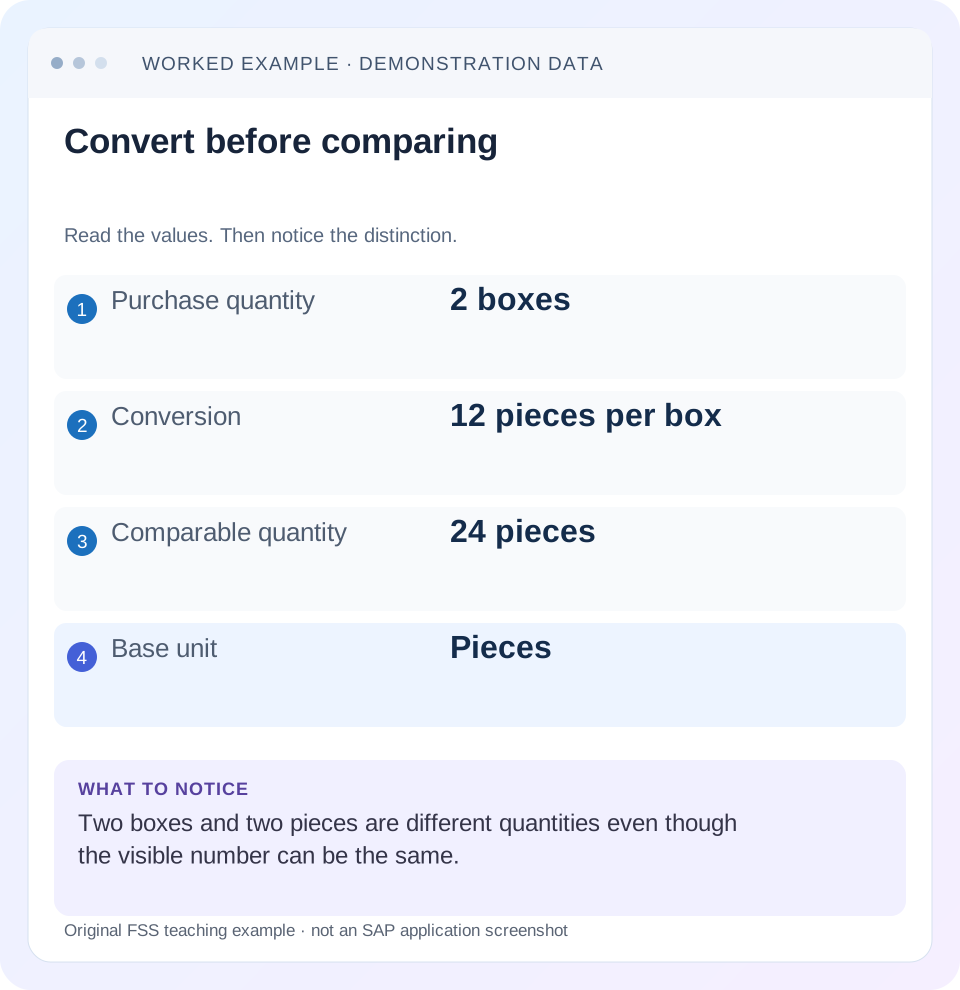
Read the example values
- Purchase quantity
- 2 boxes
- Conversion
- 12 pieces per box
- Comparable quantity
- 24 pieces
- Base unit
- Pieces
Words you’ll meet in this guide
- Master record
- Reusable information about a business entity.
- Transaction
- A recorded business action or event.
- Identifier
- A value used to distinguish one record from another.
- HANA
- SAP’s database platform.
Preview the practical steps
SEE THE CONNECTION
See it in a simple example.
A small example to make the idea concrete.
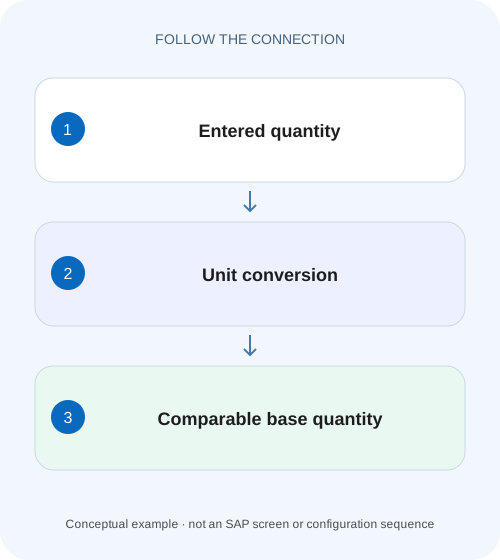
Convert component packs to usable pieces
Purchasing orders components in boxes while assembly consumes pieces, so the two teams need an agreed conversion before comparing demand and receipts.
Compare quantities only after naming the units
Two boxes and two pieces are different quantities when each box contains twelve pieces.
Scope, access and the conversion evidence
The tutorial covers base, alternative, entry, order and order-price units in classic Inventory Management and purchasing, using current SAP S/4HANA on-premise documentation.
What each unit is doing
The base or stockkeeping unit is the basis for inventory quantity management.
Convert component packs to usable pieces
Purchasing orders components in boxes while assembly consumes pieces, so the two teams need an agreed conversion before comparing demand and receipts.
Check the material's unit conversion and document units before interpreting an apparent shortage or surplus.
| Reader | Business question | Evidence to carry forward |
|---|---|---|
| Plant stores, warehouse and materials teams | Convert component packs to usable pieces | Check the material's unit conversion and document units before interpreting an apparent shortage or surplus. |
01 Compare quantities only after naming the units
Two boxes and two pieces are different quantities when each box contains twelve pieces. SAP can display both correctly because purchasing, inventory and pricing use different quantity contexts. The practical task is to identify each unit and its maintained relationship before deciding that stock, a receipt or an invoice is wrong.
This guide follows a fictional purchase of two boxes through receipt and invoice comparison. It shows how to reconcile the order unit, base quantity and price basis, and how to isolate a conversion error from a genuinely missing receipt. The method is useful for buyers, warehouse analysts and accounts-payable staff who exchange reports with numbers that appear to disagree.
02 Scope, access and the conversion evidence
The tutorial covers base, alternative, entry, order and order-price units in classic Inventory Management and purchasing, using current SAP S/4HANA on-premise documentation. The principles also apply to supported ERP processes. Batch-specific units, catch weight and industry-specific variable conversions require their own supported design and are not reduced to the fixed-box relationship below. [1] [2]
Obtain display access to the material, relevant purchasing info record where used, purchase-order item and material/invoice documents. Capture the displayed unit with every number. Read conversions from the actual material and document context rather than assuming that a common label such as BOX always means twelve pieces for every product or supplier. If operational checks are desired, use an approved training material with known packaging.
03 What each unit is doing
The base or stockkeeping unit is the basis for inventory quantity management. An alternative unit provides another expression of the same material quantity through a defined conversion. A unit of entry is the unit used when entering a movement; the system converts it into the relevant inventory basis. SAP documents conditions under which the unit must be maintained or a dimensional conversion must be possible. [1] [3]
The order unit expresses the purchase quantity. The order-price unit expresses the quantity basis used for the price and can differ from the order unit. A price of 30 currency units per ten pieces is also different from 30 per piece, even if both screens show PC. Retain the price unit quantity as well as the unit code.
These contexts explain why a report showing 24 PC can agree with a PO for 2 BOX. They also explain why correct physical quantity does not by itself prove an invoice value is correct.
04 Worked case: two boxes contain twenty-four pieces
Material PART-A has base unit PC and the fixed approved relationship 1 BOX = 12 PC. A buyer orders 2 BOX. The expected base quantity for this example is 2 × 12 = 24 PC. The supplier price is 30 currency units per BOX, giving a net item value of 60 before taxes, delivery costs or other conditions.
Receiving staff enter 2 BOX using the supported document. The posted material-document quantity should be interpretable as 24 PC on the base basis, assuming this is the actual conversion used. A warehouse report showing 24 PC and purchasing history showing 2 BOX are consistent. Subtracting 2 from 24 would mix units and produce a meaningless twenty-two-unit discrepancy.
Now suppose the supplier invoice says 24 PC at 2.50 per PC. Its simplified net amount is also 60. The different pricing unit does not itself create a mismatch; the relationship and price calculation explain equivalence. Actual invoice matching still depends on document conditions and supported invoice-verification controls.
| Context | Quantity or price | Comparable result |
|---|---|---|
| PO quantity | 2 BOX | 24 PC |
| Conversion | 12 PC / BOX | Material-specific fixed example |
| PO price | 30 per BOX | 60 net for 2 BOX |
| Invoice expression | 24 PC × 2.50 | 60 net on matching basis |
| Warehouse display | 24 PC | Same physical quantity |
05 Read the material and purchasing context first
Check the base unit and maintained alternative conversion. Write the relationship in words and as a ratio: twelve pieces per box. This prevents accidentally using the inverse when converting. Two boxes multiplied by twelve pieces per box yields twenty-four pieces; twenty-four pieces divided by twelve pieces per box yields two boxes. [3] [4]
Inspect whether the order unit was proposed from material/purchasing data and whether the actual PO item uses the expected relationship. SAP documents order-unit conversion in purchasing and a separately maintained order-price relationship when needed. Historical documents can carry their own relevant context; a current master-data display alone may not explain what was used at posting.
If a supplier changed packaging from twelve to ten pieces, determine whether a new ordering arrangement or material-specific process is needed. Do not revise the old relationship casually and then reinterpret every historical receipt as though it always used the new box.
06 Reconcile documents in a practical sequence
Use one document chain and write down all bases before calculating. Screens and app names differ by edition, but the required observations are stable.
Capture the order basis
Record PART-A, 2 BOX, the item conversion and the full price basis of 30 per BOX. Include plant and PO item.
Expected observation: The expected 24-PC quantity and 60 net value can be independently calculated.
Read the receipt basis
Display the goods-movement reference, entry quantity/unit and base quantity where available. Check reversals separately.
Expected observation: The receipt can be reconciled to the same physical quantity.
Read the invoice basis
Record invoice quantity/unit, price unit quantity, currency and relevant reference. Separate taxes and delivery costs.
Expected observation: Quantity and net price comparisons use aligned bases.
Investigate the first unexplained difference
If the receipt shows 20 PC, establish the actual posted conversion and physical count before changing documents.
Expected observation: The cause is narrowed to packaging, entry, conversion or missing goods.
07 Distinguish conversion, rounding and price-unit problems
If the material uses 12 PC per BOX but the receipt actually contains ten-piece boxes, the problem is not arithmetic. The business packaging and maintained relationship disagree. Establish the supplier agreement and physically received quantity, then determine the supported correction. A clever spreadsheet formula cannot repair the wrong process assumption. [2]
Rounding is a different issue. A conversion involving fractions can yield quantities that cannot be represented at the required precision. SAP’s material-unit guidance recommends conversions that produce simple decimal relationships rather than recurring decimals. Check the permitted decimal places and posting behavior in the actual process before accepting a supposedly negligible residual.
A third issue is price normalization. An invoice priced at 25 per ten pieces means 2.50 per piece, not 25 per piece. Preserve the price unit quantity and currency. A factor-of-ten value difference with correct base quantity often warrants this check before investigating inventory loss.
08 Do not apply a fixed conversion to variable goods blindly
The two-box example assumes identical contents for every box. Real processes may involve actual weights, batch-specific characteristics or other supported variable relationships. In those cases, the physical receipt and approved material design determine the relevant conversion evidence. Do not take twelve pieces per box from this illustration as a universal SAP packaging rule.
Dimensional conversion such as grams to kilograms is also different from product-specific packaging. One thousand grams per kilogram is a unit relationship; twelve pieces per box is a relationship for this material and packaging. A box of another material can contain six or twenty pieces without contradiction.
When exchanging data, include both unit codes and the applicable conversion context. Translating a local abbreviation to a standard unit code is an integration task separate from deciding how much product the package contains.
09 Troubleshoot by the factor and document stage
A stable factor can be a useful clue, but it is not proof. Compare actual document values and source evidence, especially when a later report has already converted quantities into another display unit.
| Symptom | Useful question | Next evidence |
|---|---|---|
| 2 in PO, 24 in stock | Are BOX and PC being compared? | Order/base units and 12-PC conversion |
| Receipt shows 20 PC for 2 BOX | Was ten-piece packaging entered or configured? | Physical pack and posted conversion |
| Correct quantity, value ten times expected | Was price per ten treated as price per one? | Order-price unit and price unit quantity |
| Small residual quantity | Is precision or a recurring ratio involved? | Conversion numerator/denominator and decimals |
| Historical and current calculations differ | Did packaging/master context change? | Original document values and change evidence |
| Only interface fails | Are unit codes and relationships mapped? | Payload unit, mapping and target interpretation |
10 Common corrections that create bigger problems
Avoid changing the base unit or conversion simply to make one report total agree. Inventory, open purchasing documents, pricing and interfaces can depend on that definition, and supported change restrictions vary. First explain the existing documents and establish what the business quantity should have been.
Do not adjust stock for the numerical difference between 2 BOX and 24 PC. They are already equal in this case. A stock adjustment would create a real quantity error while trying to resolve a display misunderstanding.
Do not correct invoice quantity to the receipt’s displayed number until their units and price basis agree. Twenty-four in the invoice and two in the order can be entirely consistent. The correction decision must be based on the underlying goods and agreement.
11 Positive, negative and boundary exercises
For the positive worksheet check, convert 2 BOX to 24 PC and back to 2 BOX. Calculate 2 × 30 and 24 × 2.50; both give 60 before excluded conditions. In an authorized training process, compare those expectations with the actual document displays and record the system’s quantity and price bases.
For the negative check, replace one conversion with 10 PC per BOX while keeping the physical evidence at twenty-four pieces. Identify the point where document expectations become twenty rather than twenty-four. Do not post the discrepancy simply to see a stock balance change.
For boundary checks, consider a partial receipt of 6 PC, equal to half a box in this fixed relationship, and verify whether the intended process permits that entry precision. Then test a full reversal and confirm that the same quantity basis is reversed. A rounded display should not be mistaken for proof that an exact residual is zero.
12 Questions and the next investigation
Can two materials use BOX differently? Yes. Product-specific packaging conversion must be established for each relevant material/process. A unit label alone does not define the contents.
Does a correct conversion prove today’s stock? No. It aligns quantities; you still need the complete relevant movement and stock context. Use the stock-overview and movement-history lessons to distinguish current balance from historical events.
A useful result for this case reads: “PO item 10 orders 2 BOX at 12 PC/BOX, or 24 PC. Receipt GR-A records that equivalent quantity. Invoice INV-A expresses 24 PC at 2.50, giving 60 net, matching the illustrative order basis. Taxes and delivery conditions remain separate checks.” This gives purchasing and finance a shared, auditable explanation.
Related services and next steps
Primary sources
Found this useful?
Share this guide with your network, or leave a like.
Your like is saved in this browser.