SAP batch versus serial number: Group identity and individual identity
A manufacturer investigates a quality complaint and must decide whether the evidence identifies a group of components or one individual piece of equipment.

Source review:
START HERE · NO PRIOR TOPIC KNOWLEDGE NEEDED
What it is. Why it matters.
A batch identifies a group of goods sharing relevant characteristics. A serial number identifies an individual item, so they support different levels of traceability.
Completely new to SAP?
Manufacturers use SAP to connect work such as buying components, recording inventory, planning production, shipping equipment and accounting for costs. SAP S/4HANA is an enterprise resource planning system: it connects these activities through shared business data.
Master data describes reusable business entities such as products and business partners. Transactions refer to those records, so identities and units need to remain consistent.
A transaction code, or t-code, is a shortcut to a task in classic SAP GUI. Fiori apps provide another way to work. Names and screens depend on the product and release; you do not need a live system to learn the concepts in this guide.

Scope and source-review notes
Scope and evidence
Source review by FAST SAP SOLUTIONS® editorial. This badge describes our editorial review; it does not represent SAP certification or independent endorsement.
Classic SAP ERP and supported SAP S/4HANA batch/serialization concepts; profiles, batch levels, uniqueness and equipment integration are process and release dependent. No EWM-specific serial configuration is prescribed.
Reviewed the cited official SAP indexed documentation excerpts on 14 November 2026. Direct Help Portal opens did not consistently expose readable page text. This is documentation-based teaching, not customer-system execution. All document identifiers, quantities and outcomes in the worked case are illustrative; installed release, edition, configuration and authorizations require local verification.
A MANUFACTURING EXAMPLE
Trace a component lot or an individual machine
Group identity versus unit identity
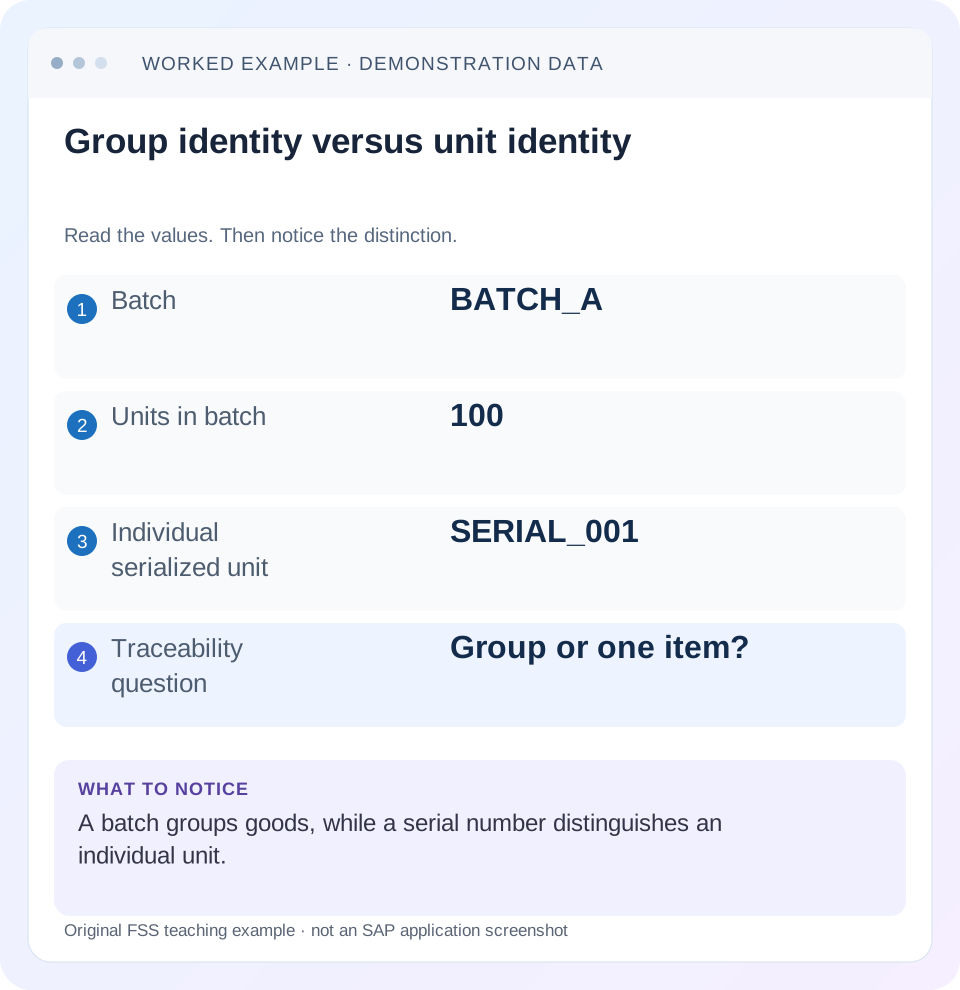
Read the example values
- Batch
- BATCH_A
- Units in batch
- 100
- Individual serialized unit
- SERIAL_001
- Traceability question
- Group or one item?
Words you’ll meet in this guide
- Master record
- Reusable information about a business entity.
- Transaction
- A recorded business action or event.
- Identifier
- A value used to distinguish one record from another.
- HANA
- SAP’s database platform.
- EWM
- Extended Warehouse Management: SAP’s application for warehouse processes.
Preview the practical steps
SEE THE CONNECTION
See it in a simple example.
A small example to make the idea concrete.
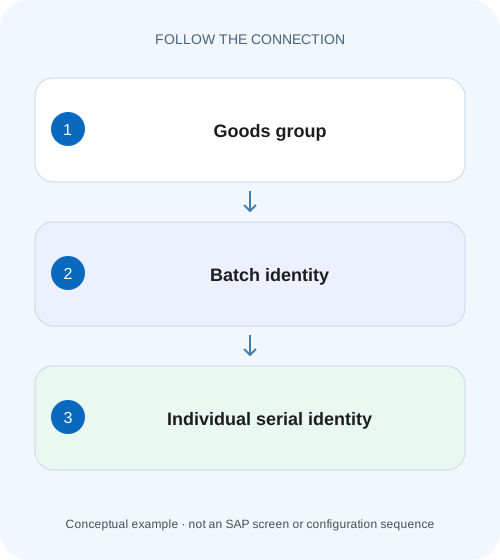
Trace a component lot or an individual machine
A manufacturer investigates a quality complaint and must decide whether the evidence identifies a group of components or one individual piece of equipment.
Choose the identity that answers the question
A batch answers which group of material a quantity belongs to.
Scope and prerequisites
This guide concerns classic SAP ERP and supported SAP S/4HANA Inventory Management serialization and batch concepts.
Separate material, batch, serial and equipment
The material identifies the type of product.
Trace a component lot or an individual machine
A manufacturer investigates a quality complaint and must decide whether the evidence identifies a group of components or one individual piece of equipment.
Use batch and serial-number identity for their documented purpose; do not treat a batch number as a unique equipment identity.
| Reader | Business question | Evidence to carry forward |
|---|---|---|
| Plant stores, warehouse and materials teams | Trace a component lot or an individual machine | Use batch and serial-number identity for their documented purpose; do not treat a batch number as a unique equipment identity. |
01 Choose the identity that answers the question
A batch answers which group of material a quantity belongs to. A serial number answers which individual unit is involved. If twenty devices came from the same manufacturing lot, they may share a batch while each carries a different serial number. Investigating a process defect across that lot and repairing one returned device require different selections. Recording one identity does not automatically supply the other.
The practical outcome of this tutorial is a traceable receipt and subsequent movement of fictional devices. You will establish the material, the group, the individual units and the documents connecting them, then test what happens when one item is returned. This makes the distinction useful to receiving staff, quality teams and support analysts rather than leaving it as a vocabulary exercise.
02 Scope and prerequisites
This guide concerns classic SAP ERP and supported SAP S/4HANA Inventory Management serialization and batch concepts. Exact batch levels, serial uniqueness, equipment integration and mandatory capture points depend on the installed process. EWM serial requirements and industry-specific single-unit batches need their own implementation checks; they should not be inferred from this example. [1]
Use a training material whose batch-management and serial-number requirements are already approved. Obtain display access to its master data, receipt documents and serial history. SAP documents serial-number profiles as controls assigned to the material, including plant context. Before posting, identify the profile applicable to the plant and process and whether serialization is required at this particular document stage.
03 Separate material, batch, serial and equipment
The material identifies the type of product. A batch differentiates a group within the applicable batch-level design and can carry shared characteristics such as production or expiration information. A serial identity distinguishes units of a material within the configured uniqueness design. Always retain the material alongside the serial rather than assuming a short number is globally unique. [1] [2]
Equipment can provide a technical object for maintenance and service. Its relationship with a material serial number is controlled by the serialization design. A serial record should not be described as automatically equivalent to a fully maintained equipment record in every landscape. For a support case, capture both identifiers when that relationship exists and establish which object the downstream service process actually uses.
These identities are complementary. A quality hold can concern every unit in a batch, while a maintenance history concerns one unit. Changing the batch selection to find a serial-related failure can broaden the business scope accidentally.
04 Worked case: twenty devices and one complaint
The fictional material DEV-20 is received at plant P100 in twenty pieces. All units carry supplier production lot LOT-A. The receiving process records internal batch BATCH-A and twenty serials S001 through S020, using the approved relationship between supplier lot and internal batch. The example assumes the configured receipt supports both identities; it does not prescribe how your system generates either number.
Later, five devices S001 through S005 are issued to a customer. The customer reports that S003 has a damaged connector. Initially the complaint scope is one known unit. If inspection instead identifies a production defect that affects LOT-A, the investigation expands to the batch and must find the disposition of all twenty units, including the fifteen still held and the five already issued.
A batch quantity of twenty proves neither that S003 remains in the warehouse nor that all twenty devices share the same service history. Conversely, finding S003 does not identify the complete population exposed to the production defect without its batch relationship and document evidence.
| Object | Identity | Meaning |
|---|---|---|
| Material | DEV-20 | Product type |
| Internal batch | BATCH-A | Twenty received devices |
| Supplier lot | LOT-A | Supplier production reference |
| Serial under investigation | DEV-20 / S003 | One physical device |
| Issued population | S001–S005 | Five individual devices |
05 Prepare the receipt evidence before entry
Compare the supplier packing list with the actual device labels. Establish how many units are physically present, whether the supplier lot is homogeneous and whether the serial list contains duplicates or omissions. Twenty pieces accompanied by nineteen distinct serials is a data problem that should be resolved before it becomes a document inconsistency. [1]
Keep the supplier lot as supplier evidence and the internal batch as the SAP identity. They can be equal by design, but equality should be a deliberate rule rather than an assumption. If the delivery contains two supplier lots, clarify whether the receipt needs separate batch quantities. Do not place unrelated lots into BATCH-A simply because the total order quantity is correct.
Review which receipt stage captures the serials. SAP documents serial requirements through procedures and profiles, so a mandatory field at goods receipt cannot be predicted solely from a material description or a barcode format.
06 Follow a controlled receipt sequence
Use the supported receiving transaction or application for the installed edition. The following sequence describes observations to establish, rather than promising one screen layout for every release.
Confirm the receiving item
Match material DEV-20, plant P100, quantity 20 PC and the purchasing or delivery reference. Check the active batch and serialization requirements.
Expected observation: The document concerns the intended product and organizational context.
Assign the group and unit identities
Record BATCH-A and the twenty approved serial values. Compare the list with labels and supplier evidence, including any supplier lot field.
Expected observation: There are twenty distinct eligible unit identities for twenty serialized pieces.
Review the posted evidence
After the authorized training receipt, display the material document, batch context and serial assignments. Retain the reference and posting date.
Expected observation: The quantity and identity relationships can be reconstructed independently of the entry screen.
07 Trace the outbound movement and the return
Before issuing S001 through S005, verify that those particular units are eligible for the selected process. A batch-level stock balance alone is insufficient: it does not prove the serial status and location of S003. Use supported serial and document displays to connect the outgoing document with the five selected identities.
For a return of S003, retain the original outgoing reference and the actual unit label. A similar device from the same batch is a different unit. Check that the returned quantity, material and serial agree, and that the return process establishes the correct subsequent stock and quality status. A return does not necessarily restore unrestricted usability.
After the return, the simplified physical population is sixteen devices on site and four remaining with the customer, provided there were no other movements. The batch still describes the production grouping. That arithmetic is an illustration of this timeline, not a universal serial-status reconciliation algorithm.
08 Troubleshoot the identity that first diverges
Start with the smallest inconsistency. If the quantity agrees but the serial list does not, investigate individual identity capture. If serials are correct but a batch recall misses units, investigate batch assignment and document scope. Solving both with a new batch or duplicate serial makes later tracing harder.
| Observation | Likely distinction | Evidence to inspect |
|---|---|---|
| 20 PC but 19 distinct serials | Quantity versus unit identity | Label list and receipt assignments |
| Correct serial, unexpected batch | Individual identity versus group membership | Receipt and subsequent document relationship |
| Same short serial on another material | Configured uniqueness context | Full material/serial identity and profile |
| Serial exists but issue fails | Existence versus allowed process/status | Current serial status and movement context |
| Equipment history absent | Serialization versus equipment integration | Configured equipment relationship |
| Batch recall finds only warehouse stock | Current location versus full traceability | Outbound documents and affected serial population |
09 Common mistakes that weaken traceability
Do not invent a missing serial to make the number of entries equal the received quantity. The resulting record may satisfy entry validation while destroying the link to the physical label. Similarly, do not overwrite a supplier lot to make it match an internal batch number without understanding which identifier each field represents. [3]
Do not assume a batch contains many units in every application. SAP also supports specialized single-unit batch scenarios. The central lesson is the configured identity model, not a rule that a batch can never represent one object. When such a design applies, verify its supported quantity and process behavior explicitly.
Avoid using a report containing only current stock as a recall register. Goods already issued may no longer appear there. A defensible recall investigation follows documents and relationships across locations and business states, with the required authorization and data retention.
10 Positive, negative and boundary checks
For a positive check, reconcile the complete receipt: twenty pieces, twenty distinct serial assignments, one intended internal batch and the supplier lot evidence. Follow S003 from receipt to issue and return. The references should identify the same physical unit throughout the proposed training case.
For a negative check, intentionally provide S003 twice in a nonposting test or worksheet and ask whether the identity list still represents twenty devices. It does not, even though twenty rows may be present. Separately replace BATCH-A with an unrelated batch for S004 and explain which group-level investigation becomes unreliable.
For a boundary check, receive one device in a batch and ask whether the batch and serial have become interchangeable. They have not: the present quantity happens to be one, while the objects and lifecycle still differ. Also test a receipt split into two batches and verify the serial-to-batch allocation, not merely the overall count.
11 Write a useful investigation result
A useful handover states: “DEV-20 / S003 belongs to internal BATCH-A, supplier lot LOT-A. It was received on GR-A, issued on OUT-A and returned on RET-A. Its current usability still requires the recorded return/quality status. The possible production defect concerns twenty original units, not just today’s batch quantity.” Replace these fictional labels with protected real references in an authorized investigation.
If an assignment is wrong, identify the supported correction process and its consequences for already posted documents. Preserve the original evidence, correction references and reason. A corrected master-data label alone may not explain historical movements, so revisit the document chain after the approved action.
12 Questions to ask next
Can batch management replace serialization? Only if the business requirement is group traceability and the approved design meets it. If warranty, service or regulation requires individual identity, a common batch label cannot distinguish which device was delivered or repaired.
Does a serial number prove ownership or availability? No. Establish the current document, stock and business status. The number identifies an object; it does not by itself prove that the object is present, company-owned or available to issue.
Where should you continue learning? Use the shelf-life lesson for batch date controls, the handling-unit lesson for packed-object identity and the stock-overview lesson for quantity context. Each answers a different question that often appears beside the serial issue.
Related services and next steps
Primary sources
Found this useful?
Share this guide with your network, or leave a like.
Your like is saved in this browser.