GR-based invoice verification: Match the invoice to the right receipt
A supplier delivers a component order in two receipts and invoices only one delivery; the plant buyer and accounts-payable analyst need the same reference.

Source review:
START HERE · NO PRIOR TOPIC KNOWLEDGE NEEDED
What it is. Why it matters.
Goods receipt records received goods. Goods-receipt-based invoice verification connects invoice checking to receipt evidence, helping match what the supplier billed to what was received.
Completely new to SAP?
Manufacturers use SAP to connect work such as buying components, recording inventory, planning production, shipping equipment and accounting for costs. SAP S/4HANA is an enterprise resource planning system: it connects these activities through shared business data.
Materials Management supports purchasing and inventory. A request, order, goods receipt and supplier invoice describe separate events, each with its own record and status.
A transaction code, or t-code, is a shortcut to a task in classic SAP GUI. Fiori apps provide another way to work. Names and screens depend on the product and release; you do not need a live system to learn the concepts in this guide.

Scope and source-review notes
Scope and evidence
Source review by FAST SAP SOLUTIONS® editorial. This badge describes our editorial review; it does not represent SAP certification or independent endorsement.
Classic ERP Logistics Invoice Verification and supported S/4HANA receipt allocation. Ariba/Business Network, service matching, reversal controls and interfaces require their own process-specific documentation.
Reviewed the cited official SAP indexed documentation excerpts on 14 November 2026. Direct Help Portal opens did not consistently expose readable page text. This is documentation-based teaching, not customer-system execution. All document identifiers, quantities and outcomes in the worked case are illustrative; installed release, edition, configuration and authorizations require local verification.
A MANUFACTURING EXAMPLE
Match a split component receipt
Which receipt does the invoice match?
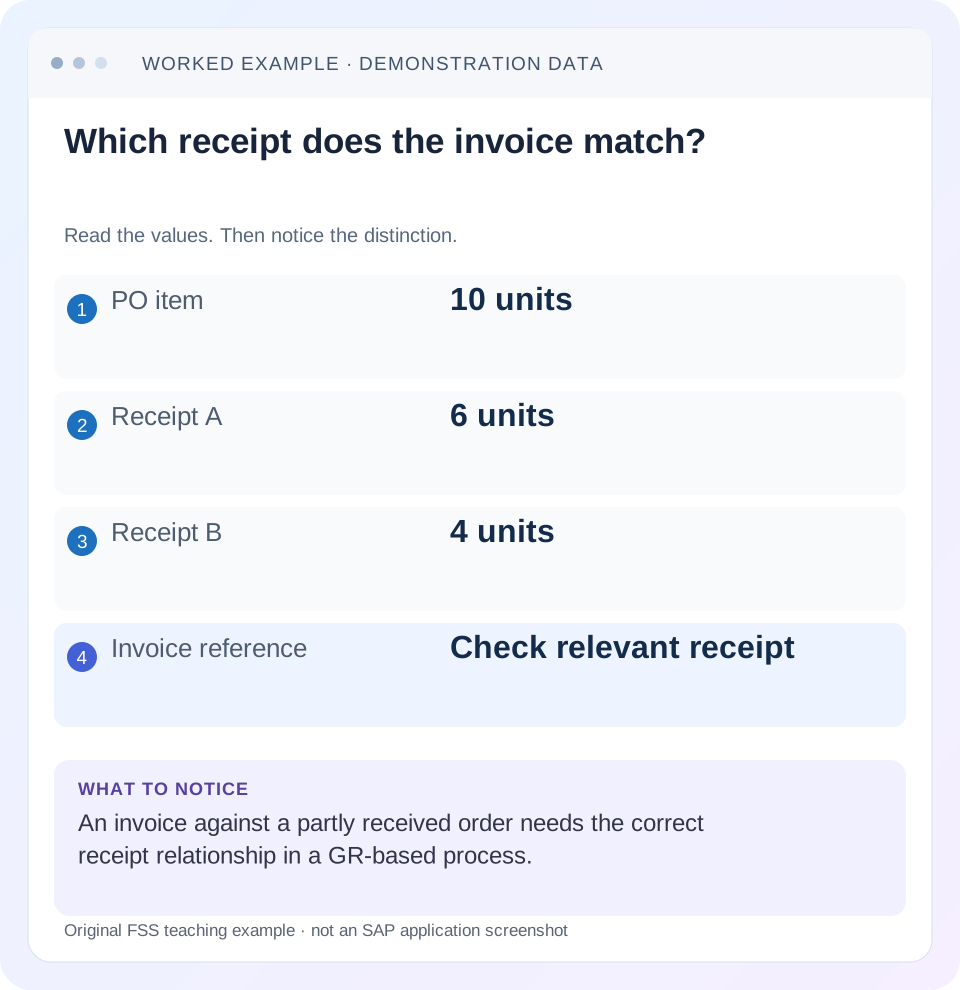
Read the example values
- PO item
- 10 units
- Receipt A
- 6 units
- Receipt B
- 4 units
- Invoice reference
- Check relevant receipt
Words you’ll meet in this guide
- Material
- A product or supply item managed in SAP.
- Plant
- An organizational unit for relevant logistics operations.
- Goods receipt
- A recorded receipt of goods in a business process.
- Purchase order
- A purchasing document requesting goods or services from a supplier or supplying plant.
- Invoice
- A supplier’s bill for goods or services.
- IDoc
- A structured SAP document format used to exchange business data.
- HANA
- SAP’s database platform.
Preview the practical steps
SEE THE CONNECTION
See it in a simple example.
A small example to make the idea concrete.
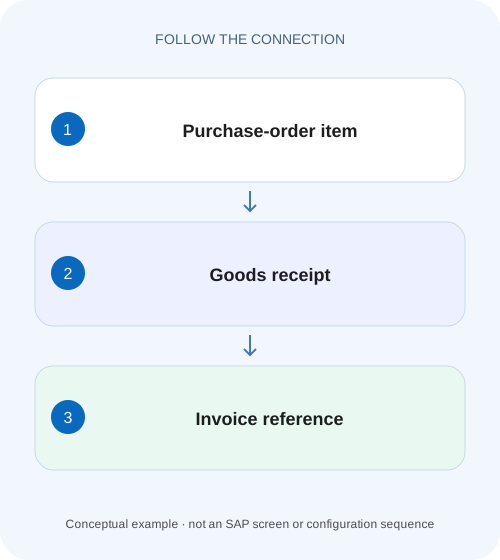
Match a split component receipt
A supplier delivers a component order in two receipts and invoices only one delivery; the plant buyer and accounts-payable analyst need the same reference.
Match the invoice to its receipt, not a convenient total
Goods-receipt-based invoice verification relates an invoice to individual deliveries.
Scope and prerequisites
This guide concerns classic ERP Logistics Invoice Verification and supported S/4HANA purchasing/invoice allocation.
Understand how the item list differs
With GR-based verification active, invoice allocation can expose separate receipt items for one PO item.
Match a split component receipt
A supplier delivers a component order in two receipts and invoices only one delivery; the plant buyer and accounts-payable analyst need the same reference.
Compare the invoice reference with the actual receipt and PO item so an undelivered quantity is not treated as received.
| Reader | Business question | Evidence to carry forward |
|---|---|---|
| Manufacturing buyers and purchasing managers | Match a split component receipt | Compare the invoice reference with the actual receipt and PO item so an undelivered quantity is not treated as received. |
01 Match the invoice to its receipt, not a convenient total
Goods-receipt-based invoice verification relates an invoice to individual deliveries. The delivery note or goods-receipt document provides the reference context instead of treating the purchase-order item as one undifferentiated received total. This matters when one order arrives in several parts. [1]
Before investigating a mismatch, verify the GR-based invoice-verification setting on the actual PO item. The same supplier or PO header does not prove every item uses the same matching approach. The practical outcome is a receipt-to-invoice map that explains which delivery is billed, what remains uninvoiced and which reference needs correction.
02 Scope and prerequisites
This guide concerns classic ERP Logistics Invoice Verification and supported S/4HANA purchasing/invoice allocation. SAP Ariba and SAP Business Network have their own matching workflows, statuses and integration rules; their behavior should not be inferred from the classic prerequisite below. Service-based verification also requires its own process analysis. [1]
Obtain the PO/item, actual GR-based setting, receipt documents, delivery-note values, invoice references and units. Display access to purchase-order history and logistics invoices is required. Proposed entry/correction tests belong in a training system with approval. The worked arithmetic excludes tax, delivery costs, price differences and currency effects so that reference matching remains visible.
SAP’s cited classic guidance states that a goods receipt must occur before invoice entry for this approach. Physical arrival and a supplier’s delivery notification are not the same as an actual posted receipt.
03 Understand how the item list differs
With GR-based verification active, invoice allocation can expose separate receipt items for one PO item. Multiple lines bearing the same PO item are therefore not necessarily duplicates. They can represent different receipt events. Without GR-based verification, the allocation basis can aggregate the order-item quantity differently. [1] [2]
Keep the identity of the receipt item, not just its quantity. Two six-piece deliveries can have different dates and notes, and an invoice intended for one should not be assigned to the other merely because the quantities match. Reference identity is the purpose of the approach.
Purchase-order history provides receipt-to-invoice assignment evidence. It should be used to check the actual relationship after entry, especially if an interface or defaulting process selected the receipt. A correct total with the wrong receipt assignment remains a meaningful defect.
04 Worked case: ten ordered as six and four
Fictional PO item 10 orders 10 PC at 20 currency units per piece. Receipt GR-A records 6 PC with delivery note DN-A. Receipt GR-B records 4 PC with delivery note DN-B. The full simplified receipt value basis is 200, but the two receipt populations remain distinct.
Invoice INV-A quotes DN-A and bills 6 PC at 20, giving 120 before excluded conditions. Its intended relationship is GR-A. GR-B’s four pieces do not need to be pulled into INV-A just because both belong to item 10. A later invoice INV-B for DN-B would explain the other four and an illustrative 80.
If INV-A instead quotes DN-B while still billing six, the order total of ten does not solve the inconsistency. Investigate whether the supplier reference, receipt note or invoice content is incorrect. Do not select GR-A silently solely because it produces a familiar amount.
| Receipt | Delivery note | Received | Intended invoice |
|---|---|---|---|
| GR-A / item 1 | DN-A | 6 PC | INV-A: 6 PC / 120 |
| GR-B / item 1 | DN-B | 4 PC | INV-B: 4 PC / 80 |
| PO item 10 | Both deliveries | 10 PC total | Total alone cannot choose receipt |
05 Inspect receipt evidence before invoice entry
Compare the supplier invoice note with the exact note captured at receiving. Leading zeros, punctuation and formatting can matter to an automated reference search. Establish the actual field value rather than relying on a scanned document that was never entered into the receipt record. [3]
For classic IDoc receipt determination, SAP documents use of the delivery-note reference and reasons why the expected receipt may not be found: incorrect invoice note, incorrect receipt note or no posted receipt yet. This is a useful diagnostic model for that documented interface; it is not a promise that every modern integration uses the same payload fields.
If the goods are physically present but receiving has not posted GR-A, resolve the receiving evidence through the approved process. Creating a duplicate goods receipt or changing the invoice-control setting to bypass the missing reference does not establish a legitimate receipt.
06 Reconcile the chain in sequence
Use one PO item and preserve receipt identity throughout the investigation. Quantity comparison follows identity matching, not the reverse.
Confirm the item control
Display PO item 10 and verify GR-based IV is actually selected. Identify any service or special-process differences.
Expected observation: The correct matching model is established.
Map the receipt populations
Record GR-A/DN-A/6 PC and GR-B/DN-B/4 PC, including dates, corrections and units.
Expected observation: Each delivery is independently identifiable.
Match invoice intent
Compare INV-A reference DN-A and its six-piece quantity/value basis with the intended receipt. Inspect any existing invoice assignment.
Expected observation: The invoice is connected to the intended delivery.
Verify after correction or entry
Use supported invoice display and PO history to inspect actual assignment and remaining relevant quantities.
Expected observation: The document chain, not merely the entry proposal, agrees.
07 Separate reference failures from real variances
A missing receipt reference is different from an invoice exceeding the quantity of the correct receipt. If DN-A correctly identifies GR-A but the invoice bills seven instead of six, investigate an actual quantity variance or supplier error. Finding the right receipt does not automatically validate its billed quantity.
Similarly, an invoice for six pieces at 22 has the right quantity but a different simplified price basis, producing 132 instead of 120. The twelve-value difference is a price question. Do not move it to GR-B to make another total agree.
Units can conceal an apparent quantity difference. Six boxes and six pieces are not comparable without the maintained relationship. Capture invoice, receipt, order and price units before calculating any remaining quantity or value.
08 Handle reversals and returns as document relationships
Suppose two of GR-A’s six pieces are reversed before invoice processing. The simplified net receipt population for that chain is four. Whether and how the installed process permits reversal after invoicing requires its supported control review; this tutorial does not prescribe a universal reversal sequence. [2]
Retain GR-A, its correction and any invoice/credit relationships. An invoice that was correct before the reversal can become part of an unresolved receipt/invoice difference afterward. The correct explanation includes timing, rather than assuming the original invoice was always wrong.
For a return and replacement, preserve the supported reference chain. The replacement’s relationship to the original delivery can matter to matching. Do not create an unrelated new receipt just to restore a quantity total without considering how the invoice is assigned.
09 Troubleshooting decisions
A matching incident should end with a named reference or control question. “PO balance wrong” is too broad to select a safe correction.
| Observation | Question | Next evidence |
|---|---|---|
| Invoice arrives before receipt posting | Does this classic process require GR first? | PO setting and actual receipt document |
| DN-A search finds nothing | Does entered note match on both sides? | Invoice/receipt note values and interface payload |
| Same PO item appears twice | Are these separate receipts? | Receipt document/item identities |
| Correct receipt, excessive invoice quantity | Is there a real billed-quantity variance? | Receipt corrections and invoice quantity |
| Totals agree, supplier disputes delivery | Was the wrong receipt assigned? | Receipt-to-invoice relationship |
| Receipt later reversed | How did timing change the relationship? | Original, correction, invoice and credit chain |
10 Avoid fixes that remove the intended control
Do not turn off GR-based verification to make a difficult invoice proceed without a design review. The control defines the matching model for the item and can affect more than one invoice. Fix the actual missing receipt or wrong reference through the supported process.
Do not submit the same invoice again after an ambiguous response until existing logistics/accounting documents are checked. A missing success message is not proof that posting failed. Capture supplier invoice number, company context and existing references.
Do not assume matching equals payment approval. Quantity/reference agreement, price/tolerance checks, posting, payment blocks and clearing are separate states. A correctly assigned invoice can remain unpaid for a different reason.
11 Positive, negative and boundary verification
For the positive worksheet check, map INV-A to GR-A’s six and INV-B to GR-B’s four, with simplified values 120 and 80. Verify actual assignments in the authorized training process and retain document references.
For the negative check, swap DN-A and DN-B on the worksheet. Explain why the ten-unit PO total cannot prove either assignment correct. Then increase INV-A to seven pieces and separate the reference question from the one-piece quantity variance.
For boundary checks, use two receipts of equal quantity, a partially invoiced receipt and a correction posted after an invoice. Equal quantities are particularly useful because they force verification by identity rather than count. Record actual restriction and message behavior for the installed release; these are proposed tests, not executed SAP results.
12 Questions and the investigation result
Does a delivery note prove a receipt exists? No. The document must be posted and the actual reference captured in the supported process. Can one invoice reference several deliveries? The supported allocation and invoice design determine how line relationships are represented; inspect the actual receipt lines rather than assuming one universal header rule.
Why use PO history? It lets you verify the assignment after processing, not merely the values proposed before entry. Payment questions still require accounting evidence.
A useful handover states: “Item 10 has GR-A six with DN-A and GR-B four with DN-B. INV-A intends GR-A and bills six at twenty. The unresolved problem is the entered delivery-note reference, not the total ten-unit order quantity.” Continue with PO history, MIR4 and invoice-tolerance lessons for the next document boundary.
Related services and next steps
Primary sources
Found this useful?
Share this guide with your network, or leave a like.
Your like is saved in this browser.