SAP invoice posted with a payment block? Inspect the tolerance reason
A supplier invoices a component delivery above the expected amount, and the plant's accounts-payable team finds the posted invoice blocked for payment.

Source review:
START HERE · NO PRIOR TOPIC KNOWLEDGE NEEDED
What it is. Why it matters.
Invoice verification compares a supplier invoice with purchasing and receipt evidence. Tolerances define acceptable differences; an invoice can be posted while a relevant discrepancy still blocks payment.
Completely new to SAP?
Manufacturers use SAP to connect work such as buying components, recording inventory, planning production, shipping equipment and accounting for costs. SAP S/4HANA is an enterprise resource planning system: it connects these activities through shared business data.
Materials Management supports purchasing and inventory. A request, order, goods receipt and supplier invoice describe separate events, each with its own record and status.
A transaction code, or t-code, is a shortcut to a task in classic SAP GUI. Fiori apps provide another way to work. Names and screens depend on the product and release; you do not need a live system to learn the concepts in this guide.

Scope and source-review notes
Scope and evidence
Source review by FAST SAP SOLUTIONS® editorial. This badge describes our editorial review; it does not represent SAP certification or independent endorsement.
S/4HANA Logistics Invoice Verification blocking/release, with on-premise 2025 FPS01 primary references. Tolerance algorithms, manual blocks, workflows and release behavior require installed-process verification.
Reviewed the cited official SAP indexed documentation excerpts on 14 November 2026. Direct Help Portal opens did not consistently expose readable page text. This is documentation-based teaching, not customer-system execution. All document identifiers, quantities and outcomes in the worked case are illustrative; installed release, edition, configuration and authorizations require local verification.
A MANUFACTURING EXAMPLE
Investigate a component invoice variance
Posted with a discrepancy
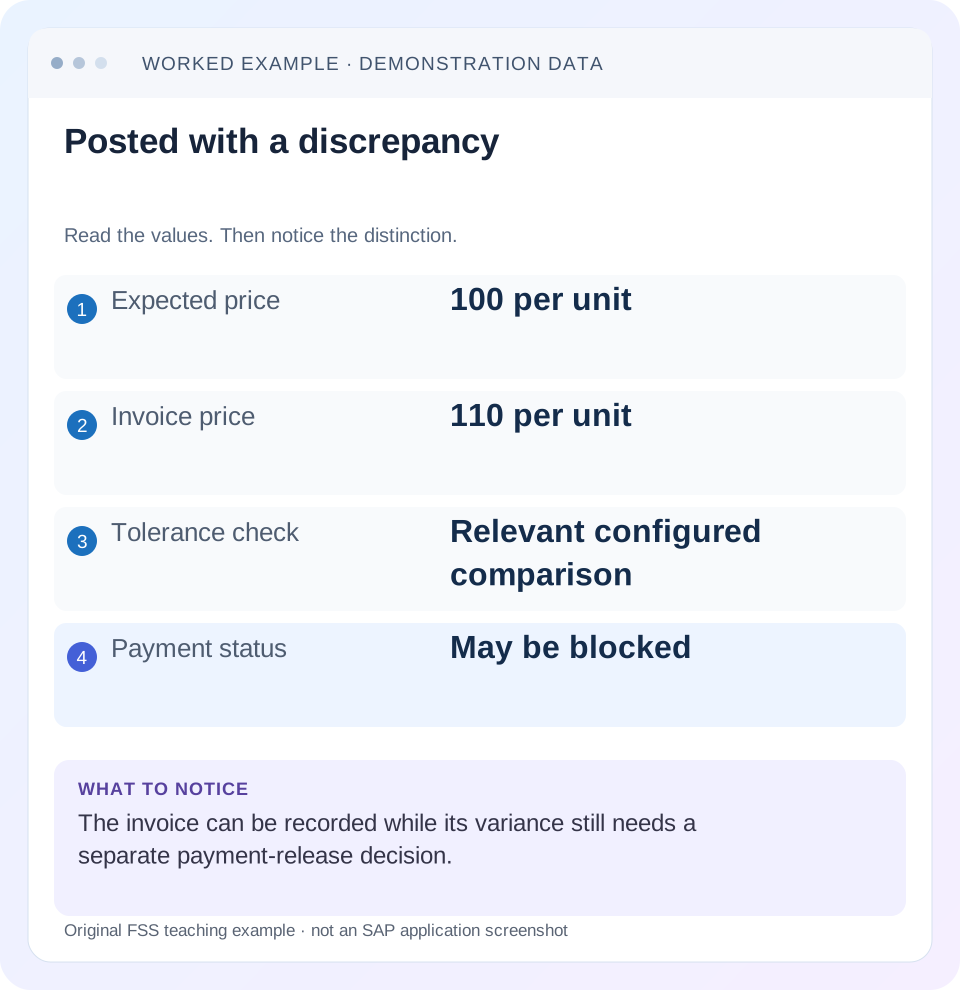
Read the example values
- Expected price
- 100 per unit
- Invoice price
- 110 per unit
- Tolerance check
- Relevant configured comparison
- Payment status
- May be blocked
Words you’ll meet in this guide
- Material
- A product or supply item managed in SAP.
- Plant
- An organizational unit for relevant logistics operations.
- Goods receipt
- A recorded receipt of goods in a business process.
- Purchase order
- A purchasing document requesting goods or services from a supplier or supplying plant.
- Invoice
- A supplier’s bill for goods or services.
- HANA
- SAP’s database platform.
- FI
- Financial Accounting: the SAP area for financial postings and reporting.
Preview the practical steps
SEE THE CONNECTION
See it in a simple example.
A small example to make the idea concrete.
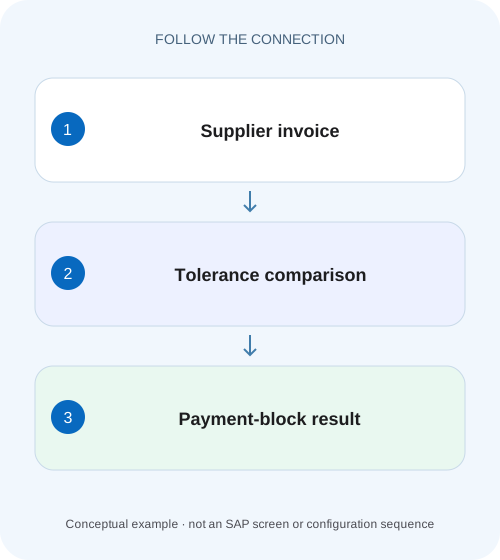
Investigate a component invoice variance
A supplier invoices a component delivery above the expected amount, and the plant's accounts-payable team finds the posted invoice blocked for payment.
Posted and ready to pay are different states
A logistics invoice can be posted and create accounting effects while remaining blocked for payment.
Scope and prerequisites
The scope is S/4HANA Logistics Invoice Verification as described by the cited on-premise 2025 FPS01 documentation.
Understand the comparison and the resulting block
Invoice verification proposes expected values from the relevant purchasing or receipt context.
Investigate a component invoice variance
A supplier invoices a component delivery above the expected amount, and the plant's accounts-payable team finds the posted invoice blocked for payment.
Compare the invoice, purchasing reference and recorded tolerance reason before requesting release or asking the supplier for correction.
| Reader | Business question | Evidence to carry forward |
|---|---|---|
| Manufacturing buyers and purchasing managers | Investigate a component invoice variance | Compare the invoice, purchasing reference and recorded tolerance reason before requesting release or asking the supplier for correction. |
01 Posted and ready to pay are different states
A logistics invoice can be posted and create accounting effects while remaining blocked for payment. An existing accounting document therefore does not prove posting failed, and it does not prove payment is permitted. SAP documents automatic blocking when applicable invoice variances exceed configured upper tolerances, as well as manual and other blocking reasons. [1]
The practical task is to identify the actual reason, compare it with purchasing/receipt evidence and verify the supported release result after resolution. Do not increase a shared tolerance or remove an accounting block merely because this one invoice is urgent. This tutorial follows an invoice price above the expected basis and a separate missing-receipt variation.
02 Scope and prerequisites
The scope is S/4HANA Logistics Invoice Verification as described by the cited on-premise 2025 FPS01 documentation. ERP concepts may be similar, but installed tolerance keys, release workflows, authorizations and applications need their own check. A manual FI payment block, a logistics variance and a stochastic block are not interchangeable procedures.
Obtain the logistics invoice/year, accounting reference, supplier, company code, PO/item, receipt evidence where relevant, actual blocking reasons and the applicable tolerance configuration. Display access is enough to investigate; authorized training access is needed for proposed recheck/release tests. The illustrative arithmetic excludes taxes, freight, exchange differences and price-unit complexity.
Payment must not be executed as a diagnostic test. Use supported invoice displays and permitted nonpayment checks to establish state.
03 Understand the comparison and the resulting block
Invoice verification proposes expected values from the relevant purchasing or receipt context. A difference can be acceptable within the configured control or can create a blocking reason. The reason identifies a question to investigate, not proof of supplier wrongdoing. A missing receipt, incorrect price, wrong unit or valid commercial change can each produce an apparent mismatch. [1] [2]
SAP documents that account postings occur and the supplier accounting line can carry a payment block when the invoice is blocked. A variance on one item can prevent payment of the invoice as a whole. Unaffected-looking items do not independently make the entire invoice payable.
Keep the recorded reason and its current validity separate. Later receiving activity or an approved purchasing correction may change the evidence, but the appropriate recheck/release process still needs to be established.
04 Worked case: expected one hundred, invoiced one hundred ten
Fictional PO item 10 is for 10 PC at 100 currency units per piece. The relevant received quantity is ten. Invoice INV-P bills ten at 110 per piece. Expected simplified net value is 1,000 and invoice net is 1,100, a difference of 100 or ten percent of the expected amount.
Assume expressly that the applicable configured upper price-variance control is exceeded in this training case. This assumption makes the example a blocked invoice; ten percent is not presented as a universal SAP tolerance or default. The actual tolerance comparison can involve configuration-specific absolute/percentage rules and price basis.
The accounting document can therefore represent 1,100 while payment is blocked. The business investigation must decide whether the invoice is wrong, the PO needs an approved commercial correction or another explanation applies. Changing the tolerance to ten percent is not an investigation result.
| Measure | Calculation | Result |
|---|---|---|
| Expected net | 10 × 100 | 1,000 |
| Invoice net | 10 × 110 | 1,100 |
| Difference | 1,100 − 1,000 | 100 |
| Simple percent | 100 ÷ 1,000 | 10% |
| Blocking assumption | Applicable upper control exceeded | Posted liability with payment restriction |
05 Confirm the reason before calculating
Read the actual invoice item/blocking reason and header block context. A payment block visible in accounting can have several origins. If the invoice is manually blocked and also contains item variances, the release selection behavior can differ from a purely manual-block case; use the documented procedure and current evidence. [2] [3]
For INV-P, verify the same ten-piece quantity and price basis on the PO, receipt and invoice. A price per hundred pieces or a different currency changes the comparison. Separate taxes and delivery costs rather than dividing the gross supplier total by quantity and calling the result the item price.
If the reason is quantity, not price, build a quantity timeline. For example, ten invoiced but only eight relevant pieces received produces a different investigation from ten received at an unexpected unit price.
Keep the gross supplier claim and the item net comparison in separate worksheet fields. If an invoice has several items, identify which one produced the reason before attributing the entire header difference to its price.
06 Investigate and resolve in a practical sequence
The supported correction should address the reason that actually applies. Keep the existing invoice identity throughout the case to avoid duplicate entry.
Identify the posted invoice
Display the logistics invoice and linked accounting reference. Record company, year, supplier and posting status.
Expected observation: A posted liability is distinguished from a draft or failed entry.
Read all block reasons
Inspect item variance reasons and header/manual context; retain exact messages.
Expected observation: No second unresolved reason is hidden by the first one investigated.
Compare the underlying basis
For INV-P, reconcile ten pieces, 100 expected and 110 invoiced with purchasing and supplier evidence.
Expected observation: The 100-value simplified variance has a business explanation.
Verify the supported resolution
After approved correction and authorized release/recheck, inspect remaining reasons and accounting block evidence.
Expected observation: Readiness is established for the original invoice without paying it as a test.
07 A later receipt can resolve a different kind of cause
For a variation, keep the expected price at 100 but receive only eight of the ten invoiced pieces. The simplified missing receipt quantity is two. If those goods actually arrived and an authorized receipt was missing, the supported receiving correction can change the basis for the quantity block.
That does not mean every blocked invoice should be solved by posting a receipt. If the two pieces never arrived, creating them in SAP would falsify stock and acceptance evidence. Confirm the physical business event before changing the document chain.
After the legitimate receipt, use the appropriate recheck/release process and inspect all remaining reasons. The price block from the original INV-P scenario would not be cured merely by receiving more goods at the same quantity basis.
08 Release controls and manual blocks need separate attention
SAP documents release procedures that distinguish variance-related, manual and stochastic blocks. Automatic release is tied to the validity of supported reasons, and a separate manual header block can require separate handling. Verify the current release-specific documentation rather than assuming one successful recheck removes every independent restriction. [2] [4]
An authorized person should retain the commercial resolution and release evidence. A message that one blocking reason was deleted does not prove the invoice is fully released. Inspect the saved result and any remaining reasons.
Avoid changing only the FI payment-block field as a shortcut around logistics processing. SAP support documentation explains that such a change can leave logistics blocked-record handling inconsistent with the accounting side. Use the supported integrated process for the installed scenario.
09 Troubleshooting decisions
Choose the branch by observed reason and document evidence. A supplier reminder cannot identify which tolerance was exceeded.
| Observation | Question | Next evidence |
|---|---|---|
| Accounting document exists, payment fails | Is a valid payment block present? | Invoice reasons and supplier line |
| Quantity reason | Is relevant receipt quantity missing or corrected? | PO/GR/invoice timeline |
| Price reason | Are price unit and approved conditions aligned? | Item conditions, currency and invoice basis |
| One reason cleared, invoice blocked | Are other item/header reasons still present? | All reasons and saved release result |
| Not visible in expected release list | Wrong block procedure or selection? | Company/year and manual/variance context |
| FI block removed, logistics list remains | Was integrated release bypassed? | Supported release evidence and original reason |
10 Common mistakes that weaken controls
Do not treat tolerances as a per-invoice convenience setting. They affect a wider population and express approved control choices. A legitimate commercial exception should be documented through the supported process rather than silently broadening every future invoice’s allowance.
Do not enter a duplicate invoice after an unclear interface response. Search the original reference and accounting evidence first. A duplicate can create a second liability while the first remains blocked.
Do not say “released means paid.” Release removes the relevant payment restriction, while due dates, other controls, proposal selection and actual payment execution still have their own evidence. A blocked-invoice incident ends at the verified state requested, not at an invented payment confirmation.
11 Verification exercises
For the positive training check, use the stated expected price, quantity and an expressly configured tolerance fixture. Confirm posting, recorded reason and accounting block, then apply the approved underlying correction and inspect the saved release result.
For the negative check, resolve only a quantity reason while retaining an independent manual block. Explain why payment readiness still needs review. Separately compare 110 per ten pieces with 100 per piece and identify why raw price numbers cannot be compared.
For boundary checks, test values just below, at and above the actual configured tolerance, including any relevant absolute and percentage criteria. Include a credit/cancellation variation and a receipt posted after invoice entry. Record installed behavior rather than assuming this worksheet’s simple ten-percent calculation is the complete SAP algorithm.
12 Questions and a useful resolution record
Can one item block the invoice? SAP documents invoice-wide payment blocking in this context even when a variance is on one item. Can a posted invoice still be wrong? Yes; posting records the event while the business discrepancy can remain unresolved. [1]
Must a block be removed immediately after a late receipt? Establish the supported recheck/release process and other reasons. One changed input is not proof of complete readiness.
A useful case result identifies INV-P and its accounting document, ten pieces at 100 expected versus 110 billed, the actual tolerance reason, the approved commercial correction and the saved remaining-block state. Continue with MIR4, GR-based matching and payment-process lessons when the question crosses the next document boundary.
Related services and next steps
Primary sources
Found this useful?
Share this guide with your network, or leave a like.
Your like is saved in this browser.