SAP split valuation versus batch management: Separate value from identity
A manufacturer handles component batches with different origins and needs to distinguish batch traceability from the valuation grouping used in accounting.

Source review:
START HERE · NO PRIOR TOPIC KNOWLEDGE NEEDED
What it is. Why it matters.
Split valuation separates how parts of stock are valued. Batch management identifies groups of goods, so financial value categories and physical traceability are different concerns.
Completely new to SAP?
Manufacturers use SAP to connect work such as buying components, recording inventory, planning production, shipping equipment and accounting for costs. SAP S/4HANA is an enterprise resource planning system: it connects these activities through shared business data.
Materials Management supports purchasing and inventory. A request, order, goods receipt and supplier invoice describe separate events, each with its own record and status.
A transaction code, or t-code, is a shortcut to a task in classic SAP GUI. Fiori apps provide another way to work. Names and screens depend on the product and release; you do not need a live system to learn the concepts in this guide.

Scope and source-review notes
Scope and evidence
Source review by FAST SAP SOLUTIONS® editorial. This badge describes our editorial review; it does not represent SAP certification or independent endorsement.
S/4HANA split-valuation concepts, using Cloud 2608 documentation. Category/type/batch integration, child/total records and supported master changes require installed-edition verification; event-based production settlement is outside the procurement fixture.
Reviewed the cited official SAP indexed documentation excerpts on 14 November 2026. Direct Help Portal opens did not consistently expose readable page text. This is documentation-based teaching, not customer-system execution. All document identifiers, quantities and outcomes in the worked case are illustrative; installed release, edition, configuration and authorizations require local verification.
A MANUFACTURING EXAMPLE
Separate component identity from value
Separate value from identity
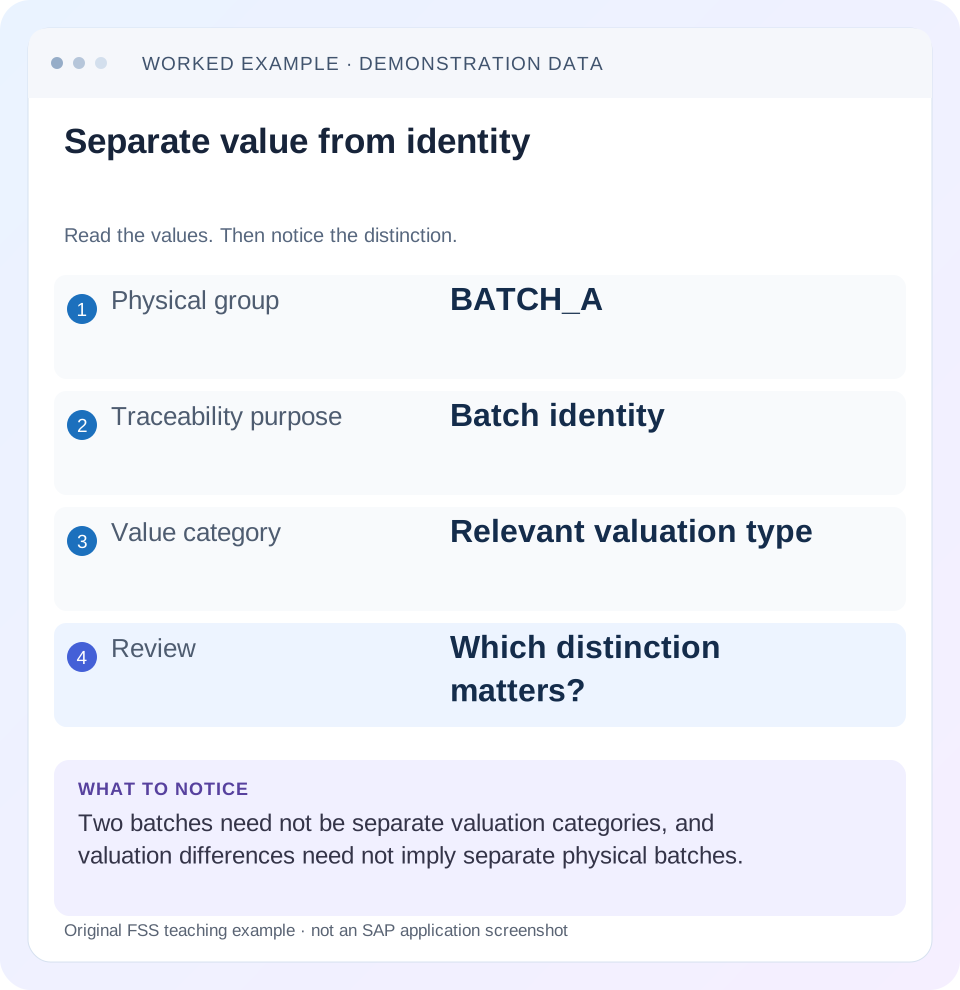
Read the example values
- Physical group
- BATCH_A
- Traceability purpose
- Batch identity
- Value category
- Relevant valuation type
- Review
- Which distinction matters?
Words you’ll meet in this guide
- Material
- A product or supply item managed in SAP.
- Plant
- An organizational unit for relevant logistics operations.
- Goods receipt
- A recorded receipt of goods in a business process.
- Purchase order
- A purchasing document requesting goods or services from a supplier or supplying plant.
- Invoice
- A supplier’s bill for goods or services.
- HANA
- SAP’s database platform.
Preview the practical steps
SEE THE CONNECTION
See it in a simple example.
A small example to make the idea concrete.
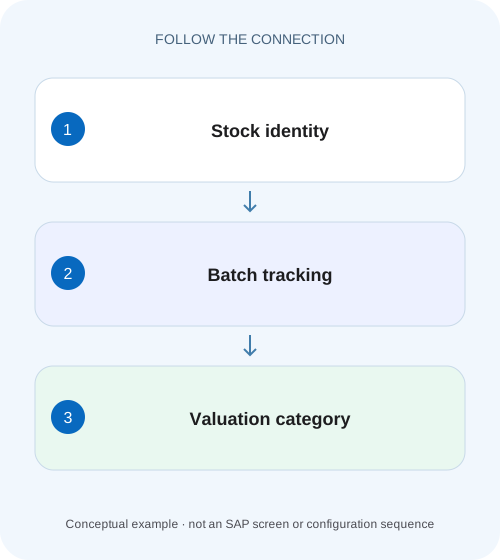
Separate component identity from value
A manufacturer handles component batches with different origins and needs to distinguish batch traceability from the valuation grouping used in accounting.
Batch identity does not automatically create a separate price
Batch management identifies groups of goods.
Scope and prerequisites
The guide uses SAP S/4HANA split-valuation documentation, including current Cloud production-accounting concepts.
Read category, type and batch as separate attributes
The valuation category specifies the differentiation criterion.
Separate component identity from value
A manufacturer handles component batches with different origins and needs to distinguish batch traceability from the valuation grouping used in accounting.
Read the batch and valuation-type context separately before attributing a cost difference to the physical batch.
| Reader | Business question | Evidence to carry forward |
|---|---|---|
| Plant stores, warehouse and materials teams | Separate component identity from value | Read the batch and valuation-type context separately before attributing a cost difference to the physical batch. |
01 Batch identity does not automatically create a separate price
Batch management identifies groups of goods. Split valuation separates the valuation of sub-stocks according to the configured criterion. Two batches can therefore have distinct traceability while sharing a valuation design, and different valuation types can distinguish value without being a general replacement for batch traceability. [1]
The practical question is whether the incident concerns which goods were received or how the relevant stock is valued. This tutorial follows two batches in one valuation type and a second valuation type with a different value basis. It then explains why category X, Automatic (Batch), is a specific design rather than proof that every batch-managed material has a unique accounting price.
02 Scope and prerequisites
The guide uses SAP S/4HANA split-valuation documentation, including current Cloud production-accounting concepts. The detailed event-based production example in that source is outside this article’s procurement fixture. ERP and other S/4HANA editions require their installed split-valuation and master-data rules.
Collect material, valuation area, valuation category/types, price control, price unit, currency, batch identities and representative movement/accounting references. Obtain authorized display access to material accounting data, batches and valuation documents. Proposed receipts/issues or master-data redesign belong in an approved training process.
Changing a live valuation category is not a routine incident workaround. Existing stock, documents and supported conversion restrictions must be reviewed. This tutorial teaches investigation and arithmetic under explicit assumptions, not a blanket procedure for switching valuation design.
03 Read category, type and batch as separate attributes
The valuation category specifies the differentiation criterion. The valuation type identifies the relevant sub-stock characteristic under that design. SAP documents criteria such as origin, quality or in-house versus external procurement. Batch identity serves traceability and can carry production or quality characteristics, but it does not by itself establish separate valuation. [1]
For an approved origin-based design, valuation types might represent two allowed origins. Several physical batches can belong to the same type when the supported design permits it. Their batch labels differ while transactions affect the valuation sub-stock selected by the actual document context.
Always retain valuation area and currency. A material price from another plant/valuation area or another currency cannot prove the current sub-stock value is wrong.
04 Worked case: two batches share one valuation type
Fictional material PART-SV has an approved split design with illustrative types LOCAL and IMPORT. LOCAL contains batch L-A with ten PC and batch L-B with twenty PC. For this worksheet, LOCAL has thirty PC and a value of 300, giving ten per PC on its stated basis. IMPORT contains ten PC worth 140, or fourteen per PC.
L-A and L-B are different traceable groups, but both belong to LOCAL in this fixture. Expecting a unique price for each merely because their batch numbers differ would misunderstand the design. IMPORT is separately valued because it belongs to a different valuation sub-stock, not merely because it has another batch label.
The combined worksheet quantity is forty and value 440, giving an aggregate average of eleven. That aggregate does not mean issuing a LOCAL piece must use IMPORT’s fourteen or the aggregate eleven. Inspect the actual sub-stock price control and document valuation.
| Valuation type | Batch quantities | Sub-stock quantity/value | Worksheet unit basis |
|---|---|---|---|
| LOCAL | L-A 10 PC; L-B 20 PC | 30 PC / 300 | 10 per PC |
| IMPORT | I-A 10 PC | 10 PC / 140 | 14 per PC |
| Combined | All stated batches | 40 PC / 440 | 11 aggregate average; not a batch-specific instruction |
05 Understand total and sub-stock records
SAP’s current split-valuation reference describes total and child/sub-stock segments. Valuation-relevant movements operate at sub-stock level and also update the total context. The documented design distinguishes the total price-control representation from the child price-control possibilities. Verify those records in the installed release instead of reading one total price as every sub-stock’s issue price. [1]
In the worksheet, 300 plus 140 equals 440. If LOCAL is consumed by five pieces at the stated simple ten-per-piece basis, LOCAL would become twenty-five pieces worth 250 and the combined fixture thirty-five worth 390, assuming no other effects. IMPORT’s ten pieces and 140 remain unchanged.
This calculation demonstrates sub-stock isolation. It does not claim every real issue can be reproduced from rounded displayed prices or that actual costing and period-end processes are absent.
06 Trace a receipt or issue in sequence
Inspect the actual document’s batch and valuation context rather than inferring one from the other.
For a second receipt worksheet, add ten LOCAL pieces worth 120 under an expressly moving-average child assumption. LOCAL becomes forty pieces worth 420, or 10.50 per piece, while IMPORT remains ten/value 140. The combined population is fifty/value 560. This calculation demonstrates why a receipt into LOCAL can change its average without creating an individual price for each existing LOCAL batch.
Confirm the valuation design
Display PART-SV in the relevant area and identify category, allowed types, price controls, unit and currency.
Expected observation: The accounting criterion is explicit.
Map physical identity
Read L-A/L-B/I-A and their supported valuation relationships. Confirm quantity and organizational context.
Expected observation: Traceable batches are distinguished from value sub-stocks.
Follow one movement
Inspect the material-document item and applicable accounting lines, retaining batch and valuation type where relevant.
Expected observation: The affected sub-stock is identified from actual evidence.
Reconcile child and total
For the worksheet, compare LOCAL 300 plus IMPORT 140 with total 440; after the five-piece example compare 250 plus 140 with 390.
Expected observation: The arithmetic explains which stock changed and which did not.
07 Category X is a special batch-based valuation design
The cited current documentation identifies category X, Automatic (Batch), as a special case in which predefined fixed types are not used and a goods-receipt batch serves as the valuation type. Review this only when the actual material uses that design. [1]
Do not generalize the special case into “batch management always creates batch prices.” A material with batches under another valuation setup has to be interpreted through that setup. Equally, do not assume all split valuation requires ordinary production-batch traceability in precisely the same way.
For a category-X investigation, identify the batch-created valuation record and relevant receipt/issue evidence in the installed edition. Keep any production accounting, settlement or actual-costing dependencies explicit rather than transferring the procurement worksheet unchanged.
08 Price control remains another independent question
A sub-stock can have a supported standard or moving-average price-control design. Split valuation identifies the separate valuation population; price control explains how that population’s value responds to transactions. These are related but different decisions.
For the worksheet, ten and fourteen are stated simple unit bases. If a later invoice changes LOCAL’s value under its supported moving-average treatment, that does not automatically change IMPORT. If LOCAL uses standard price, relevant differences follow the applicable accounting treatment instead of simply replacing its price with the last invoice.
Use the price-control lesson to trace transaction order, stock coverage and currencies. A batch-selection problem should not be repaired by changing price control, and a valuation problem should not be hidden by creating a new batch label.
09 Troubleshooting decisions
Start with whether the mismatched field concerns identity, valuation population or price behavior. That distinction prevents unrelated master-data changes.
| Observation | Question | Next evidence |
|---|---|---|
| Two batches have one price | Do they share a valuation type? | Batch/type mapping and accounting design |
| Different types have different prices | Is separate valuation intended? | Category criterion and sub-stock records |
| Total price differs from child price | Is aggregate being compared with sub-stock? | Total/child quantities and values |
| Receipt asks for valuation context | Which sub-stock belongs to this event? | Material design and purchasing/movement reference |
| Batch change proposed to repair value | Is the problem actually accounting? | Movement/accounting valuation evidence |
| Category X assumed for every batch | Does material actually use X? | Actual category and installed documentation |
10 Common mistakes with live master data
Do not rename or replace a batch to create a desired accounting value without understanding the supported valuation relationship. Historical documents can continue to carry the original context, and a new identity can split traceability.
Do not change the valuation category or type on an established material simply to make one receipt proceed. Inspect current stock, open documents and documented change restrictions. A controlled redesign may be needed, but it should explain how existing quantities and values are preserved.
Do not use the combined average eleven as a universal issue-price instruction for LOCAL. The five-piece worksheet shows why sub-stock basis matters. Rounded displays, price units and actual costing can add further differences that require accounting evidence.
11 Verification exercises
For the positive worksheet check, reconcile L-A ten plus L-B twenty to LOCAL thirty, value 300; add IMPORT ten/value 140 to forty/value 440. Then consume five LOCAL at the stated ten basis and verify twenty-five/250 plus ten/140 equals thirty-five/390.
For the negative check, assign IMPORT’s fourteen to LOCAL’s five-piece issue merely because another batch had that price. Explain the wrong sub-stock selection. Separately assume L-A and L-B must have separate prices and identify the missing category-X or other design evidence.
For boundary checks, inspect one type with zero stock, two batches in one type, different child price controls and a genuine category-X training material. Record actual permitted fields and generated valuation records. These proposed tests are documentation-based, not executed SAP results.
12 Questions and the investigation result
Can batch management exist without the expected separate prices? Yes; read the actual valuation design. Can split valuation separate values by criteria other than batches? The documentation describes several criteria. Is category X a synonym for ordinary batch management? It is a specific valuation design and must be verified.
A useful result states PART-SV’s valuation area/category, LOCAL with L-A/L-B and 30/300, IMPORT with 10/140, and the actual movement’s affected type. It separates traceability from accounting instead of saying that a batch price is wrong without naming the valuation context.
Continue with batch/serial identity, stock overview and price control to investigate which goods exist, where they are and how their values respond to the actual document chain.
Related services and next steps
Primary sources
Found this useful?
Share this guide with your network, or leave a like.
Your like is saved in this browser.