SAP stock transport order versus transfer posting: Choose the document flow
One factory sends components to another; the receiving planner sees less received than the sending plant dispatched.

Source review:
START HERE · NO PRIOR TOPIC KNOWLEDGE NEEDED
What it is. Why it matters.
A stock transport order plans supply between locations with purchasing-document control. A transfer posting records a stock change in the applicable process; the required business trail determines the route.
Completely new to SAP?
Manufacturers use SAP to connect work such as buying components, recording inventory, planning production, shipping equipment and accounting for costs. SAP S/4HANA is an enterprise resource planning system: it connects these activities through shared business data.
Materials Management supports purchasing and inventory. A request, order, goods receipt and supplier invoice describe separate events, each with its own record and status.
A transaction code, or t-code, is a shortcut to a task in classic SAP GUI. Fiori apps provide another way to work. Names and screens depend on the product and release; you do not need a live system to learn the concepts in this guide.

Scope and source-review notes
Scope and evidence
Source review by FAST SAP SOLUTIONS® editorial. This badge describes our editorial review; it does not represent SAP certification or independent endorsement.
Classic ERP/S/4HANA transfer and STO concepts; current PP/DS reference is 2025 FPS02. One/two-step, delivery, billing, cross-company and warehouse variants have distinct stock/value behavior.
Reviewed the cited official SAP indexed documentation excerpts on 14 November 2026. Direct Help Portal opens did not consistently expose readable page text. This is documentation-based teaching, not customer-system execution. All document identifiers, quantities and outcomes in the worked case are illustrative; installed release, edition, configuration and authorizations require local verification.
A MANUFACTURING EXAMPLE
Track components between plants
Which transfer trail is needed?
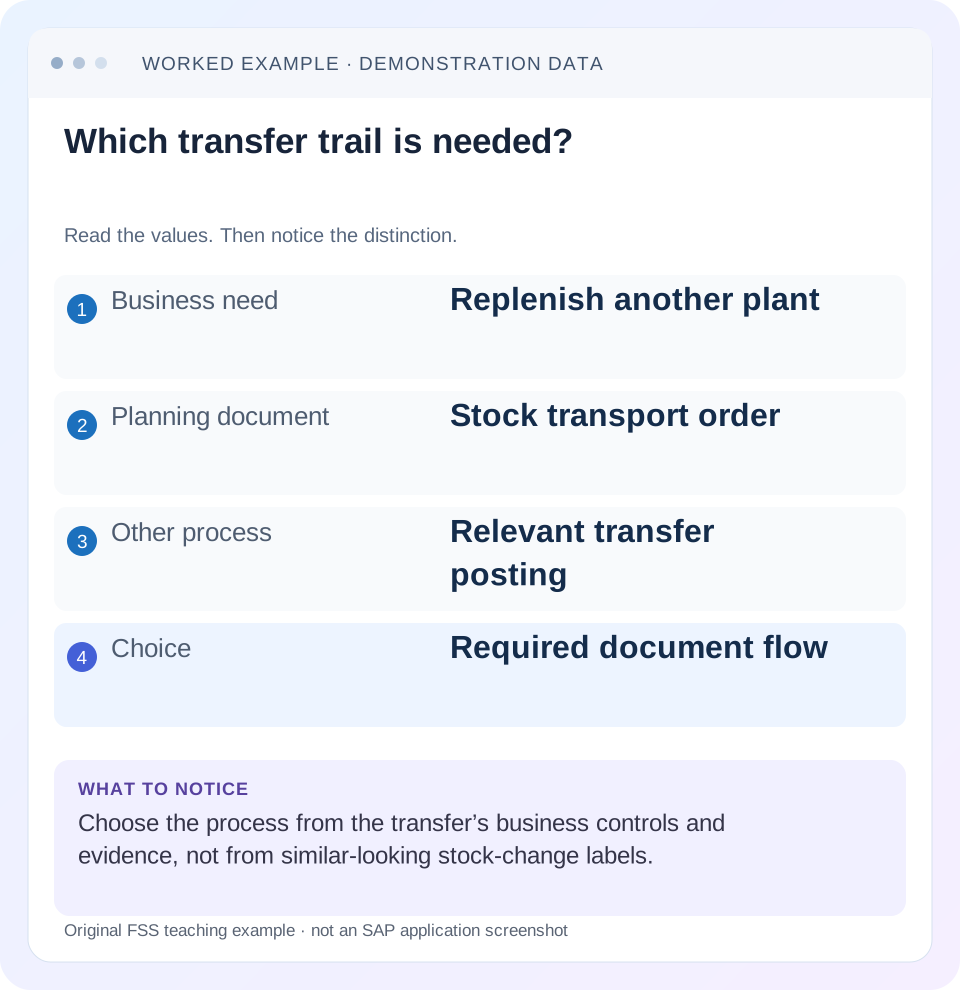
Read the example values
- Business need
- Replenish another plant
- Planning document
- Stock transport order
- Other process
- Relevant transfer posting
- Choice
- Required document flow
Words you’ll meet in this guide
- Material
- A product or supply item managed in SAP.
- Plant
- An organizational unit for relevant logistics operations.
- Goods receipt
- A recorded receipt of goods in a business process.
- Purchase order
- A purchasing document requesting goods or services from a supplier or supplying plant.
- Invoice
- A supplier’s bill for goods or services.
- HANA
- SAP’s database platform.
- MRP
- Material requirements planning: comparing demand with supply to propose what is needed.
Preview the practical steps
SEE THE CONNECTION
See it in a simple example.
A small example to make the idea concrete.
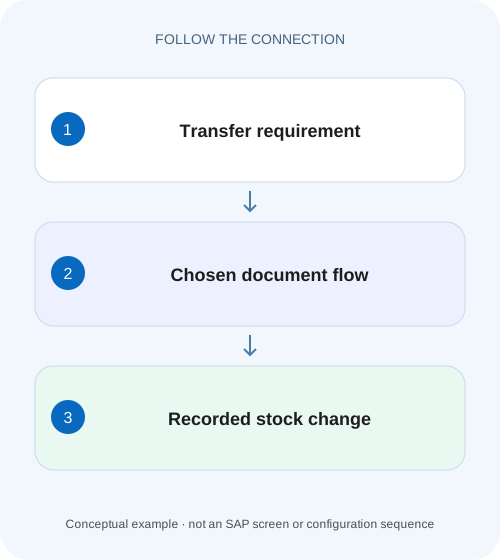
Track components between plants
One factory sends components to another; the receiving planner sees less received than the sending plant dispatched.
Choose the required trail before choosing a movement
A stock transport order plans and controls supply between plants through a purchasing-document flow.
Scope and prerequisites
The scope is classic Inventory Management stock transfer and STO concepts in ERP and supported S/4HANA.
What the STO adds to the process
SAP documents advantages including planned receiving-plant goods receipt, MRP participation, purchase-order history, applicable delivery costs and availability/shipping functions.
Track components between plants
One factory sends components to another; the receiving planner sees less received than the sending plant dispatched.
Trace the applicable transfer process, dispatch and receipt documents before treating the quantity in transit as stock already available at the destination.
| Reader | Business question | Evidence to carry forward |
|---|---|---|
| Plant stores, warehouse and materials teams | Track components between plants | Trace the applicable transfer process, dispatch and receipt documents before treating the quantity in transit as stock already available at the destination. |
01 Choose the required trail before choosing a movement
A stock transport order plans and controls supply between plants through a purchasing-document flow. A transfer posting records a stock change in its supported process. Both can move material between organizational contexts, but they do not provide identical planning, shipping, monitoring or accounting evidence. [1] [2]
Start with the business requirement: does the receiving plant need a planned receipt, are shipping papers required, is there a separate dispatch/receipt interval and do company-code or warehouse processes apply? This tutorial follows a forty-piece interplant replenishment and a partial receipt. It explains how to distinguish a planned order from goods issued, goods in transit and goods actually received.
02 Scope and prerequisites
The scope is classic Inventory Management stock transfer and STO concepts in ERP and supported S/4HANA. STOs with delivery, without delivery and with billing/invoice variants are different scenarios. Cross-company, warehouse, tax and transportation integration require their own configuration and references.
Collect supplying/receiving plants, storage locations, material, quantity/unit, company-code relationship, planning need and required logistics documents. Obtain authorized display access to the STO or transfer documents, delivery where used, material documents and relevant accounting evidence. Proposed postings belong in an approved training flow.
No universal movement code is prescribed for an unknown landscape. The supported reference/process should determine the appropriate movement and subsequent documents. Do not choose a code solely because it produces a desired stock number.
03 What the STO adds to the process
SAP documents advantages including planned receiving-plant goods receipt, MRP participation, purchase-order history, applicable delivery costs and availability/shipping functions. Those features explain why an STO can be preferable when the business needs visible planned replenishment and a monitored document chain. [1] [2]
A simpler transfer-posting route can fit a different approved requirement. It should not be selected merely to bypass missing STO data or approval. Compare what evidence and control the business actually needs, including whether the receiver must see an expected supply before dispatch.
The source documentation distinguishes variants involving different components. Do not assume every STO creates a delivery and billing document, or that a process without billing has the same cross-company accounting as one with billing.
04 Worked case: forty planned, forty dispatched, thirty received
Fictional plant P100 supplies PART-T to plant P200. STO-A item 10 requests 40 PC for an agreed date. For this teaching fixture, use an approved staged STO process in which issue and receipt are separate and the relevant transit state is explicitly monitored. There is no opening transit quantity or other transfer.
Dispatch records forty PC against the correct chain. P200 initially receives thirty. The simplified outstanding transit quantity for that isolated chain is forty issued minus thirty received, or ten. The ten are not automatically lost: they require physical/transport and document reconciliation.
The STO’s forty-piece planned quantity is not another physical stock addition. Before issue it is a requirement/planned receipt. After partial receipt, the chain has forty dispatched, thirty received and ten unresolved between those stages. The actual installed transit terminology, quantity updates and value timing must be inspected.
| Stage | Quantity | Meaning |
|---|---|---|
| STO-A / 10 | 40 PC planned | Requirement, not physical movement |
| Issue reference GI-A | 40 PC dispatched | Actual supplying-side event |
| Receipt reference GR-A | 30 PC received | Actual receiving-side event |
| Isolated chain difference | 10 PC | Needs transit/receiving reconciliation |
| Potential final receipt | 10 PC if actually delivered | Must use supported original chain |
05 Compare one-step and staged transfers honestly
A one-step transfer records the relevant source/destination change together in its supported process. A staged transfer separates removal and receipt, introducing an interval or intermediate context. These designs answer different operational needs even when their eventual end quantities are the same. [1]
For plants far apart, a single immediate posting can be a poor representation of physical timing unless it is the approved design. Conversely, adding an STO and delivery chain to a simple local reclassification can create unnecessary obligations if the business does not need them. Choose based on process requirements, not transaction familiarity.
The ERP stock-transfer comparison uses distinct intermediate stock concepts for particular routes. Keep the installed process’s actual terms rather than calling every incomplete movement “stock in transit” as though all variants were technically identical.
06 Follow the actual documents in sequence
For STO-A, retain one item identity across planning, issue and receipt. A document-flow map is more useful than separately comparing two plant totals.
Confirm the chosen variant
Record P100/P200, company relationship, delivery/billing scope and the forty-piece planned item.
Expected observation: The expected document chain is explicit.
Verify issue evidence
Read GI-A and any delivery/warehouse references, quantity, unit and date. Confirm it belongs to STO-A/10.
Expected observation: Dispatch is distinguished from merely creating the STO or delivery.
Verify receipt evidence
Read GR-A for thirty PC, the receiving plant/location and any corrections.
Expected observation: The receiving event uses the same chain and quantity basis.
Reconcile the ten-piece difference
Compare physical shipment/receipt evidence and the installed intermediate-stock display.
Expected observation: The unresolved ten has a named transport or posting question.
Inspect the authorized completion
After legitimate final receipt or correction, revisit history, transit context and applicable accounting.
Expected observation: The original transfer is reconciled without creating another forty-piece order.
07 Partial receipt and physical shortage require different evidence
If the carrier delivered only thirty so far, the ten-piece outstanding transfer can be valid. If forty arrived but receiving posted thirty, the issue is an unrecorded receiving portion. If thirty arrived and ten were damaged/lost, a supported business disposition is required. The quantity difference alone cannot decide among these cases.
Ask for packing/shipping references and receiving evidence tied to the actual shipment. Do not post the final ten just to clear the transit display when no goods arrived. Equally, do not create a second transfer for ten while an original ten remains legitimately outstanding unless the process intentionally replaces or cancels it.
Preserve the timing. A receipt posted the next day can explain why yesterday’s sender/receiver reports differed without either being wrong.
For a partial-issue variation, dispatch only twenty-five of the forty planned pieces and receive all twenty-five. The isolated issued-versus-received difference is zero, but fifteen planned pieces have not been dispatched. This is a different open question from the original ten pieces between dispatch and receipt. A worklist that labels both simply open quantity can hide the distinction. Retain planned, issued and received as separate columns and inspect the actual item controls before deciding whether the remaining fifteen are still expected.
08 Cross-company and value questions need the correct variant
Transferring goods between plants within a company and across company codes can have different financial and commercial consequences. Billing/invoice-based variants add documents that a simple Inventory Management transfer does not reproduce. Establish the actual setup before predicting account entries or intercompany settlement. [1] [2]
Quantity reconciliation should still retain source, destination and references, but a forty-issued/thirty-received bridge is not a financial settlement formula. Currency, valuation, transfer prices and invoicing can need separate reconciliation.
If someone proposes a direct transfer to avoid an intercompany billing problem, identify the missing financial document and authorized process. Matching stock quantities through another route does not prove the intended commercial/accounting flow has been completed.
09 Warehouse execution adds another lifecycle
An outbound delivery can exist before warehouse work finishes, and warehouse task/order completion can be separate from posted Inventory Management goods issue. The receiving warehouse can likewise have inbound processing after a receipt-related milestone.
Use the actual delivery and warehouse references to identify which step owns the delay. “STO created” does not prove picking; “picked” does not automatically prove the goods issue posting; “received in ERP” does not establish every bin-level usability condition.
For the tutorial’s ten-piece discrepancy, warehouse evidence may explain why a physical quantity was staged or received differently. Keep those facts connected to STO-A rather than replacing the transfer chain with a warehouse-only total.
10 Troubleshooting decisions
Choose the missing document/state, not a substitute posting that happens to change stock.
| Observation | Question | Next evidence |
|---|---|---|
| STO exists, source stock unchanged | Was goods issue actually posted? | GI and delivery/warehouse status |
| Source issued forty, destination thirty | What explains the ten-piece interval? | Transit context and physical receiving evidence |
| Destination has goods, no receipt | Is receiving posting missing? | Shipment/receiving reference and actual GR |
| No planned receipt visible | Was a direct posting route used? | Chosen process and receiving planning scope |
| Quantity reconciles, intercompany invoice missing | Which billing variant applies? | Actual billing/invoice/accounting chain |
| Second transfer proposed | Is original outstanding supply still active? | Original history and approved replacement decision |
11 Verification exercises
For the positive worksheet check, reconcile forty planned separately from forty issued and thirty received. Under the isolated staged assumptions, identify ten requiring explanation; then add a legitimate final ten-piece receipt and verify no unresolved quantity in that chain.
For the negative check, count the STO’s forty plus dispatch forty as eighty physical units. Explain why a requirement is not a second movement. Then clear the final ten without physical evidence and identify the unsupported inventory claim.
For boundary checks, test an approved one-step route, a partial issue, a receipt reversal and a cross-company delivery/billing variant in training. Capture actual transit terminology, value timing and generated references. The simple fixture does not establish every variant’s behavior.
12 Questions and the transfer handover
Does every STO use Shipping? SAP documents with- and without-delivery variants. Does an STO move stock when saved? Its existence alone is a planning/document event; inspect actual movement evidence. Is every transfer posting simpler and therefore preferable? Choose the trail that meets the approved planning and logistics requirements.
A useful result names STO-A/10, plants, process variant, forty issued on GI-A, thirty received on GR-A, the ten-piece explanation and relevant accounting/warehouse references. This is more actionable than saying both plant totals should match.
Continue with movement types, stock overview and warehouse tasks to inspect the event meaning, organizational position and execution state.
Related services and next steps
Primary sources
Found this useful?
Share this guide with your network, or leave a like.
Your like is saved in this browser.