SAC data access control: Why testing with an administrator can mislead you
A manufacturer shares analytics across plants while users have different responsibilities for the data they should read.

Source review:
START HERE · NO PRIOR TOPIC KNOWLEDGE NEEDED
What it is. Why it matters.
A dimension groups reporting data, such as region or product. Data access control limits which dimension members a user can read or change, separating visible detail from general report access.
Completely new to SAP?
Manufacturers use SAP to connect work such as buying components, recording inventory, planning production, shipping equipment and accounting for costs. SAP S/4HANA is an enterprise resource planning system: it connects these activities through shared business data.
Analytics organizes business data into useful comparisons. Planning adds proposed future values. Learn what the numbers represent before comparing totals or changing a forecast.
A transaction code, or t-code, is a shortcut to a task in classic SAP GUI. Fiori apps provide another way to work. Names and screens depend on the product and release; you do not need a live system to learn the concepts in this guide.

Scope and source-review notes
Scope and evidence
Source review by FAST SAP SOLUTIONS® editorial. This badge describes our editorial review; it does not represent SAP certification or independent endorsement.
SAP Analytics Cloud model dimension DAC using official 2026 help. Applies where SAC model security controls the facts; live-source authorization and specialized model types require separate checks.
Documentation review on 14 November 2026 used the official SAP sources listed below, including indexed excerpts where full text was unavailable. Scope and availability depend on the stated product, release and configuration. All document references, quantities, dates and outcomes in worked cases are illustrative; no customer SAP system or tenant was accessed and the proposed exercises were not executed.
A MANUFACTURING EXAMPLE
Restrict plant reporting to the intended scope
Test ordinary users against known plant facts
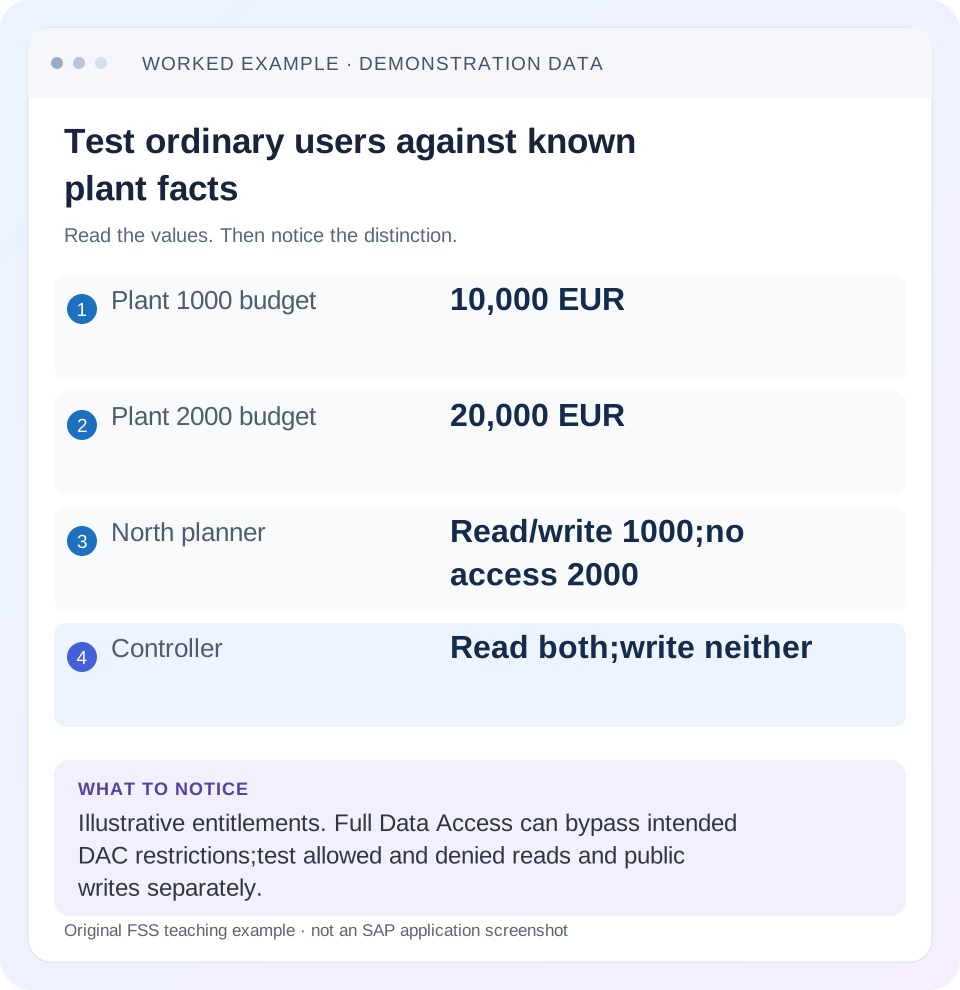
Read the example values
- Plant 1000 budget
- 10,000 EUR
- Plant 2000 budget
- 20,000 EUR
- North planner
- Read/write 1000;no access 2000
- Controller
- Read both;write neither
Words you’ll meet in this guide
- Dimension
- A way to group data, such as month or product.
- Measure
- A numeric value, such as revenue or quantity.
- Model
- A defined organization of data and calculation rules.
- SAC
- SAP Analytics Cloud: a cloud application for analytics and planning.
Preview the practical steps
SEE THE CONNECTION
See it in a simple example.
A small example to make the idea concrete.
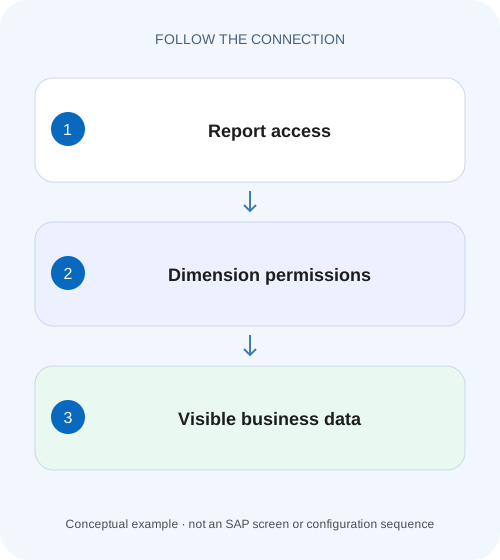
Restrict plant reporting to the intended scope
A manufacturer shares analytics across plants while users have different responsibilities for the data they should read.
A shared story and an allowed data region are different permissions
Data access control restricts which dimension members' data a user may read or write in an applicable SAC model.
Understand why administrator testing can mislead
SAP's DAC documentation explains that roles and model security take priority over DAC.
Express the policy as business intersections
Suppose plant 1000's planner should read and maintain that plant's budget, but should neither see nor change plant 2000's budget.
Restrict plant reporting to the intended scope
A manufacturer shares analytics across plants while users have different responsibilities for the data they should read.
Check the actual dimension-level access configuration and user context before treating missing rows as a loading failure.
| Reader | Business question | Evidence to carry forward |
|---|---|---|
| SAP developers and application teams supporting manufacturers | Restrict plant reporting to the intended scope | Check the actual dimension-level access configuration and user context before treating missing rows as a loading failure. |
01 A shared story and an allowed data region are different permissions
Data access control restricts which dimension members' data a user may read or write in an applicable SAC model. Sharing a story gives access to a content object; it does not alone define the allowed facts inside that story. Investigate content sharing, model permissions and member-level access as separate parts of one effective security path.
This guide is for SAC modelers and security testers with an approved nonproduction fixture and representative ordinary-user accounts. Do not use another person's credentials. You need known member data, expected user entitlements and visibility into assigned roles/teams. The example uses fictional plants and maintenance budgets, so positive and negative tests can be discussed without revealing sensitive operational values.
02 Understand why administrator testing can mislead
SAP's DAC documentation explains that roles and model security take priority over DAC. A role with Full Data Access can provide unrestricted access across models and dimensions. An administrator seeing both plants therefore does not prove that the ordinary planner's restriction failed. It may simply demonstrate that the administrator has the documented broader privilege. [1]
The reverse mistake is testing only as an administrator and declaring the policy effective because setup saved successfully. The target user may have no model access at all, or a team assignment may grant more access than intended. A valid test needs a permitted case and a denied case under the same representative identity.
03 Express the policy as business intersections
Suppose plant 1000's planner should read and maintain that plant's budget, but should neither see nor change plant 2000's budget. A central controller should read both plants but change neither. The model owner has separate administrative duties. Write those intentions before editing permissions, including what happens when a user belongs to multiple teams.
Read and write must be tested independently. A user who can view 1000 may still be unable to publish changes. A user with broad role privileges may bypass the member restriction you intended to demonstrate. Include the version dimension and other secured dimensions in the effective access analysis when applicable to the real model.
| Identity | Plant 1000 | Plant 2000 |
|---|---|---|
| Planner North | Read and write | No access |
| Planner South | No access | Read and write |
| Controller | Read only | Read only |
| Administrative test identity | Broad privileges possible | Not the restriction proof |
04 Build known data before testing visibility
Load a small fixture with plant 1000 maintenance budget 10,000 EUR and plant 2000 budget 20,000 EUR for the same month and planning version. Keep a reference table available to the model owner. A blank cell by itself cannot distinguish security filtering from missing data, a story filter or an unbooked intersection.
Use consistent IDs and descriptions. Two members both described as “North” can make a security test appear inconsistent when they are different identities. Record the member ID, model and version in evidence. If access applies at a hierarchy level, verify the effective descendants using the installed security behavior rather than assuming that every hierarchy relationship grants identical rights.
05 Inspect the complete permission path
Start with the user's ability to open the story and model. Then inspect role privileges, model access and enabled DAC dimensions. Only after that should you interpret the member-level read/write assignments. This order prevents trying to repair a story-sharing issue by widening access to financial data.
Define the ordinary identity
Record assigned roles and teams, excluding unintended Full Data Access for the restriction test.
Expected observation: The tested identity represents the planner.
Confirm content/model access
Open the intended story and model through the same route used in work.
Expected observation: Access failure is separated from member filtering.
Inspect member assignments
Compare effective read/write rights for plant 1000 and 2000 against the matrix.
Expected observation: Each required entitlement has a documented source.
Test the facts
Read known values, attempt an allowed change in the fixture, and test the denied member separately.
Expected observation: Visibility and maintainability match the business policy.
06 Distinguish reading, editing and publishing
A planner can sometimes experiment in a private version even when the corresponding public write is restricted. Do not interpret a value visible in the planner's private workspace as proof that the public model has been updated. Publish through the approved fixture and inspect the actual result and messages.
SAP's public-version guidance describes enforcement of security on publication and notes that restricted changes may not be published. Test the final public data with an independent authorized reader. A local edit that appears successful is insufficient evidence for the permission policy; the decisive outcome includes what reaches the shared version. [2]
07 Diagnose the failure at the right layer
Keep error messages and context. “Access denied” can concern a story, connection, model, member, version or locked planning region. A specific denied intersection gives the security owner much more useful evidence than a screenshot with all context removed.
| Observation | Possible branch | Next check |
|---|---|---|
| Cannot open story | Content sharing or role | Story permission and role |
| Story opens but all data blank | Model/member access or filters | Known fixture and effective access |
| Administrator sees restricted plant | Full Data Access | Assigned role privileges |
| Planner sees another plant | Additional effective grant | Team/role/member assignments |
| Planner reads but cannot publish | Write/version/lock restrictions | Publish details and secured intersection |
| One story differs from another | Consumer context | Model, filters and live/import path |
08 Test combinations of secured dimensions
If both plant and cost center are secured, define a small matrix of intersections. Plant 1000 permission does not by itself establish the intended access to every cost center. Include at least one allowed plant/cost-center combination and one combination that should be restricted. Observe the actual model behavior rather than applying a simplistic union or intersection rule without checking its documentation.
Also test an ordinary user belonging to more than one relevant team. Organizational changes can add a second grant that defeats the original test assumption. Retain the effective assignments with the test evidence so a later reviewer can explain why access changed without blaming a story layout.
09 Verify positive, negative and boundary outcomes
The positive read test expects the North planner to see 10,000 EUR for plant 1000. The negative read test expects plant 2000's 20,000 EUR to remain inaccessible under the intended policy, including the actual story route. The positive write test changes 1000 to 10,500 EUR in the fixture and confirms permitted publication. The negative write test must not change 2000.
A boundary test adds a new plant member or changes team membership through the approved process, then repeats the matrix. Do not assume a newly created member automatically receives the desired policy. Test any required alternate consumption or export route explicitly; one rendered chart does not prove every authorized route applies the same effective controls.
10 Avoid using filters as security controls
A story filter can improve navigation, but a user able to change the filter may reach another member if security permits it. Keep the policy in the appropriate model/source authorization mechanism. Conversely, a locked planning region controls a different concern from simple read visibility; do not report all noneditable cells as DAC failures.
If the model is live against BW or another source, establish which data restrictions are enforced there. SAC dimension settings from an imported planning model are not universal replacements for source authorization. Record connection type as part of the security design so testers know which layer is expected to deny access.
11 Use a concrete read/write evidence sheet for each identity
Create four fixture observations for North: read 1000, read 2000, write 1000 andwrite 2000. For each, record expected entitlement, actual visible value or denied outcome, and the exact model/version/intersection. Do the same for Controller, whose read tests should succeed for both plants while public-write tests should fail under the stated policy. This produces eight distinct permission observations rather than a single “security works”screenshot.
After North publishes 1000=10,500, Controller should read 10,500 for 1000 and 20,000 for 2000 if both facts are permitted and the same public version is selected. North should not need access to 2000 to prove that 1000 changed correctly; the independent controller provides that broader verification. The test deliberately separates permitted readership from maintenance rights.
If North can publish 2000 unexpectedly, inspect every effective role and team grant attached to that test identity before editing the member assignments. An additional broad role can explain the result even when the dimension table appears narrowly maintained. Keep a permission snapshot with the test so later role changes can be distinguished from a regression in the model.
12 Distinguish inaccessible values from unbooked intersections
Add plant 3000 with no budget fact in the fixture and define its intended permission separately. A blank 3000 intersection may simply be unbooked. A blank 2000 intersection for North represents the intended restricted population. Comparing those two blanks without a reference identity would conflate data absence and access filtering. Have the authorized model owner confirm the known 20,000-EUR fact for plant 2000 before diagnosing visibility.
For a team-change boundary, remove North from an intentionally broad test team through the approved process and repeat both allowed and denied cases. Do not stop after the newly restricted case works: confirm 1000 remains usable. Permission repair is complete only when it preserves necessary work as well as excluding the unintended region.
13 Close with a reproducible permission result
A useful result names model, story, ordinary identity, role/team snapshot, secured member IDs, version and allowed/denied outcomes. Keep administrative access evidence separate. The test has demonstrated a policy only within that documented context, not a blanket claim about every model in the tenant.
Why can an administrator see everything? Check Full Data Access before concluding DAC is ineffective. Why can a user read but not change a value? Read and write are distinct, and publication may add other restrictions. Does sharing the story grant plant data? It must be interpreted with model and data permissions. Continue with planning versions for publish behavior and live/import connections for locating the enforcement layer.
Related services and next steps
Primary sources
Found this useful?
Share this guide with your network, or leave a like.
Your like is saved in this browser.