SAP incident versus change: Restore service and govern a correction
A manufacturer's billing process stops after deployment, requiring both incident evidence and a controlled change to correct the cause.

Source review:
START HERE · NO PRIOR TOPIC KNOWLEDGE NEEDED
What it is. Why it matters.
An incident records a service problem. A change controls an intended modification, including its review and deployment; reporting a problem does not itself authorize changing the system.
Completely new to SAP?
Manufacturers use SAP to connect work such as buying components, recording inventory, planning production, shipping equipment and accounting for costs. SAP S/4HANA is an enterprise resource planning system: it connects these activities through shared business data.
SAP Basis work keeps relevant SAP systems running. Logs, background jobs and connection tools help explain what happened to a task at a particular time.
A transaction code, or t-code, is a shortcut to a task in classic SAP GUI. Fiori apps provide another way to work. Names and screens depend on the product and release; you do not need a live system to learn the concepts in this guide.

Scope and source-review notes
Scope and evidence
Source review by FAST SAP SOLUTIONS® editorial. This badge describes our editorial review; it does not represent SAP certification or independent endorsement.
Concepts for SAP support leads, application owners and change coordinators. SAP Solution Manager 7.2 documentation supports the ChaRM examples; status names, approvals and workflows are customer configured. This is not a SAP Cloud ALM screen guide.
Documentation review on 14 November 2026 used the available official SAP indexed excerpts; several SAP Help pages returned no readable full text. The worked case and proposed checks are original illustrative teaching material, not execution evidence from a customer SAP system. Exact fields, permitted actions and behavior must be confirmed against the installed product, release and configuration.
A MANUFACTURING EXAMPLE
Separate a factory outage from its correction
Report a fault, control a change
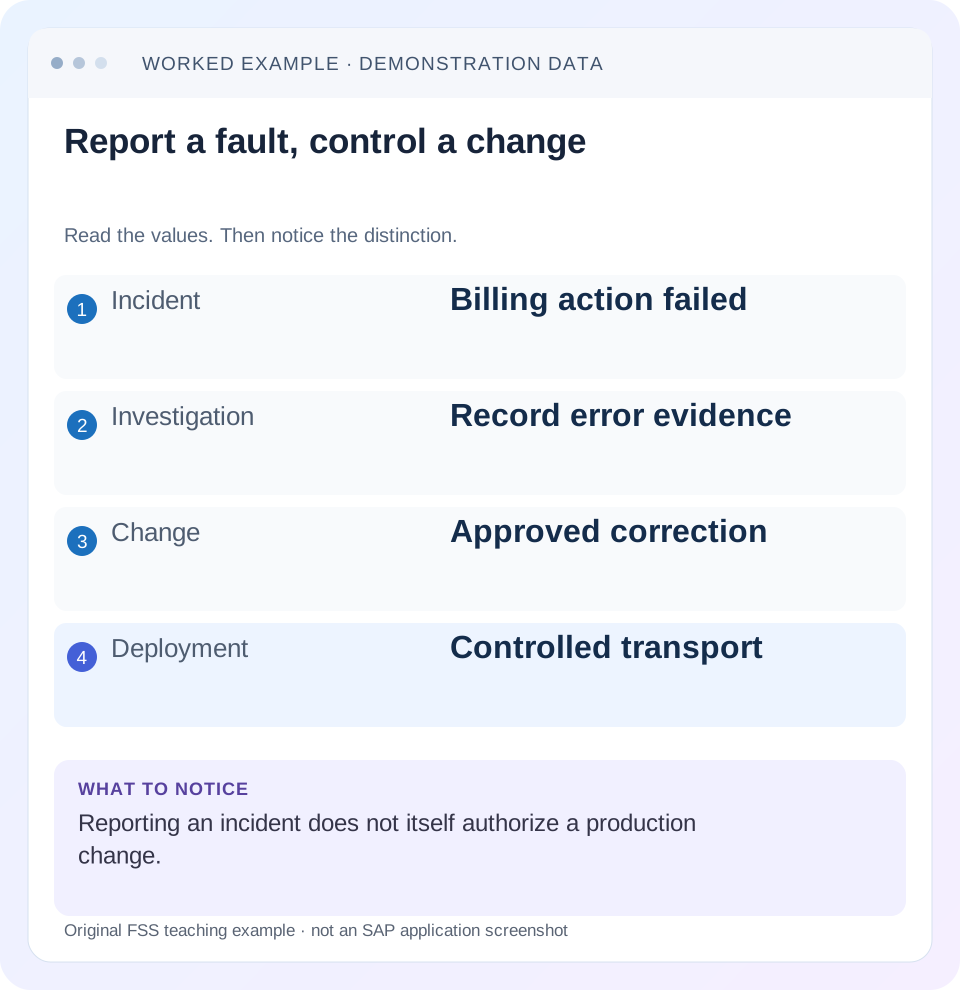
Read the example values
- Incident
- Billing action failed
- Investigation
- Record error evidence
- Change
- Approved correction
- Deployment
- Controlled transport
Words you’ll meet in this guide
- Instance
- A running SAP application-server environment.
- Client
- A logically separate data and configuration context in an ABAP system.
- Log
- A recorded sequence of events and messages.
- ABAP
- SAP’s programming language for business applications.
Preview the practical steps
SEE THE CONNECTION
See it in a simple example.
A small example to make the idea concrete.
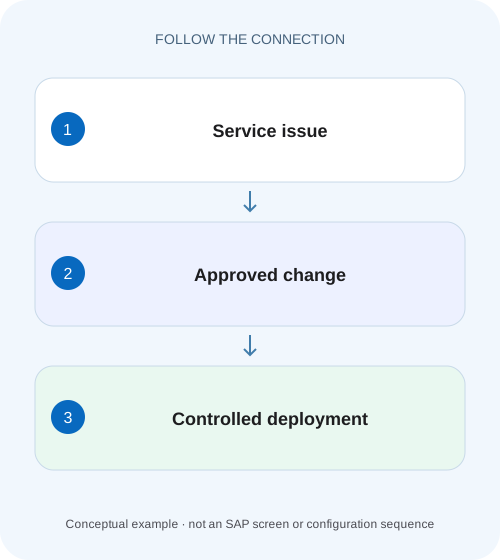
Separate a factory outage from its correction
A manufacturer's billing process stops after deployment, requiring both incident evidence and a controlled change to correct the cause.
An incident and a change answer different questions
An incident asks what service has failed, who is affected and how service can be restored.
Audience and process boundaries
This tutorial is for service-desk analysts, SD support consultants, Basis operators and change coordinators working together on an ABAP landscape.
Worked incident: billing stops after a deployment
In this fictional case, billing job BILL_RUN_A normally processes delivery-related invoices for company 1000.
Separate a factory outage from its correction
A manufacturer's billing process stops after deployment, requiring both incident evidence and a controlled change to correct the cause.
Link the affected process, incident and change records without treating a closed ticket as proof that production behavior was restored.
| Reader | Business question | Evidence to carry forward |
|---|---|---|
| SAP developers and application teams supporting manufacturers | Separate a factory outage from its correction | Link the affected process, incident and change records without treating a closed ticket as proof that production behavior was restored. |
01 An incident and a change answer different questions
An incident asks what service has failed, who is affected and how service can be restored. A change asks what modification should be made, what it might affect and how it will be tested and introduced. One billing outage can therefore have an incident, an operational workaround and a linked permanent change without those records being duplicates.
SAP Solution Manager Change Request Management connects change processing with implementation documents and transport control. Treat that integration as traceability: a transport can belong to a governed correction, but its number does not explain the business impact or establish acceptance. Likewise, an urgent incident is evidence of impact, rather than automatic approval to alter production. [1]
02 Audience and process boundaries
This tutorial is for service-desk analysts, SD support consultants, Basis operators and change coordinators working together on an ABAP landscape. You need access to the relevant ticket information, permitted display of the failed business documents and the organization's change model. You can rehearse the example on paper without changing a system.
The product examples refer to Solution Manager 7.2 request-for-change and change-document concepts. Other ALM products may implement different records. Even within Solution Manager, transaction types, status actions and approval rules can be customized. Use the configured process rather than treating a status label here as an instruction to press a particular button.
03 Worked incident: billing stops after a deployment
In this fictional case, billing job BILL_RUN_A normally processes delivery-related invoices for company 1000. At 09:05, support receives reports that eligible deliveries are not being billed. The run log identifies an account-determination error for a particular customer/material combination. Eight deliveries are affected; other combinations still bill. The earlier deployment time, 08:30, is relevant context but does not prove causation.
The incident describes an interrupted billing service for that population. It records the last successful comparable run, failed run identity, exact sanitized message and affected delivery references. Its impact is delayed invoicing, not yet lost revenue. Quantifying that distinction prevents a plausible technical hypothesis from becoming an exaggerated business statement.
| Time | Observation | Meaning |
|---|---|---|
| 08:30 | Configuration import completed | Possible correlate, not cause proof |
| 09:00 | BILL_RUN_A fails for one combination | Identify failed and successful records |
| 09:05 | Eight deliveries reported unbilled | Reconcile impact population |
| 10:10 | Partial workaround accepted | Residual eight-delivery scope stays visible |
04 Build an evidence timeline before choosing a correction
Construct a timeline from independent observations. A release at 08:30, first failed run at 09:00 and report at 09:05 are different events. Compare a successful and failing item to find the earliest meaningful difference in account-assignment inputs or configuration. If the allegedly affected deliveries were already blocked yesterday, the deployment hypothesis needs revision.
Keep the failed job, billing documents that did succeed and unbilled deliveries separate. A job marked canceled does not prove that all its prior work rolled back. Before rerunning it, reconcile existing invoices against the intended delivery population. The incident owner needs an accurate affected set, not merely the total selected by the job.
05 Restore service with a controlled workaround
Assume investigation finds that only one combination is affected and an approved business process allows unaffected deliveries to be billed separately. A temporary variant that excludes the affected combination might restore part of the service. Whether that is acceptable depends on completeness controls, billing deadlines and the ability to retain the excluded population for later processing.
Record exactly what the workaround restores and what remains outstanding. “Billing restored for seven customer groups; eight deliveries held for correction” is stronger than “system working.” Give the temporary measure an owner and a removal condition. A workaround that silently leaves records out of subsequent runs can create a second incident after the first one appears closed.
06 Turn the cause into a bounded change proposal
Suppose the evidence supports a missing approved revenue-account mapping, rather than a program defect. The proposed change should identify the relevant determination inputs, intended mapping and affected organizational scope. It should explain why that correction is appropriate for finance, rather than choosing any account that makes posting succeed.
The request for change records the need and decision context. The implementation document tracks the work governed by that request. SAP documents scope items and roles within ChaRM; the exact split depends on configuration. Distinguish the request's business decision from a developer's object edits and from the transport's technical contents. [2] [3]
07 Define tests that follow the failure mechanism
For the fictional mapping change, test the original failing customer/material combination and verify the resulting accounting entries. Then test a previously successful combination to detect an unintended mapping change. A negative case with an intentionally unsupported combination should still produce the expected controlled error, rather than posting to a catch-all account.
Use quantities and values that can be reconciled. For example, an illustrative invoice for 10 units at EUR 100 has a net value of EUR 1,000 before tax. Verify the expected revenue account and receivable/tax effects according to the training configuration. An invoice PDF alone is insufficient: the billing document and accounting-transfer result must agree with the acceptance criteria.
08 Keep transport evidence connected to the decision
A complete implementation record connects approved scope, changed objects or configuration, development validation, quality-system results, transport identities and import evidence. A screenshot of a successful import answers a technical question about that import. It does not prove the billing scenario passed or that the transported contents match every approved requirement.
Before release, review dependencies and sequence. A mapping that relies on a new account or another configuration object can fail if only one request reaches the target. Conversely, putting unrelated fixes into the same request makes a targeted recovery harder to explain. Document a supported recovery approach and its business reconciliation implications, including invoices already created.
09 Decide incident closure separately from change completion
Service restoration can be verified before the permanent correction reaches production. If local policy permits incident closure after a successful workaround, the closure must say that the change remains open and link the residual risk. If the affected deliveries are still blocked and the workaround excludes them, describe that unresolved impact explicitly.
Change completion requires its own implementation and acceptance evidence. After import, recheck the eight held deliveries, any invoices already produced and accounting-transfer status. Close the loop on the temporary exclusion so the next scheduled run includes the normal intended population. The incident's restoration clock and the change's delivery milestones measure different work.
10 Troubleshoot broken traceability
A record saying “resolved by transport” is incomplete if nobody can identify the original symptom or the actual verification. Reconstruct the document chain: incident, approved change, implementation record, transport, target import and business test. The missing link determines whether the next action is technical investigation, business acceptance or documentation repair.
Avoid creating a new unrelated ticket for every team handoff. Maintain a common incident reference while assigning specific investigation tasks. For repeated occurrences, a problem investigation can analyze the underlying cause across incidents; that does not eliminate the need to govern the eventual modification as a change.
| Observation | Missing evidence | Next action |
|---|---|---|
| Incident closed; excluded deliveries remain | Restoration scope | Reconcile held population and owner |
| Import successful; billing still fails | Business acceptance | Repeat original combination and inspect accounting |
| Change implemented; workaround still active | Removal verification | Review normal scheduled-run population |
| Ticket contains only a transport number | Change intent and scope | Link approved requirement and test results |
11 Practice the restoration and correction decisions
Use the fictional timeline to hold a short tabletop exercise. Give one participant only the canceled job status, another the successful invoice list and another the proposed mapping. Ask them to agree which deliveries remain unbilled. They should discover that a global rerun decision cannot be made from a single job-status screenshot.
Then vary one fact: the workaround restores all eight deliveries without changing configuration, or the proposed mapping fails the negative test. The first variation may support incident restoration while further investigation continues. The second blocks acceptance of that particular correction even if the original positive example succeeds. Keep both decisions grounded in their own evidence.
Name the affected set
List successful invoices and still-open delivery references separately.
Expected observation: No delivery is counted as both unbilled and invoiced.
Write two acceptance statements
State what restores the service and what completes the permanent correction.
Expected observation: Each statement names its evidence and owner.
12 A concrete review package for the billing correction
Assemble a small evidence package before the release decision: a protected list of the eight excluded delivery references, the successful invoice references from the original run, the failing determination inputs and the quality-system test results. The package should explain whether the proposed mapping affects only the failing combination or also changes an existing access path. Finance should recognize the intended account meaning; Basis should recognize the transport route and dependencies.
At the release checkpoint, ask the reviewer to reconcile one delivery through billing into accounting, then identify how the remaining seven will be processed without duplication. At the next normal run, check the selection variant and the exception population again. This catches a subtle failure mode: the correction is right, but the workaround still excludes precisely the documents that need it. Record the removal of that exclusion as part of implementation verification.
13 Questions support teams should resolve explicitly
Can an emergency bypass ordinary approvals? The organization's emergency process defines its controls. Urgency changes the route or timing only where that process allows it; this article cannot grant deployment authority. Record the emergency rationale, authorized decision and required retrospective evidence in the applicable records.
Does every incident require a change? No. A corrected user input, a verified transient interruption or use of an already approved operational procedure may restore service without a new system modification. Does every successful transport resolve an incident? No. Only a check of the failed service and its affected records establishes that outcome. Follow the linked job, billing and transport lessons when those are the actual evidence gaps.
Related services and next steps
Primary sources
Found this useful?
Share this guide with your network, or leave a like.
Your like is saved in this browser.