SAP transport return codes 4, 8 and 12: Read the detail before retrying
A manufacturer's release imports some configuration while a dependent object fails, leaving a mixed result.

Source review:
START HERE · NO PRIOR TOPIC KNOWLEDGE NEEDED
What it is. Why it matters.
A transport return code summarizes an import outcome. The detailed log explains the affected step and messages, so a code alone is not a full recovery instruction.
Completely new to SAP?
Manufacturers use SAP to connect work such as buying components, recording inventory, planning production, shipping equipment and accounting for costs. SAP S/4HANA is an enterprise resource planning system: it connects these activities through shared business data.
SAP Basis work keeps relevant SAP systems running. Logs, background jobs and connection tools help explain what happened to a task at a particular time.
A transaction code, or t-code, is a shortcut to a task in classic SAP GUI. Fiori apps provide another way to work. Names and screens depend on the product and release; you do not need a live system to learn the concepts in this guide.

Scope and source-review notes
Scope and evidence
Source review by FAST SAP SOLUTIONS® editorial. This badge describes our editorial review; it does not represent SAP certification or independent endorsement.
Classic ABAP CTS transport-log and R3trans concepts for release/Basis teams. Other deployment systems have their own semantics. SAP ABAP Platform references distinguish overall transport summaries from tool-specific detail; exact procedures depend on installed release.
Documentation review on 14 November 2026 used the available official SAP indexed excerpts; several SAP Help pages returned no readable full text. The worked case and proposed checks are original illustrative teaching material, not execution evidence from a customer SAP system. Exact fields, permitted actions and behavior must be confirmed against the installed product, release and configuration.
A MANUFACTURING EXAMPLE
Review an incomplete plant application import
A summary code needs detail
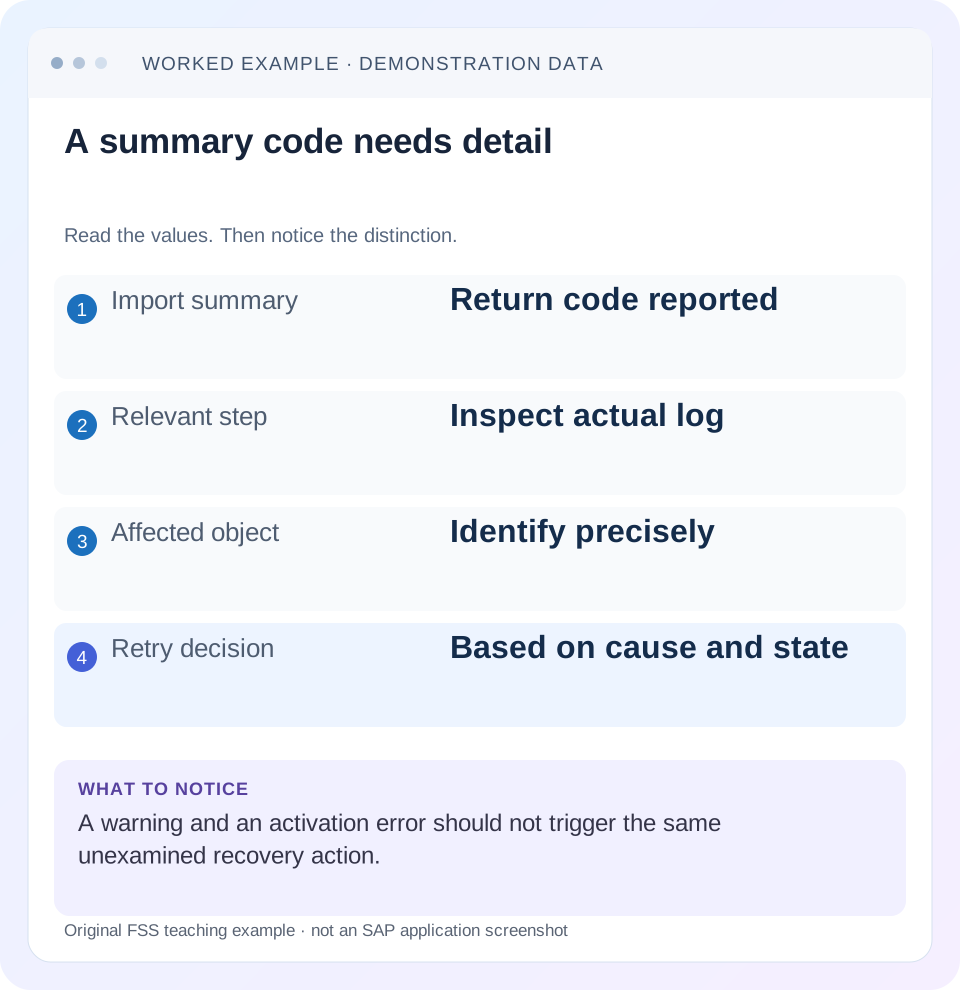
Read the example values
- Import summary
- Return code reported
- Relevant step
- Inspect actual log
- Affected object
- Identify precisely
- Retry decision
- Based on cause and state
Words you’ll meet in this guide
- Instance
- A running SAP application-server environment.
- Client
- A logically separate data and configuration context in an ABAP system.
- Log
- A recorded sequence of events and messages.
- ABAP
- SAP’s programming language for business applications.
- ADT
- ABAP Development Tools: SAP tools for ABAP development in Eclipse and, on supported systems, Visual Studio Code.
Preview the practical steps
SEE THE CONNECTION
See it in a simple example.
A small example to make the idea concrete.
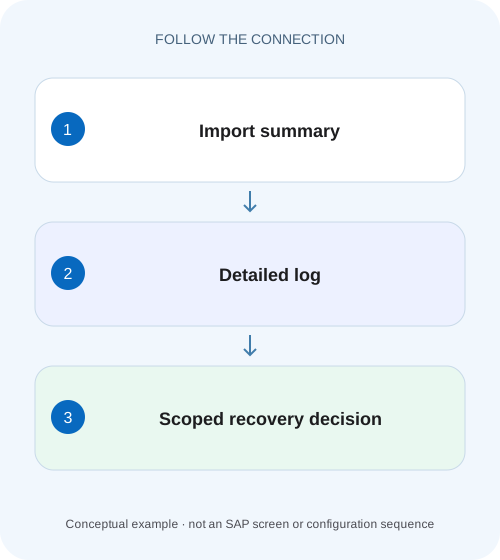
Review an incomplete plant application import
A manufacturer's release imports some configuration while a dependent object fails, leaving a mixed result.
The return code points you to the log
In the documented CTS transport log, return code 4 means warnings, 8 means object-level errors and 12 or greater means termination.
Prerequisites and scope
This tutorial is for Basis operators, release coordinators and developers with permitted transport-log access.
Worked case: configuration imports, dependent object fails
In our fictional release, request R-A contains a prerequisite Dictionary structure and R-B contains report ZDEMO_BILL_CHECK that uses it.
Review an incomplete plant application import
A manufacturer's release imports some configuration while a dependent object fails, leaving a mixed result.
Read the detailed transport logs and affected dependencies before retrying or declaring the plant application ready.
| Reader | Business question | Evidence to carry forward |
|---|---|---|
| SAP developers and application teams supporting manufacturers | Review an incomplete plant application import | Read the detailed transport logs and affected dependencies before retrying or declaring the plant application ready. |
01 The return code points you to the log
In the documented CTS transport log, return code 4 means warnings, 8 means object-level errors and 12 or greater means termination. The next action is to read the detailed message for the producing step and object, not to retry based only on the number. [1]
A transport can have several stages and tools. Record request, source, target, time, step and tool context. A summary may combine results from several activities. A successful export does not establish a successful import, and an import summary does not prove that the intended business scenario works in the target.
02 Prerequisites and scope
This tutorial is for Basis operators, release coordinators and developers with permitted transport-log access. Obtain the approved change, expected object list, dependency sequence and actual import attempt. Use the supported transport tools for your landscape and begin with read-only log review.
The examples concern classic ABAP CTS and R3trans. Do not transfer a code meaning into another deployment product without its documentation. Even within CTS, distinguish the general transport log from a particular tool's code description. This article supplies no unconditional-import flags, overwrite commands or production retry recipe.
03 Worked case: configuration imports, dependent object fails
In our fictional release, request R-A contains a prerequisite Dictionary structure and R-B contains report ZDEMO_BILL_CHECK that uses it. The approved sequence is R-A then R-B. In quality, R-B is imported first and reports RC8 with a relevant activation error; another part of its content has already arrived.
The missing dependency is a hypothesis supported only if the detailed messages and target state agree. The correct response is to inspect the failed object, prerequisite presence and actual import history. Repeating R-B unchanged before R-A exists is unlikely to resolve a genuine missing-dependency error. The labels are illustrative, not real transport identifiers.
04 Understand RC4 without treating warnings as invisible
The transport-log reference describes RC4 as successful object transport with peculiarities that may be unintended, including an object-deletion warning. R3trans's own return-code documentation uses its tool-specific warning description. Read the actual warning and decide whether it matches the approved change. [1] [2]
If a deletion was intended and tested, retain that review evidence. If it was unexpected, investigate content and business impact before declaring the release clean. “Warnings allowed” is not a useful blanket acceptance rule. The release owner needs to know which warning occurred, why it is acceptable and what target behavior was checked.
| Context | Meaning | Required review |
|---|---|---|
| Transport-log RC4 | Warnings; peculiarities may be unintended | Exact warning and approved scope |
| Transport-log RC8 | Individual-object errors | Failed objects and partial arrival |
| RC12 or greater | Transport termination | Producing tool, stage and serious error |
| R3trans RC16 | Internal/exceptional condition examples | Tool-specific detail and support path |
05 Understand RC8 as incomplete object success
RC8 indicates errors affecting individual objects in the transport-log documentation. Some objects can arrive while others fail. Therefore, neither “nothing imported” nor “mostly fine” is a reliable summary without object-level reconciliation. [1]
In the worked case, identify which report or dependency failed and what version is active in the target. A previous version may still execute, or a dependent object may be unusable. Review the detailed activation/import messages and compare the approved contents. Do not infer the runtime state solely from the fact that the request appears in import history.
06 Understand RC12 and greater as termination evidence
SAP's R3trans documentation gives fatal file read/write and database-interface errors as examples for RC12, while the general transport-log reference describes serious termination normally outside request content. Preserve the exact producing tool and last relevant messages to distinguish environment failure from an object correction. [1] [2]
Other codes exist, including tool/operating-system termination distinctions and RC16 in documented contexts. Do not reduce every nonzero result to 4, 8 or 12. If the tool stopped, establish which stages completed and whether another process is still active before planning recovery. The failed attempt's logs are essential evidence.
07 Open the detailed step, then the relevant message
Use the supported transport log display for the exact target and attempt. SAP's ADT documentation describes a hierarchy of transport steps and opening detail in the ABAP Log view; classic administration tools expose corresponding log detail through their own interface. Follow the installed tool's navigation. [3]
Record the first actionable object/tool error, surrounding context and any later summary. A final RC8 line cannot explain whether the cause is a protected object, syntax problem or missing prerequisite. Preserve the actual text and object identity so the developer or Basis owner can reproduce the relevant state without guessing from a screenshot's color.
08 Compare sequence and target state
For R-B, inspect whether R-A was released and imported into the correct target before the failure. Compare the target's actual prerequisite object and active version with the approved release. A request queued ahead of another is not proof that it completed successfully.
Also review later imports that touch the same objects. A successful correction can be overwritten by a subsequent older request, making the final state differ from the earlier successful log. The investigation needs chronological content and final target evidence. Do not reimport a whole release set merely because one dependency is uncertain.
09 Choose correction in the responsible layer
If the object content is wrong, correct and test it in the approved source process. If a dependency is missing, restore the reviewed sequence. If the transport environment failed, address that specific infrastructure condition through the Basis procedure. These are different causes with different owners and recovery evidence.
Do not choose overwrite or exceptional import options merely to suppress protection messages. A repaired or original object may be protected for a reason. Review ownership, versions and the intended correction route before an exception. A repeated import with unchanged conditions can reproduce the failure and complicate the history without improving target correctness.
10 Reconcile partial arrival before retry
Create an object-level ledger: intended contents, successfully processed objects, failed objects and unknown state. For the fictional case, record any R-B content already active and the failed report/dependency relationship. The ledger prevents a retry plan based on the false assumption that the failed attempt had no effect.
The recovery decision should name the exact condition corrected, intended request sequence and target checks. Retain original and recovery attempt references. If the system's supported process requires additional postprocessing, identify that explicitly. A lower summary code after retry is evidence of the new attempt, not an explanation of what changed in business behavior.
| Content | Observed state | Next check |
|---|---|---|
| R-A prerequisite | Not successfully imported | Approved sequence and target object |
| R-B report | Activation error | Exact message and active version |
| Other R-B objects | Some processed | Inventory final target state |
| Business scenario | Not accepted | Run after technical recovery |
11 Verify technical and functional outcomes separately
After approved recovery, inspect the detailed logs, object activation/version and required configuration in the target context. Then execute the agreed training business scenario. For ZDEMO_BILL_CHECK, confirm the correct rule and expected reconciliation output for the defined company, rather than merely opening the program.
Include a representative unaffected case and a negative case that should remain controlled. If a warning persists, document its acceptance or unresolved action. If the technical import succeeds but business output is wrong, move to application inputs/configuration and runtime evidence instead of repeating the transport automatically. Technical arrival and functional correctness are separate acceptance conditions.
12 Exercises in log-driven decisions
A positive paper fixture imports R-A then R-B and contains expected successful object messages. The learner should still request the agreed functional check. A negative fixture gives RC4 for an unexpected deletion; the learner must review the deletion rather than call it automatically harmless.
A boundary fixture gives RC12 after some completed stages. The learner should preserve logs and identify completed versus unknown state before retrying. Another fixture shows RC8 for a protected repaired object; the correct next step is version/ownership review, not an unqualified overwrite. These exercises test reasoning without running transport-tool commands.
For the worked dependency failure, build a chronological worksheet containing R-B’s initial attempt, R-A’s prerequisite import and R-B’s supported recovery attempt. Preserve the failed object text from the first attempt and the successful object/version evidence from the last. The final explanation should show which condition changed between attempts, rather than suggesting that retries randomly cured an RC8.
Add a later hypothetical request R-C that overwrites the report. Ask the reviewer to identify the final active version and repeat the functional check. If R-B’s successful history remains visible but R-C changes behavior, the first success is no longer sufficient evidence of current correctness. This is a practical reason to record final state, import chronology and acceptance time together.
For a warning review, ask whether the target contains an intended object deletion rather than merely whether the warning was acknowledged. If an obsolete report should disappear, verify that approved outcome and the absence of dependent use in the agreed test scope. If deletion was unintended, the sameRC 4 cannot be accepted solely because every object technically transported. Record the specific object and business consequence. That makes warning acceptance a content decision supported by the change scope, while avoiding an invented rule that every warning is either always harmless or always a failed release.
13 Questions and a useful release conclusion
Does RC4 always mean no action? Read and assess the warning. Does RC8 mean every object failed? No; reconcile individual results. Does RC12 prove the developer's code is wrong? The documented examples include serious tool/environment failures, so identify the actual message and producing stage.
A useful conclusion says: “R-B quality import at 18:10 ended RC8; report activation failed because the referenced prerequisite is absent. R-A not yet successfully imported. Other processed objects listed separately. Recovery sequence and functional verification pending.” That statement connects code, detail, target state and next decision without disguising partial deployment as either total failure or complete success.
Related services and next steps
Primary sources
Found this useful?
Share this guide with your network, or leave a like.
Your like is saved in this browser.