SAP SM59 connection test succeeds: What does that actually prove?
A manufacturer's RFC destination passes a connection test while the actual order-status operation still fails.

Source review:
START HERE · NO PRIOR TOPIC KNOWLEDGE NEEDED
What it is. Why it matters.
RFC lets SAP systems call functions remotely. SM59 manages connection destinations; a successful connection test confirms only the tested part of the route.
Completely new to SAP?
Manufacturers use SAP to connect work such as buying components, recording inventory, planning production, shipping equipment and accounting for costs. SAP S/4HANA is an enterprise resource planning system: it connects these activities through shared business data.
SAP Basis work keeps relevant SAP systems running. Logs, background jobs and connection tools help explain what happened to a task at a particular time.
A transaction code, or t-code, is a shortcut to a task in classic SAP GUI. Fiori apps provide another way to work. Names and screens depend on the product and release; you do not need a live system to learn the concepts in this guide.

Scope and source-review notes
Scope and evidence
Source review by FAST SAP SOLUTIONS® editorial. This badge describes our editorial review; it does not represent SAP certification or independent endorsement.
Classic AS ABAP SM59 destination concepts for Basis, integration developers and security analysts. Destination type, trusted logon, SNC and installed release change available tests; HTTP destinations require their own protocol interpretation.
Documentation review on 14 November 2026 used the available official SAP indexed excerpts; several SAP Help pages returned no readable full text. The worked case and proposed checks are original illustrative teaching material, not execution evidence from a customer SAP system. Exact fields, permitted actions and behavior must be confirmed against the installed product, release and configuration.
A MANUFACTURING EXAMPLE
Separate a connection test from a component read
What did the test establish?
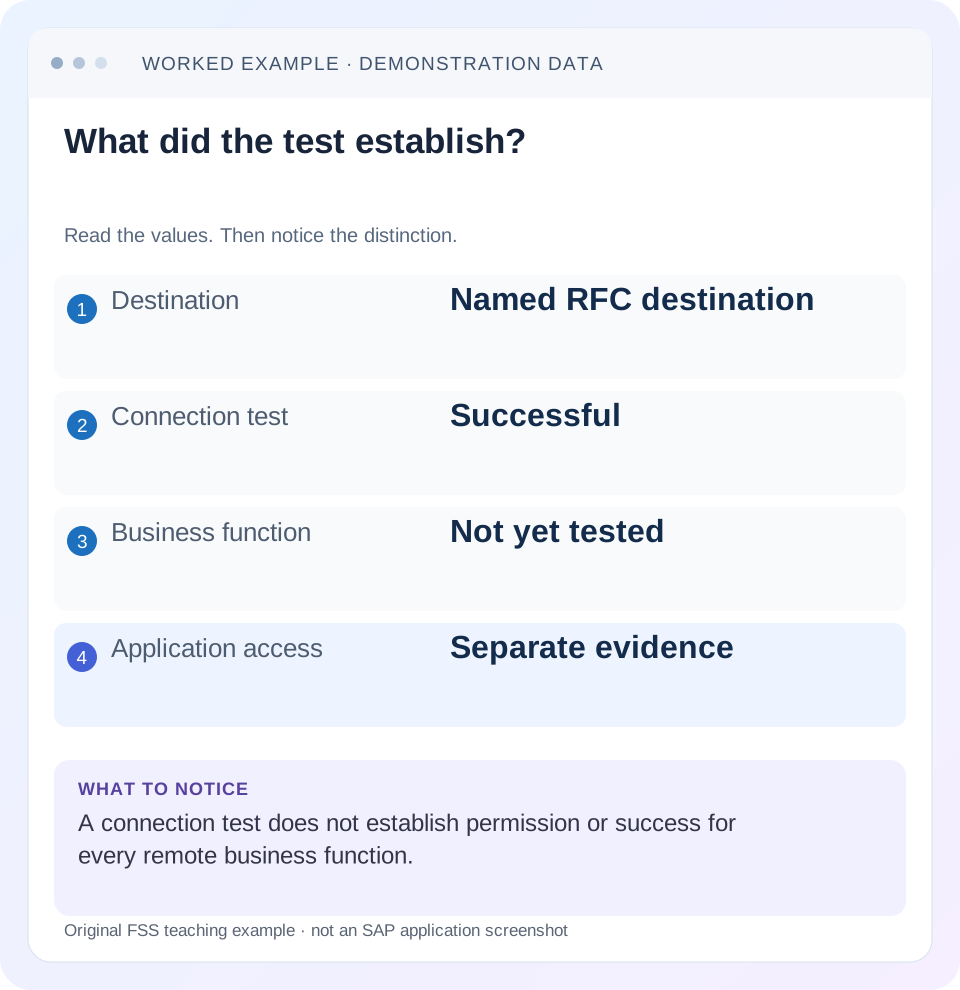
Read the example values
- Destination
- Named RFC destination
- Connection test
- Successful
- Business function
- Not yet tested
- Application access
- Separate evidence
Words you’ll meet in this guide
- Instance
- A running SAP application-server environment.
- Client
- A logically separate data and configuration context in an ABAP system.
- Log
- A recorded sequence of events and messages.
- ABAP
- SAP’s programming language for business applications.
- RFC
- Remote Function Call: a way for one system to call functions in another.
- HTTP
- The request-and-response protocol used by web applications and APIs.
Preview the practical steps
SEE THE CONNECTION
See it in a simple example.
A small example to make the idea concrete.
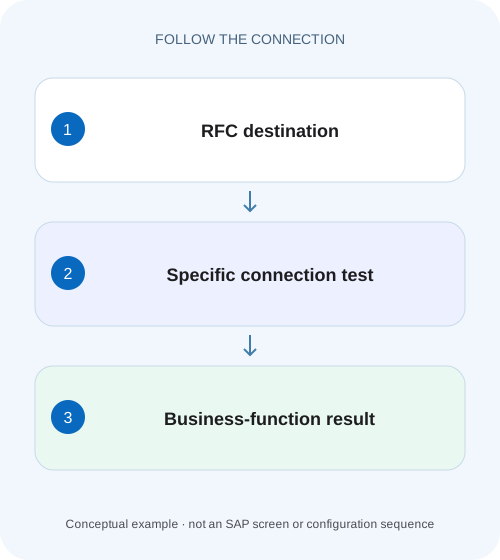
Separate a connection test from a component read
A manufacturer's RFC destination passes a connection test while the actual order-status operation still fails.
A green test establishes the tested operation
A successful SM59 Connection Test is useful evidence for a named destination at a particular time.
Know the destination type and supported security design
This guide is for permitted Basis and integration analysts inspecting classic ABAP destinations.
Worked case: destination passes, order-status read fails
In our fictional QAS source, destination Z_ORDER_READ points to a target ABAP system and client 200.
Separate a connection test from a component read
A manufacturer's RFC destination passes a connection test while the actual order-status operation still fails.
Compare the technical destination test with the function, authorization and business inputs used by the application.
| Reader | Business question | Evidence to carry forward |
|---|---|---|
| SAP developers and application teams supporting manufacturers | Separate a connection test from a component read | Compare the technical destination test with the function, authorization and business inputs used by the application. |
01 A green test establishes the tested operation
A successful SM59 Connection Test is useful evidence for a named destination at a particular time. It is not an end-to-end certificate for every function called through that destination. Record which test was used before deciding what passed.
SAP documents Connection Test, Authorization Test and Unicode-Test separately; the Authorization Test checks logon data. Remote Login is another function. Those labels do not imply that a business function, its input data or its downstream posting has been validated. Conversely, some connection tests can encounter authorization checks, so avoid claiming that all connection tests are purely network tests. [1] [2]
02 Know the destination type and supported security design
This guide is for permitted Basis and integration analysts inspecting classic ABAP destinations. You need the source system, destination name and type, intended target, application error and a supported harmless test. Read the installed product documentation before changing a destination, and keep credentials out of tickets and screenshots.
A type-3 ABAP connection, an HTTP connection and a registered external program have different semantics. The tutorial's worked case is an ABAP-to-ABAP interface. Do not translate its remote-function reasoning into an HTTP endpoint without checking the HTTP method, path and response contract. Maintain destinations through supported tools; SAP explicitly excludes direct maintenance of RFCDES. [1]
03 Worked case: destination passes, order-status read fails
In our fictional QAS source, destination Z_ORDER_READ points to a target ABAP system and client 200. A scheduled interface uses technical identity IF_STATUS to read order 47000123 in sales organization 1000. At 14:00 the Connection Test succeeds. At 14:02 the interface reports a business authorization error for that order.
The two results can coexist. The destination test exercised its own operation; the application exercised a particular function and business object. The analyst must establish whether both used the same effective identity and route. If an administrator manually logged in during the test, that session may say little about IF_STATUS.
| Check | Result | Scope |
|---|---|---|
| Connection Test 14:00 | Successful | Named destination test |
| Interface 14:02 | Business denial | Order 47000123, organization 1000 |
| Manual login as analyst | Successful | Different identity unless proven otherwise |
| Known-object read as IF_STATUS | Proposed acceptance test | Application contract |
04 Capture the exact failing application context
Record the interface run or request identifier, source execution time, destination selected at runtime, target context and sanitized error. Verify that the program actually used Z_ORDER_READ rather than a fallback, dynamically selected destination or another system's similarly named entry.
Distinguish a remote communication failure from a remote exception or structured business message. These outcomes suggest different next questions. A business denial shows more application progress than a failed connection, but it still requires evidence of the actual function and identity. A generic “RFC failed” wrapper is often too coarse for diagnosis; inspect the original permitted error context.
05 Compare configuration without exposing secrets
Display the nonsecret technical and logon settings relevant to the connection type: target or load-balancing context, client where applicable, configured user strategy and security mechanism. Compare them with the interface design and the target environment. A destination label containing PRD or QAS is not proof of its real target.
For trusted or current-user scenarios, the effective caller can depend on runtime context. A dialog test by an administrator and a background call by IF_STATUS can therefore differ even when they reference the same destination. Preserve that distinction in the incident rather than copying one person's successful manual result into the application's acceptance evidence. [3]
06 Run the documented tests as separate observations
Use only the tests authorized for the incident and destination type. Record result, time and test identity for each one. A logon-oriented test can identify a problem earlier than business execution, while Unicode compatibility addresses a different property. A successful manual Remote Login demonstrates that particular manual context.
If a Connection Test unexpectedly requests logon, investigate the target-side security context using the installed documentation. SAP's support explanation notes that RFC authorization-check behavior can affect this outcome. Do not weaken an authority-check parameter to make the screen green; resolve the intended security requirement and the exact rejected operation. [2]
07 Define an application-level read test
Have the interface owner select a supported read-only operation with a known training object. For the illustration, order 47000123 should return a known status for organization 1000 under IF_STATUS. Specify expected fields and identity before execution. Calling an arbitrary function from a catalog is not the same as validating the interface contract.
A useful positive result contains the expected object reference and status, not merely a technically successful call with an empty table. An empty result can be valid for an unknown object or can reflect authorization/filtering. Compare with the contract and a known fixture. Do not infer business completeness from the absence of a communication exception.
08 Diagnose authorization at both remote-call and business levels
Remote-call permission and application-level business permission are distinct questions. The target can accept a user and then reject the called function, or permit the function and reject the requested organization. The exact authorization checks depend on the function and security configuration.
For the example, confirm that IF_STATUS is the effective target identity and obtain the permitted authorization diagnostic for the failing read. If the denial concerns organization 1000, review the intended business role rather than granting unrestricted RFC access. If the function itself is denied, inspect its documented access requirements. The error's layer determines which evidence and owner are relevant.
09 Treat asynchronous or write outcomes as separate state problems
A successful synchronous read does not validate a queued or transactional write interface. Asynchronous processing has its own message/unit identity and monitoring. Its caller may have handed work off without the business object being completed. Use the actual interface technology's supported monitoring rather than repeatedly retesting SM59.
For any uncertain write, reconcile target persistence before resubmitting. A timeout can occur after the target has committed. Identify the external reference, business key and available transaction/message state, then follow the application's duplicate-prevention or recovery procedure. Repeating the write because the connection test is green can create duplicates instead of solving the original uncertainty.
10 Troubleshoot by the earliest failed boundary
If no connection can be established, compare route, destination type and target availability. If logon fails, inspect the intended authentication context. If only one business object fails, compare its inputs and permission scope with a successful object. If only background execution fails, compare runtime identities and selected destinations.
Intermittent behavior needs a timeline and, where relevant, target-instance correlation. A single successful test at 15:00 cannot explain a failure at 14:02. Preserve the application's timestamp and test interval. A load-balanced destination may reach different application instances; investigate that possibility only when the landscape and evidence support it.
| Observation | Evidence to obtain |
|---|---|
| Connection fails | Technical route and target availability |
| Logon rejected | Authentication method and effective identity |
| Function denied | Documented remote-call access requirements |
| One organization denied | Business authorization context |
| Timeout after write | Target persistence and transaction reference |
11 Verification checks for the fictional interface
The positive check reads the known authorized order with IF_STATUS through the actual interface path. The negative check uses an approved fixture outside its permission and expects a controlled denial. The boundary check uses a nonexistent order and verifies the documented not-found behavior rather than a stale result from the previous call.
Also compare dialog and scheduled execution using the intended identities. If both should share the same authorization scope, the returned reference and status should agree. If they intentionally differ, document that design. For recovery, prove that the same external reference cannot create an unintended duplicate through the supported mechanism before adopting automatic retry.
12 Compare the scheduled call with the manual test
For Z_ORDER_READ, compare the scheduled 14:02 call with the 14:00 manual test in three dimensions: selected route, effective target identity and returned order data. A mismatch in any dimension explains why the two results cannot yet be treated as equivalent.
For the authorization comparison, keep a two-row identity record: manual tester and scheduled interface. Add source client, target client and authentication strategy for each, without secrets. If the manual test establishes user ANALYST_A while the application establishes IF_STATUS, the result difference may follow legitimate role differences. If both establish IF_STATUS but call different operations, the operation boundary remains. Only when identity, route, operation and relevant input are aligned does a direct comparison support an application-level conclusion. This avoids turning an administrator’s successful login into a misleading acceptance test for the scheduled business interface.
Confirm destination selection
Inspect the interface run configuration or permitted runtime evidence for the actual selected destination. Record source client, destination type and target context without credentials. If runtime selects a different entry, investigate that selection before editing Z_ORDER_READ.
Expected observation: The test and application reference the same intended route.
Confirm the effective target user
Use the supported target-side evidence for the specific request to identify the effective user. Compare it with IF_STATUS and the manual tester. A successful administrator session is retained as separate evidence.
Expected observation: Any identity difference is explicit.
Confirm the returned business identity
For the permitted known-order read, compare the response reference with 47000123 and the organization scope with 1000. Check the documented not-found case independently so an empty result is not silently called success.
Expected observation: The application result matches the intended object and contract.
13 Questions and a precise incident conclusion
Does Authorization Test prove every business authorization? No; SAP describes it as a logon-data check. Can Connection Test involve authorization? Depending on context, yes, so retain the exact result and installed security behavior. Can a green result prove a remote document was posted? No; inspect the application's actual persistence and processing state.
A precise conclusion says: “Z_ORDER_READ Connection Test passed at 14:00; IF_STATUS application read of order 47000123 failed at 14:02 for organization 1000. Target identity confirmed; business authorization investigation remains.” That statement gives each result its proper boundary and directs the next action to evidence rather than broad connectivity changes.
Related services and next steps
Primary sources
Found this useful?
Share this guide with your network, or leave a like.
Your like is saved in this browser.