SAP SICF service activation versus access permission: Check both layers
A manufacturer's operational app fails against an ABAP HTTP service, and support needs to distinguish activation from permission.

Source review:
START HERE · NO PRIOR TOPIC KNOWLEDGE NEEDED
What it is. Why it matters.
An HTTP service is an entry point for a web request. SICF manages relevant SAP services, helping administrators establish whether the requested endpoint is available.
Completely new to SAP?
Manufacturers use SAP to connect work such as buying components, recording inventory, planning production, shipping equipment and accounting for costs. SAP S/4HANA is an enterprise resource planning system: it connects these activities through shared business data.
SAP Basis work keeps relevant SAP systems running. Logs, background jobs and connection tools help explain what happened to a task at a particular time.
A transaction code, or t-code, is a shortcut to a task in classic SAP GUI. Fiori apps provide another way to work. Names and screens depend on the product and release; you do not need a live system to learn the concepts in this guide.

Scope and source-review notes
Scope and evidence
Source review by FAST SAP SOLUTIONS® editorial. This badge describes our editorial review; it does not represent SAP certification or independent endorsement.
For Basis, ABAP and security teams on classic AS ABAP ICF. SAP NetWeaver 7.52 and historical ICF references support concepts; exact service documentation and installed release govern configuration. Not a public-cloud service activation recipe.
Documentation review on 14 November 2026 used the available official SAP indexed excerpts; several SAP Help pages returned no readable full text. The worked case and proposed checks are original illustrative teaching material, not execution evidence from a customer SAP system. Exact fields, permitted actions and behavior must be confirmed against the installed product, release and configuration.
A MANUFACTURING EXAMPLE
Explain a plant app's service response
Where did the HTTP call stop?
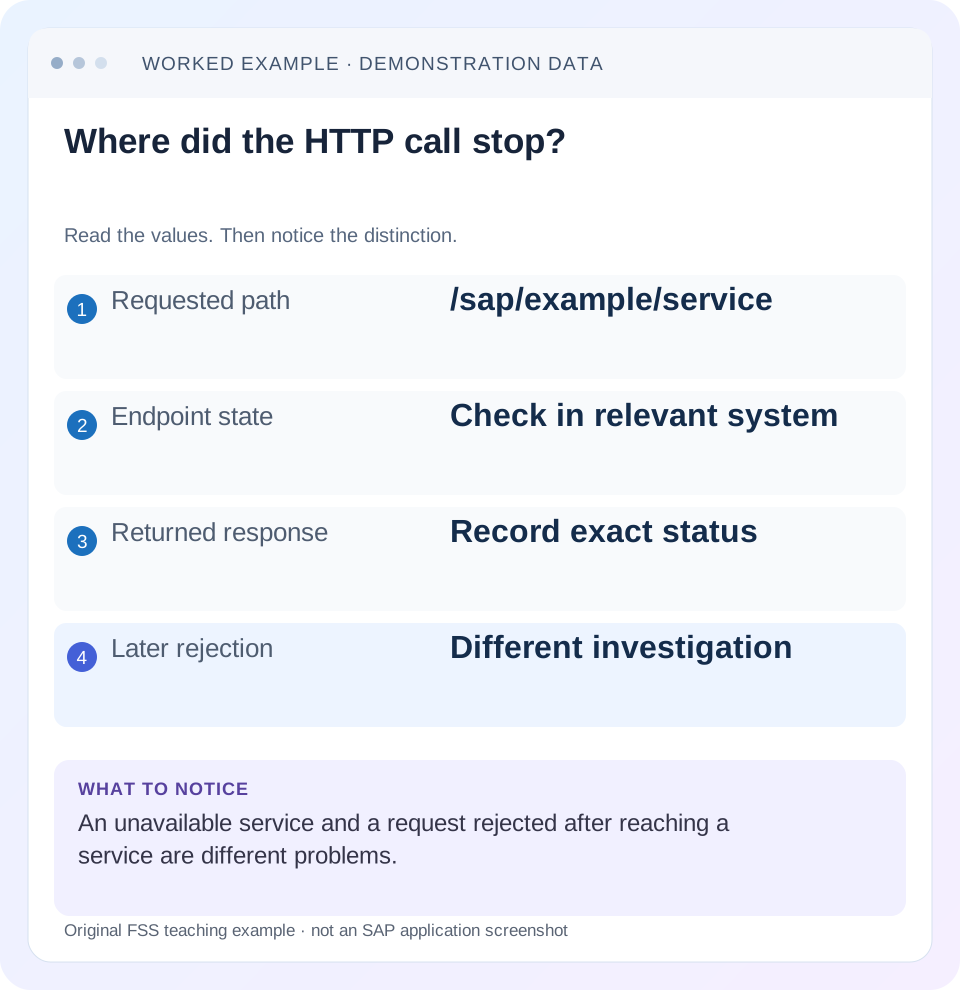
Read the example values
- Requested path
- /sap/example/service
- Endpoint state
- Check in relevant system
- Returned response
- Record exact status
- Later rejection
- Different investigation
Words you’ll meet in this guide
- Instance
- A running SAP application-server environment.
- Client
- A logically separate data and configuration context in an ABAP system.
- Log
- A recorded sequence of events and messages.
- ABAP
- SAP’s programming language for business applications.
- GUI
- Graphical user interface. SAP GUI is a desktop interface used for many classic SAP tasks.
- HTTP
- The request-and-response protocol used by web applications and APIs.
Preview the practical steps
SEE THE CONNECTION
See it in a simple example.
A small example to make the idea concrete.
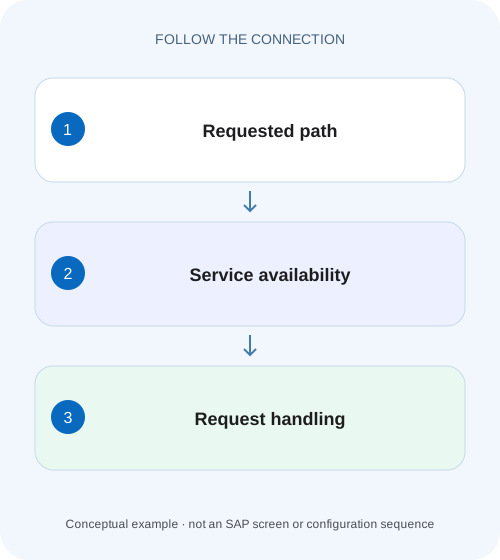
Explain a plant app's service response
A manufacturer's operational app fails against an ABAP HTTP service, and support needs to distinguish activation from permission.
Activation makes a service available; permission is another decision
An active ICF service can accept a request for processing while still requiring the caller to authenticate and pass application authorization checks.
Scope and safe prerequisites for this investigation
This guide is for Basis administrators and developers investigating classic ABAP HTTP services with an application/security owner.
Draw the route before opening SICF
Write the route as consumer, external host, proxy or Web Dispatcher where present, ABAP instance and service path.
Explain a plant app's service response
A manufacturer's operational app fails against an ABAP HTTP service, and support needs to distinguish activation from permission.
Check the exact service and response state before treating activation as proof that the application user can execute the business request.
| Reader | Business question | Evidence to carry forward |
|---|---|---|
| SAP developers and application teams supporting manufacturers | Explain a plant app's service response | Check the exact service and response state before treating activation as proof that the application user can execute the business request. |
01 Activation makes a service available; permission is another decision
An active ICF service can accept a request for processing while still requiring the caller to authenticate and pass application authorization checks. Conversely, assigning a business role cannot make an inactive endpoint available. Diagnose the exact failed request before choosing either activation or a role change.
SAP's ICF documentation separates service creation, logon settings and handler assignment. That distinction is the useful model: the request must reach the correct endpoint, resolve to the intended service, establish an identity and execute permitted application behavior. A failure at one stage does not establish a defect in the next stage. [1]
02 Scope and safe prerequisites for this investigation
This guide is for Basis administrators and developers investigating classic ABAP HTTP services with an application/security owner. You need the complete intended URL, the service's product documentation, a permitted identity and a harmless request that does not create business data. Start in display and use an approved training system for configuration experiments.
SICF is relevant to ICF services on AS ABAP. A cloud integration endpoint, reverse-proxy route or non-ABAP service may have different administration. The SAP REST tutorial's demonstration handler is an example of service wiring, not a handler to copy into an unrelated productive service. Release-specific logon and authorization settings remain essential.
03 Draw the route before opening SICF
Write the route as consumer, external host, proxy or Web Dispatcher where present, ABAP instance and service path. Include the intended client if the application uses one, the HTTP method and the observation time. Hide credentials, cookies and tokens. A request to the right path on the wrong environment is still the wrong request.
A browser error alone can hide an earlier redirect or a proxy-generated response. Capture the actual HTTP result using the consumer's supported diagnostics. A TLS failure occurs before an HTTP application response; a sign-in page returned after a redirect is not necessarily the expected application payload. Establish which component produced the evidence before interpreting it.
04 Worked case: the service changes from unavailable to forbidden
Our fictional training service is /sap/bc/zshipment_status, intended for a GET of shipment reference DEMO-2401. The supported design uses an authenticated technical caller with read permission for sales organization 1000. The path is illustrative and is not an SAP-delivered service or an endpoint to activate in your system.
At 10:00 the integration receives an unavailable-service response. At 10:15, after an approved activation in the training environment, it receives an application authorization error. These are two observations at different layers. The second result can mean progress through routing and authentication, but its exact message and handler evidence must support that conclusion. It does not mean activation failed.
| Observation | Established | Still to prove |
|---|---|---|
| 10:00 unavailable response | Consumer received a response | Correct route and active service |
| 10:15 business denial as IF_READ | Handler/identity evidence points to application | Permission for organization 1000 |
| 10:30 expected shipment returned | Positive read contract met | Negative and boundary behavior |
05 Locate the documented service and inspect its hierarchy
In SICF, identify the intended virtual host and documented service node. Match the full path rather than a similar leaf name. Review the node's state and the relevant ancestor context. SAP's Web Dynpro guidance notes that a URL can require several service nodes; the dependency set is determined by the application, not by guessing which neighboring services look useful. [2]
Inspect inherited configuration as well as values shown directly on the leaf. A child node can be affected by settings above it. Record which node and setting actually supply the effective behavior. Activating a large subtree may expose unrelated functions and still miss an application-specific dependency, so use the documented service set and change scope.
06 Verify handler dispatch independently of identity
A service node associates the path with application processing. Check its handler configuration against the owning application's documentation or approved development design. A node being active is insufficient if the wrong handler, wrong service version or unintended routing alias receives the request.
For the fictional service, the expected result for a known reference is a small read-only status response. A generic HTML page from another handler or a method-not-supported response needs investigation before roles are changed. Also check whether the application uses further resource routing beneath one ICF node; SAP's REST example does not require an ICF node for every resource template. [1]
07 Authenticate the real consumer, not an administrator's browser
Review the documented logon procedure and the identity actually established by the failing call. A successful test in an administrator's existing browser session can use a different client, single-sign-on context or user from the integration. Its success proves only that test context.
If authentication fails, resolve that specific mechanism: certificate mapping, configured logon data, SSO or another supported method. Do not replace the design with anonymous access to make the error disappear. Record the nonsecret identity and method, then distinguish failure to establish a user from failure of an established user to access a business function.
08 Check business authorization with an object-specific question
Once the request reaches the intended application under the intended user, inspect the exact denied operation through the approved security diagnostic process. The useful question is whether this caller may read shipment DEMO-2401 in sales organization 1000. “Give the interface access to SICF” confuses service administration with application use.
SAP documents separate administration and application authorization concepts for ICF. The applicable application can perform additional checks inside its handler or called business logic. Granting broad administration rights is therefore neither a reliable application fix nor an appropriate substitute for the documented role design. Correct the narrow authorization gap supported by the actual failure. [3]
09 Interpret HTTP results as clues, not universal verdicts
HTTP status codes are useful but can be generated by several layers. A 404 can reflect an incorrect path, routing behavior or application-level absence. A 403 can reflect a proxy rule, service-level check or business denial. A 500 identifies server-side failure without telling you which ABAP component caused it.
Correlate time, response content and request identity with the responsible layer. If the request reaches the handler and a dump occurs, investigate the runtime error. If the application writes a log, use its object and external reference. A successful TCP connection or TLS handshake does not prove that any of those application stages succeeded.
| Evidence | Next check |
|---|---|
| TLS negotiation fails | Peer, trust and selected TLS context |
| Wrong HTML page | Redirect chain, path and handler |
| Authenticated user denied | Application authorization and business scope |
| Application exception | Runtime/error log and input reference |
| Local test works, consumer fails | Route, client and identity differences |
10 Verify a minimal, meaningful test matrix
For the fictional service, the positive check reads a known shipment in organization 1000 with the intended integration identity. Confirm response type, reference and status fields, rather than just HTTP success. The negative check uses an approved test identity without that business permission and expects a controlled denial without data disclosure.
Boundary checks include an unknown shipment, an unsupported method and an expired or absent credential in the training design. Their expected responses come from the actual service contract. They should not silently fall back to another identity, return another customer's data or create documents. After an approved change, retest through the real consumer route to include proxy and logon behavior.
11 Common mistakes and useful handover evidence
Do not infer that a successful service-node test covers the reverse-proxy path. Do not infer that a logged-in GUI user and an HTTP technical user have identical authorization. Do not import a demonstration handler to repair a productive application. Each shortcut replaces the actual failed context with a different, easier one.
A useful handover states the URL path, environment, method, time, effective user, service node and exact sanitized response. Add the expected application contract and which stages are established. For example: “Training GET reaches the documented handler as IF_READ; organization 1000 authorization is denied.” That finding points directly to the next investigation without asserting that every layer is healthy.
12 Walk through the exact request boundary in display mode
For DEMO-2401, first record the consumer request method, effective URL after redirects and response content type. Next compare the URL path with the virtual-host/service hierarchy in SICF. Inspect the documented node state and effective logon configuration, then the handler list. Finally compare the established HTTP user and business scope with the intended read contract. This sequence moves from the outside route into application behavior, so each observation has a clear purpose.
If the response changes after a reviewed activation, retain both results with their timestamps. A later denial should not overwrite the evidence of the earlier unavailable service. If the same call succeeds through a direct internal route but fails through the external host, compare proxy routing and identity handling before altering the ICF service again. Expected observations are a consistent handler, intended identity and contract-compliant response through the actual consumer path.
13 Questions that often follow an activation check
Must every resource have its own SICF node? Not necessarily. The SAP REST example uses an ICF service path with application-level resource templates. Follow the actual framework's design. Can a service be active yet unusable? Yes: routing, logon, authorization, handler implementation and business validation can each prevent the intended result.
Does activating the parent fix every child? The relevant nodes and inheritance must be inspected under the documented application setup; a broad activation is not an evidence-based dependency analysis. If the endpoint is reachable but HTTPS still fails for the real consumer, continue with ICM and PSE diagnosis. If a business reference fails after successful dispatch, continue with application logs and the service owner's documented error model.
Related services and next steps
Primary sources
Found this useful?
Share this guide with your network, or leave a like.
Your like is saved in this browser.