SAP internal order versus cost center: Follow the purpose and settlement trail
A manufacturer wants to distinguish ongoing department costs from a specific factory improvement activity collected on an internal order.

Source review:
START HERE · NO PRIOR TOPIC KNOWLEDGE NEEDED
What it is. Why it matters.
A cost center represents an area of cost responsibility. An internal order can collect or monitor costs for a defined measure or activity under the controlling design.
Completely new to SAP?
Manufacturers use SAP to connect work such as buying components, recording inventory, planning production, shipping equipment and accounting for costs. SAP S/4HANA is an enterprise resource planning system: it connects these activities through shared business data.
Financial Accounting records business events as accounting documents. An account groups relevant amounts; individual entries explain how the total arose.
A transaction code, or t-code, is a shortcut to a task in classic SAP GUI. Fiori apps provide another way to work. Names and screens depend on the product and release; you do not need a live system to learn the concepts in this guide.

Scope and source-review notes
Scope and evidence
Source review by FAST SAP SOLUTIONS® editorial. This badge describes our editorial review; it does not represent SAP certification or independent endorsement.
Classic SAP Controlling cost-center and internal-order concepts. Real/statistical orders, order categories and settlement options depend on the controlling design and release.
Reviewed relevant official SAP indexed documentation excerpts on 14 November 2026. Examples, identifiers, amounts and expected observations are illustrative; no customer SAP execution was performed. Transaction availability, labels and results depend on the installed release, deployment and local configuration.
A MANUFACTURING EXAMPLE
Track a factory improvement separately
Separate responsibility from an activity
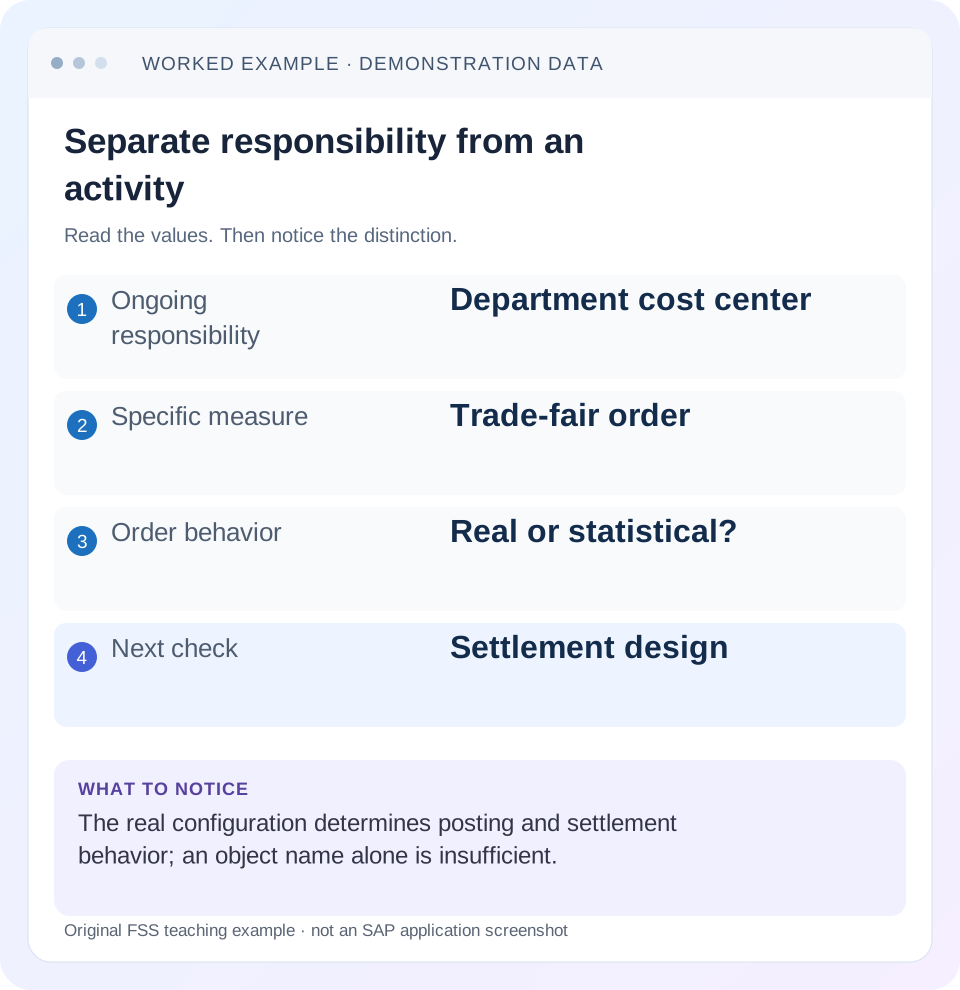
Read the example values
- Ongoing responsibility
- Department cost center
- Specific measure
- Trade-fair order
- Order behavior
- Real or statistical?
- Next check
- Settlement design
Words you’ll meet in this guide
- Posting
- Recording a financial entry.
- General ledger
- The main collection of financial accounts.
- Open item
- An accounting entry still needing matching or settlement.
- Company code
- An organizational unit used for separate financial accounts.
- Accounting document
- A record of a financial entry with a header and individual account lines.
- HANA
- SAP’s database platform.
Preview the practical steps
SEE THE CONNECTION
See it in a simple example.
A small example to make the idea concrete.
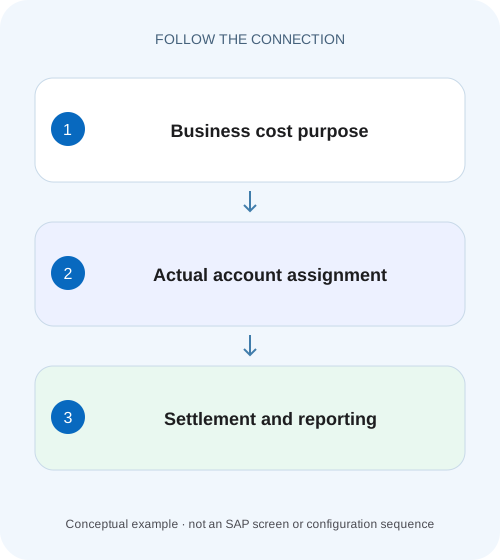
Track a factory improvement separately
A manufacturer wants to distinguish ongoing department costs from a specific factory improvement activity collected on an internal order.
Separate the activity you track from the responsibility that owns it
A cost center commonly represents continuing responsibility for costs; an internal order can collect or monitor the costs of a specific measure or activity.
Read the real or statistical indicator before interpreting balances
A real order is a controlling object that can collect actual costs for later settlement according to its design.
Worked case: a real factory-improvement order collects 12,000
Maintenance cost center MAINT100 is responsible for an illustrative factory improvement.
Track a factory improvement separately
A manufacturer wants to distinguish ongoing department costs from a specific factory improvement activity collected on an internal order.
Check the actual order type, real or statistical behavior and settlement design before interpreting the activity's balance.
| Reader | Business question | Evidence to carry forward |
|---|---|---|
| Manufacturing finance, controlling and purchasing teams | Track a factory improvement separately | Check the actual order type, real or statistical behavior and settlement design before interpreting the activity's balance. |
01 Separate the activity you track from the responsibility that owns it
A cost center commonly represents continuing responsibility for costs; an internal order can collect or monitor the costs of a specific measure or activity. They answer different questions. “How much did Maintenance spend this month?” and “What did the October factory improvement cost?” can both be valid questions about the same underlying business activity. The correct design depends on which object carries real costs and how those costs ultimately reach their intended receiver. [1]
This guide addresses classic overhead cost controlling in SAP ERP and supported S/4HANA scenarios. It is for controllers, finance analysts and posting teams who can display relevant master data, actual line items and settlement evidence. Internal orders are not universally short projects, and order categories have different uses. The fictional factory-improvement example illustrates a real overhead order and contrasts it with a statistical order; it does not describe every investment, production or maintenance order.
02 Read the real or statistical indicator before interpreting balances
A real order is a controlling object that can collect actual costs for later settlement according to its design. A statistical order provides an additional informational view while another real account assignment carries the actual costs. SAP explicitly distinguishes these behaviors. The object description “Factory Improvement” does not tell you which behavior applies; inspect its master data and actual posting context. [2]
If a supplier expense is posted with a statistical order and a real cost center, a report may show the event against both objects. That does not create two external supplier expenses. Adding both reports as if they were disjoint costs produces a misleading total. The reverse mistake is expecting settlement to move a statistical balance as though the order were the real cost collector.
03 Worked case: a real factory-improvement order collects 12,000
Maintenance cost center MAINT100 is responsible for an illustrative factory improvement. Real overhead order IMPR26 collects workshop contractor costs 7,000, transport 2,000 and installation support 3,000. These expenses total 12,000 in one period and currency. The approved design settles all eligible order costs to MAINT100. Tax, commitments, currencies and other orders are excluded so that the real-cost movement is visible.
Before settlement the order carries the 12,000 actual cost balance. After a complete settlement of these costs, the order has corresponding settlement credits and the cost center has the receiving debit. Original invoices remain part of the document trail; settlement is not deletion or a replacement supplier invoice. A report that includes original debits but excludes settlement credits can still show 12,000 of gross order activity after its net balance is zero.
| Expense | Order debit | Purpose |
|---|---|---|
| Booth rental | 7,000 | Venue services |
| Transport | 2,000 | Moving exhibition equipment |
| Event staffing | 3,000 | Temporary event support |
| Total | 12,000 | Eligible costs in this simplified case |
04 Compare the statistical alternative without duplicating expense
Under a statistical design, the same illustrative invoice costs could be assigned to the real cost center MAINT100 and additionally identified with statistical order IMPR26. The cost center already carries the real 12,000, while the statistical order helps answer the improvement-cost question. There is no need to treat the statistical total as a second cost pool to settle merely to place it on Maintenance. [2] [3]
This distinction affects how users read reports and how they fill account assignments. A posting that expects one real object cannot be diagnosed by filling every available field with a familiar master-data number. Inspect the supported account-assignment logic and any derivation. If the resulting real object differs from the intended design, trace the posting before correcting it.
05 Display the order master and business status
Use the authorized order display available in your system; classic landscapes commonly provide KO03. Establish controlling area, company-code context, order type, responsible cost center, real/statistical behavior and the relevant system or user statuses. Check the actual process controls attached to those statuses. A meaningful description is not proof that the order accepts the intended posting or settlement.
Record the validity and reporting purpose agreed with the controller. A factory-improvement order may remain available for late supplier invoices after the physical work ends, depending on the local process. Closing it immediately because the improvement work finished could block a legitimate later posting; leaving it indefinitely available could capture unrelated expenses. The status decision should follow the completion and correction process, with the effect verified in a training or approved business context.
06 Read the settlement rule as a dated instruction
Settlement requires an applicable rule and a permitted receiver under the order’s settlement design. SAP documents a one-receiver scenario in which costs can be settled to a cost center, G/L account or business process using one settlement cost element. That limited scenario is useful evidence of the mechanism, not a universal list of every receiver available for every order type. [4]
For IMPR26, record receiver MAINT100, the intended 100% share and the applicable settlement period or rule validity. If the business instead approves 75% Maintenance and 25% Production, independently calculate 9,000 and 3,000 before inspecting the supported rule. Verify receiver eligibility and share coverage in the actual configuration. A receiver’s name alone does not prove that it belongs to the correct organizational context.
07 Reconcile posting and settlement in sequence
Choose the same actual/plan basis, period, currency and controlling area in every comparison. Keep commitment reports separate from actual posted costs: an open purchase commitment and its later invoice can describe related stages rather than additive actual expenses.
Identify the real cost collector
Display one representative expense document and inspect its actual account assignment. Confirm whether IMPR26 is real or statistical.
Expected observation: The report interpretation follows the posting behavior.
Reconstruct the eligible cost base
List booth, transport and staffing actuals, their corrections and any excluded costs.
Expected observation: The illustrative eligible base totals 12,000.
Review settlement inputs and messages
Inspect the applicable settlement rule, permitted receiver, period and supported test output. Resolve missing or invalid receiver evidence.
Expected observation: The proposed receiving debit is explained before posting.
Follow the resulting documents
Compare order settlement credits with receiver debits and inspect representative settlement documents.
Expected observation: A complete 12,000 settlement explains the net order balance and the receiving cost-center amount.
08 Understand why an order may retain a balance
A remaining balance can reflect late postings, a partial share, a period mismatch, excluded cost categories, an invalid receiver or settlement processing that did not finish for the intended scope. The balance itself does not identify the cause. Start with the difference between expected eligible costs and actual settlement credits, then trace the first unmatched posting or message.
In the example, suppose 12,000 was settled and a later transport correction adds 500. The order can legitimately show 500 until the supported follow-up settlement process handles the additional amount. Rerunning a report with a wider date range does not settle it. Conversely, if the report shows gross debits of 12,500 and credits of 12,500, it may already have zero net balance; check the report’s column definitions before requesting a correction.
09 Troubleshoot the responsible object rather than the label
When a report surprises you, separate master-data behavior, posting evidence, settlement definition and reporting selection. A change in one layer can conceal a problem in another. Changing the order description will not change real/statistical behavior or move a posted cost.
| Observation | First distinction | Evidence |
|---|---|---|
| Order and cost center both show 12,000 | Real versus statistical view | Actual account assignment and report value type |
| Settlement receiver is missing | Rule versus execution | Applicable rule and settlement messages |
| Order remains at 500 after settlement | Late cost versus incomplete coverage | Posting timestamps and settlement scope |
| No posting permitted | Object status versus user access | Status-dependent business transaction and authorization evidence |
| Cost center report differs | Period/currency/value selection | Identical report basis and settlement documents |
| Event report includes unrelated expense | Selection or posting assignment | Order line items and source documents |
10 Test the design before using it for reporting decisions
For the positive case, verify three expenses totaling 12,000 on the intended real order and a corresponding complete settlement to MAINT100. Check the order’s net amount and the receiver debit, including document references. A successful settlement message without the receiver reconciliation is insufficient evidence for the worked result.
For a negative case, display a statistical order and demonstrate why its informational amount cannot be added to the real cost-center total. For a boundary case, introduce a late 500 expense in an authorized training scenario and observe its treatment in the next supported settlement. Also test an invalid or unavailable receiver through a safe test process: the expected outcome is an explained message or exclusion, not an invented replacement receiver. These exercises are proposed, not executed.
11 Avoid confusing budget, plan, commitment and actual cost
A budget is an approved control amount, a plan is a planning value, a commitment can represent a future obligation, and an actual is a posted business event. Their exact availability and integration depend on the order design. A budget of 15,000 and actuals of 12,000 do not mean that an extra 3,000 should be posted or settled. They describe different quantities of financial information.
When comparing the event with departmental reporting, label the figures clearly. “12,000 real actual costs collected and settled” is a different statement from “12,000 planned” or “12,000 including commitments.” Retain the report basis in a handover so that an apparent difference does not turn into a speculative journal entry.
12 Questions to answer before selecting an object
Does an internal order have to end quickly? No. SAP describes orders for measures and detailed monitoring; the business design determines duration and closure. If the object represents continuing departmental responsibility, consider whether a cost center already answers the question more naturally.
Can a cost center and order both be useful? Yes, especially when responsibility and a cross-period activity need separate views. Identify which carries real costs and how the other view is produced. Does settlement erase original expenses? No; trace both collection and settlement evidence. When the question becomes how costs should be shared across several departments, use the allocation lesson to decide the required receiver detail and driver rather than treating settlement and assessment as interchangeable labels.
Related services and next steps
Primary sources
Found this useful?
Share this guide with your network, or leave a like.
Your like is saved in this browser.