Company code versus controlling area: Which SAP structure answers which question?
A manufacturer operates plants in two legal companies while managing some costs in a shared controlling context.

Source review:
START HERE · NO PRIOR TOPIC KNOWLEDGE NEEDED
What it is. Why it matters.
A company code is a unit for separate financial accounts. A controlling area organizes internal cost accounting; the two structures answer different reporting questions.
Completely new to SAP?
Manufacturers use SAP to connect work such as buying components, recording inventory, planning production, shipping equipment and accounting for costs. SAP S/4HANA is an enterprise resource planning system: it connects these activities through shared business data.
Financial Accounting records business events as accounting documents. An account groups relevant amounts; individual entries explain how the total arose.
A transaction code, or t-code, is a shortcut to a task in classic SAP GUI. Fiori apps provide another way to work. Names and screens depend on the product and release; you do not need a live system to learn the concepts in this guide.

Scope and source-review notes
Scope and evidence
Source review by FAST SAP SOLUTIONS® editorial. This badge describes our editorial review; it does not represent SAP certification or independent endorsement.
SAP ERP and S/4HANA FI/CO organizational concepts. Classic shared-controlling-area prerequisites and current S/4HANA Cloud leading-ledger qualifications must be interpreted for the installed edition.
Reviewed relevant official SAP indexed documentation excerpts on 14 November 2026. Examples, identifiers, amounts and expected observations are illustrative; no customer SAP execution was performed. Transaction availability, labels and results depend on the installed release, deployment and local configuration.
A MANUFACTURING EXAMPLE
Separate plant legal reporting from controlling
Two organizational questions
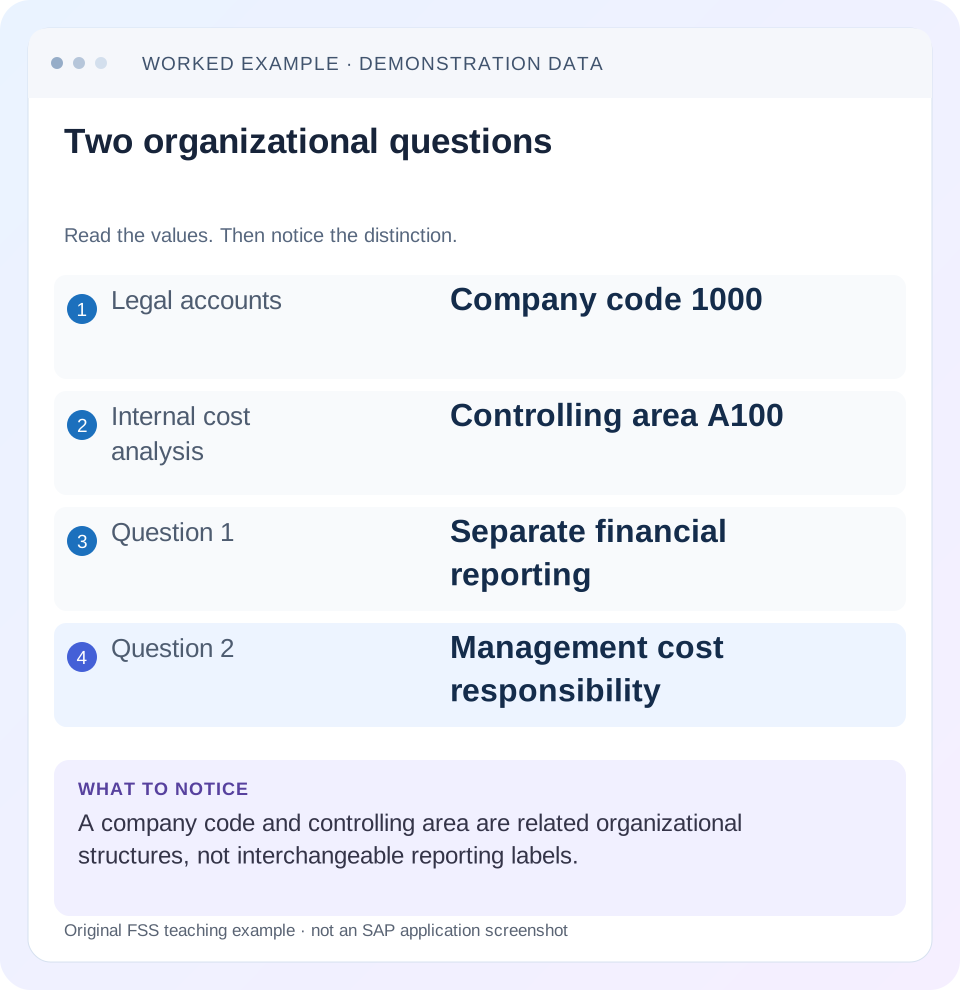
Read the example values
- Legal accounts
- Company code 1000
- Internal cost analysis
- Controlling area A100
- Question 1
- Separate financial reporting
- Question 2
- Management cost responsibility
Words you’ll meet in this guide
- Posting
- Recording a financial entry.
- General ledger
- The main collection of financial accounts.
- Open item
- An accounting entry still needing matching or settlement.
- Company code
- An organizational unit used for separate financial accounts.
- Accounting document
- A record of a financial entry with a header and individual account lines.
- HANA
- SAP’s database platform.
- FI
- Financial Accounting: the SAP area for financial postings and reporting.
Preview the practical steps
SEE THE CONNECTION
See it in a simple example.
A small example to make the idea concrete.
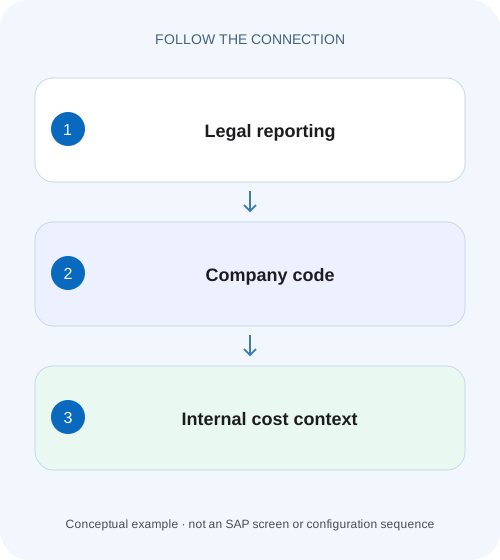
Separate plant legal reporting from controlling
A manufacturer operates plants in two legal companies while managing some costs in a shared controlling context.
Two structures answer two different accounting questions
A company code defines a scope for a self-contained set of external financial accounts.
What belongs to the company-code question?
The company-code question is “Which accounting entity records this transaction?” An invoice, bank posting or adjustment belongs to a defined accounting scope with its own relevant currency, fiscal settings and reporting obligations under the configured design.
What belongs to the controlling-area question?
The controlling area supplies a common management-accounting context for objects and processes such as cost centers, internal orders and allocations.
Separate plant legal reporting from controlling
A manufacturer operates plants in two legal companies while managing some costs in a shared controlling context.
Identify the company-code and controlling-area relationships before comparing legal postings with management responsibility.
| Reader | Business question | Evidence to carry forward |
|---|---|---|
| Manufacturing finance, controlling and purchasing teams | Separate plant legal reporting from controlling | Identify the company-code and controlling-area relationships before comparing legal postings with management responsibility. |
01 Two structures answer two different accounting questions
A company code defines a scope for a self-contained set of external financial accounts. A controlling area defines the organizational scope used for management accounting. When a posting is wrong, first ask whether the issue concerns the accounting entity that owns it or the cost-accounting context in which it is analyzed. Similar-looking identifiers do not make these structures interchangeable. [1] [2]
This lesson is for FI/CO analysts, master-data teams and readers interpreting cross-company reports in SAP ERP or S/4HANA. It explains classic organizational relationships, with explicit limits for cloud and ledger-specific designs. You need display access to the actual organizational assignments, representative documents and report selections. Do not redesign an organizational structure to resolve an unexplained report difference; establish the posting and selection evidence first.
02 What belongs to the company-code question?
The company-code question is “Which accounting entity records this transaction?” An invoice, bank posting or adjustment belongs to a defined accounting scope with its own relevant currency, fiscal settings and reporting obligations under the configured design. The fact that management combines costs across entities does not remove the need to identify which company code owns each posting.
For example, an expense posted in company code 1000 is not automatically an expense in company code 2000 because both companies share a group name. A management report can aggregate the two with explicit selection and currency treatment. An external-accounting reconciliation must still preserve their separate document identities. A document number by itself is insufficient when the same number can exist in another company code or fiscal year.
03 What belongs to the controlling-area question?
The controlling area supplies a common management-accounting context for objects and processes such as cost centers, internal orders and allocations. Depending on the supported design, one controlling area can be associated with one or multiple company codes. This relationship is an explicit assignment with prerequisites, not an automatic consequence of companies being related. [2] [3]
Ask which cost objects are valid in the controlling context and which company code each relevant object or posting belongs to. Cross-company management analysis is a different issue from creating legal intercompany postings. Sharing a controlling area does not by itself authorize a transfer, eliminate an intercompany balance or establish that every allocation method supports every receiver combination.
04 Check prerequisites rather than memorizing a diagram
SAP documents common operating-chart-of-accounts requirements and compatible fiscal-year relationships for company codes assigned to one controlling area. Classic guidance explains that fiscal-year variants may differ in special-period counts while their time frames must not conflict. A January–December period structure cannot simply be treated as equivalent to April–March because both have twelve ordinary periods. [2] [3] [4]
Current S/4HANA Cloud documentation also discusses the leading-ledger relationship and additional fiscal-year variants in supported ledger/company-code scenarios. Therefore, state the deployment and ledger context before applying a classic restriction to an entire modern landscape. The practical task is to inspect the documented prerequisites for the installed edition and actual assignment, including any supported exceptions.
05 Worked case: two companies share one management context
Fictional companies 1000 and 2000 are assigned to controlling area A100 under an approved common design. Assume a compatible calendar fiscal year, a common operating chart and EUR comparison currency. Company 1000 incurs 8,000 of maintenance cost on cost center MA100; company 2000 incurs 5,000 on MA200. There are no intercompany postings or allocations in this initial example.
A company-code report for 1000 should explain its 8,000. A report for 2000 should explain 5,000. A management view explicitly selecting both companies in A100 can show 13,000 on the stated basis. The 13,000 does not mean that either company owns the other’s 5,000 or 8,000. It is an aggregation of two accounting scopes.
| Selection | Included expense | Question answered |
|---|---|---|
| Company 1000 only | 8,000 | What did company 1000 record? |
| Company 2000 only | 5,000 | What did company 2000 record? |
| A100 with both companies | 13,000 | What is the combined management cost? |
| A100 filtered to MA100 | 8,000 | What did that selected cost center incur? |
06 Follow one document through both dimensions
Open a representative 3,000 expense included within company 1000’s 8,000. Record its company code, year, document/item identity, expense account, cost assignment, amount and currency. Then find the same item in the relevant cost-center report. The two displays can describe the same economic event through different dimensions; they should not be added together as separate expenses.
If the cost-center report excludes the item, investigate the actual cost-accounting relevance, assignment and report selection. If it appears under an unexpected object, trace the posted assignment and supported derivation. If the company code itself is wrong, determine the source process and approved correction path. Changing the controlling-area filter cannot move an incorrectly posted accounting document to another company.
07 A practical investigation sequence
Work from one reproducible difference rather than comparing broad screenshots. Record the expected scope in plain language before opening the configuration display.
Define the report question
Write whether the requested answer is entity accounts, departmental cost or combined management performance.
Expected observation: The appropriate organizational dimension is explicit.
Capture the actual assignments
Display the company-code/controlling-area relationship and relevant object identities for this release.
Expected observation: 1000 and 2000 are confirmed within A100 in the illustration.
Align periods and currencies
Compare fiscal period mapping, ledger or valuation scope, actual/plan basis and displayed currency.
Expected observation: 8,000 and 5,000 are comparable before being summed.
Trace a representative item
Match company, year, document and line to the cost-accounting report.
Expected observation: The same 3,000 event is recognized across views.
Explain the remaining difference
Separate excluded company codes, object selection, currency translation and genuine missing postings.
Expected observation: The next action targets the first unsupported relationship.
08 Currencies and periods can create valid differences
An amount in company-code currency and an amount in a controlling or reporting currency are not automatically comparable. Preserve currency type and conversion context. If company 2000 records 5,000 in a different currency, adding its raw number to 8,000 EUR does not produce a meaningful total. Translate or use a supported common-currency report, then retain the basis.
The same applies to time. A report called “October” may select calendar dates, fiscal period values or a year-to-date range. Confirm how the report derives its period before comparing it with an FI balance. Special periods and adjustments can affect year-end comparisons even when ordinary fiscal periods align. A reporting label is a prompt to inspect selection, not proof that selections match.
09 Troubleshoot structure, posting and report differences separately
Organizational identifiers are often blamed for a discrepancy that comes from a report variant. Conversely, a plausible total can conceal a wrong entity posting. Use the actual document identity to distinguish those cases.
| Observation | Evidence to inspect | Interpretation to test |
|---|---|---|
| Combined report exceeds entity report | Selected companies and objects | Aggregation may be expected |
| Same numeric amount, different currency | Currency type and rate basis | Raw numbers may be incomparable |
| Object not accepted in posting | Assignment and object validity | Wrong organizational context or status |
| Fiscal months do not align | Variant and calendar mapping | Same period number may cover different dates |
| One entity appears absent | Report filters and assigned scope | Selection versus missing posting |
| External accounts wrong, CO view plausible | Source accounting document | A management filter cannot correct entity ownership |
10 Verification exercises for the shared-area example
For the positive case, select 1000 and 2000 on the same EUR actual basis and reconstruct 8,000 + 5,000 = 13,000. Drill to one document from each entity and verify that their company-code identities remain distinct. Then filter to 1000 and expect only the relevant 8,000 in this declared dataset.
For a negative test, intentionally compare 1000-only FI with both-company CO and explain the 5,000 selection difference without changing a posting. For a boundary test, give company 2000 a different raw currency amount and require a common-currency basis before aggregation. A further design exercise proposes incompatible ordinary fiscal-year calendars and asks whether the installed edition supports the relationship. Resolve that from documentation and configuration; do not create experimental production assignments.
11 Treat structural change as a design project
Changing a controlling area or its relationship to company codes can affect master objects, transactional history, allocations, planning, interfaces and reporting. A support incident should first produce a precise explanation and, if needed, a scoped correction proposal. It should not silently become a reorganization merely because a user prefers one combined report.
For an approved design review, record desired management processes, entity boundaries, chart-of-accounts compatibility, fiscal-year and currency requirements, and migration/history needs. Confirm supported tooling and constraints for the exact edition. A report that joins selected company-code data may meet the question without changing transactional organization; evaluate the actual business requirement before choosing an architectural change.
12 Distinguish a cost allocation from an intercompany conclusion
Suppose company 1000 provides a shared service and management wants 1,000 of its costs attributed to company 2000. The shared controlling area is only organizational context. Identify the supported allocation, its sender and receiver eligibility, required accounting documents and the legal/intercompany treatment under the actual design. Do not assume that the combined 13,000 report proves a 1,000 intercompany charge has occurred.
Reconcile the resulting company-code documents separately if an approved process is executed. A management transfer can change the internal cost view while a legally required billing or intercompany settlement follows another process. State which result was verified. This extra distinction prevents a report-level cost redistribution from being described as a completed commercial settlement between entities.
13 Questions to resolve before closing the investigation
Can several company codes share a controlling area? In supported designs, yes, subject to documented prerequisites. Does that mean they are one external-accounting entity? No; preserve company-code scope and any required intercompany process. Can the same cost-center-looking number exist in different contexts? Treat identifiers with their organizational context and actual master data rather than relying on names.
Why does a CO total differ from FI? Align company selection, fiscal period, currency, ledger/value basis and the relevant posting population. Then investigate the remaining items. For responsibility within that scope, use the cost-center/profit-center guide. For moving shared costs, use the distribution/assessment guide and verify the allowed sender/receiver relationship for the actual process.
Related services and next steps
Primary sources
Found this useful?
Share this guide with your network, or leave a like.
Your like is saved in this browser.