SAP open-item management: A balance is not a cleared item
A factory's supplier account has an acceptable balance, but accounts payable still needs to explain individual unsettled items.

Source review:
START HERE · NO PRIOR TOPIC KNOWLEDGE NEEDED
What it is. Why it matters.
Open-item management tracks entries that still need to be matched or settled. An account balance is a total, while clearing describes what happened to individual entries.
Completely new to SAP?
Manufacturers use SAP to connect work such as buying components, recording inventory, planning production, shipping equipment and accounting for costs. SAP S/4HANA is an enterprise resource planning system: it connects these activities through shared business data.
Financial Accounting records business events as accounting documents. An account groups relevant amounts; individual entries explain how the total arose.
A transaction code, or t-code, is a shortcut to a task in classic SAP GUI. Fiori apps provide another way to work. Names and screens depend on the product and release; you do not need a live system to learn the concepts in this guide.

Scope and source-review notes
Scope and evidence
Source review by FAST SAP SOLUTIONS® editorial. This badge describes our editorial review; it does not represent SAP certification or independent endorsement.
SAP ERP and S/4HANA ordinary open-item concepts for subledgers and applicable G/L accounts. Ledger-specific and extended management types and conversion procedures require release-specific documentation.
Reviewed relevant official SAP indexed documentation excerpts on 14 November 2026. Examples, identifiers, amounts and expected observations are illustrative; no customer SAP execution was performed. Transaction availability, labels and results depend on the installed release, deployment and local configuration.
A MANUFACTURING EXAMPLE
Explain a supplier balance that is still open
Zero balance, two open entries
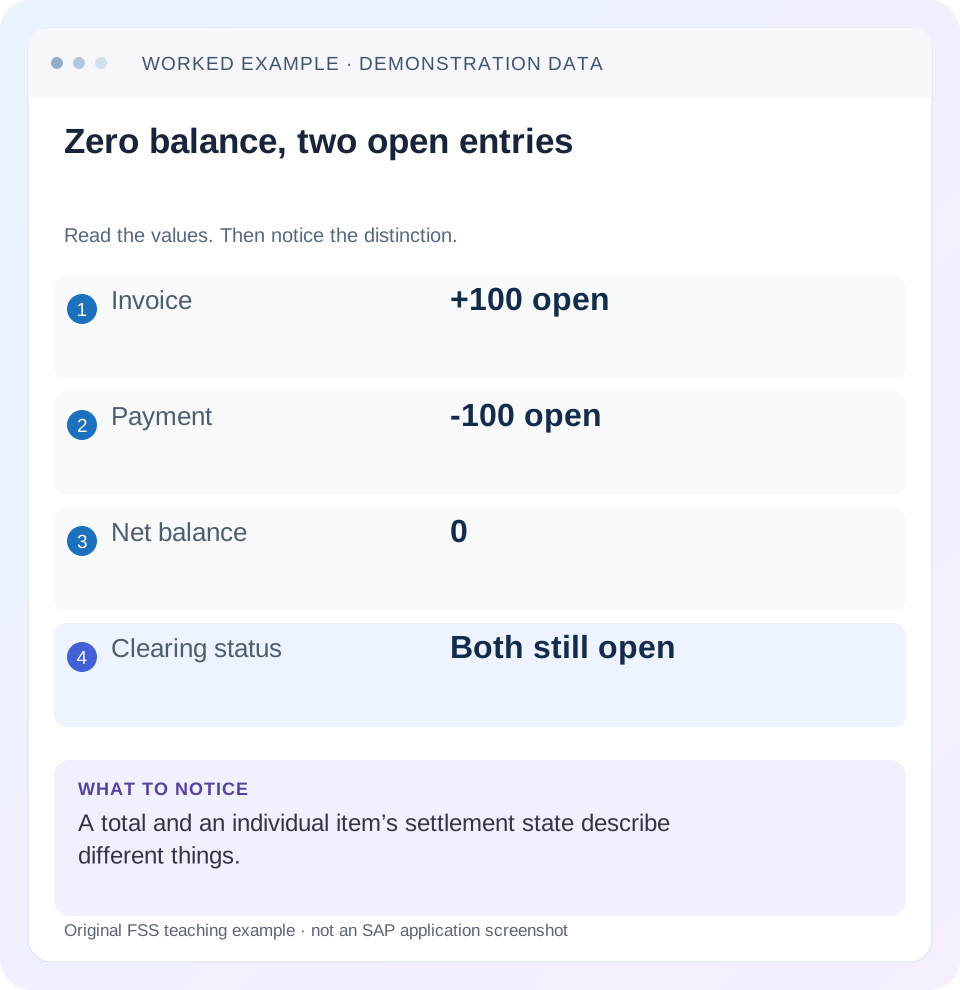
Read the example values
- Invoice
- +100 open
- Payment
- -100 open
- Net balance
- 0
- Clearing status
- Both still open
Words you’ll meet in this guide
- Posting
- Recording a financial entry.
- General ledger
- The main collection of financial accounts.
- Open item
- An accounting entry still needing matching or settlement.
- Company code
- An organizational unit used for separate financial accounts.
- Accounting document
- A record of a financial entry with a header and individual account lines.
- HANA
- SAP’s database platform.
- FI
- Financial Accounting: the SAP area for financial postings and reporting.
Preview the practical steps
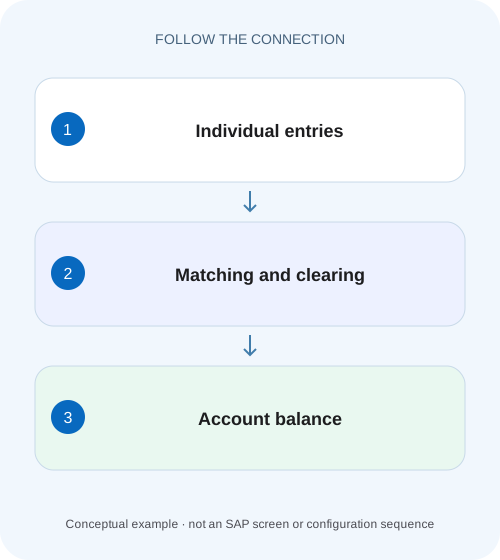
SEE THE CONNECTION
See it in a simple example.
A small example to make the idea concrete.
Explain a supplier balance that is still open
A factory's supplier account has an acceptable balance, but accounts payable still needs to explain individual unsettled items.
A zero balance does not tell you which transactions are complete
Open-item management tracks whether individual accounting items remain open or have been cleared through a matching relationship.
Understand the item lifecycle
An item posted to an applicable open-item-managed account initially represents an unresolved transaction in that account’s process.
Customer, supplier and G/L contexts differ
Customer and supplier accounts use open-item concepts to track invoices and offsetting postings.
Explain a supplier balance that is still open
A factory's supplier account has an acceptable balance, but accounts payable still needs to explain individual unsettled items.
Separate the balance from item-level clearing evidence before reporting that the supplier position is fully reconciled.
| Reader | Business question | Evidence to carry forward |
|---|---|---|
| Manufacturing finance, controlling and purchasing teams | Explain a supplier balance that is still open | Separate the balance from item-level clearing evidence before reporting that the supplier position is fully reconciled. |
01 A zero balance does not tell you which transactions are complete
Open-item management tracks whether individual accounting items remain open or have been cleared through a matching relationship. An account balance is an aggregate. Two opposite postings can net to zero while both remain open, so a zero total does not demonstrate that the expected reconciliation has been completed. [1] [2]
This tutorial is for FI learners, accountants and support analysts in SAP ERP or supported S/4HANA G/L and subledger processes. It focuses on ordinary open-item concepts; ledger-specific and extended open-item management have additional design constraints. You need authorized account-master, line-item and clearing-document display. The worked figures are fictional and do not represent an executed SAP clearing or a recommendation to change an existing account setting.
02 Understand the item lifecycle
An item posted to an applicable open-item-managed account initially represents an unresolved transaction in that account’s process. A later matching operation records clearing information against the relevant items. The original postings remain visible in all-item or historical views; clearing changes their lifecycle state and relationship, not the fact that they were posted. [1] [2]
SAP documents that the balance of an open-item-managed G/L account equals the balance of its open items. This does not imply that every open item has a nonzero net contribution as a pair. It means the remaining open population explains the account balance. You still need to inspect whether opposite items in that population should be matched.
03 Customer, supplier and G/L contexts differ
Customer and supplier accounts use open-item concepts to track invoices and offsetting postings. For G/L accounts, open-item management is a specific master-data and process design. SAP learning identifies uses such as bank clearing, GR/IR and salary clearing, where an original event needs an offsetting-event relationship. [1] [3]
Do not generalize this to every bank or expense account. A main bank account and an intermediate bank clearing account serve different purposes. The classic documentation explicitly distinguishes bank accounts from bank clearing accounts in its recommendation. Inspect the actual accounting design and supported account type rather than turning on open-item management because a report appears difficult to reconcile.
04 Worked case: 100 debit and 100 credit are still open
Fictional clearing account CL100 contains item D1 debit 100 and item C1 credit 100, both in the same declared currency and ordinary eligible scope. The account nets to zero. The business references show that C1 offsets D1, but no clearing relationship has yet been recorded.
Before clearing, an open-item report can list both D1 and C1, even though their sum is zero. After a supported authorized clearing, both carry clearing evidence and no longer belong in the current open population. The net account balance remains zero throughout. That unchanged balance is expected; the new information is the completed matching relationship.
| Measure | Before matching | After supported clearing |
|---|---|---|
| D1 debit 100 | Open | Cleared with reference/date |
| C1 credit 100 | Open | Cleared with reference/date |
| Current open-item count | 2 | 0 for this pair |
| Net account balance | 0 | 0 |
| Business evidence | Offset relationship known | Offset relationship recorded |
05 Add an unmatched item to see why the balance still matters
Now add D2 debit 40 for another business event with no offset. Before clearing D1/C1, the open population is 100 + 40 − 100 = debit 40. After clearing the valid pair, only D2 remains open and still explains debit 40. Both status and balance are required to understand the result.
If an analyst clears D2 against an unrelated 40 credit merely to reduce open-item count, the account can look tidy while the genuine unresolved event is concealed. Commercial identity and source references matter as well as arithmetic. The goal is a true completed relationship, not a small list or a zero headline.
06 Clearing is distinct from payment and reversal
A customer invoice may be cleared by a payment, credit memo or another supported offset. Therefore clearing alone does not prove that cash moved. A payment can also be posted on account and remain unallocated. Read the composition of the clearing relationship and any bank evidence separately.
Reversal concerns correcting a posting; reset clearing concerns undoing a matching relationship. A valid invoice incorrectly matched to a payment can require reset clearing without an invoice reversal. An invalid invoice may require a different sequence after its clearing state is addressed. Preserve these distinctions so one reconciliation error does not trigger an unnecessary financial correction.
07 Read open status at the requested key date
An item cleared today may have been open at last month-end. SAP’s line-item function documentation defines historical open inclusion using both posting and clearing dates. A current open-item list and a historical key-date list can therefore legitimately differ. [4]
For example, D1 and C1 posted on 20 October and cleared on 5 November can remain relevant to an open-at-31-October question even when neither is currently open. Record the report key date and item dates. Do not describe historical exposure as a current unresolved task without checking subsequent clearing evidence.
08 Investigate an unexplained open balance systematically
Work from the account purpose and exact item population. A meaningful reconciliation connects every material open item with an expected next business event or a documented exception.
Confirm account design
Display the relevant G/L master and supported open-item-management type; for subledgers identify the account family.
Expected observation: The report’s lifecycle interpretation is appropriate.
List signed items
Capture document/item, amount/currency, reference, posting date and clearing status.
Expected observation: The open population independently explains the balance.
Identify genuine offset pairs
Match source-event evidence rather than equal amounts alone.
Expected observation: D1/C1 are related; D2 remains separate.
Check matching method
Inspect automatic criteria or the permitted manual-clearing route and exceptions.
Expected observation: An unresolved pair has a specific process explanation.
Verify saved clearing
Read actual clearing reference/date and recheck remaining open items.
Expected observation: Only D2 remains open for 40 in the extended example.
09 Troubleshoot the relationship, not just the total
Keep item existence, account configuration, report selection and clearing state separate. An open-item-management indicator cannot fix a wrong source posting by itself.
| Observation | Inspect | Reasoning |
|---|---|---|
| Balance zero, two open items | Clearing relationship | Offsetting amounts may still be unmatched |
| Balance 40, many open rows | Signed item reconstruction | Gross activity can exceed net exposure |
| Cleared item in historical list | Key date and clearing date | It was open at the requested time |
| No clearing action available | Account/process design and access | Not every G/L account uses the same management type |
| Pair fails automatic clearing | Configured grouping and eligibility | Equal amounts may not share a group |
| Open count decreases unexpectedly | Clearing documents and scope | Verify which items were matched, not only count |
10 Do not toggle the setting as an incident workaround
Changing open-item management on an existing G/L account has historical and procedural consequences. The reviewed classic documentation describes zero-balance conditions and limits on subsequent activation; current S/4HANA designs can require supported conversion procedures for the chosen management type. A zero balance is not a complete migration plan. [1] [3]
If the account was designed incorrectly, treat the change as an accounting-data project: identify historical items, ledger scope, clearing needs, supported tools and reconciliation evidence. Do not assume that a checkbox retroactively constructs valid matching relationships for all prior postings. Likewise, deactivation should not be used to hide unresolved items or make an open-item report empty.
11 Positive, negative and boundary checks
For the positive worksheet exercise, reconstruct D1/C1 net zero, then the extended D1/D2/C1 debit 40. After a supported training clearing of the genuine 100 pair, verify their clearing references and the remaining D2 40. The account balance should remain 40 in the extended dataset.
For a negative test, offer an unrelated opposite 40 and explain why arithmetic alone does not justify matching D2. For a boundary test, query the items before and after their clearing date and explain historical status. Another exercise asks whether an existing nonzero account can simply have its management setting changed; inspect the installed release’s supported procedure rather than attempting a production toggle. These are proposed checks, not executed SAP tests.
12 Use an ageing explanation that points to business events
For each unresolved material item, record source identity, age, amount/currency and the expected offset or correction. “Old open item” is less useful than “receipt reference R1 awaits invoice I1” or “bank payment P1 awaits matching statement evidence.” The item’s age can prioritize investigation but does not establish that it should be written off.
For the extended example, a useful statement is: “CL100 has debit 40 open on D2; the 100 debit/credit pair was matched under clearing X on the stated date. D2 belongs to a separate event awaiting its documented offset.” This connects total, lifecycle and next action while preserving the distinction between clearing and a new financial posting.
13 Measure reconciliation completeness without hiding gross exposure
Open-item count and net balance are useful but incomplete measures. In the extended example, three open rows net to 40 before the 100 pair is cleared. A different account with one debit 40 also nets to 40, but its unresolved population is simpler. Preserve both item-level composition and the net result when prioritizing investigation.
Age and reference quality add further meaning. Two very old 100 offsets may indicate missed matching, while a new 40 item may await an entirely normal future event. Do not write off the 40 or ignore the 100 pair based only on one aggregate. A good reconciliation assigns each item a documented business relationship or next event.
14 Frequently asked questions
Why are there open items when the account balances to zero? The items can offset arithmetically without a recorded clearing relationship. Does clearing remove history? No; use the appropriate all-item or historical view. Does an open invoice mean it is overdue? No; due-date status is separate from clearing status.
Can automatic clearing do all matching? Only where eligible groups meet reliable supported criteria; use the F.13 lesson. Can manual clearing bypass business evidence? It still requires a legitimate relationship and deliberate difference handling. If the wrong relationship was saved, use reset-clearing guidance before deciding whether any original posting itself is invalid.
Related services and next steps
Primary sources
Found this useful?
Share this guide with your network, or leave a like.
Your like is saved in this browser.