Cost center versus profit center: Follow responsibility, not similar names
A machinery manufacturer wants to read a maintenance department's costs separately from the profitability responsibility of its equipment division.

Source review:
START HERE · NO PRIOR TOPIC KNOWLEDGE NEEDED
What it is. Why it matters.
A cost center tracks where costs are incurred. A profit center tracks responsibility for results, helping managers understand different aspects of the same business activity.
Completely new to SAP?
Manufacturers use SAP to connect work such as buying components, recording inventory, planning production, shipping equipment and accounting for costs. SAP S/4HANA is an enterprise resource planning system: it connects these activities through shared business data.
Financial Accounting records business events as accounting documents. An account groups relevant amounts; individual entries explain how the total arose.
A transaction code, or t-code, is a shortcut to a task in classic SAP GUI. Fiori apps provide another way to work. Names and screens depend on the product and release; you do not need a live system to learn the concepts in this guide.

Scope and source-review notes
Scope and evidence
Source review by FAST SAP SOLUTIONS® editorial. This badge describes our editorial review; it does not represent SAP certification or independent endorsement.
SAP ERP and S/4HANA cost-center and profit-center responsibility, source-object derivation and report reconciliation. Actual derivation, validity, ledgers and reorganization behavior depend on edition and configuration.
Reviewed relevant official SAP indexed documentation excerpts on 14 November 2026. Examples, identifiers, amounts and expected observations are illustrative; no customer SAP execution was performed. Transaction availability, labels and results depend on the installed release, deployment and local configuration.
A MANUFACTURING EXAMPLE
Explain maintenance costs and division results
Where was cost incurred?
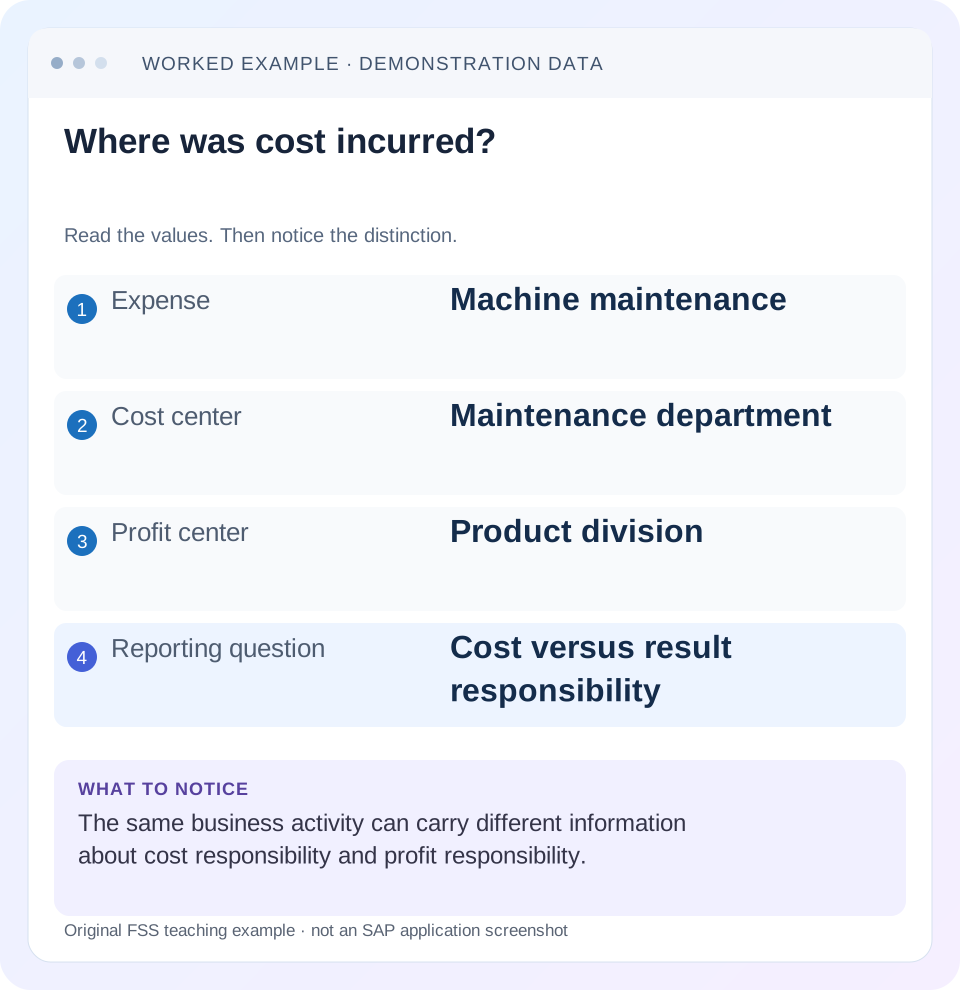
Read the example values
- Expense
- Machine maintenance
- Cost center
- Maintenance department
- Profit center
- Product division
- Reporting question
- Cost versus result responsibility
Words you’ll meet in this guide
- Posting
- Recording a financial entry.
- General ledger
- The main collection of financial accounts.
- Open item
- An accounting entry still needing matching or settlement.
- Company code
- An organizational unit used for separate financial accounts.
- Accounting document
- A record of a financial entry with a header and individual account lines.
- HANA
- SAP’s database platform.
- FI
- Financial Accounting: the SAP area for financial postings and reporting.
Preview the practical steps
SEE THE CONNECTION
See it in a simple example.
A small example to make the idea concrete.
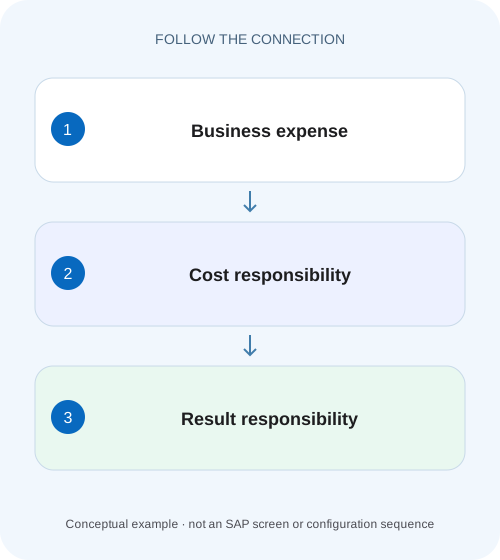
Explain maintenance costs and division results
A machinery manufacturer wants to read a maintenance department's costs separately from the profitability responsibility of its equipment division.
Choose the responsibility question before the field
A cost center identifies responsibility for costs, such as a maintenance department.
Understand the different populations of transactions
A maintenance cost-center report may show expenses incurred by that department.
How the profit-center assignment reaches the document
SAP documents derivation of profit-center information from cost-relevant account assignments in relevant primary-cost processes.
Explain maintenance costs and division results
A machinery manufacturer wants to read a maintenance department's costs separately from the profitability responsibility of its equipment division.
Trace the relevant assignments and reporting dimensions before interpreting similar-looking object names as equivalent responsibilities.
| Reader | Business question | Evidence to carry forward |
|---|---|---|
| Manufacturing finance, controlling and purchasing teams | Explain maintenance costs and division results | Trace the relevant assignments and reporting dimensions before interpreting similar-looking object names as equivalent responsibilities. |
01 Choose the responsibility question before the field
A cost center identifies responsibility for costs, such as a maintenance department. A profit center supports management responsibility for a result that includes costs and revenues. One business event can contribute to both dimensions. They are not alternative spellings of a department, and a cost-center total should not automatically equal a whole profit-center result. [1] [2]
This tutorial is for SAP FI/CO analysts, posting teams and managers reading SAP ERP or S/4HANA reports. You need authorized access to the relevant master records, representative accounting lines and report selections. It focuses on interpretation and derivation, not a universal configuration recipe. Ledger design, document splitting, account assignments and applications vary by release; verify the actual process before changing master data.
02 Understand the different populations of transactions
A maintenance cost-center report may show expenses incurred by that department. A product-division profit center can receive costs from several departments and revenue from sales, and may support balance-sheet reporting under the configured accounting design. The cost center is therefore a narrower responsibility view than the overall result question in this example. [1] [3]
Do not conclude that a profit center is incomplete merely because a revenue line has no departmental cost center. Revenue and balance-sheet processes have their own relevant account assignments and derivation. Start with the business transaction and its supported accounting model. A report that requires cost center on every line can inadvertently exclude legitimate profit-center information.
03 How the profit-center assignment reaches the document
SAP documents derivation of profit-center information from cost-relevant account assignments in relevant primary-cost processes. Other objects, such as materials, orders or sales-related assignments, can participate in profit-center determination in their supported scenarios. Inspect the actual source object and posted line rather than assuming the user typed the profit center manually. [1] [4]
For a departmental expense, compare the cost center’s valid assignment with the posted profit-center field at the transaction date. For another process, identify the object that supplies the value. A correct current master assignment does not prove that an earlier document used it, and a changed master record is not evidence of a historical reposting.
04 Worked case: maintenance costs and a division result
Fictional maintenance cost center MA100 belongs to the Bikes profit center PCBIKE for the relevant interval. It receives an external repair expense of 2,400. Assume that the supported posting derives PCBIKE from MA100 and no other derivation overrides it. The Bikes division also has 20,000 revenue and 11,000 other costs on the same simplified period/currency basis.
MA100’s cost report shows 2,400 for this dataset. PCBIKE’s simplified result is 20,000 − 11,000 − 2,400 = 6,600. The 2,400 appears as part of the division’s costs; it is not an additional expense to add a second time to the division result. These figures exclude tax, inventories, internal transfer pricing and other valuation complexities.
| Business fact | Cost-center view | Profit-center view |
|---|---|---|
| External repair expense | MA100 cost 2,400 | PCBIKE cost 2,400 |
| Other division costs | Other relevant objects | PCBIKE cost 11,000 |
| Division revenue | Not MA100 departmental expense | PCBIKE revenue 20,000 |
| Question answered | Where did 2,400 arise? | What is the simplified 6,600 result? |
05 Read the master record with its valid interval
Identify the cost center by controlling context and number, then inspect the relevant validity interval, company-code context, responsible manager and profit-center assignment where used. Keep the organizational meaning distinct from the descriptive name. A department named “Bikes Maintenance” is not proof that the master points to PCBIKE.
For the profit center, inspect its defined organizational scope and relevant validity. A reorganization can change responsibility over time. Determine which date and derivation logic apply to the source process. If a manager expects October to belong to a new division but the change starts in November, the disagreement may be an effective-date requirement rather than a failed posting.
06 Trace an expense from source to both reports
Open the representative 2,400 accounting document and retain company code, fiscal year, document/item, expense account, cost center, profit center, currency and posting date. Compare the line with the source evidence and the valid assignment. Then locate it in both reports using the same period and currency basis.
If the departmental report includes it and the profit-center report does not, inspect report filters, ledger and actual posted assignment before editing the cost center. If the profit center is correct but the department is wrong, the correction concerns cost responsibility. If both are wrong because the source used the wrong cost object, correct that relationship through the supported accounting process rather than patching only the displayed result.
07 Investigate a discrepancy through five explicit checks
Use one representative document to establish the mechanism before expanding to all affected items. This makes a proposed correction reviewable.
Name the intended responsibility
Write “MA100 owns the maintenance expense; PCBIKE owns the division result” and identify the relevant period.
Expected observation: The two required meanings are explicit.
Read source assignment
Inspect the actual accounting item and the source object used by that process.
Expected observation: The 2,400 has an observed cost center and profit center.
Check master-data timing
Compare the assignment valid for the relevant transaction context, including any reorganization.
Expected observation: The expected derivation has a dated basis.
Align report selections
Use the same currency, period, ledger/value basis and document population.
Expected observation: A report filter is excluded as the cause.
Verify the supported correction
If the posting is wrong, review its source and follow the appropriate correction process. Recheck both dimensions.
Expected observation: Correcting cost responsibility also preserves result reporting.
08 Keep allocations distinct from organizational derivation
An assignment tells the system which responsibility dimension applies to a posting under the process design. An allocation transfers or redistributes costs according to a defined rule. Changing a cost center’s profit-center assignment is not the same as allocating its expenses among several receivers. If the business wants 60% Bikes and 40% Accessories, identify the intended allocation process and accounting representation.
For example, splitting the illustrative 2,400 into 1,440 and 960 requires a supported rule and resulting document trail. It does not follow from writing two profit-center names in a spreadsheet. Also examine whether the allocation crosses company codes or profit centers and how the selected accounting design represents the transfer. Do not infer support from the existence of the master records.
09 Troubleshoot the first incorrect relationship
The useful question is not “Which field is missing?” but “Which relationship fails to explain this transaction?” An intentionally blank field in one process may be legitimate; an unexpected populated field may be wrong.
| Observation | Check | Possible explanation |
|---|---|---|
| Cost center correct; profit center unexpected | Dated assignment and derivation source | Old mapping, different source object or override |
| Profit-center total exceeds department costs | Transaction population | Revenue and other departments are included |
| Revenue excluded by a report | Cost-center filter | The selection may omit lines without cost centers |
| Current master differs from old posting | Validity and change timeline | Historical posting need not reflect today’s assignment |
| Both reports show 2,400 | Document/item identity | Same event in two dimensions, not duplicate expense |
| Reorganization appears incomplete | Supported reorganization scope | Master and transactional changes need separate evidence |
10 Verify the worked result and its boundaries
For the positive case, find the same illustrative 2,400 item in MA100 and PCBIKE, then reconstruct PCBIKE’s 6,600 result using the declared 20,000 revenue and 13,400 total cost. Preserve the item identity to show that only one external expense exists.
For a negative test, filter the division report to MA100 and observe that it no longer represents the whole division result. For a boundary test, move the relevant assignment effective date across the posting context in an authorized training scenario and inspect the actual derived value. Another exercise introduces a revenue line without MA100: decide whether excluding it still answers the result question. These are proposed checks; no customer-system behavior has been executed for this lesson.
11 Correct the source without rewriting the explanation
If the source document is wrong, determine whether reversal/reposting, a supported reposting process or a source-module correction is appropriate. Keep original and correction references, reason and final responsibility assignments together. A manual journal that balances a report may leave the original operational assignment unexplained.
If the business changed its organization, document the effective change and the intended historical treatment. Do not imply that editing current master data retroactively reallocates all prior costs. Review reporting comparability, downstream objects and any supported reorganization process. After the change, check both the relevant master assignment and representative new or corrected postings; they prove different parts of the result.
12 Read a change in responsibility as a dated business event
Suppose MA100 moves from PCBIKE to PCACCESS from 1 November. A 2,400 expense posted in October and a new 600 expense in November need not carry the same profit-center result under the relevant supported timing logic. The correct investigation captures both document dates and the actual dated assignment; it does not compare both documents only with the master record visible today.
Build a two-row comparison showing transaction identity, relevant date, source object and saved profit center. If October is intended to remain historical, the difference can be valid. If management requires an approved historical reorganization, establish its supported scope and resulting documents separately. A master-data change record and a reposting document prove different things, and both may be needed to explain a deliberate reorganization.
13 Frequently asked questions
Can one profit center include several cost centers? Yes, that is a common conceptual design, subject to actual master-data and organizational rules. Does every profit-center line require a cost center? No; inspect the supported business process and its relevant account assignment. Can matching names prove a correct assignment? No, use the saved identifiers and valid relationship.
Why do department and division totals differ? They can represent different populations and responsibility questions. Align selections and trace representative items before judging the difference. If the question concerns a specific temporary activity, use the internal-order lesson. If it concerns shared costs, use the assessment/distribution lesson and specify the receiver detail that the business needs.
Related services and next steps
Primary sources
Found this useful?
Share this guide with your network, or leave a like.
Your like is saved in this browser.