Cloud Integration header versus exchange property: Choose by message scope
A manufacturer's supplier integration moves context through processing steps and an external receiver that do not all preserve headers and properties identically.

Source review:
START HERE · NO PRIOR TOPIC KNOWLEDGE NEEDED
What it is. Why it matters.
An integration message carries content plus supporting information. A header may travel with a message, while a process property can hold information used inside a flow; each component’s behavior matters.
Completely new to SAP?
Manufacturers use SAP to connect work such as buying components, recording inventory, planning production, shipping equipment and accounting for costs. SAP S/4HANA is an enterprise resource planning system: it connects these activities through shared business data.
SAP Business Technology Platform, or BTP, provides cloud services for applications, data and integration. A connection needs a route, an identity and permission to perform the intended task.
A transaction code, or t-code, is a shortcut to a task in classic SAP GUI. Fiori apps provide another way to work. Names and screens depend on the product and release; you do not need a live system to learn the concepts in this guide.

Scope and source-review notes
Scope and evidence
Source review by FAST SAP SOLUTIONS® editorial. This badge describes our editorial review; it does not represent SAP certification or independent endorsement.
SAP Cloud Integration message headers, bodies and exchange properties. Adapter-specific handling and external header restrictions remain scenario dependent.
Documentation review on 14 November 2026 using official SAP sources and indexed official excerpts where full Help text was unavailable. Scope and service or release differences are explained in the lesson. All datasets, requests and checks are illustrative; no customer SAP runtime execution or measured results are claimed.
A MANUFACTURING EXAMPLE
Preserve meaning across a supplier-message flow
Inside the flow or sent outside?
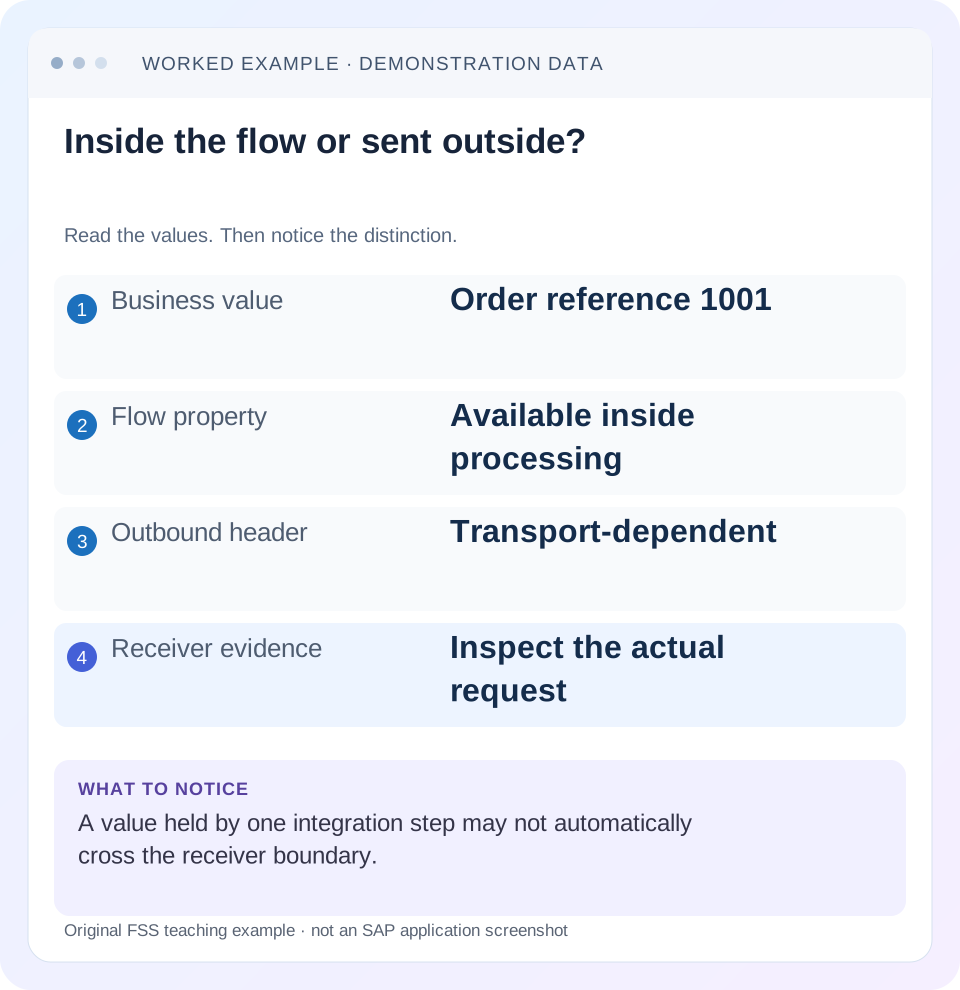
Read the example values
- Business value
- Order reference 1001
- Flow property
- Available inside processing
- Outbound header
- Transport-dependent
- Receiver evidence
- Inspect the actual request
Words you’ll meet in this guide
- Backend
- The service or system doing the work behind an interface.
- Destination
- Named connection settings for another service.
- Credential
- Access information used to prove an identity.
- Subaccount
- A BTP scope for applications, services and access settings.
- HTTP
- The request-and-response protocol used by web applications and APIs.
- XML
- A format that organizes data into named, nested elements.
Preview the practical steps
SEE THE CONNECTION
See it in a simple example.
A small example to make the idea concrete.
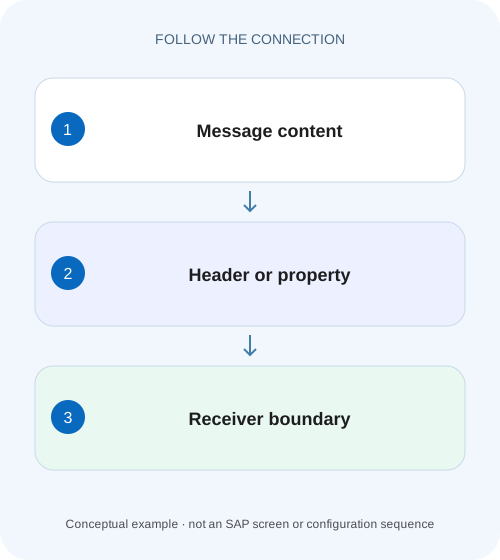
Preserve meaning across a supplier-message flow
A manufacturer's supplier integration moves context through processing steps and an external receiver that do not all preserve headers and properties identically.
Choose storage by who should see the value
Use an exchange property for temporary internal processing state and a message header when the supported receiver contract needs a header.
Understand the exchange and message lifecycles
A message has its body and headers, while the exchange provides a container for additional processing state.
Worked case: route an order internally and publish one correlation value
Imagine a flow receiving order ORD-1001 for sales area NORTH with quantity 4.
Preserve meaning across a supplier-message flow
A manufacturer's supplier integration moves context through processing steps and an external receiver that do not all preserve headers and properties identically.
Check the intended boundary and actual message state before assuming an internal property reaches the remote business application.
| Reader | Business question | Evidence to carry forward |
|---|---|---|
| SAP developers and application teams supporting manufacturers | Preserve meaning across a supplier-message flow | Check the intended boundary and actual message state before assuming an internal property reaches the remote business application. |
01 Choose storage by who should see the value
Use an exchange property for temporary internal processing state and a message header when the supported receiver contract needs a header. In SAP Cloud Integration, headers and properties are separate namespaces. For HTTP-based receiver adapters, exchange properties are not automatically converted into outbound HTTP headers, while message headers can cross that boundary according to adapter configuration. Creating a value is different from deliberately publishing it. [1] [2]
This lesson is for integration developers using Content Modifier and supported Cloud Integration expressions. You need a development integration flow, a sanitized sample message and an approved test receiver that can report request headers safely. Adapter forwarding and framework-provided names vary, so check the exact adapter documentation. The example names prefixed fss are authored teaching names and have no built-in SAP meaning.
02 Understand the exchange and message lifecycles
A message has its body and headers, while the exchange provides a container for additional processing state. Properties can hold values needed while the exchange runs. That makes them useful for routing decisions, lookup keys and values saved before a body transformation. They are not a durable database and should not be assumed to survive an unrelated invocation or a separately designed persistence boundary. [2]
Headers can be set by inbound messages, adapters, Content Modifier and other processing steps. A familiar name does not establish that its value is trustworthy or that the current step created it. Follow the assignment and overwrite sequence. A header that controls a dynamic endpoint deserves particular attention because inbound user input could otherwise influence a later receiver call.
03 Worked case: route an order internally and publish one correlation value
Imagine a flow receiving order ORD-1001 for sales area NORTH with quantity 4. Internally it selects route WHOLESALE and saves the original order reference for reconciliation. The receiver contract requires HTTP header X-Correlation-ID with value demo-ORD-1001. It does not require an internal route flag or the complete original payload in HTTP headers.
Store the internal choice as exchange property fssRoute and the order reference as fssOrderRef. Set the required outbound header deliberately near the receiver boundary. If fssRoute is accidentally created as a header, it may be forwarded unnecessarily. If X-Correlation-ID is stored only as a property, the receiver will not receive it automatically. These two mistakes have opposite symptoms despite using the same text value.
| Value | Storage | Reason |
|---|---|---|
| WHOLESALE | Property fssRoute | Internal routing decision |
| ORD-1001 | Property fssOrderRef | Internal reconciliation key |
| demo-ORD-1001 | Header X-Correlation-ID | Explicit receiver contract |
| Original XML payload | Body or supported internal design | Avoid stuffing payload into headers |
04 Configure the values with the intended expression namespace
In Content Modifier, define the internal property and outbound header in their respective areas. If the receiving step supports dynamic expressions, use the documented property or header reference appropriate to that field. The examples below show the namespace distinction; they are configuration expressions, not an executable Groovy program or a universal syntax for every mapping language. [3]
After creating fssOrderRef from the sanitized input, a later supported expression can read ${property.fssOrderRef}. Reading ${header.fssOrderRef} asks for a different value, even if the property exists. If the expression yields empty output, first verify the namespace and assignment step before replacing the payload extraction with an overly broad XPath.
Internal order reference: ${property.fssOrderRef}
Explicit header reference: ${header.X-Correlation-ID}
Authored correlation value: demo-ORD-1001
05 Trace creation, mutation and consumption across the flow
Make a small value ledger with one row for each relevant step. Record whether the current value is absent, assigned, overwritten or consumed. Include Request Reply, scripts and Content Modifier steps that can change headers or the body. A property saved before an external lookup can preserve the original key while the body becomes a lookup response.
In the worked flow, step 1 extracts ORD-1001 into fssOrderRef; step 2 derives WHOLESALE into fssRoute; step 3 calls a lookup; step 4 builds the business payload; step 5 sets X-Correlation-ID. If the header is correct before the lookup but wrong at the receiver, inspect the intervening assignments. Do not assume the first successful trace snapshot describes the final outbound request.
Give each value an owner and purpose. Avoid using one name alternately for a property and header unless the translation is intentional and documented. Names such as status or id become hard to interpret after several lookups. fssOrderRef communicates the business identity more clearly than a generic temporary variable.
Use distinctive harmless sentinel values while debugging, such as internal-ORD-1001 and outbound-ORD-1001. If the receiver observes the internal sentinel, the leak is visible without exposing actual business data. Remove those temporary fixture values after the verification and retain only the intended contract field.
06 Validate inbound values before allowing them to control processing
A caller can supply headers as well as a body. If the flow uses an inbound route flag, first establish whether the interface permits the caller to choose that route. Otherwise derive the internal decision from trusted configuration and validated business data. Merely copying an inbound header into a property changes storage scope, not trustworthiness.
For example, an inbound fssRoute value of ADMIN should not bypass the flow’s sales-area rules. Reject unsupported values or compute the permitted result independently. If the route controls a dynamic address, constrain it to the approved set and follow the adapter’s supported dynamic configuration. An exchange property can still contain an unsafe endpoint if the flow populates it from unchecked input.
07 Review the outbound header set at the receiver boundary
Inspect which headers the receiver adapter forwards and which framework-provided headers it interprets. Remove unneeded business or temporary headers through supported configuration or a Content Modifier, while preserving required protocol and authentication behavior. A blanket deletion can remove something the adapter needs; a blanket forwarding policy can expose something the partner never requested.
SAP documents header-size constraints for HTTP receivers and recommends removing headers that should not be outbound. Do not treat an illustrative kilobyte range as a universal limit; receiver servers and proxies impose their own constraints. The practical design is to keep headers small and purposeful. A full XML document, a large lookup response or a base64 attachment belongs in an appropriate payload or storage design, not a casual header. [2]
08 Distinguish internal properties from persistence and cross-flow contracts
An exchange property is useful temporary state during processing. It is not a promise that another independent integration flow will see the value. If the design calls another flow, uses a queue or stores a message, inspect that specific component’s supported propagation behavior. A value surviving one local processing path does not prove it survives every boundary.
Design explicit contracts at those boundaries. If the receiving flow needs the original order reference, include it through the supported message or header contract rather than relying on an undocumented memory assumption. For durable reconciliation, use the appropriate supported persistence mechanism and business key. Also consider how retries reconstruct state: a temporary lookup result may need to be recomputed or included deliberately in the persisted message.
09 Troubleshooting by where the value disappears or leaks
Compare the actual value immediately before its consumer and at the outbound receiver. This separates a missing assignment from wrong namespace, overwrite and adapter behavior. Keep trace use short and sanitized; tracing every production payload is not required to prove a header/property mistake.
| Observation | Likely question | Next check |
|---|---|---|
| Property exists, receiver header absent | Was publication configured? | Explicit outbound header and adapter contract |
| Expression returns empty | Is the correct namespace read? | header versus property reference |
| Value changes after a call | Which step overwrote it? | Step-by-step value ledger |
| Receiver sees internal flag | Was it created or forwarded as a header? | Header assignments and outbound allowlist |
| HTTP header too large | Was payload stored in a header? | Header sizes and unneeded values |
| Other flow cannot read property | Did the boundary propagate it? | Explicit cross-flow contract |
10 Verify with distinctive values and a small test receiver
For the positive case, send ORD-1001 and confirm that the internal route is WHOLESALE while the receiver gets X-Correlation-ID: demo-ORD-1001. The receiver should not get fssRoute or fssOrderRef merely because those properties exist. Inspect the actual request rather than relying on the final Content Modifier view.
For a negative case, omit the order reference and verify the flow follows its explicit validation contract. It should not send a correlation value left over from an earlier message or a literal unresolved expression. For a trust-boundary case, send an unexpected inbound route header and confirm that it cannot override the approved routing rules.
For a boundary case, create both a header and property called fssOrderRef with different harmless values in an isolated test. Read each namespace and verify the expected distinction. Then remove the ambiguity from the production design. This exercise demonstrates why matching names are not interchangeable scopes.
If the flow branches or splits, test the value at each relevant branch consumer. Do not infer propagation from the straight-line example. Record the actual supported component behavior and ensure a branch does not accidentally overwrite a value needed elsewhere.
11 Questions that make the design maintainable
Are properties always safer? They reduce accidental HTTP header publication for internal state, but they can still hold untrusted or sensitive data. Validate inputs and avoid logging secrets regardless of storage location.
Can I use a property in message mapping? Use the mapping feature’s documented mechanism. A Content Modifier expression and an XSLT or message-mapping expression do not necessarily use identical syntax. The related mapping lesson explains structural and business validation after values are available.
What should the handoff say? List each non-body value, its owner, storage namespace, creation and consumption points, and whether it crosses a receiver or persistence boundary. That small contract lets another developer extend the flow without accidentally publishing internal state or losing required metadata.
Related services and next steps
Primary sources
Found this useful?
Share this guide with your network, or leave a like.
Your like is saved in this browser.