Integration Suite says Completed, but the business action failed: What to inspect
A manufacturer's integration run is technically completed, but the receiver's response rejects the supplier invoice for a business reason.

Source review:
START HERE · NO PRIOR TOPIC KNOWLEDGE NEEDED
What it is. Why it matters.
An integration run can finish technically while the receiving business application rejects its content. Technical delivery and business acceptance therefore need separate evidence.
Completely new to SAP?
Manufacturers use SAP to connect work such as buying components, recording inventory, planning production, shipping equipment and accounting for costs. SAP S/4HANA is an enterprise resource planning system: it connects these activities through shared business data.
SAP Business Technology Platform, or BTP, provides cloud services for applications, data and integration. A connection needs a route, an identity and permission to perform the intended task.
A transaction code, or t-code, is a shortcut to a task in classic SAP GUI. Fiori apps provide another way to work. Names and screens depend on the product and release; you do not need a live system to learn the concepts in this guide.

Scope and source-review notes
Scope and evidence
Source review by FAST SAP SOLUTIONS® editorial. This badge describes our editorial review; it does not represent SAP certification or independent endorsement.
SAP Integration Suite Cloud Integration response-handling pattern. Adapter behavior and receiver contracts determine the applicable implementation.
Documentation review on 14 November 2026 using official SAP sources and indexed official excerpts where full Help text was unavailable. Scope and service or release differences are explained in the lesson. All datasets, requests and checks are illustrative; no customer SAP runtime execution or measured results are claimed.
A MANUFACTURING EXAMPLE
Explain a rejected supplier invoice after HTTP success
Technical completion is one result
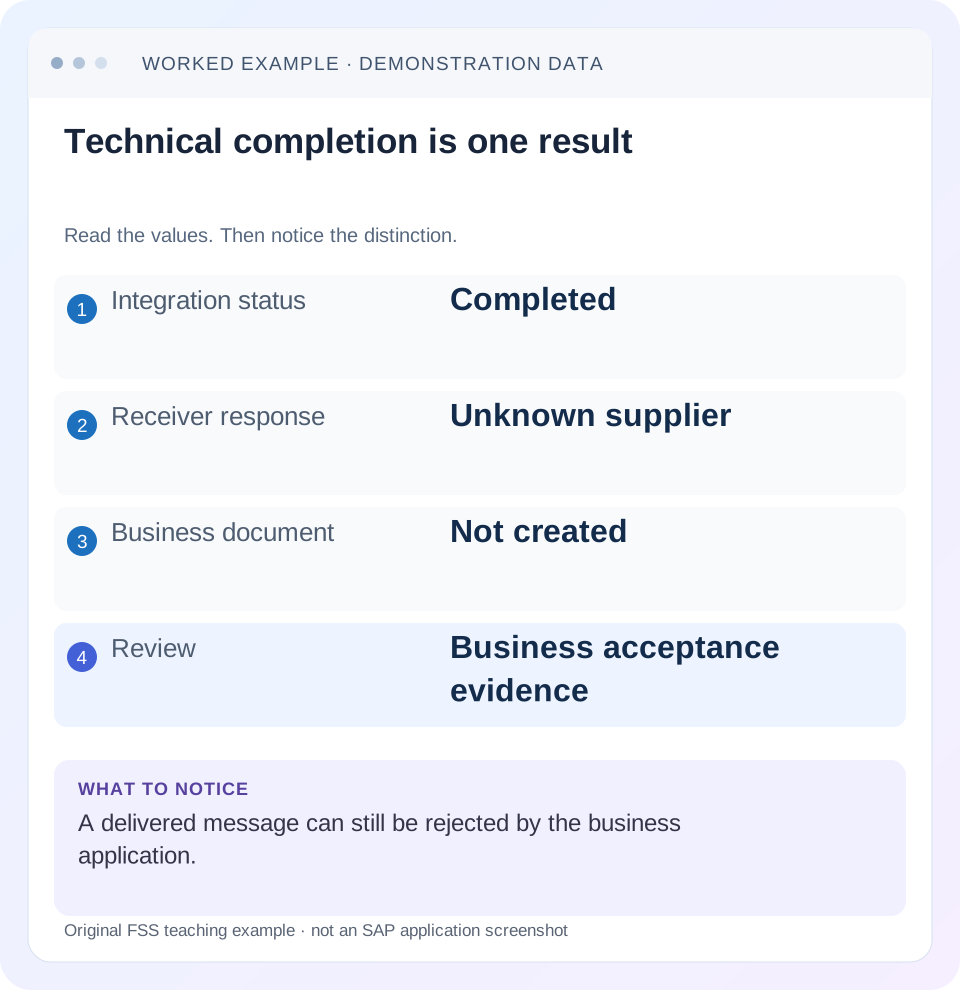
Read the example values
- Integration status
- Completed
- Receiver response
- Unknown supplier
- Business document
- Not created
- Review
- Business acceptance evidence
Words you’ll meet in this guide
- Backend
- The service or system doing the work behind an interface.
- Destination
- Named connection settings for another service.
- Credential
- Access information used to prove an identity.
- Subaccount
- A BTP scope for applications, services and access settings.
- API
- A defined interface through which programs exchange data or request actions.
- HTTP
- The request-and-response protocol used by web applications and APIs.
Preview the practical steps
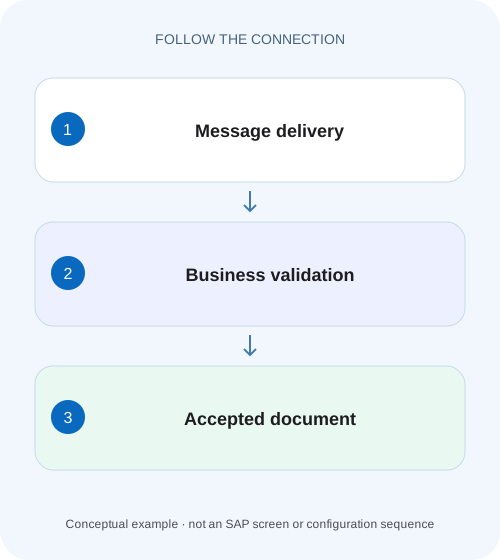
SEE THE CONNECTION
See it in a simple example.
A small example to make the idea concrete.
Explain a rejected supplier invoice after HTTP success
A manufacturer's integration run is technically completed, but the receiver's response rejects the supplier invoice for a business reason.
Completed describes flow processing, not every business outcome
A Cloud Integration message can finish Completed even though the receiver rejected the requested business action.
Separate transport, integration and business evidence
Transport evidence answers whether an HTTP exchange or other protocol operation completed.
Worked case: HTTP 200 contains an unknown-supplier rejection
Imagine a fictional receiver API accepting invoice EXT-8001 with supplier V404 and amount 120.00 EUR.
Explain a rejected supplier invoice after HTTP success
A manufacturer's integration run is technically completed, but the receiver's response rejects the supplier invoice for a business reason.
Read the response contract and business result before treating transport success as successful posting.
| Reader | Business question | Evidence to carry forward |
|---|---|---|
| SAP developers and application teams supporting manufacturers | Explain a rejected supplier invoice after HTTP success | Read the response contract and business result before treating transport success as successful posting. |
01 Completed describes flow processing, not every business outcome
A Cloud Integration message can finish Completed even though the receiver rejected the requested business action. This occurs when the receiver communicates an error inside a technically successful response and the flow does not interpret it, or when an exception is handled through a path designed to end normally. Inspect the receiver contract and the flow’s response handling before concluding that an invoice or order was posted. [1] [3]
This tutorial is for developers and operations analysts investigating a missing business result. You need the deployed flow version, message-processing-log identity, a sanitized receiver response and a supported business lookup. It focuses on Cloud Integration, not a universal interpretation of every Integration Suite capability. Response fields below are an authored example contract, not a standard SAP API payload.
02 Separate transport, integration and business evidence
Transport evidence answers whether an HTTP exchange or other protocol operation completed. Integration evidence answers which flow steps ran and how they ended. Business evidence answers whether the intended object was accepted, created or changed in the receiver. A design may deliberately treat a business rejection as a successfully delivered rejection response, so its monitoring status must be interpreted in that context.
Define the expected action precisely. “Invoice sent” is ambiguous. “Receiver created one invoice for external reference EXT-8001 in company code 1000” is testable. If the interface is asynchronous, identify its later acknowledgment or status resource. The sender’s initial accepted response cannot stand in for that later business evidence.
03 Worked case: HTTP 200 contains an unknown-supplier rejection
Imagine a fictional receiver API accepting invoice EXT-8001 with supplier V404 and amount 120.00 EUR. It returns HTTP 200 with accepted false, no documentId and error code SUPPLIER_UNKNOWN. The integration flow forwards the response without examining accepted and ends Completed. Operations sees a green run, but a receiver lookup confirms no invoice was created.
The defect is not that HTTP 200 universally means failure. The defect is that this interface’s documented business result is carried in fields the flow ignored. A different API may correctly use a 4xx response or a later asynchronous acknowledgment. Write the contract for this actual receiver before designing a parser or status rule.
{"externalReference":"EXT-8001","accepted":false,"documentId":null,"messages":[{"severity":"ERROR","code":"SUPPLIER_UNKNOWN","text":"Supplier V404 is not available in target context"}]}04 Find the receiver response belonging to the exact attempt
Use message monitoring to locate the flow, timestamp and message identity. SAP documents opening processed-message details and inspecting error information, with tracing as a further diagnostic when needed. A Completed message may have no platform exception, so compare the actual response handling and available approved diagnostics rather than expecting a red error tile. [2]
Preserve the sanitized response and its relationship to EXT-8001. If payload evidence is unavailable, reproduce the contract in an authorized development fixture or use a supported receiver status lookup. Do not enable broad, indefinite tracing simply because the first monitor view lacks a response. Define the message, time window and sensitive-field handling for any additional diagnostics.
05 Turn the response contract into an explicit decision
For the fictional contract, success requires accepted true and a nonempty documentId identifying the intended invoice. A business rejection has accepted false with a documented reason. Missing fields, invalid JSON or contradictory combinations such as accepted true with no required document identity should be handled as a contract or uncertain-outcome error, not silently converted into success.
Use the flow’s supported parsing, router, mapping or scripting mechanism to implement those decisions. This lesson does not invent an SAP built-in accepted field. The field is specific to the fictional receiver. Keep the rule close to the receiver response boundary so a later transformation does not discard the evidence before it is interpreted.
| Response shape | Meaning under this example contract | Handling |
|---|---|---|
| accepted true + documentId | Receiver confirms creation | Return/record business success |
| accepted false + business code | Explicit business rejection | Actionable rejection or exception path |
| accepted true + missing documentId | Contradictory response | Contract error; reconcile before replay |
| Malformed or missing response | Outcome uncertain | Diagnostic and receiver lookup |
06 Choose the operational outcome deliberately
SAP’s successful-response error-handling guidance describes options including additional log information, a custom sender response or raising an integration error. Choose based on who must act and what the sender contract promises. A synchronous caller may need a clear business rejection payload. An asynchronous process may need a durable exception work item and alert with a business reference. [1]
Do not throw an exception for every warning merely to force a red status. A warning can accompany a valid created document. Classify severity and codes according to the receiver’s contract, including whether partial acceptance is possible. Likewise, do not suppress an error merely to reduce monitoring noise. The status, sender response and recovery process should tell the same story.
07 Review exception end events and nested processing scope
An exception subprocess can catch an error, log information and end with a normal message end event. SAP documents examples where this yields Completed even though an exception occurred. Error End is used for a different propagated-failure outcome. Inspect the end event and the containing process rather than assuming that the presence of an exception subprocess always makes monitoring Failed. [3]
When a local or connected flow is involved, trace which process catches the error and what it returns to its caller. A lower-level flow may produce an error object that the parent treats as a normal response. A parent can also intentionally convert a rejection into a final business response. Record both technical status and business classification, especially in splitter/gather designs with partial results.
08 Distinguish corrective rejection from retryable failure
SUPPLIER_UNKNOWN normally requires corrected input, mapping or prerequisite master data. Retrying the unchanged request every minute does not create supplier V404. A temporary receiver outage can be retryable. A lost response after submission is uncertain and needs reconciliation. Build the recovery classification from the actual operation and receiver behavior.
In the fixture, validate whether V404 is the correct business supplier and target context. If a value mapping should have produced V100, repair that mapping with the proper agency and identifier context. If master data is missing, follow the authorized business process. Do not replace V404 with a known existing supplier merely to obtain a successful document.
09 Reconcile before resending an ambiguous request
Query the receiver using the stable external reference and required organizational context. If EXT-8001 already exists, compare amount, supplier and document state. A timeout or parsing failure can happen after a commit. Resending as a new reference can bypass duplicate protection and create a second invoice.
If the receiver confirms explicit rejection and no document, replay through the supported correction process once prerequisites are repaired. If the lookup remains inconclusive, retain the uncertain state and escalate to the responsible application investigation with the exact identifiers. Do not convert uncertainty into an automatic success or an unbounded retry.
Where partial business effects are possible, list them. An API could create a header and reject some items, or post one object in a bulk request while rejecting another. A single boolean at parent level may not be enough; the design must reconcile the result granularity promised by that API.
10 Troubleshooting decisions for a green run and missing object
Follow the first discrepancy between the expected action and observed evidence. A missing document can also result from the wrong receiver system or client, not just an ignored business error. Verify environment identity before modifying response rules.
| Observation | Question | Next evidence |
|---|---|---|
| HTTP 200, accepted false | Did the flow inspect business fields? | Receiver contract and response-handling branch |
| Exception handled, Completed | How did the handler end? | Message End versus Error End and parent scope |
| Document ID returned, lookup empty | Is the lookup in the correct system/context? | Receiver identity, client and organizational keys |
| Timeout after submission | Could the receiver have committed? | External-reference lookup and receiver logs |
| Some items missing | Does the API allow partial acceptance? | Per-item result and recovery ledger |
| Warning plus document created | Is the warning nonfatal? | Document identity and documented warning meaning |
11 Verify accepted, rejected and contradictory responses
For a positive fixture, return accepted true with documentId INV-90001 and verify that the flow records business success for EXT-8001. For a negative fixture, return the illustrated supplier rejection and verify the sender and operations receive an actionable outcome. The response must retain the safe business reference and reason without leaking unnecessary payload data.
For boundary fixtures, return accepted true without a document ID, an empty response and a partial item result. Verify each follows its explicit contract rule. Also test a valid created document accompanied by a warning so the flow does not classify every message array as failure. These tests should assert business identity and classification, not merely the final monitor color.
Finally verify a timeout/uncertain case against the duplicate-reconciliation design. The expected behavior is a lookup or controlled investigation before a potentially duplicating replay. Status interpretation and idempotency are connected: fixing the monitor while leaving replay unsafe is an incomplete repair.
12 Questions to settle before closing the case
Should every business rejection make the integration Failed? Not universally. A flow can successfully return a rejection as part of an agreed synchronous contract. What matters is that callers and operations can distinguish it from an accepted business action and know the next step.
Can I trust the document ID alone? Compare it with the intended external reference, receiver context and documented result state. Some interfaces return an intermediate request ID rather than the final business document identity.
What belongs in the handoff? Include flow version, message ID, business reference, receiver response classification, actual document outcome and recovery disposition. The related synchronous/asynchronous and idempotency lessons explain how those meanings change when acknowledgment and business completion occur at different times.
Related services and next steps
Primary sources
Found this useful?
Share this guide with your network, or leave a like.
Your like is saved in this browser.