SAP supplier consignment: Separate stock ownership, withdrawal and settlement
A machinery plant holds supplier-owned bearings beside its assembly line; stores has received them, but purchasing needs to distinguish delivery from ownership and settlement.

Source review:
START HERE · NO PRIOR TOPIC KNOWLEDGE NEEDED
What it is. Why it matters.
Supplier consignment stock can be physically at your site while still owned by the supplier. Relevant withdrawals or transfers create the settlement question under the configured process.
Completely new to SAP?
Manufacturers use SAP to connect work such as buying components, recording inventory, planning production, shipping equipment and accounting for costs. SAP S/4HANA is an enterprise resource planning system: it connects these activities through shared business data.
Materials Management supports purchasing and inventory. A request, order, goods receipt and supplier invoice describe separate events, each with its own record and status.
A transaction code, or t-code, is a shortcut to a task in classic SAP GUI. Fiori apps provide another way to work. Names and screens depend on the product and release; you do not need a live system to learn the concepts in this guide.

Scope and source-review notes
Scope and evidence
Source review by FAST SAP SOLUTIONS® editorial. This badge describes our editorial review; it does not represent SAP certification or independent endorsement.
Supplier consignment in classic Inventory Management and Logistics Invoice Verification. Ownership-transfer/consumption movements, applicable conditions, returns, settlement grouping and accounting depend on the approved installed process.
Reviewed the cited official SAP indexed documentation excerpts on 14 November 2026. Direct Help Portal opens did not consistently expose readable page text. This is documentation-based teaching, not customer-system execution. All document identifiers, quantities and outcomes in the worked case are illustrative; installed release, edition, configuration and authorizations require local verification.
A MANUFACTURING EXAMPLE
Explain supplier-owned bearings
Stored quantity differs from withdrawn
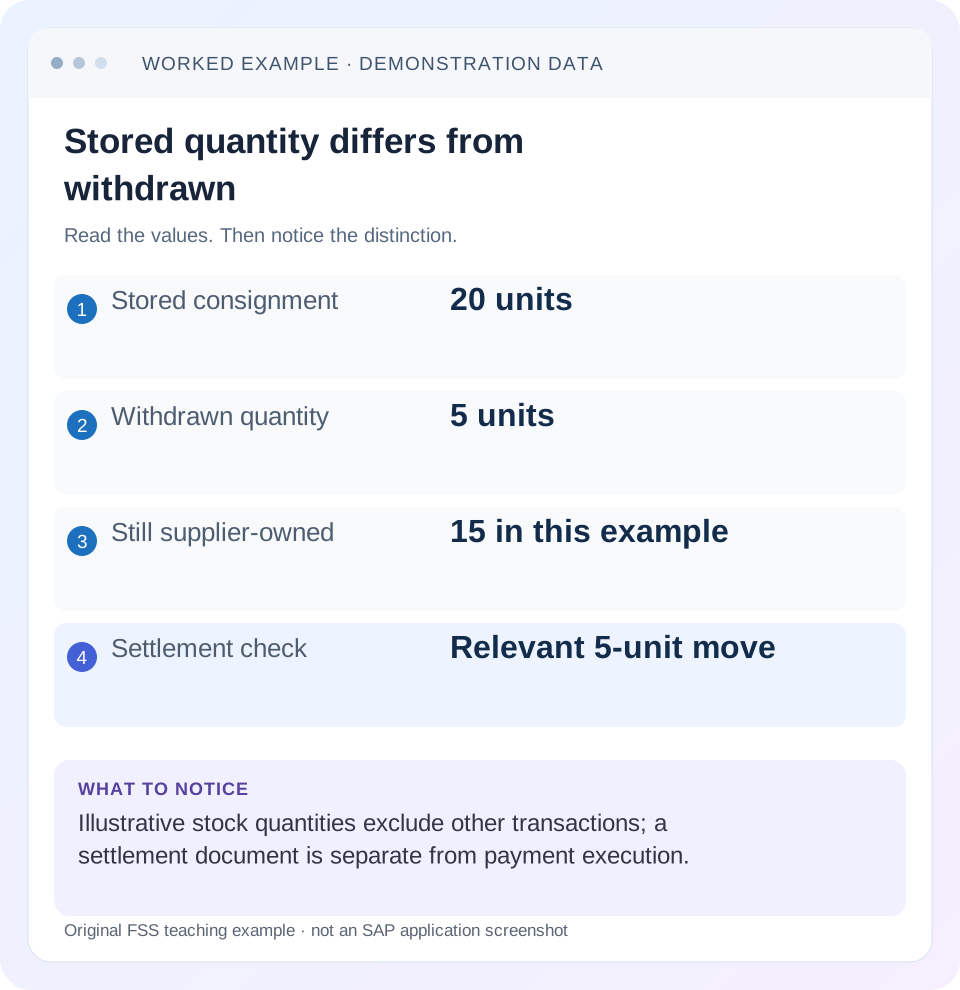
Read the example values
- Stored consignment
- 20 units
- Withdrawn quantity
- 5 units
- Still supplier-owned
- 15 in this example
- Settlement check
- Relevant 5-unit move
Words you’ll meet in this guide
- Material
- A product or supply item managed in SAP.
- Plant
- An organizational unit for relevant logistics operations.
- Goods receipt
- A recorded receipt of goods in a business process.
- Purchase order
- A purchasing document requesting goods or services from a supplier or supplying plant.
- Invoice
- A supplier’s bill for goods or services.
- HANA
- SAP’s database platform.
Preview the practical steps
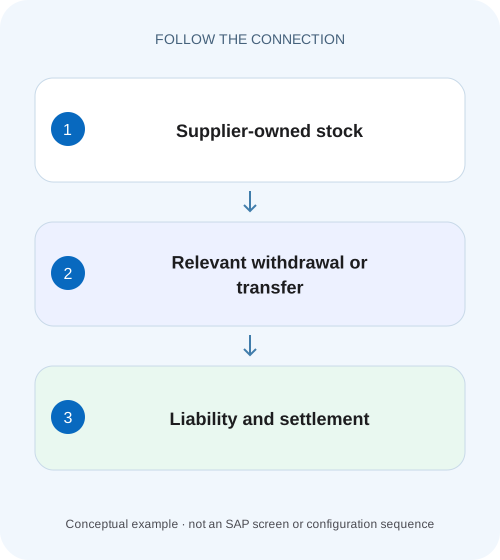
SEE THE CONNECTION
See it in a simple example.
A small example to make the idea concrete.
Explain supplier-owned bearings
A machinery plant holds supplier-owned bearings beside its assembly line; stores has received them, but purchasing needs to distinguish delivery from ownership and settlement.
Separate location, ownership and liability
Supplier consignment lets goods be physically at your site while ownership remains with the supplier until the relevant withdrawal or transfer into company-owned stock.
Scope and prerequisites
The scope is supplier consignment in classic Inventory Management and Logistics Invoice Verification, with supporting ERP and S/4HANA documentation.
Why a consignment receipt is not the liability trigger
A consignment receipt records that supplier-owned goods arrived.
Explain supplier-owned bearings
A machinery plant holds supplier-owned bearings beside its assembly line; stores has received them, but purchasing needs to distinguish delivery from ownership and settlement.
Follow the receipt, actual withdrawal and settlement evidence separately rather than treating all stock at the plant as company-owned.
| Reader | Business question | Evidence to carry forward |
|---|---|---|
| Plant stores, warehouse and materials teams | Explain supplier-owned bearings | Follow the receipt, actual withdrawal and settlement evidence separately rather than treating all stock at the plant as company-owned. |
01 Separate location, ownership and liability
Supplier consignment lets goods be physically at your site while ownership remains with the supplier until the relevant withdrawal or transfer into company-owned stock. Receiving twenty consignment units is therefore different from buying twenty ordinary stock units. The physical balance, ownership balance and liability each answer a different question.
This tutorial follows the existing twenty-unit teaching example through a five-unit withdrawal and settlement. You will reconcile what remains supplier-owned, which movement creates the settlement question and what a settlement document proves. It is particularly useful when warehouse staff say “we have received it” and accounts payable ask why no normal supplier invoice should be entered.
02 Scope and prerequisites
The scope is supplier consignment in classic Inventory Management and Logistics Invoice Verification, with supporting ERP and S/4HANA documentation. Customer consignment is a different process. Subcontracting is also different: your components can be physically at a supplier while remaining your property, reversing the location/ownership relationship in this example.
Before investigating, obtain supplier, material, plant, consignment-stock context, posting dates, relevant conditions and movement references. Display access to stock, PO history where applicable, material documents and settlement/accounting evidence is needed. Proposed settlement and correction checks require an authorized training process. Tax, currency and valuation details remain subject to the installed accounting configuration.
03 Why a consignment receipt is not the liability trigger
A consignment receipt records that supplier-owned goods arrived. The subsequent relevant withdrawal or transfer establishes the ownership/consumption event that the settlement process needs. Do not infer a payable for every unit merely because the goods are on company premises. Conversely, a withdrawal can create a liability before the periodic settlement has been run. [1] [2]
The material and supplier context matter because the same material can be present as company-owned stock and as supplier consignment. A stock display that totals physical quantities can conceal that distinction. Retain the special-stock and supplier identity in any extract used for reconciliation.
A transfer into company-owned stock and direct consumption have different operational meanings even where both produce settlement-relevant consignment events. Record the actual movement purpose and resulting stock context; the word “withdrawal” alone should not erase that distinction.
04 Worked case: twenty received, five withdrawn
The fictional site receives twenty supplier-owned units of PART-C from supplier S100. There are no other starting balances or movements. Five units are subsequently withdrawn through the approved consignment process. Fifteen units remain in the supplier-owned consignment context, while the five-unit event becomes the settlement question.
Assume solely for the value exercise that the applicable consignment condition is 10 currency units per unit, with no taxes, exchange effects or additional charges. The simplified withdrawal value is 5 × 10 = 50. The twenty-unit physical receipt does not imply a 200 settlement for all goods. The actual system value must still be established from the relevant conditions and accounting documents.
A periodic settlement then includes the five-unit event. Its document is separate from payment execution. After settlement, the supplier may still be unpaid, depending on the resulting open item and payment process. “Received,” “withdrawn,” “settled” and “paid” should therefore be separate states in a support report.
| Event | Supplier-owned quantity on site | Settlement interpretation |
|---|---|---|
| Receive 20 units | 20 units | Physical receipt; do not settle all stock |
| Withdraw 5 units | 15 units | Relevant five-unit liability event |
| Settle the event | 15 units | Settlement document for selected movement |
| Pay resulting supplier item | 15 units | Separate accounting/payment evidence |
05 Read the condition and organizational context
Check the actual supplier/material purchasing relationship and applicable pricing context before reproducing the value. A price displayed on an unrelated standard PO is not necessarily the consignment condition relevant to the withdrawal. Capture validity, unit, currency and organizational scope. Align the withdrawal quantity with the price unit before calculating. [3]
If the condition is quoted per box but the withdrawal is in pieces, establish the documented conversion. A difference between fifty and five hundred can be a price-unit interpretation problem rather than ten times as much consumption. Keep quantity reconciliation and valuation reconciliation separate until each has a sound basis.
Also retain company code and posting period. SAP’s documented settlement processing groups results according to relevant organizational/currency criteria; do not predict a single invoice document merely because the selection contains one supplier.
06 Investigate stock and movement evidence in sequence
Start with the physical/ownership question and only then move to settlement. This prevents a financial run from being used as an attempt to discover what happened in receiving.
Identify the consignment stock
Display the supplier-specific material/plant stock and compare the twenty-unit receipt reference. Distinguish company-owned quantities.
Expected observation: The starting supplier-owned quantity is established.
Find the five-unit event
Read the actual withdrawal or ownership-transfer document, date, quantity, unit and supplier context. Include corrections.
Expected observation: The settlement candidate is supported by a specific movement.
Inspect existing settlement status
Use the supported settlement display to distinguish unsettled and already settled withdrawals and their document references.
Expected observation: The event is not inadvertently selected for duplicate handling.
Trace accounting and payment separately
After authorized settlement, inspect the resulting accounting/open-item evidence and any later payment reference.
Expected observation: Settlement and payment conclusions have independent evidence.
07 Display before settlement and reconcile the selection
SAP documents display options for unsettled withdrawals and settled withdrawals, including restriction to relevant invoice documents. Use the display function first to establish the actual selected population. Confirm supplier, material, period and organizational criteria and compare the list with the five-unit event expected in this case. [3] [4]
If the list contains more events, investigate their references instead of settling an unexplained total. Another warehouse or an ownership transfer can legitimately add movements. If it contains none, check whether the event is already settled, outside selection or not the kind of movement assumed.
For a permitted settlement run, retain selection criteria, processing result and resulting document references. The documented process can create invoice or credit-memo evidence and supplier communication. An output record being created is not proof that the supplier received it; output processing has its own evidence.
08 Returns and corrections need their original relationship
Suppose two of the five withdrawn units are returned through an approved process. Do not simply edit the worksheet to three and discard the original five-unit movement. Retain the return/correction reference, its date and whether the original event had already been settled. The resulting financial treatment must follow the supported process.
If the return restores supplier-owned stock in this simplified scenario, the physical/ownership balance would become seventeen. That is a conditional illustration, not a universal rule that every return restores consignment ownership. A return of company-owned stock to a supplier or a reversal of a consumption posting can have different document meanings.
When a settled event is corrected, inspect the resulting settlement/correction documents and open items. A later credit or offset is not the same as the original settlement never having existed. Preserve both to explain period differences.
09 Troubleshooting decisions
A low consignment balance and an unsettled liability can both be correct at a point in time. Use the question being asked to decide which evidence matters.
| Observation | Distinction | Next useful evidence |
|---|---|---|
| Goods on site but no standard invoice | Ownership versus physical receipt | Consignment receipt and supplier-stock context |
| Stock fell by five, no settlement yet | Movement liability versus periodic settlement | Five-unit document and unsettled list |
| Selection total exceeds five | Expected case versus complete selection | Other movements, dates and organization |
| Event missing from unsettled list | Not selected versus already settled | Settled display and document references |
| Settlement exists, supplier unpaid | Settlement versus payment | Supplier open item, blocks and payment evidence |
| Value differs from worksheet | Quantity versus condition basis | Price unit, currency, validity and tax context |
10 Common mistakes that conceal ownership
Do not combine company-owned and supplier-owned quantities and then call the total “our stock value.” Physical totals can be useful, but ownership and valuation must remain visible. A warehouse bin is a location, not a legal ownership rule. [3] [4]
Do not enter an ordinary supplier invoice merely because the periodic settlement has not happened yet. SAP documents the settlement process for relevant withdrawals without expecting the ordinary supplier-invoice step for those events. First establish the correct process and existing documents.
Do not rerun settlement blindly after an unclear response. Inspect the existing results and selected events. A timeout or missing printout is a communication symptom; it does not prove no accounting document was created.
11 Verification exercises
For a positive worksheet check, reconcile twenty received less five relevant withdrawals to fifteen remaining supplier-owned units, under the stated no-other-movements assumption. Separately calculate the fifty-unit simplified value and connect the withdrawal with one intended settlement result.
For a negative check, try to justify a settlement of all twenty units from the receipt alone. Identify the missing ownership/liability evidence. Then put the same material under a different supplier and explain why that stock must not be pooled into S100’s settlement selection.
For boundary checks, include an already settled event, an event just outside the selected period and a supported return/correction. Verify that selection, settlement and accounting evidence account for each separately. In a training system, capture actual outcomes rather than marking these proposed tests as executed.
12 Questions and the handover
Does settlement mean paid? No. Trace the resulting supplier accounting item and payment evidence. Does a consignment quantity belong to the company? The supplier-owned context and relevant ownership-transfer events decide that question; physical location alone does not.
Can the same material have several ownership contexts? That is precisely why the supplier and special-stock context must be retained. A material-level total may answer a physical-capacity question while remaining unsuitable for liability reconciliation.
A useful result for this example states: “Twenty PART-C units arrived in S100 consignment, five were withdrawn on WD-A and fifteen remain in that context. WD-A is the fifty-value simplified settlement case. SET-A documents settlement; payment remains a separate check.” Continue with subcontracting and stock-overview lessons when location and ownership are still being confused.
Related services and next steps
Primary sources
Found this useful?
Share this guide with your network, or leave a like.
Your like is saved in this browser.