SAP subcontracting stock at the supplier: Provision is not consumption
A manufacturer provides components to an outside processor and needs to explain what remains at the supplier after finished assemblies are received.

Source review:
START HERE · NO PRIOR TOPIC KNOWLEDGE NEEDED
What it is. Why it matters.
Subcontracting provided stock consists of company-owned components held at a supplier. Providing those components and recording their consumption are different inventory events.
Completely new to SAP?
Manufacturers use SAP to connect work such as buying components, recording inventory, planning production, shipping equipment and accounting for costs. SAP S/4HANA is an enterprise resource planning system: it connects these activities through shared business data.
Materials Management supports purchasing and inventory. A request, order, goods receipt and supplier invoice describe separate events, each with its own record and status.
A transaction code, or t-code, is a shortcut to a task in classic SAP GUI. Fiori apps provide another way to work. Names and screens depend on the product and release; you do not need a live system to learn the concepts in this guide.

Scope and source-review notes
Scope and evidence
Source review by FAST SAP SOLUTIONS® editorial. This badge describes our editorial review; it does not represent SAP certification or independent endorsement.
Classic IM subcontracting with current S/4HANA corroboration of provision/consumption events. Public Cloud/Business Network replication is not assumed for ERP; MRO, special-stock, by-product, batch and valuation behavior need their own scope.
Reviewed the cited official SAP indexed documentation excerpts on 14 November 2026. Direct Help Portal opens did not consistently expose readable page text. This is documentation-based teaching, not customer-system execution. All document identifiers, quantities and outcomes in the worked case are illustrative; installed release, edition, configuration and authorizations require local verification.
A MANUFACTURING EXAMPLE
Reconcile components at a subcontractor
Provision is not consumption
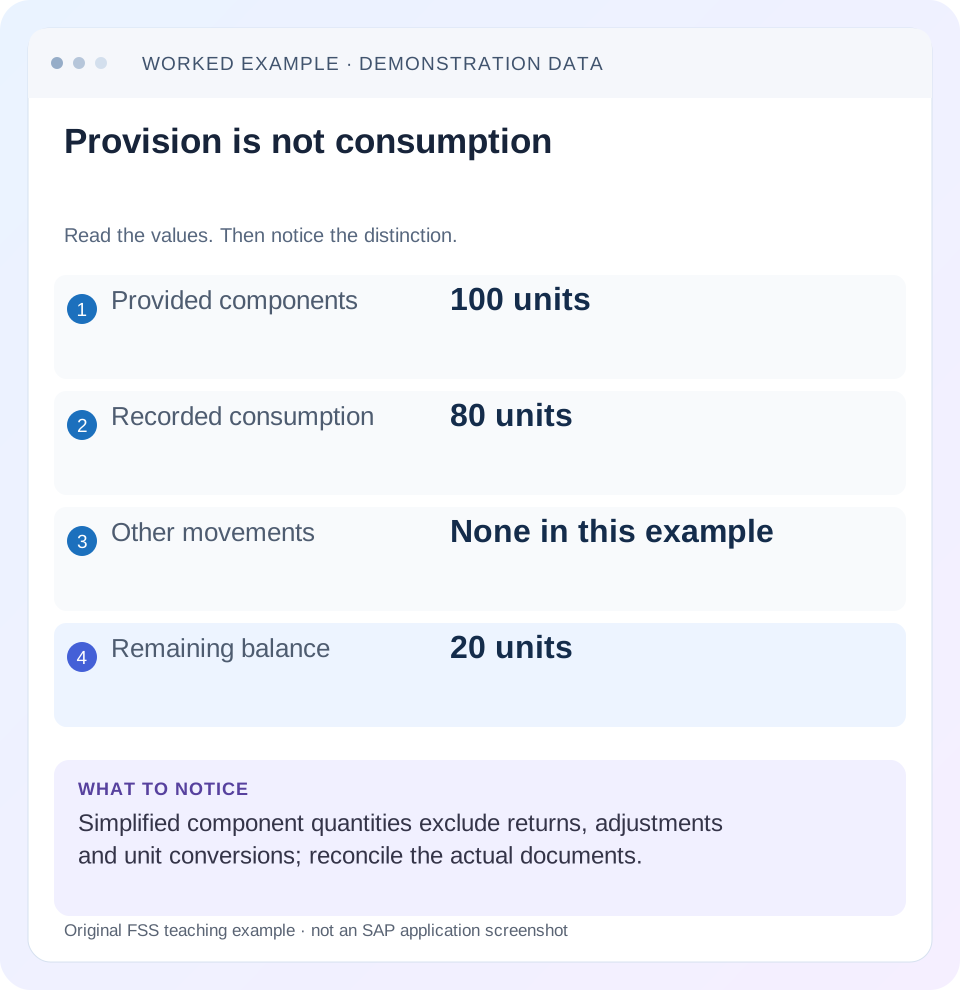
Read the example values
- Provided components
- 100 units
- Recorded consumption
- 80 units
- Other movements
- None in this example
- Remaining balance
- 20 units
Words you’ll meet in this guide
- Material
- A product or supply item managed in SAP.
- Plant
- An organizational unit for relevant logistics operations.
- Goods receipt
- A recorded receipt of goods in a business process.
- Purchase order
- A purchasing document requesting goods or services from a supplier or supplying plant.
- Invoice
- A supplier’s bill for goods or services.
- HANA
- SAP’s database platform.
Preview the practical steps
SEE THE CONNECTION
See it in a simple example.
A small example to make the idea concrete.
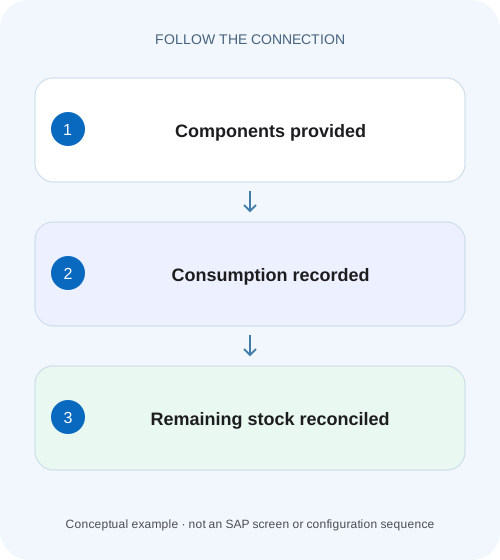
Reconcile components at a subcontractor
A manufacturer provides components to an outside processor and needs to explain what remains at the supplier after finished assemblies are received.
Sending components does not mean they were consumed
Subcontracting provided stock represents components held at the subcontractor for the supported production/procurement process.
Scope and prerequisites
The guide concerns classic Inventory Management subcontracting and supported S/4HANA flows.
Understand provision, output receipt and component consumption
The documented subcontracting process provides components to a supplier and later receives the subcontracted product.
Reconcile components at a subcontractor
A manufacturer provides components to an outside processor and needs to explain what remains at the supplier after finished assemblies are received.
Separate provision from consumption and reconcile the relevant component and receipt evidence before requesting more material.
| Reader | Business question | Evidence to carry forward |
|---|---|---|
| Manufacturing buyers and purchasing managers | Reconcile components at a subcontractor | Separate provision from consumption and reconcile the relevant component and receipt evidence before requesting more material. |
01 Sending components does not mean they were consumed
Subcontracting provided stock represents components held at the subcontractor for the supported production/procurement process. Provision changes where the company’s components are held; consumption records their actual use in connection with the subcontracted output. Treating both events as the same reduction hides what should remain at the supplier. [1] [2]
This tutorial preserves the one-hundred-provided/eighty-consumed example, connects it with output receipts and then adds a subsequent adjustment. The goal is a supplier/component reconciliation that distinguishes location, ownership, consumption and remaining quantity, with every change tied to a document.
02 Scope and prerequisites
The guide concerns classic Inventory Management subcontracting and supported S/4HANA flows. A current Public Cloud/Business Network source corroborates provision and consumption events; its replication setup is not assumed for classic ERP. MRO subcontracting, customer/project stock, by-products and direct supplier-to-supplier provision have additional scope.
Collect subcontracting PO/item, output material, components and required quantities, plant, subcontractor, batch/valuation context, units and all provision/receipt/adjustment references. Obtain authorized stock, purchasing, movement and accounting display access. Proposed postings require a training process and approved supplier consumption evidence.
Do not use a supplier’s spreadsheet alone as the complete SAP balance. It is valuable physical evidence that must be reconciled with the actual stock context and posting dates.
03 Understand provision, output receipt and component consumption
The documented subcontracting process provides components to a supplier and later receives the subcontracted product. The output receipt can generate the associated component-consumption items according to the PO’s component requirements. A supplier shipment notification does not itself prove that these SAP postings occurred. [1]
SAP’s current process reference distinguishes 541 provision and 543 consumption purposes in its documented scope. These identifiers help read evidence, but the installed supported process and reference should determine actual entry rather than a memorized code.
Stock at a subcontractor is different from supplier consignment physically at your site. In the subcontracting fixture, the provided components remain part of the company’s stock context until the relevant consumption or other disposition. Keep the supplier identity and special-stock context in the reconciliation. [3]
04 Worked case: one hundred components, eighty consumed
Fictional PO-S item 10 orders forty assemblies of OUT-A. The illustrative requirement is two PC of component COMP-A per assembly, or eighty components for the forty. The company provides 100 PC of COMP-A to subcontractor V100, intentionally sending twenty extra for later needs. There is no opening provided stock or other movement in this fixture.
The forty-assembly receipt is posted through the supported subcontracting chain, with eighty components consumed under the stated requirement. The simplified remaining provided quantity is 100 − 80 = 20 PC. Provision and consumption must not both be counted as expenses or as two independent removals from supplier-held stock.
The output quantity and component quantity use different materials and units of meaning. Forty assemblies do not imply forty component pieces. The two-per-assembly relationship explains eighty, and the actual PO/component evidence must support that relationship.
| Event/basis | Quantity | Interpretation |
|---|---|---|
| Output order | 40 assemblies | Subcontracted item |
| Component requirement | 2 PC per assembly | 80 PC for full output |
| Provision PRV-A | 100 PC COMP-A | At supplier in provided-stock context |
| Consumption CNS-A | 80 PC COMP-A | Linked to actual output receipt |
| Remaining provided | 20 PC COMP-A | Assumes no other events |
05 Review the component requirement before posting receipt
Compare the PO component list and its quantity basis with the business manufacturing requirement. A component quantity can be wrong before any goods are shipped. If a forty-assembly receipt proposes forty components when two per assembly are required, investigate the requirement/master/reference context rather than accepting the proposal because stock is available.
Check units and conversions. Two kilograms per assembly differs from two pieces, and the supplier’s report may use another unit. Batches and valuation types can further identify which population was actually provided and consumed.
Provision should also be reconciled independently. A planned component shipment, outbound delivery and posted stock transfer can be different states. Confirm the actual material-document evidence before telling the supplier that SAP shows 100 provided.
06 Trace the documents in sequence
Follow one component and supplier first. Add other components only after this chain is clear.
Confirm output and component scope
Read PO-S/10, forty OUT-A and the stated two-PC COMP-A requirement. Confirm V100 and plant.
Expected observation: The expected eighty-component use has a defined basis.
Reconcile provision
Display PRV-A and any corrections/returns, retaining supplier, quantity, unit and batch context.
Expected observation: The actual 100-PC provided population is established.
Inspect the output receipt
Read the forty-assembly GR and its component-consumption evidence, including corrections.
Expected observation: The eighty-PC consumption is tied to the actual receipt.
Compare supplier evidence
Reconcile the twenty-PC expected remainder with the supplier’s physical report at a consistent date.
Expected observation: Any variance has a specific missing-event or actual-consumption question.
Verify supported adjustment
After an approved training correction, inspect the adjustment, remaining provided stock and output/consumption chain.
Expected observation: One business difference is recorded once and remains traceable.
07 Subsequent adjustment records a difference, not a new total
Suppose V100 reports that eighty-four components were actually consumed for the forty assemblies. The difference from the posted eighty is four. SAP documents subsequent adjustment to correct over- or underconsumption after the output receipt. Use the supported PO/item reference and direction. [2]
Under the simplified overconsumption fixture, an additional four consumed reduces the remaining provided quantity from twenty to sixteen. Entering eighty-four as though it were the difference would grossly overstate the correction. Establish whether the supplier message states a total or a difference before entry.
For underconsumption of seventy-eight total, the difference is two fewer than eighty. The supported underconsumption correction would restore the relevant two to the provided-stock context under the stated assumptions, producing twenty-two remaining. Actual batch and stock restrictions require their own checks.
08 Returns and scrap must not be hidden inside consumption
If the supplier physically returns ten unused components, record the supported return/provision-reversal event and receiving evidence. That is not the same business purpose as ten components consumed in production. In the original twenty-remainder fixture, a ten-piece return would leave ten at the supplier and ten back in the relevant company location, assuming the supported process reflects those states.
Scrap is another distinct purpose. An approved loss/scrap disposition should retain its reason and document context, rather than being silently reported as additional assembly consumption. The correct account and stock effects depend on the process.
When combining these cases, keep a full timeline. A supplier physical balance of sixteen can be explained by extra consumption, a return or another event; the matching number alone does not identify which occurred.
09 Batch and valuation context need careful adjustment
A material-level balance can agree while the wrong batch was consumed or restored. SAP’s subsequent-adjustment guidance discusses batch defaults and checking limitations in its documented classic scenario. Do not assume a proposed batch value proves that the physical batch relationship is correct. [2]
For COMP-A, retain the supplied batch and the output receipt/finished-batch relationship where used. Compare the supplier’s actual evidence with the document defaults before approving an adjustment. The quality traceability question can remain unresolved even when the component total is sixteen.
Split valuation adds a financial context. A correction against the wrong valuation type can move the value explanation as well as quantity identity. Inspect actual accounting and batch/valuation records rather than solving the incident solely at the material total.
10 Troubleshooting decisions
Choose the first unexplained event. Directly editing a displayed balance would lose the provision/consumption explanation.
| Observation | Question | Next evidence |
|---|---|---|
| Components shipped, supplier stock unchanged | Was provision posted or only planned? | Delivery and material-document chain |
| Provided stock fell at output receipt | Was component consumption generated? | Output GR and component items |
| 100 provided,80 consumed, supplier says 16 | Was actual use 84 or another event? | Consumption report, returns and adjustments |
| Adjustment total unexpectedly huge | Was total entered instead of difference? | Original 80 and intended delta 4 |
| Material total agrees, batch differs | Was wrong batch proposed/used? | Provision and consumption batch references |
| Invoice differs from component value | Are processing charge and provided components mixed? | PO conditions and separate inventory/accounting evidence |
11 Common mistakes in supplier reconciliation
Do not subtract the 100 provision again from the 100 supplier-held starting population when calculating consumption. Provision establishes that population; eighty consumption then reduces it to twenty.
Do not assume that an assembly receipt’s quantity is the component quantity. Use the component relationship, actual receipt and any supported consumption adjustment.
Do not create a second provision to make a supplier report agree until existing shipments, receipts and corrections are checked. Duplicate provision can leave SAP showing components at the supplier that were never physically shipped.
Do not equate invoice settlement with component reconciliation. The supplier’s processing charge, output acceptance and company-owned component balance each require their own evidence.
12 Verification exercises
For the positive worksheet check, calculate forty times two equals eighty and 100 minus eighty equals twenty. Add the four-piece overconsumption difference and verify sixteen remains. For the alternative underconsumption fixture, restore two to reach twenty-two.
For the negative check, enter eighty-four as a delta against eighty already posted and explain the double-counting. Separately use forty components for forty assemblies despite the two-per requirement and identify the missing forty.
For boundary checks, test partial output receipt, no output receipt, a component return, batch-specific provision and a reversal/adjustment after invoicing in an authorized training plan. Capture actual supported restrictions and document relationships. These are proposed checks, not customer-system execution.
13 Questions and the reconciliation result
Does sending components mean they were consumed? No. Provision and consumption are separate events. Does an output shipment notice prove SAP consumption? Inspect the actual receipt and generated component evidence. Does a supplier total tell me what adjustment to enter? Establish whether it is physical balance, total use or the difference from prior use.
A useful result states V100/COMP-A, 100 provided on PRV-A, eighty consumed with the forty-assembly receipt, and an approved four-piece overconsumption adjustment leaving sixteen under the stated no-other-events assumptions. Include batch/valuation and accounting evidence where relevant.
Continue with consignment ownership, movement history and unit conversion to avoid confusing where goods are, who owns them and how quantities compare.
Related services and next steps
Primary sources
Found this useful?
Share this guide with your network, or leave a like.
Your like is saved in this browser.