Service entry sheet saved, but invoice blocked? Check acceptance first
A contractor reports eight maintenance hours at the factory, but a saved service entry does not yet settle whether the service was accepted for invoicing.

Source review:
START HERE · NO PRIOR TOPIC KNOWLEDGE NEEDED
What it is. Why it matters.
A service entry sheet records services reported as performed. Acceptance confirms the relevant business approval, which can be necessary before the related invoice can proceed.
Completely new to SAP?
Manufacturers use SAP to connect work such as buying components, recording inventory, planning production, shipping equipment and accounting for costs. SAP S/4HANA is an enterprise resource planning system: it connects these activities through shared business data.
Materials Management supports purchasing and inventory. A request, order, goods receipt and supplier invoice describe separate events, each with its own record and status.
A transaction code, or t-code, is a shortcut to a task in classic SAP GUI. Fiori apps provide another way to work. Names and screens depend on the product and release; you do not need a live system to learn the concepts in this guide.

Scope and source-review notes
Scope and evidence
Source review by FAST SAP SOLUTIONS® editorial. This badge describes our editorial review; it does not represent SAP certification or independent endorsement.
Classic External Services Management acceptance, with on-premise 2025 FPS01 documentation. Lean services, network/Fieldglass integrations, partial handling and cancellation dependencies require their own installed-process verification.
Reviewed the cited official SAP indexed documentation excerpts on 14 November 2026. Direct Help Portal opens did not consistently expose readable page text. This is documentation-based teaching, not customer-system execution. All document identifiers, quantities and outcomes in the worked case are illustrative; installed release, edition, configuration and authorizations require local verification.
A MANUFACTURING EXAMPLE
Confirm a contractor's plant work
Saved services still need approval
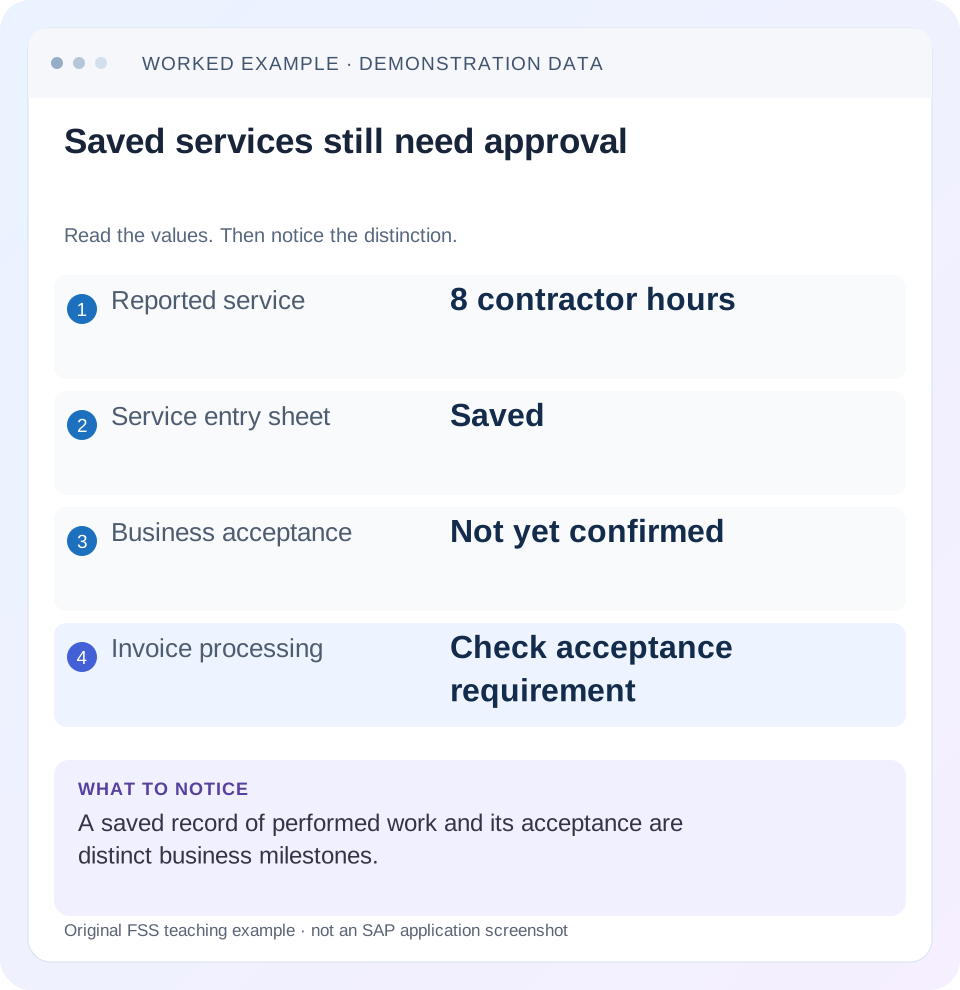
Read the example values
- Reported service
- 8 contractor hours
- Service entry sheet
- Saved
- Business acceptance
- Not yet confirmed
- Invoice processing
- Check acceptance requirement
Words you’ll meet in this guide
- Material
- A product or supply item managed in SAP.
- Plant
- An organizational unit for relevant logistics operations.
- Goods receipt
- A recorded receipt of goods in a business process.
- Purchase order
- A purchasing document requesting goods or services from a supplier or supplying plant.
- Invoice
- A supplier’s bill for goods or services.
- HANA
- SAP’s database platform.
Preview the practical steps
SEE THE CONNECTION
See it in a simple example.
A small example to make the idea concrete.
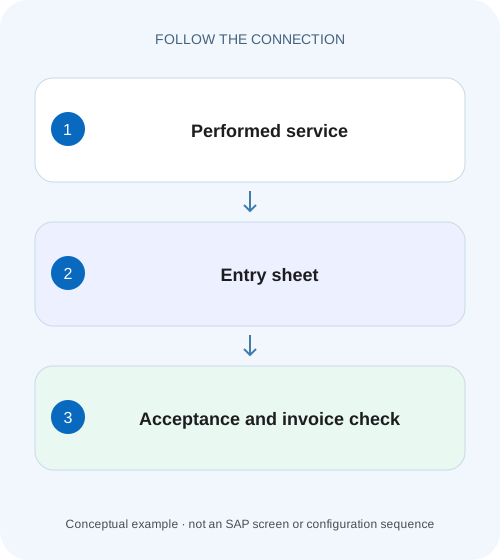
Confirm a contractor's plant work
A contractor reports eight maintenance hours at the factory, but a saved service entry does not yet settle whether the service was accepted for invoicing.
Saved services and accepted services are different evidence
A service entry sheet records services reported as performed.
Scope and prerequisites
The scope is classic External Services Management, using current S/4HANA on-premise service-acceptance documentation and the corresponding ERP concepts.
Understand what acceptance changes
SAP documents responsible persons checking whether performed work is satisfactory and formally accepting it.
Confirm a contractor's plant work
A contractor reports eight maintenance hours at the factory, but a saved service entry does not yet settle whether the service was accepted for invoicing.
Compare the service-entry state, acceptance evidence and purchasing reference before moving the invoice issue to payment follow-up.
| Reader | Business question | Evidence to carry forward |
|---|---|---|
| Manufacturing buyers and purchasing managers | Confirm a contractor's plant work | Compare the service-entry state, acceptance evidence and purchasing reference before moving the invoice issue to payment follow-up. |
01 Saved services and accepted services are different evidence
A service entry sheet records services reported as performed. In the classic External Services Management process, formal acceptance is a separate business milestone and the accepted sheet provides the basis for service invoice verification. A saved entry sheet therefore does not prove that the invoice has the required accepted-service evidence. [1]
Begin with the PO item, entry-sheet identity and actual acceptance state. This tutorial follows eight contractor hours, separates the performed quantity from the accepted quantity and then investigates an invoice. The aim is to identify whether the missing step is service approval, incorrect content, reference matching or another invoice validation.
02 Scope and prerequisites
The scope is classic External Services Management, using current S/4HANA on-premise service-acceptance documentation and the corresponding ERP concepts. Lean services, SAP Business Network integration and Fieldglass-originated processes can have different documents, applications and workflow states. Establish the actual model before applying a classic acceptance sequence.
Obtain the service PO/item, service specifications or limits, entry sheet, reported quantities/value, acceptance evidence, account assignment and supplier invoice reference. Display access to service/purchasing documents and the relevant invoice is needed. Acceptance and financial changes require the authorized process and appropriate training roles.
The worked amounts exclude tax, currency differences, overtime conditions and retention. They are a transparent teaching fixture, not evidence that contractor work was inspected or approved in a customer system.
03 Understand what acceptance changes
SAP documents responsible persons checking whether performed work is satisfactory and formally accepting it. In the cited classic process, acceptance generates logistics/material-document evidence and charges the account-assignment objects at that stage. Read the actual resulting documents rather than assuming that saving reported hours already did this. [1]
Acceptance can use one-step or multistep procedures. A partially completed approval route does not necessarily mean the sheet is finally accepted. Establish the applicable procedure and final state, especially when one approver says they have completed their task.
Entry and acceptance can be performed by the same person in a permitted design or organizationally separated for dual control. The tutorial does not prescribe one segregation model, but it does require evidence that the installed authorized acceptance process finished.
04 Worked case: eight reported contractor hours
Fictional PO-A item 10 purchases maintenance service at 100 currency units per hour. SES-A reports eight hours, giving a simplified reported value of 800. The service owner has not yet confirmed acceptance. An invoice INV-A bills the same eight hours and references this service relationship.
At that point, the existence of SES-A is evidence of recorded reported work, not final accepted work. In the stated classic process, the invoice investigation must establish acceptance before treating SES-A as the accepted basis. Accounts payable should not create a second entry sheet merely because the first lacks the required state.
Now suppose the service owner verifies only six hours at first. The unresolved two hours require explanation: perhaps unsupported time, incomplete work or a recording error. Do not describe all eight as accepted merely because the report total is 800. Use the supported correction/partial-service design for the installed process and identify the actual accepted document population.
| Measure | Quantity/value | Meaning |
|---|---|---|
| PO rate | 100 per hour | Simplified agreed basis |
| SES-A reported | 8 hours / 800 | Recorded performed-service claim |
| Initially accepted | Not confirmed | Saved does not prove acceptance |
| Verified first portion | 6 hours / 600 | Illustrative reviewed scope |
| Unresolved portion | 2 hours / 200 | Needs evidence and supported disposition |
| INV-A claim | 8 hours / 800 | Must match actual accepted basis and controls |
05 Read the content before routing approval
Compare reported service lines with the PO’s service specification, approved limits and actual evidence such as a maintenance completion record or timesheet. The entry sheet should describe the work actually performed, using the correct unit and rate context.
A recording error should be corrected through the supported process before someone accepts it merely to unblock invoicing. If eight hours were entered twice, the issue is not slow approval. If the correct eight were reported but only six are supported, the issue is business acceptance scope.
Check the account assignment adopted for the services. The accepted work must charge the intended recipient under the actual design. A service description that looks correct does not justify an unrelated cost object or an obsolete project assignment.
06 Investigate the chain in sequence
The following sequence preserves the existing service evidence and identifies the first unresolved milestone.
Confirm the process model
Identify classic service procurement versus lean/network/other integration and the actual PO item.
Expected observation: The expected lifecycle is based on the installed scenario.
Read SES-A content and state
Record eight hours at the stated basis and the exact acceptance/release status. Inspect any prior changes.
Expected observation: Reported content is separated from final acceptance.
Locate the outstanding decision
Compare work evidence with the approved procedure and identify the actual pending acceptance step or content correction.
Expected observation: The service owner receives a precise action, not a request to accept blindly.
Trace acceptance evidence
After the authorized training acceptance, inspect final status, generated logistics document and relevant assignment/accounting evidence.
Expected observation: The accepted population is document-supported.
Recheck INV-A
Compare the invoice reference and quantity/value with accepted services and inspect the exact remaining validation result.
Expected observation: Acceptance is verified without assuming every invoice check now passes.
07 Partial performance needs a coherent document population
A PO can cover more work than has been performed or accepted. The full order limit/value is not proof that an invoice for all planned work is ready. Work at the actual service lines, entry sheets and acceptance evidence.
For the six-of-eight illustration, record which six hours were verified and how the remaining two are represented in the supported process. Do not invent a universal partial-acceptance button or assume every sheet can be accepted line by line in the same way. The installed classic/lean design determines the permitted document handling.
If the two hours are later validated, preserve the additional acceptance or correction reference. The invoice chain should explain when the full eight became supported. If they are rejected, retain the supplier/business resolution rather than making the original reported quantity disappear from the explanation.
08 Acceptance is one prerequisite, not a universal invoice release
An accepted sheet can still leave an invoice problem. The invoice might reference another PO item, use the wrong unit, bill a different price or have an independent payment block. Read the actual invoice message before concluding that acceptance failed.
For example, eight accepted hours at 100 support an illustrative 800 net basis. Eight invoiced at 110 gives 880, an eighty-value price question even when service acceptance is correct. A reference error and a price variance require different evidence.
Follow the invoice through its own posting and payment states. An invoice that posts against accepted services can still remain blocked or open. Do not use “service accepted” as a synonym for “supplier paid.”
09 Reversal and correction need the existing financial chain
Before canceling acceptance or changing the recorded services, inspect existing invoices and other follow-on evidence. Supported restrictions can depend on those documents. A correction appropriate before invoicing may not be available in the same way afterward.
Preserve original entry, acceptance, reversal/correction and invoice references. They explain what changed and when. Directly changing a status or editing a table would not establish a legitimate service review and is outside this tutorial.
If an interface response was unclear, search for the existing entry sheet and invoice before resubmission. Duplicate reported hours and duplicate invoices can arise independently, so reconcile both document populations rather than checking only one.
10 Troubleshooting decisions
The first branch is whether accepted-service evidence exists for the intended content. After that, follow the specific invoice symptom.
| Observation | Question | Next evidence |
|---|---|---|
| Sheet saved, invoice cannot proceed | Is final acceptance complete? | Actual sheet state and acceptance procedure |
| One approver finished, still unaccepted | Are further release points required? | Current approval route and final state |
| Invoice bills eight, only six verified | What service population is accepted? | Line evidence and supported partial/correction design |
| Accepted sheet, invoice price mismatch | Is the issue now commercial variance? | Rate/unit and invoice reason |
| Invoice references wrong service item | Is the intended chain selected? | PO/item/SES relationship |
| Correction fails after invoicing | Which follow-on dependencies exist? | Acceptance, invoice and reversal references |
11 Common mistakes that confuse accountability
Do not accept services solely to remove an invoice error without checking satisfactory performance. Acceptance is business evidence with document and financial consequences in the cited process.
Do not create another entry sheet for the same eight hours to obtain a different status. That can double the recorded service claim while leaving the original unresolved. Correct the actual document through the supported process.
Do not transfer classic service instructions into lean-service workflow without checking the edition and model. Similar labels can conceal different lifecycle and integration behavior. Record the model in the support case so the next analyst does not repeat that mismatch.
12 Verification exercises
For the positive worksheet check, trace PO-A’s rate, SES-A’s eight hours, final authorized acceptance and INV-A’s eight-hour/800 basis. In training, inspect actual status transitions and generated references.
For the negative check, leave SES-A saved but unaccepted and explain why the document number alone does not establish the accepted basis. Then accept eight at 100 but invoice at 110 and identify the separate eighty-value variance.
For boundary checks, use a multistep acceptance route, a corrected service quantity, multiple entry sheets under one PO item and an acceptance cancellation with invoice dependencies. Record the installed restrictions and messages; these are proposed checks, not executed SAP results.
13 Questions and the handover
Does a saved sheet prove work approval? No. Read the actual acceptance state. Does acceptance guarantee invoice posting or payment? No. Match the invoice and inspect its independent controls. Can acceptance be one-step? SAP documents several designs; establish the installed authorized procedure.
A useful result names PO-A/10, SES-A, eight reported hours, the verified accepted scope, acceptance/reference evidence and INV-A’s actual remaining issue. If acceptance is pending, identify the decision and evidence required. If it is complete, stop asking for a second acceptance and follow the invoice cause.
Continue with account assignment, invoice display and tolerance-block lessons to inspect where service costs are charged and what the invoice’s later states mean.
Related services and next steps
Primary sources
Found this useful?
Share this guide with your network, or leave a like.
Your like is saved in this browser.