Maintenance order costs remain: Check the settlement receiver and rule
A factory repair order still carries costs after maintenance considers the work complete, and controlling needs the settlement context.

Source review:
START HERE · NO PRIOR TOPIC KNOWLEDGE NEEDED
What it is. Why it matters.
A maintenance order collects relevant costs for work. A settlement rule identifies where those costs should be transferred under the configured accounting process.
Completely new to SAP?
Manufacturers use SAP to connect work such as buying components, recording inventory, planning production, shipping equipment and accounting for costs. SAP S/4HANA is an enterprise resource planning system: it connects these activities through shared business data.
Plant Maintenance organizes care of technical assets. A notification reports a need; an order plans work; recorded execution and costs explain what was actually done.
A transaction code, or t-code, is a shortcut to a task in classic SAP GUI. Fiori apps provide another way to work. Names and screens depend on the product and release; you do not need a live system to learn the concepts in this guide.

Scope and source-review notes
Scope and evidence
Source review by FAST SAP SOLUTIONS® editorial. This badge describes our editorial review; it does not represent SAP certification or independent endorsement.
Classic periodic maintenance-order settlement concepts in SAP ERP/S/4HANA;default-rule creation differs across apps and editions. Event-based accounting,capitalization and specialized refurbishment receivers require their own configuration guidance.
Documentation review on 14 November 2026 used the official SAP sources listed below, including indexed excerpts where full text was unavailable. Scope and availability depend on the stated product, release and configuration. All document references, quantities, dates and outcomes in worked cases are illustrative; no customer SAP system or tenant was accessed and the proposed exercises were not executed.
A MANUFACTURING EXAMPLE
Explain an unsettled machine repair
Reconcile sender and approved receivers
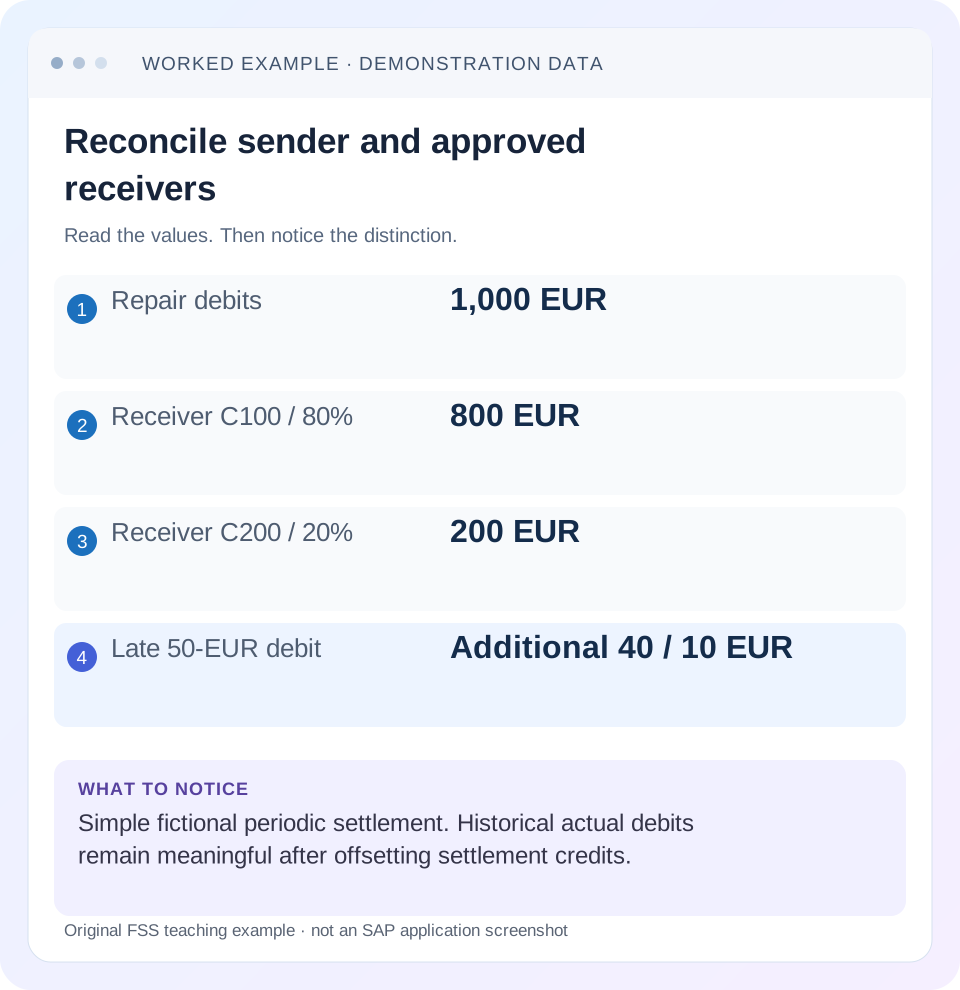
Read the example values
- Repair debits
- 1,000 EUR
- Receiver C100 / 80%
- 800 EUR
- Receiver C200 / 20%
- 200 EUR
- Late 50-EUR debit
- Additional 40 / 10 EUR
Words you’ll meet in this guide
- Technical object
- An asset or location maintained in the system.
- Notification
- A report of an issue or maintenance need.
- Settlement
- Transfer of collected costs under accounting rules.
- HANA
- SAP’s database platform.
- TECO
- Technical completion: a processing status used for relevant orders.
Preview the practical steps
SEE THE CONNECTION
See it in a simple example.
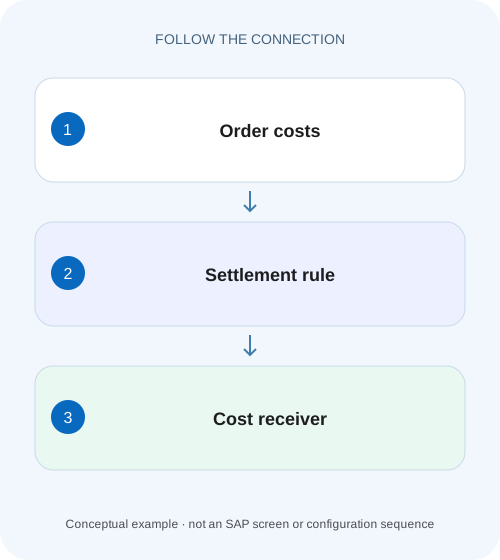
A small example to make the idea concrete.
Explain an unsettled machine repair
A factory repair order still carries costs after maintenance considers the work complete, and controlling needs the settlement context.
Separate completed work from completed cost allocation
A maintenance order can collect material, labor and service costs while the physical repair is already complete.
Understand sender, receiver and distribution rule
The order is the sender collecting costs.
Work through a 1,000-EUR repair
Suppose order M100 collects 600 EUR materials,300 EUR internal labor and 100 EUR external service in period 11.
Explain an unsettled machine repair
A factory repair order still carries costs after maintenance considers the work complete, and controlling needs the settlement context.
Compare the settlement rule, receiver and processing evidence instead of treating technical completion as proof that costs were settled.
| Reader | Business question | Evidence to carry forward |
|---|---|---|
| Factory quality and maintenance teams | Explain an unsettled machine repair | Compare the settlement rule, receiver and processing evidence instead of treating technical completion as proof that costs were settled. |
01 Separate completed work from completed cost allocation
A maintenance order can collect material, labor and service costs while the physical repair is already complete. Settlement transfers eligible costs to the intended receiver under its settlement rule. A technical completion status is not evidence that this allocation occurred, and historical actual-cost postings do not disappear simply because the order has been settled.
This tutorial is for maintenance planners and controlling analysts investigating an order balance. You need the order, controlling/fiscal period, currency, cost detail, settlement rule and settlement log. The worked figures illustrate a simple periodic case, not a prescribed accounting treatment. Receiver choice must follow the organization's approved responsibility and accounting design.
02 Understand sender, receiver and distribution rule
The order is the sender collecting costs. The receiver may be an approved cost object supported by the settlement profile. The distribution rule identifies the receiver and how costs are distributed, with period/validity and settlement-type context as applicable. Inspect the whole rule rather than copying the cost-center label visible on another master-data tab.
SAP's maintenance-order cost guidance describes generating a default settlement rule when the required configuration exists. A default is a derived proposal, not proof of correct business responsibility. If account-assignment data is missing or outdated, the resulting rule can be absent or inappropriate. Read the actual saved distribution rule for this order. [1]
03 Work through a 1,000-EUR repair
Suppose order M100 collects 600 EUR materials,300 EUR internal labor and 100 EUR external service in period 11. Its approved rule distributes 80% to cost center C100 and 20% to C200. Under the simplified assumption that all 1,000 EUR are eligible in that period, the expected receiver effects are 800 and 200 EUR, and the sender receives 1,000 EUR of settlement credit.
Historical debit 600/300/100 remains visible in a cost analysis even when net balance is zero. A report showing 1,000 EUR of actual debits can therefore coexist with successful settlement. Establish whether the user is looking at debits, credits, net balance or another reporting measure before diagnosing an allocation failure.
| Posting class | Sender effect | Receiver effect |
|---|---|---|
| Material issue | +600 EUR | Not yet allocated by settlement |
| Labor allocation | +300 EUR | Not yet allocated by settlement |
| External service | +100 EUR | Not yet allocated by settlement |
| Settlement to C100 | −800 EUR | +800 EUR |
| Settlement to C200 | −200 EUR | +200 EUR |
| Net sender balance | 0 EUR | Total received 1,000 EUR |
04 Inspect the rule in the relevant order application
The cited S/4HANA maintenance-order guidance names Create Default Settlement Rule in the individual order header. Older documented interfaces place standard-rule creation in another area. Use the instructions for the installed application rather than presenting one button location as universal. Display the current rule first; creating a new default is a change, not a passive diagnostic action. [1]
Public-edition settlement-rule documentation describes rule creation on release under that edition's configuration and distribution-rule requirements. Do not generalize that prerequisite to every historical ERP order type. For the actual order, record receiver category/identity, percentages or other distribution method, validity and applicable settlement type. [2]
05 Use the settlement log to choose the correction
Read the detailed message for the intended period. A missing receiver, invalid receiver, closed period, incomplete rule or absence of eligible costs are different conditions. Changing to an arbitrary active cost center may remove one error while allocating the repair to the wrong business owner.
Reconcile the sender
List period 11 debits and existing settlement credits in the same currency.
Expected observation: A1,000-EUR debit is distinguished from the net balance.
Review receiver rules
Confirm C100/C200 and 80/20 distribution with accounting responsibility.
Expected observation: Expected 800/200 allocation is explicit.
Inspect the run log
Record period, execution mode and object-specific errors/results.
Expected observation: The next action addresses the actual failure.
Verify sender and receiver
After the approved run, check settlement documents and receiver effects.
Expected observation: Net balance and destination agree with the rule.
06 Account for late costs and subsequent periods
Suppose the initial 1,000 EUR settles, then a 50-EUR service adjustment posts afterward. The order can legitimately show a 50-EUR remaining balance until the relevant subsequent settlement. Under the same simplified 80/20 rule, the additional receiver effects would be 40 and 10 EUR. The earlier settlement did not fail retroactively merely because a new debit arrived.
Compare posting dates, fiscal periods and run cutoffs. A period 11 report and a period 12 balance can answer different questions. Also inspect whether the rule's validity changes between periods. Do not use a cumulative order total to infer that every period's settlement ran with identical parameters.
07 Troubleshoot the remaining balance
Preserve the original rule and log before changing them. A useful investigation explains both what did post and what remains, so a later operator does not repeat a completed run under a different assumption.
| Observation | Main question | Next evidence |
|---|---|---|
| No distribution rule | Default creation/input missing? | Account assignment and settlement configuration |
| Receiver rejected | Valid in this period/context? | Receiver status, category and log |
| Actual costs still shown | Debit versus net balance? | Settlement credits and reporting measure |
| 50 EUR remains after prior success | Late debit? | Posting timeline and run cutoff |
| Sender zero, wrong department charged | Incorrect receiver? | Settlement document and approved responsibility |
| Test succeeds, actual run absent | Preview versus posting? | Actual execution reference and documents |
08 Avoid confusing rule maintenance with reversal
Changing the rule for future settlement does not by itself explain or reverse an earlier allocation. If 800 EUR already reached C100 and that receiver was wrong, follow the documented accounting correction path and reconcile posted effects. Do not assume a newly saved rule automatically relocates every historical cost.
Similarly, a zero-looking sender figure is insufficient if the cost reached the wrong receiver or period. Verify the destination and business ownership. The objective is correct allocation, not making one monitor blank. Specialized capitalization, refurbishment and event-based scenarios need their own accounting semantics beyond this simple periodic example.
09 Verify positive, negative and boundary cases
The positive fixture posts 1,000 eligible EUR and confirms 800/200 receiver allocation with zero sender net balance. A negative test uses an intentionally invalid receiver in an authorized test and expects a clear failed allocation, not silent posting to another receiver. Retain the actual message rather than inventing a universal error code.
The boundary test adds 50 EUR after the first settlement and reconciles the residual balance and later 40/10 effects. Another useful check compares an actual-debit view with a net-balance view after settlement: the former can still show 1,050 EUR even when the final net balance is zero. Explain the difference to the maintenance team.
10 Read the settlement rule as a period-specific allocation instruction
For M100, write one line per receiver with category, receiver ID, distribution method, value and applicable validity/settlement context. The 80%/20% fixture should represent the complete eligible allocation under its assumptions. If the actual rule has only 80%, do not silently add 20% to a convenient receiver; inspect the real settlement validation and intended responsibility.
Compare the settlement profile and rule with the cost population. A valid cost-center receiver does not automatically establish that every sender cost element is eligible for the same treatment. Allocation structure and other accounting configuration can explain a residual or error even when percentages look complete. Read the detailed object/period message and map it to the actual cost line before changing the receiver.
Use the documented order cost-analysis/default-rule interface for the installed edition to display the actual rule and cost detail. Retain the current rule before generating or changing a default. Derivation from an equipment or location account assignment can be stale after an asset move, so verify the business owner independently of the field's existence.
11 Reconcile a partial settlement and a late posting without hiding history
Extend the repair ledger to a failed first run. Suppose the actual posted evidence shows 600 EUR settled and 400 still on the sender. The residual alone does not reveal whether a receiver failed, some costs were ineligible, or the run used another period/scope. Inspect settlement documents to see where the 600 went and compare that with the rule. Do not assume it means 60% of each receiver was processed.
If documents establish 480 to C100 and 120 to C200, then a later eligible 400 would yield 320 and 80 under the same 80/20 rule. The cumulative receiver effects become 800 and 200. A further late 50 then adds 40 and 10, producing 840 and 210, total 1,050. This explicit cumulative ledger prevents treating prior credits as new maintenance costs or rerunning an arbitrary full amount.
For verification, compare historical sender debits 1,050, settlement credits 1,050, net balance 0, and receiver totals 840/210. If any of those disagree, retain the exact period and document gap. A single zero in one cost report cannot distinguish correct cumulative allocation from an offset posted elsewhere. The four-way comparison provides a reviewable financial result without claiming that the fictional postings were executed.
12 Distinguish test execution from posted allocation
Where the installed settlement application provides a test/preview mode, retain its messages separately from the actual posting reference. A successful test demonstrates the checked conditions under that scope; it does not create the 800/200 receiver effects in the worked case. Verify actual sender credits and receiver documents after the authorized posting run. Repeat the comparison after any intervening late debit or rule change.
13 Questions and handover
Does TECO settle the order? It is an operational state; inspect financial processing separately. Can a default rule be wrong? Yes, review its derived receiver against responsibility. Does zero balance mean no repair cost occurred? No, the order's historical debits and corresponding settlement credits remain meaningful.
Close with order, period, currency, debits, credits, net balance, rule, receiver results and unresolved late postings. Continue with system/user status for blocked actions and notification versus order for the original maintenance scope. The resulting record should explain where the costs went, not merely that a run finished.
Related services and next steps
Primary sources
Found this useful?
Share this guide with your network, or leave a like.
Your like is saved in this browser.