Availability check versus credit check: Two different order decisions
A machinery customer orders 100 units, but only part is confirmed for the requested date and a separate credit decision remains unresolved.

Source review:
START HERE · NO PRIOR TOPIC KNOWLEDGE NEEDED
What it is. Why it matters.
An availability check assesses relevant supply for a requested quantity and date. A credit check assesses financial exposure under configured rules, so they answer different order questions.
Completely new to SAP?
Manufacturers use SAP to connect work such as buying components, recording inventory, planning production, shipping equipment and accounting for costs. SAP S/4HANA is an enterprise resource planning system: it connects these activities through shared business data.
Sales and Distribution connects customer orders, logistics and billing. Each stage has its own documents, quantities and status, so one stage’s success does not prove the whole sale is complete.
A transaction code, or t-code, is a shortcut to a task in classic SAP GUI. Fiori apps provide another way to work. Names and screens depend on the product and release; you do not need a live system to learn the concepts in this guide.

Scope and source-review notes
Scope and evidence
Source review by FAST SAP SOLUTIONS® editorial. This badge describes our editorial review; it does not represent SAP certification or independent endorsement.
SD availability and SAP Credit Management concepts for sales operations and SD support. S/4HANA on-premise documentation supports credit-rule and shipping-check concepts. Classic ATP, aATP and legacy credit designs differ; simplified arithmetic is not an exposure or availability algorithm.
Documentation review on 14 November 2026 used the available official SAP indexed excerpts; several SAP Help pages returned no readable full text. The worked case and proposed checks are original illustrative teaching material, not execution evidence from a customer SAP system. Exact fields, permitted actions and behavior must be confirmed against the installed product, release and configuration.
A MANUFACTURING EXAMPLE
Separate equipment availability from credit permission
Two dated promises, one risk review
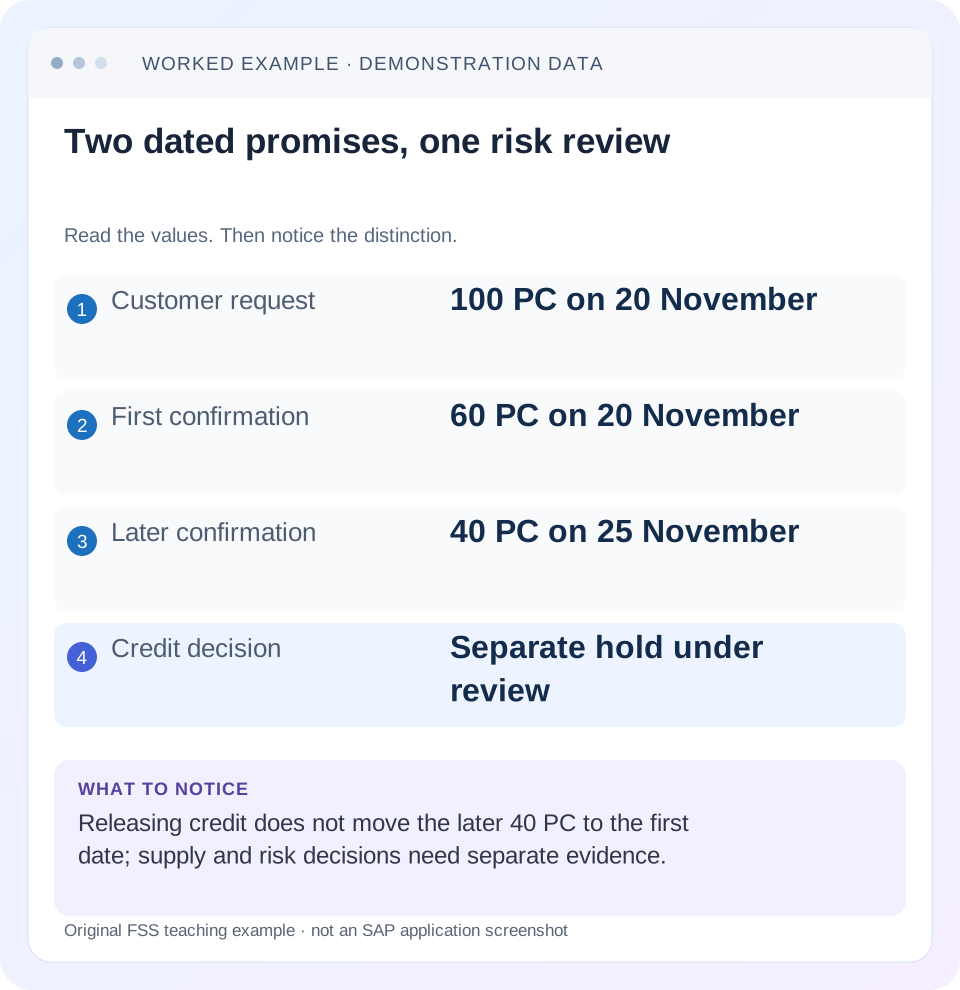
Read the example values
- Customer request
- 100 PC on 20 November
- First confirmation
- 60 PC on 20 November
- Later confirmation
- 40 PC on 25 November
- Credit decision
- Separate hold under review
Words you’ll meet in this guide
- Sales order
- A record of a customer’s order.
- Delivery
- A document organizing goods to be sent.
- Billing
- The process that creates a customer charge.
- HANA
- SAP’s database platform.
Preview the practical steps
SEE THE CONNECTION
See it in a simple example.
A small example to make the idea concrete.
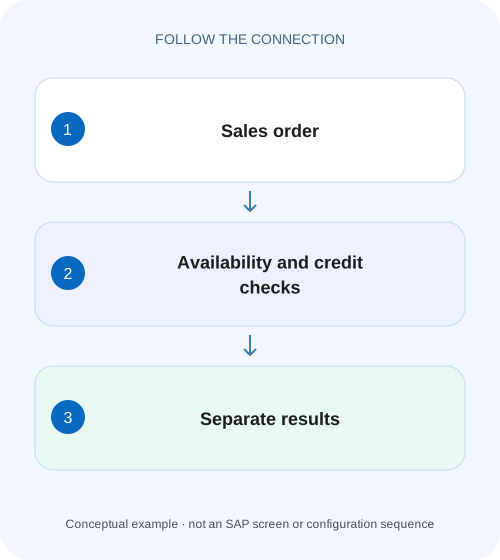
Separate equipment availability from credit permission
A machinery customer orders 100 units, but only part is confirmed for the requested date and a separate credit decision remains unresolved.
Stock availability and credit approval are independent decisions
An availability check asks which quantity can be confirmed for which date under the configured supply/requirements scope.
Audience and prerequisites
This guide is for sales operations, SD support and credit/shipping owners.
Worked order: 100 requested, 60 confirmed, credit blocked
Our fictional order 47000123/10 requests 100 PC for 20 November at EUR 50 net per PC.
Separate equipment availability from credit permission
A machinery customer orders 100 units, but only part is confirmed for the requested date and a separate credit decision remains unresolved.
Communicate the dated supply confirmation and credit state separately before promising dispatch.
| Reader | Business question | Evidence to carry forward |
|---|---|---|
| Equipment and component sales, dispatch and customer-service teams | Separate equipment availability from credit permission | Communicate the dated supply confirmation and credit state separately before promising dispatch. |
01 Stock availability and credit approval are independent decisions
An availability check asks which quantity can be confirmed for which date under the configured supply/requirements scope. A credit check evaluates financial-risk conditions for the relevant partner and process. An order can pass either check while failing the other.
SAP documents credit rules and check steps, with checks possible at different points in the sales cycle. Its shipping documentation also describes updated availability checking as supply conditions change. Neither decision is a permanent guarantee for every later stage. Read the actual current result and process context before telling a customer that an order can proceed. [1] [2]
02 Audience and prerequisites
This guide is for sales operations, SD support and credit/shipping owners. You need order/item, requested quantity/date, schedule-line confirmation, relevant credit result and partner/organizational context. Use permitted document displays and the supported credit/availability tools for the installed design.
The example is conceptual across SD availability and S/4HANA SAP Credit Management. It does not equate classic ATP with every aATP feature or legacy credit control with FIN-FSCM-CR. Exact scope-of-check elements, credit segments, exposure updates and release actions depend on configuration and release. Do not apply the simplified arithmetic as a production check formula.
03 Worked order: 100 requested, 60 confirmed, credit blocked
Our fictional order 47000123/10 requests 100 PC for 20 November at EUR 50 net per PC. The schedule result confirms 60 PC for 20 November and 40 PC for 25 November. Separately, the order is held under its configured credit process.
The illustrative order net value is EUR 5,000. The first-date quantity corresponds to EUR 3,000 at that simple price, but that does not establish the amount used by the configured credit calculation. Credit exposure can have other document, currency and rule context. The practical message is: supply is partially dated; financial release remains a separate decision.
| Dimension | Observed value | Meaning |
|---|---|---|
| Demand | 100 PC on 20 November | Customer request |
| Confirmation | 60 PC on 20 November | First-date supply result |
| Later confirmation | 40 PC on 25 November | Later supply result |
| Credit | Blocked under configured rule | Separate risk decision |
04 Read schedule lines rather than the order total
Inspect requested dates, confirmed quantities and later confirmations for the actual item in a consistent unit. The order's 100-PC quantity expresses demand, while 60 PC on the first date expresses the current supported confirmation for that date. Do not promise all 100 for 20 November from the order total alone.
Also review partial/complete-delivery agreements and the applicable delivery process. A 60-PC confirmation does not automatically mean the customer accepts a partial delivery. If complete delivery is required, the operational implication can differ from a process allowing 60 now and 40 later. Keep agreement and supply result separate in the explanation.
05 Understand what contributes to availability
Availability is based on the configured scope and relevant planned inward/outward movements, rather than a raw on-hand number alone. SAP's shipping guidance explains that changes in supply circumstances can require rechecking at delivery. Stock shown in another plant, unit or status may not be available to this item/date under the actual rules. [2] [3]
For the fixture, do not invent a cause for the 60/40 split. Obtain the supported availability result and its scope. A planned receipt on 25 November may explain the later confirmation only when the actual checking design includes it and other requirements are considered. “There are 100 in inventory” is insufficient without plant, date and usable-stock context.
06 Read credit evidence in its own scope
Inspect the actual credit status/message, relevant partner and configured check context. SAP describes applying a check rule and its assigned steps. A block can reflect a failed business-risk condition or a technical issue in the credit-check process; the exact result must distinguish them. [1]
The sold-to name alone may not identify every credit-relevant relationship. Use the actual configured partner/account/segment context shown by the supported process. Do not adjust material confirmations or requested dates merely to conceal the credit result. The authorized credit owner needs the reason, exposure context and appropriate review evidence.
07 Use simplified exposure arithmetic only to explain the concept
Imagine a purely illustrative credit limit of EUR 20,000 and existing relevant exposure of EUR 18,000. Adding a hypothetical EUR 5,000 order amount gives EUR 23,000, above that simple limit by EUR 3,000. That arithmetic explains why available stock cannot settle financial risk.
It is not a claim that SAP always calculates exposure by adding net order value to one balance. Actual checks can include currency conversion, open items, document categories, horizons and other configured rules. The analyst should use the system's actual credit analysis and reconciliation, while keeping any teaching calculation clearly labeled as simplified.
08 Identify the current bottleneck without erasing another one
If credit is released while the 60/40 schedule remains, the order still lacks a 100-PC first-date confirmation. If supply becomes fully confirmed while credit remains blocked, financial permission still needs resolution. A single “released” or “confirmed” label cannot describe both dimensions.
For customer communication, state both: “60 PC confirmed for 20 November, 40 for 25 November; shipment subject to the separate credit process.” Use the business's approved wording and commitment policy. Internal support should name the next owner for each unresolved condition rather than routing the whole order to whichever team responded first.
09 Investigate changed results after an order update
A quantity, date, partner or value change can affect one or both decisions under the configured process. Compare before/after inputs and the actual recheck results. A previously acceptable order can need a new credit decision after value increases, while a previously confirmed date can change after supply changes.
Do not assume that a manual status release freezes all future behavior. Use the documented lifecycle for renewed checks and released documents. If an edit unexpectedly reblocks the order, inspect which check ran and why. If confirmations change, inspect the availability scope and relevant date/quantity inputs rather than treating the credit release as a supply override.
10 Troubleshoot the two branches independently
If confirmed quantity is zero but credit is acceptable, investigate item/schedule-line determination, checking scope, plant/date and supply. If quantity is confirmed but credit blocks processing, investigate the actual credit decision and authorized review. If both fail, keep two action tracks with shared order identity.
If both appear acceptable but delivery fails, inspect delivery blocks, incompletion, due-list selection and logistics requirements. The problem may be at another control boundary. Removing a credit block because a delivery is urgent cannot repair a missing shipping point or an incomplete delivery; likewise, changing ATP data cannot resolve a credit-service technical failure.
11 Practical investigation sequence
Start with one order/item and write requested quantity/date, each confirmed quantity/date, current credit result and attempted next action. Confirm units and partner/organizational scope. Then inspect the relevant supply and credit evidence separately and identify the earliest missing prerequisite for the intended process.
For the fictional order, the expected evidence record contains 100 requested, 60 confirmed on the first date, 40 later and a separately identified credit hold. If the schedule totals do not reconcile or the credit context belongs to another account, resolve those identity gaps before any business release decision. Reconcile existing deliveries before a create attempt.
12 Verify positive, negative and boundary combinations
A useful training matrix contains four combinations: supply confirmed/credit acceptable, supply confirmed/credit blocked, supply unconfirmed/credit acceptable and both unresolved. The learner should predict the unresolved decision in each case without assuming one check supplies the other.
Add a partial-confirmation boundary: 60/40 across two dates with complete delivery required. The correct operational interpretation must include the agreement. After an approved correction, verify the changed result and the unchanged independent control. If credit is released, inspect dated supply again; if supply improves, confirm the current credit result before claiming the order is ready for the next step.
Create a two-axis worksheet for the order rather than one overall ready/not-ready flag. In the supply column, retain the 60-PC first confirmation and 40-PC later confirmation with dates and units. In the credit column, retain the actual check result, scope and review owner. Add a third column for the intended next action, because a decision that permits order entry may still be checked again later under the configured process.
Then change only the credit outcome in the paper fixture to acceptable. The worksheet should still show the 40-PC later quantity and any complete-delivery agreement. Change only the supply outcome to 100 PC on the first date while restoring the credit hold; the credit action remains unresolved. This controlled comparison exposes an operational communication error: calling the order fully ready after fixing just the most recently discussed issue.
For a support-priority exercise, give shipping evidence that all 100 PC are physically present at the relevant plant while the order remains credit-blocked. The learner should request the actual configured availability result and credit review rather than assume warehouse stock grants financial permission. Then give acceptable credit with stock expected only next week: the learner should preserve the supply/date gap. These two controlled observations help sales explain why urgency, inventory visibility and customer risk are different inputs, and why either owner’s completed task can leave a valid unresolved prerequisite for fulfillment.
| Supply | Credit | Unresolved question |
|---|---|---|
| Confirmed | Acceptable | Other delivery prerequisites still apply |
| Confirmed | Blocked | Credit review/release |
| Unconfirmed | Acceptable | Supply and scheduling |
| Unconfirmed | Blocked | Both independent decisions |
13 Questions and a clear order handoff
Does credit approval reserve inventory? No; use availability and confirmation evidence. Does physical stock guarantee credit release? No. Does an order quantity equal a date-specific promise? Read schedule lines. Can a delivery availability check differ from the earlier order result? SAP documents rechecking because supply conditions can change. [2]
A useful handoff names order/item, units, requested and confirmed dates/quantities, exact credit status/reason and the attempted next function. Keep any limit arithmetic illustrative unless reconciled from actual system evidence. Continue with schedule-line, delivery-block and due-list lessons when the unresolved control belongs to those stages.
Related services and next steps
Primary sources
Found this useful?
Share this guide with your network, or leave a like.
Your like is saved in this browser.