SAP BW full load versus delta initialization: Protect the extraction sequence
A factory reporting team needs to distinguish a full load, delta initialization and later changes when reconciling production-order data.

Source review:
START HERE · NO PRIOR TOPIC KNOWLEDGE NEEDED
What it is. Why it matters.
A full load transfers the selected dataset; a delta load transfers relevant changes. Initialization establishes the supported starting point for later delta processing.
Completely new to SAP?
Manufacturers use SAP to connect work such as buying components, recording inventory, planning production, shipping equipment and accounting for costs. SAP S/4HANA is an enterprise resource planning system: it connects these activities through shared business data.
Analytics organizes business data into useful comparisons. Planning adds proposed future values. Learn what the numbers represent before comparing totals or changing a forecast.
A transaction code, or t-code, is a shortcut to a task in classic SAP GUI. Fiori apps provide another way to work. Names and screens depend on the product and release; you do not need a live system to learn the concepts in this guide.

Scope and source-review notes
Scope and evidence
Source review by FAST SAP SOLUTIONS® editorial. This badge describes our editorial review; it does not represent SAP certification or independent endorsement.
Classic SAP NetWeaver BW InfoPackage/scheduler delta initialization, contrasted with DTP delta handling. ODP subscriptions and extractor-specific initialization procedures require their own current guidance.
Documentation review on 14 November 2026 used the official SAP sources listed below, including indexed excerpts where full text was unavailable. Scope and availability depend on the stated product, release and configuration. All document references, quantities, dates and outcomes in worked cases are illustrative; no customer SAP system or tenant was accessed and the proposed exercises were not executed.
A MANUFACTURING EXAMPLE
Explain a production-order reporting refresh
Verify baseline and captured changes together
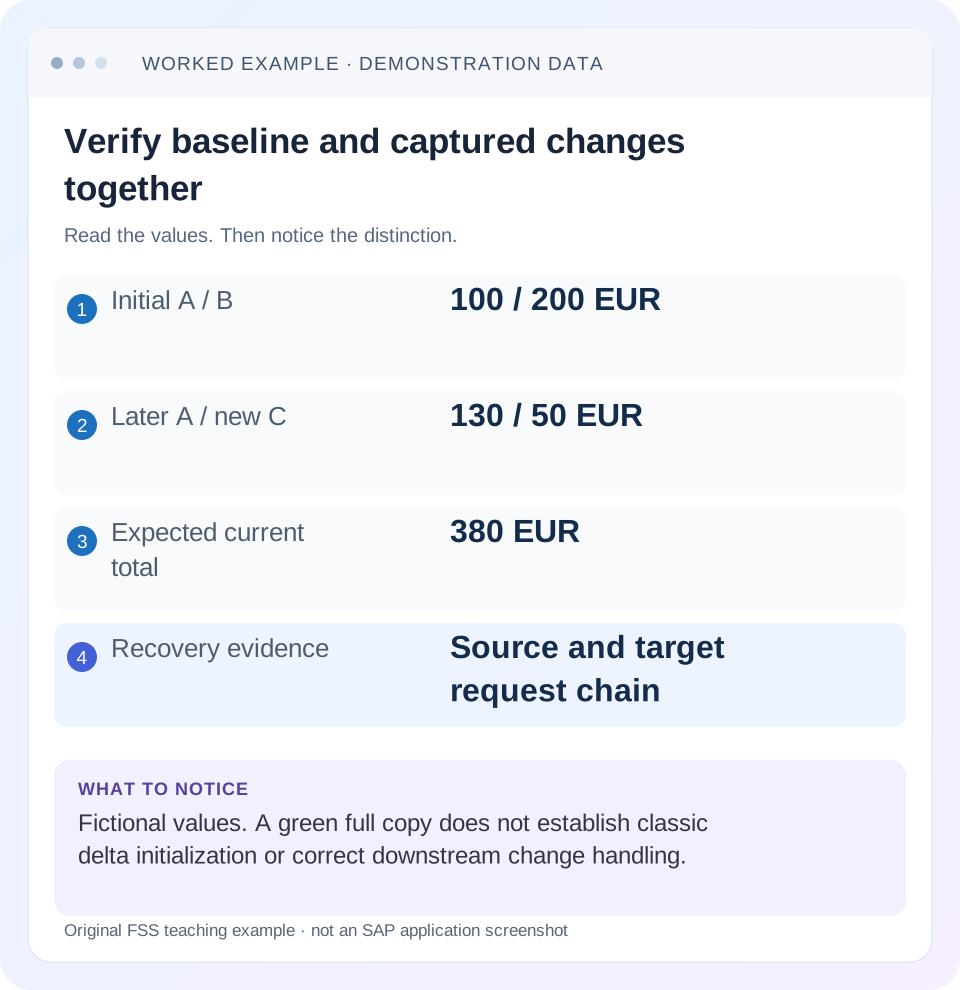
Read the example values
- Initial A / B
- 100 / 200 EUR
- Later A / new C
- 130 / 50 EUR
- Expected current total
- 380 EUR
- Recovery evidence
- Source and target request chain
Words you’ll meet in this guide
- Dimension
- A way to group data, such as month or product.
- Measure
- A numeric value, such as revenue or quantity.
- Model
- A defined organization of data and calculation rules.
- HANA
- SAP’s database platform.
- aDSO
- Advanced DataStore object: a SAP BW/4HANA object that stores and organizes data.
- DTP
- Data Transfer Process: a configured process that moves data in SAP BW.
Preview the practical steps
SEE THE CONNECTION
See it in a simple example.
A small example to make the idea concrete.
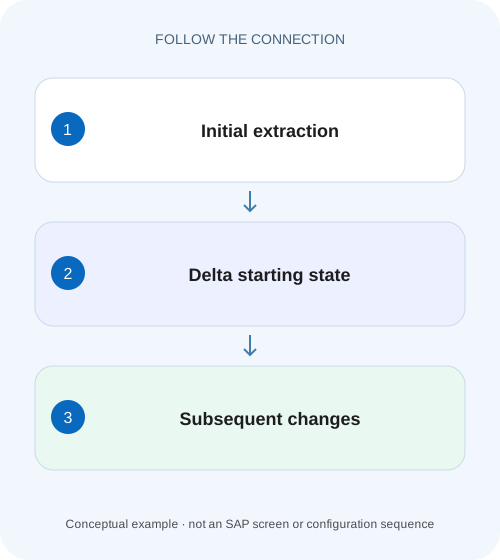
Explain a production-order reporting refresh
A factory reporting team needs to distinguish a full load, delta initialization and later changes when reconciling production-order data.
A full request and a delta starting point solve different problems
A full load copies the records selected by that request.
Establish which delta mechanism you actually have
The classic SAP scheduler documentation explicitly distinguishes full update, delta update and initialization, and states that initialization selections are copied for subsequent delta records.
Explain the three business datasets
An initial dataset is the baseline from which the reporting model begins.
Explain a production-order reporting refresh
A factory reporting team needs to distinguish a full load, delta initialization and later changes when reconciling production-order data.
Compare extraction scope and request history before repeating a load or treating equal row counts as equal business content.
| Reader | Business question | Evidence to carry forward |
|---|---|---|
| SAP developers and application teams supporting manufacturers | Explain a production-order reporting refresh | Compare extraction scope and request history before repeating a load or treating equal row counts as equal business content. |
01 A full request and a delta starting point solve different problems
A full load copies the records selected by that request. Delta initialization establishes the supported starting state for later change extraction. In classic BW scheduler processing, a green full request does not by itself prove that delta initialization exists. When tomorrow's delta fails or omits a change, investigate extraction administration as well as the records already present in BW.
This guide is for BW support analysts coordinating with the source-extraction owner. You need the source system, DataSource, extraction technology, selection criteria, request history and target update semantics. The central examples use classic InfoPackage/scheduler concepts. They are not a reset procedure for an ODP subscription or instructions to transplant an older initialization sequence into BW/4HANA.
02 Establish which delta mechanism you actually have
The classic SAP scheduler documentation explicitly distinguishes full update, delta update and initialization, and states that initialization selections are copied for subsequent delta records. First identify whether the incident concerns that extraction layer. A DataSource name alone does not tell you which framework transports its changes. [1]
A DTP has a different lifecycle: SAP documentation explains that explicit delta initialization as used with an InfoPackage is not necessary for a delta transfer with a DTP. A flow can contain both source-extraction state and internal BW transfer state. Saying “the delta was initialized” without naming the layer makes troubleshooting ambiguous. Record the exact object and mechanism whenever you discuss a pointer or subscription. [2]
03 Explain the three business datasets
An initial dataset is the baseline from which the reporting model begins. A later change set contains changes captured under the extractor's contract. The current reporting state results from applying those changes correctly to the baseline. These three datasets can have different record counts. An update may replace an amount without adding a new current business row; a deletion can require a deletion representation rather than a positive amount.
A full copy describes what matched the selection at extraction time. It does not inherently describe all changes that occurred during the copying interval. Correctness therefore depends on the extractor's documented synchronization and initialization procedure. Decide how the baseline boundary and change-capture boundary relate before initiating a large load, especially when the source stays operational.
04 Work through a production-order example
Suppose a fictional source initially has orders A and B, each with a current cost amount: A is 100 EUR and B is 200 EUR. During the initialization window, A changes to 130 EUR and new order C appears at 50 EUR. The desired final current-state total is 380 EUR: 130 plus 200 plus 50. The correctness question is whether the supported sequence carries both changes exactly as intended.
This is a reconciliation fixture, not a claim that every extractor emits after-images or supports concurrent initialization. A movement-based feed may encode A's adjustment as plus 30, while a snapshot-based feed may send 130. The target must interpret the extractor's supported record modes. Counting two delta rows cannot establish that the final amount is correct.
| Business event | State or change | Desired final interpretation |
|---|---|---|
| Baseline A | 100 EUR | Later replaced by 130 EUR |
| Baseline B | 200 EUR | Remains 200 EUR |
| A corrected during load window | Current amount becomes 130 EUR | Do not add 130 to the old 100 |
| C created during load window | Current amount 50 EUR | Must appear once |
| Final current state | A 130 + B 200 + C 50 | Total 380 EUR |
05 Plan initialization with the source contract
Some documented extraction processes support initialization with data; others support a controlled initialization without data combined with a separate baseline. The phrase “without data” does not mean the omitted baseline is unnecessary. It means a specific sequence must establish both the initial data and the delta boundary without leaving a gap or double applying an overlap.
Before execution, write down the baseline selection and intended delta selection using the real business dimensions. If the baseline covers plant 1000 and the later extraction is expected to cover plants 1000 and 2000, explain how plant 2000 receives its baseline. Changing a selection can change the population rather than merely improve performance. Use the extractor's current guidance for allowed selection and initialization combinations.
06 Investigate an existing failed delta
Preserve request identifiers and messages before any restart. Separate “no delta state exists,” “a request failed,” “no changes were relevant,” and “changes arrived but were interpreted incorrectly.” These observations lead to different recovery scopes.
Identify the layer
Record source system, DataSource, InfoPackage or DTP, framework and target.
Expected observation: The failing object is unambiguous.
Inspect administration and selections
Compare the supported initialization/subscription state with the original baseline selection and later request filters.
Expected observation: The delta population and boundary can be explained.
Reconcile one known change
Trace order A's source update time, extracted representation, request and final target amount.
Expected observation: You can locate the first point where expected and actual states diverge.
Define recovery before running it
State which requests or data partitions will be replaced, retained or replayed under the supported procedure.
Expected observation: Baseline and later changes have one coherent history.
07 Choose the recovery branch from evidence
Do not interpret a request with zero records as automatically broken. There may be no relevant changes, an excluding selection, a missing source event or a framework-specific administration problem. A known changed key is more useful than a grand total because it lets you follow one identity through each layer.
If the source event exists and the extraction layer includes it, stop resetting source administration and investigate the downstream transformation or ADSO. Conversely, correcting an ADSO total does not repair an extraction boundary that is still missing future events. Keep cause and compensating data repair separate in the incident record.
| Observation | Distinction to establish | Next check |
|---|---|---|
| Full succeeded, first delta rejected | Full copy versus initialization | Classic initialization or actual subscription state |
| Delta green, zero rows | No relevant change versus missed event | Known source change and selection |
| Target amount doubled | Overlap or wrong record semantics | Baseline/replay scope and target update |
| New plant has only recent orders | Missing baseline population | Original initialization selection |
| Source request green, report old | Downstream processing pending | DTP, activation and consumer dependencies |
08 Why deleting initialization is consequential
In classic processing, initialization administration and already loaded target data are distinct. A change to the administration is not a universal purge of historical business data. Reinitializing into a populated additive target can therefore introduce overlap; deleting target data while retaining an inconsistent extraction boundary can introduce a gap.
A recovery plan should name the affected population, the retained baseline, the replacement window and the way known changes will be checked. It should also account for downstream consumers already updated from earlier requests. The supported action can be small when only a failed transfer needs repair, or substantial when baseline and boundary must be rebuilt. Neither case justifies a generic “delete everything and try again” instruction.
09 Verify continuity, not just the first green request
In a controlled fixture, establish A 100 and B 200, perform the supported initial sequence, then change A to 130 and add C 50. Verify the current-state rows and total 380. Add a second delta with no further changes and check the documented behavior without expecting a second copy of C. The expected state remains unchanged.
For a negative check, change an order deliberately outside the agreed selection. It should not contaminate the selected target population. For a boundary check, create a documented change near the baseline/capture boundary and trace it using the extractor's supported timing semantics. Avoid inventing a universal timestamp cutoff: queue, subscription and extractor implementations differ.
10 Separate source extraction requests from internal transfer requests
Add an explicit object ledger to the worked case. Let source request S0 establish the documented baseline, internal transfer T0 move it into the target, and activation A0 consolidate it. Later source request S1 carries A's correction and C's creation; T1 and A1 process those effects downstream. These are illustrative reference labels, not SAP-generated request formats. The ledger keeps a green S1 from being mistaken for a completed A1.
At 09: 00, the source may correctly expose A130/B200/C50 while the reporting ADSO still shows A100/B200 because T1 has not run. That is a target total 300 versus source 380, an 80-EUR difference consisting of the 30-EUR correction and 50-EUR new order. Reinitializing the extractor at that point addresses the wrong layer. Locate S1's extracted records, then T1 and the relevant activation before deciding which process requires recovery.
Conversely, if T1 and A1 completed with the available changes but C never entered S1, investigate the source selection/capture boundary. A downstream replay cannot recover an event that is absent from its source population. The object ledger therefore acts as a decision tool, not merely a list of timestamps.
11 Demonstrate overlap and gap with the same three keys
Use two deliberately incorrect paper reconstructions. In the overlap reconstruction, the baseline already contains C50 and the same C50 is added again as a movement. The target becomes 430 instead of 380, assuming A's correction is otherwise handled correctly. In the gap reconstruction, A's plus 30 correction is captured but C's creation is missed; the target becomes 330. These results identify different boundary failures even though both can have green request statuses.
An overwrite snapshot target might conceal a repeated C50 because replacing 50 with 50 leaves the same current amount. That does not prove the extraction sequence is clean; another additive consumer or event-count report can still be wrong. Verify both the capture contract and the target interpretation. Keep the baseline selection, known-change keys and extraction technology with the test evidence so the same procedure is not incorrectly applied to a DTP or ODP layer.
For a real initialization recovery, define the evidence window before execution: which source business state should be present at the baseline, which known updates must enter subsequent capture, and how each resulting target key will be checked. The outcome is continuity with explained correction semantics, not a promise that one universal initialization button works for every extractor.
12 Document a useful operational result
A strong handover states the framework, object, baseline population, initialization reference, subsequent requests, known changed keys and target outcomes. For this example, “A is 130, B is 200 and C is 50 after delta D1” is stronger than “delta is green.” Keep the request timeline so future support can distinguish a replay from a fresh source change.
Must a full load always precede delta? No; the supported initialization may itself load the baseline. Can a DTP delta be diagnosed using classic InfoPackage steps? Only after separating the layers and following the correct documentation. Does a green initialization prove end-to-end reporting correctness? No; transformation, target update semantics, activation and report scope remain part of verification. Continue with ADSO lifecycle and process-chain dependencies for those later stages.
Related services and next steps
Primary sources
Found this useful?
Share this guide with your network, or leave a like.
Your like is saved in this browser.