SAP dunning block versus payment block: Which process are you stopping?
A manufacturer has a disputed equipment customer invoice and a separate component supplier payment issue, each requiring a different process decision.

Source review:
START HERE · NO PRIOR TOPIC KNOWLEDGE NEEDED
What it is. Why it matters.
Dunning reminds customers about overdue amounts; payment processing pays amounts owed. Their blocks stop different activities, so the right control depends on the business intention.
Completely new to SAP?
Manufacturers use SAP to connect work such as buying components, recording inventory, planning production, shipping equipment and accounting for costs. SAP S/4HANA is an enterprise resource planning system: it connects these activities through shared business data.
Financial Accounting records business events as accounting documents. An account groups relevant amounts; individual entries explain how the total arose.
A transaction code, or t-code, is a shortcut to a task in classic SAP GUI. Fiori apps provide another way to work. Names and screens depend on the product and release; you do not need a live system to learn the concepts in this guide.

Scope and source-review notes
Scope and evidence
Source review by FAST SAP SOLUTIONS® editorial. This badge describes our editorial review; it does not represent SAP certification or independent endorsement.
FI customer-account dunning and payment-block concepts using classic ERP and S/4HANA references. Item-level blocks, reason configuration and manual payment behavior require scenario-specific review.
Reviewed relevant official SAP indexed documentation excerpts on 14 November 2026. Examples, identifiers, amounts and expected observations are illustrative; no customer SAP execution was performed. Transaction availability, labels and results depend on the installed release, deployment and local configuration.
A MANUFACTURING EXAMPLE
Separate customer disputes from supplier payments
What are you trying to stop?
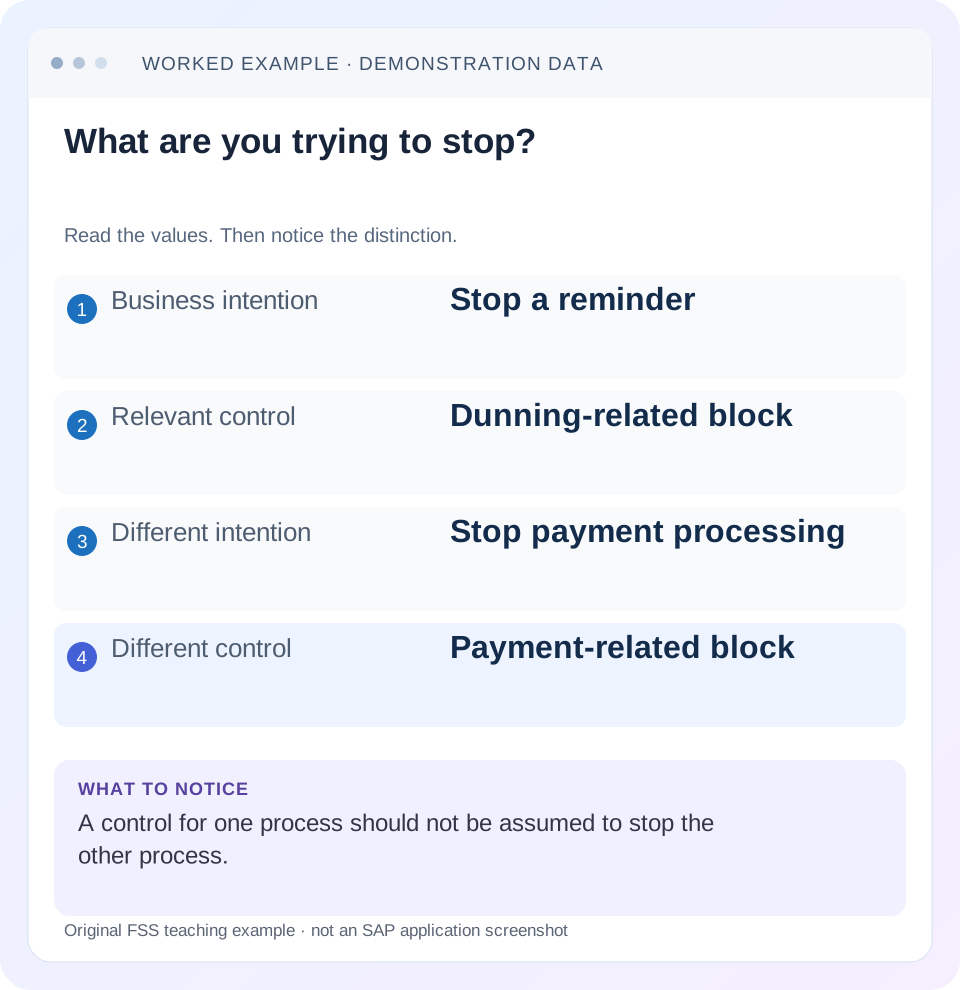
Read the example values
- Business intention
- Stop a reminder
- Relevant control
- Dunning-related block
- Different intention
- Stop payment processing
- Different control
- Payment-related block
Words you’ll meet in this guide
- Posting
- Recording a financial entry.
- General ledger
- The main collection of financial accounts.
- Open item
- An accounting entry still needing matching or settlement.
- Company code
- An organizational unit used for separate financial accounts.
- Accounting document
- A record of a financial entry with a header and individual account lines.
- HANA
- SAP’s database platform.
- FI
- Financial Accounting: the SAP area for financial postings and reporting.
Preview the practical steps
SEE THE CONNECTION
See it in a simple example.
A small example to make the idea concrete.
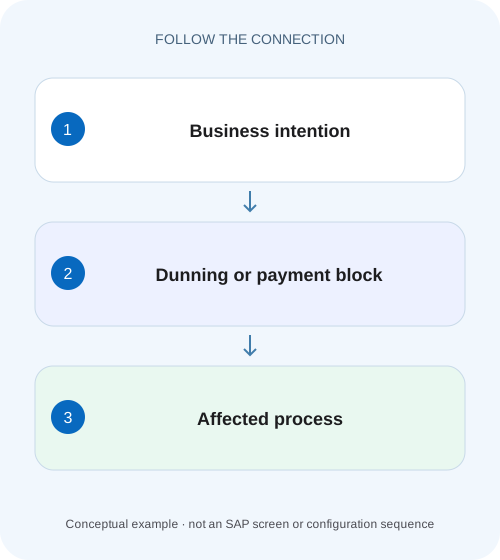
Separate customer disputes from supplier payments
A manufacturer has a disputed equipment customer invoice and a separate component supplier payment issue, each requiring a different process decision.
Name the process you intend to stop
A dunning block controls whether an account or item is dunned; a payment block controls payment processing under the applicable payment rules.
A block is a process control, not an accounting correction
An invoice can remain open for 1,000 while being blocked from a particular follow-on process.
Understand account scope and item scope
SAP documents dunning blocks in a master record or an individual item, with reason text explaining the block.
Separate customer disputes from supplier payments
A manufacturer has a disputed equipment customer invoice and a separate component supplier payment issue, each requiring a different process decision.
Identify whether the question concerns receivables follow-up or outgoing payment before interpreting a block.
| Reader | Business question | Evidence to carry forward |
|---|---|---|
| Manufacturing finance, controlling and purchasing teams | Separate customer disputes from supplier payments | Identify whether the question concerns receivables follow-up or outgoing payment before interpreting a block. |
01 Name the process you intend to stop
A dunning block controls whether an account or item is dunned; a payment block controls payment processing under the applicable payment rules. Choose the control by the business intention. A disputed customer invoice may need to be excluded from collection reminders without changing its accounting balance. A supplier invoice under review may need to remain posted while being excluded from an automatic payment. Those are different outcomes. [1] [2]
This guide is for receivables, payables and FI support teams in SAP ERP or supported S/4HANA processes. It covers ordinary FI account/item concepts, not every Contract Accounting or industry collection mechanism. You need access to relevant business-partner/company-code data, line-item status and the actual dunning or payment proposal evidence. Screen paths and block-reason behavior depend on the application, release and local configuration.
02 A block is a process control, not an accounting correction
An invoice can remain open for 1,000 while being blocked from a particular follow-on process. The block does not reduce the receivable, reverse the invoice or demonstrate payment. It changes eligibility or processing behavior according to the selected control. Keep accounting amount, open/cleared status, due date and process block as separate observations.
This separation helps explain a common incident: a customer sees an overdue balance even though collection agreed not to send a reminder during a dispute. The balance can correctly remain outstanding while dunning is suspended. If the invoice amount is actually wrong, a separate credit or supported correction process must resolve it. Removing a block will not repair an incorrect invoice.
03 Understand account scope and item scope
SAP documents dunning blocks in a master record or an individual item, with reason text explaining the block. An account-level block can affect a wider population than one disputed invoice. An item-level block can isolate a particular dispute while other eligible items continue through the process. Establish the required scope before maintenance. [1] [2]
For payment processing, similarly identify whether the relevant block comes from account/company-code data, the individual item or the invoice/source process. Do not inspect only the field that appears on the current screen. The reason code and its configuration can determine behavior, including handling in manual routes. A key’s label is useful business information, but its actual supported behavior must be verified.
04 Worked case: one disputed invoice and one undisputed invoice
Fictional customer C100 has invoice INV-A for 1,000 and invoice INV-B for 500, both open and overdue under the declared test conditions. Only INV-A is disputed. The agreed collection action is to suspend dunning for INV-A while continuing the normal assessment of INV-B. No payment, credit memo or clearing is posted in this example.
An appropriately supported item-level dunning block on INV-A should explain why that invoice is excluded or shown as blocked in the relevant run evidence. INV-B remains subject to its normal dunning rules. A broad account block would address a different requirement because it can suppress the account’s wider dunning activity. A payment block alone does not establish the intended dunning result.
| Item | Open amount | Business decision | Verification target |
|---|---|---|---|
| INV-A | 1,000 | Suspend dunning during dispute | Correct item block/reason and run exclusion |
| INV-B | 500 | Continue normal dunning assessment | No unintended account-wide suppression |
| Customer total | 1,500 | Balance remains outstanding | No credit, reversal or clearing inferred |
05 Read dunning blocks separately from dunning keys
SAP distinguishes a dunning block from a dunning key. The block prevents an account or item from being dunned in its documented scope; a dunning key can limit an item’s dunning level or influence separate presentation on a notice. A key that changes notice presentation is not automatically a complete suspension of dunning. [2]
For INV-A, state the desired outcome first: no reminder while a documented dispute is active. Then inspect the actual control and run evidence. If the requirement is instead to show a residual difference separately or cap escalation, a different supported key or process may be relevant. Avoid replacing a block with a familiar dunning key just because both fields appear in the same area.
06 Understand the payment-program distinction
The cited SAP customer-account guidance explains that an account blocked for the payment program can still have its open items processed or analyzed while no items are paid from that blocked account. Therefore “the account appeared in a log” is not equivalent to “the payment block failed.” Read the proposed payment result, exception and actual payment document separately. [1] [2]
The same discipline applies to dunning evidence. A blocked item can appear in an exception list or other run analysis without being included in the issued notice. Establish which list or status the user is showing. A candidate population, exception output and final business document are different stages, and screen labels vary between products.
07 Investigate the specific process in sequence
Use the business reference and exact run identity. Do not apply a different block as a speculative workaround before understanding the existing one.
Define the outcome and scope
For C100, write “exclude INV-A from dunning; allow normal assessment of INV-B.” Record company code and dispute owner.
Expected observation: The intended process and item population are explicit.
Display saved controls
Inspect relevant account and item fields, reason texts and the source of any block.
Expected observation: The observed control matches the intended scope.
Review the actual run
Inspect proposal/test evidence, exception lists and final notice/payment status where authorized.
Expected observation: An analyzed item is distinguished from an executed notice or payment.
Inspect reason behavior where needed
Compare the relevant reason configuration and manual/exception routes for this edition.
Expected observation: The effect is verified for the actual process, without a universal promise.
Recheck after approved maintenance
Use the same run basis or a new identified test and inspect both invoices.
Expected observation: The disputed item is controlled and the unaffected item remains correctly eligible.
08 Troubleshoot the observed outcome
A block complaint is incomplete until it says which operation still occurred. An overdue balance, a dunning proposal entry and a sent notice are not the same symptom.
| Observation | Check | Interpretation |
|---|---|---|
| Customer still owes 1,500 | Accounting open items | A block does not reduce the balance |
| INV-A appears on an exception list | Output category and reason | It may be correctly excluded from the notice |
| INV-B also suppressed | Account versus item scope | A broad block may exceed the dispute requirement |
| Payment blocked, reminder still sent | Control type | Payment and dunning are separate processes |
| Manual payment still possible | Reason configuration and route | Do not assume all reasons stop every route |
| Block removed, old proposal unchanged | Proposal creation time and refresh process | Saved proposal evidence may predate the change |
09 Give every temporary block a resolution condition
For a dispute, record what will release the block: receipt of supporting evidence, a commercial decision, a credit posting or another defined outcome. Assign a responsible business owner and review date. The goal is not to accumulate permanent blocked items that nobody can explain.
When the dispute is resolved, establish whether the invoice remains valid, needs a credit or requires another correction before removing the block. If INV-A is valid and collection resumes, its original due-date and dunning context still need interpretation. A block release does not automatically restart every process from a clean state. Inspect the relevant proposal and notices under the actual application’s supported procedure.
10 Verification: isolate the intended and unintended effects
A positive test uses C100’s two invoices and checks the supported dunning result: INV-A is controlled by the documented block while INV-B follows its normal rules. Confirm that total open receivables remain 1,500 in this dataset. This verifies both process scope and accounting-state separation.
A negative test applies only a payment-related block in a training scenario and checks that it is not accepted as evidence of a dunning suspension. A boundary test moves from item scope to account scope and observes the broader effect. Another uses a block-reason variant with different manual-payment handling, then checks the actual supported route. These are proposed learning exercises; no notices or payments were issued for this article.
11 Avoid misleading support handovers
Write “INV-A, 1,000, has item-level dunning reason X pending dispute resolution; INV-B, 500, remains subject to normal assessment. The balance is still 1,500. Run D1 shows the expected exception and no notice contribution for INV-A under the reviewed rules.” Use actual protected identifiers and observed evidence in a real case.
A handover that says only “customer blocked” leaves payables, collections and support to infer different processes. Include system/company context, account versus item scope, block type, reason, owner, observation time and the proposal or document evidence. If manual or external routes were not examined, state that limit explicitly rather than promising that all activity is stopped.
12 Review a block against the proposal creation time
Suppose the block is added at 10:00 but the disputed notice was proposed at 09:00. A screenshot of that saved proposal does not establish how a newly evaluated run would treat the current item. Record creation and maintenance times, then follow the application’s supported proposal-change or regeneration process where a reassessment is required.
The same reasoning applies when a block is released. An old exception entry may correctly describe the earlier state. Preserve the run identity instead of comparing two unnamed screenshots. For INV-A, the final evidence should connect the currently saved block, the reviewed run and the actual notice outcome. This temporal link is especially useful when collections, master-data maintenance and batch processing are performed by different teams during the same business day.
13 Frequently asked questions
Does a dunning block stop an invoice from being posted? It controls the documented dunning process; posting restrictions are separate controls. Does a payment block clear the invoice? No. Clearing requires its own matching/posting evidence. Does being listed in a run mean the item was acted upon? No; inspect whether the list represents selection, exceptions, proposal or final output.
Can one block reason work everywhere? Confirm the actual reason configuration and application route; do not assume a universal effect. If the issue concerns supplier payment, follow the payment-block and proposal-versus-payment lessons. If the disputed amount should change, use the accounting-document and correction chain instead of treating a process block as a financial adjustment.
Related services and next steps
Primary sources
Found this useful?
Share this guide with your network, or leave a like.
Your like is saved in this browser.