SAP payment blocks: Why an invoice can be posted but not paid
A component invoice is posted in the manufacturer's system, but treasury cannot include it in the intended payment process.

Source review:
START HERE · NO PRIOR TOPIC KNOWLEDGE NEEDED
What it is. Why it matters.
A payment block prevents an item from being paid through the affected payment process. An invoice can therefore exist in accounting while payment still requires a separate decision.
Completely new to SAP?
Manufacturers use SAP to connect work such as buying components, recording inventory, planning production, shipping equipment and accounting for costs. SAP S/4HANA is an enterprise resource planning system: it connects these activities through shared business data.
Financial Accounting records business events as accounting documents. An account groups relevant amounts; individual entries explain how the total arose.
A transaction code, or t-code, is a shortcut to a task in classic SAP GUI. Fiori apps provide another way to work. Names and screens depend on the product and release; you do not need a live system to learn the concepts in this guide.

Scope and source-review notes
Scope and evidence
Source review by FAST SAP SOLUTIONS® editorial. This badge describes our editorial review; it does not represent SAP certification or independent endorsement.
SAP ERP and supported S/4HANA payment-block concepts, with Logistics Invoice Verification source/release reasoning. Direct FI reasons, manual payments and cloud applications require their own configuration scope.
Reviewed relevant official SAP indexed documentation excerpts on 14 November 2026. Examples, identifiers, amounts and expected observations are illustrative; no customer SAP execution was performed. Transaction availability, labels and results depend on the installed release, deployment and local configuration.
A MANUFACTURING EXAMPLE
Investigate an unpaid component invoice
Posted is not necessarily payable
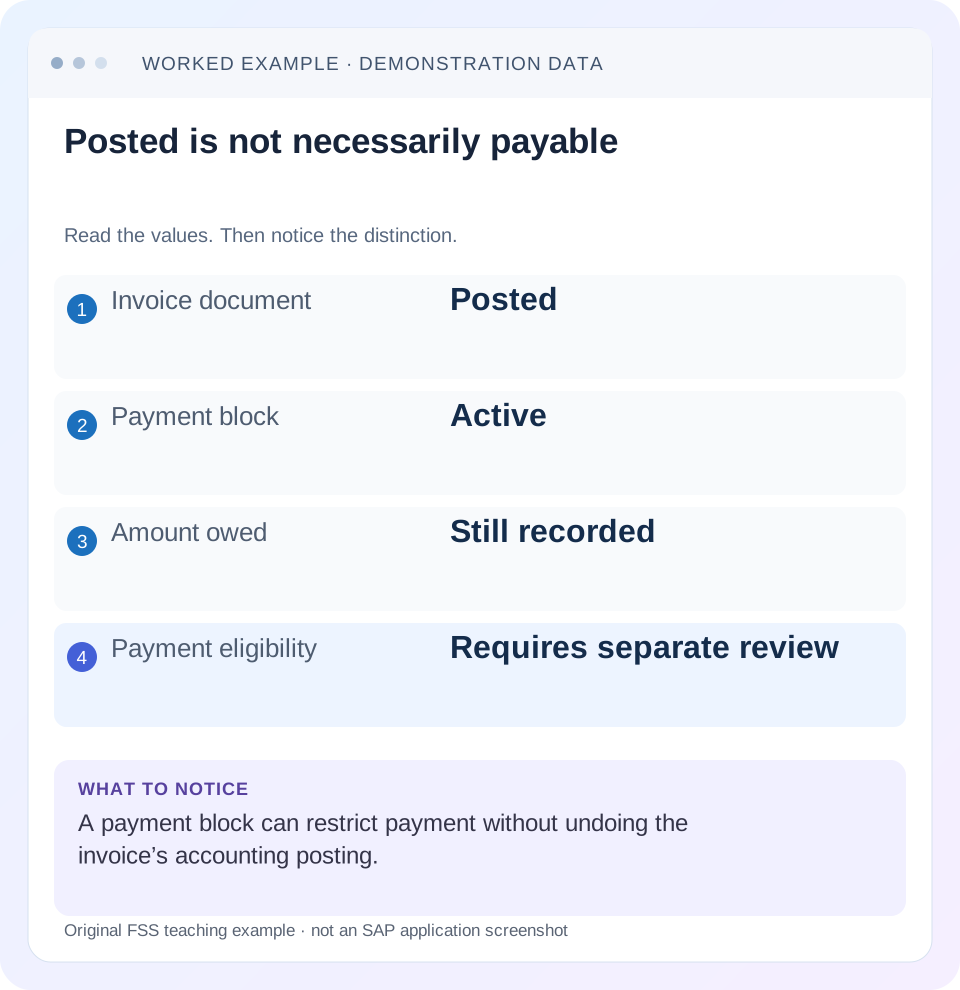
Read the example values
- Invoice document
- Posted
- Payment block
- Active
- Amount owed
- Still recorded
- Payment eligibility
- Requires separate review
Words you’ll meet in this guide
- Posting
- Recording a financial entry.
- General ledger
- The main collection of financial accounts.
- Open item
- An accounting entry still needing matching or settlement.
- Company code
- An organizational unit used for separate financial accounts.
- Accounting document
- A record of a financial entry with a header and individual account lines.
- HANA
- SAP’s database platform.
- FI
- Financial Accounting: the SAP area for financial postings and reporting.
Preview the practical steps
SEE THE CONNECTION
See it in a simple example.
A small example to make the idea concrete.
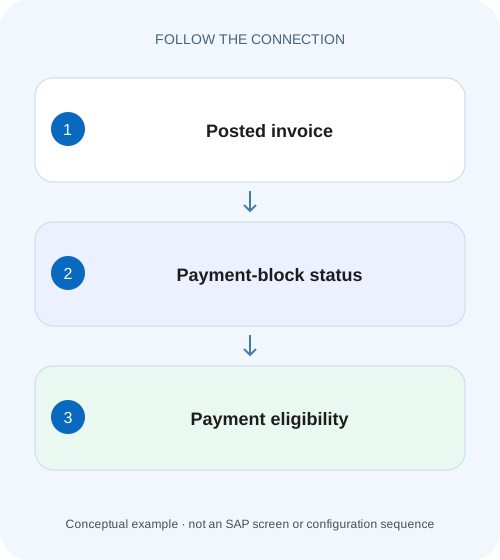
Investigate an unpaid component invoice
A component invoice is posted in the manufacturer's system, but treasury cannot include it in the intended payment process.
Posted and eligible for payment are separate states
A supplier invoice can be posted in accounting while a payment block prevents payment through the affected process.
Identify the source and reason of the block
SAP documents automatic and manual invoice blocks, including variance, item-amount and stochastic reasons in Logistics Invoice Verification.
Worked case: invoiced quantity exceeds received quantity
Fictional PO item 10 orders 100 pieces at 10 EUR each.
Investigate an unpaid component invoice
A component invoice is posted in the manufacturer's system, but treasury cannot include it in the intended payment process.
Read the actual payment-block context and authorized release responsibility rather than equating posting with payment eligibility.
| Reader | Business question | Evidence to carry forward |
|---|---|---|
| Manufacturing finance, controlling and purchasing teams | Investigate an unpaid component invoice | Read the actual payment-block context and authorized release responsibility rather than equating posting with payment eligibility. |
01 Posted and eligible for payment are separate states
A supplier invoice can be posted in accounting while a payment block prevents payment through the affected process. Posting records the liability and related accounting; payment eligibility depends on separate controls and unresolved business conditions. Seeing a document in an accounting display is therefore insufficient evidence that the next automatic payment run will pay it. [1] [2]
This guide is for accounts payable, purchasing and FI/MM support in SAP ERP or supported S/4HANA processes. It covers payment-block concepts with a Logistics Invoice Verification example. Direct FI blocks, reason configuration and manual routes can differ. You need authorized invoice, PO/receipt, accounting-item and proposal display. The worked quantities and amounts are illustrative and do not prescribe tolerance limits or authorize a release.
02 Identify the source and reason of the block
SAP documents automatic and manual invoice blocks, including variance, item-amount and stochastic reasons in Logistics Invoice Verification. A block due to price variance requires different evidence from a manual commercial hold. A stochastic review can affect an invoice without an item variance, so absence of a visible quantity discrepancy is not proof that the block is invalid. [1] [2] [3]
Capture logistics-invoice identity, accounting reference, supplier/company context and current reason evidence. Distinguish source-process blocking information from the accounting supplier-line payment field. Looking only at one field can leave the cause unexplained, especially when a source process must coordinate release across both representations.
03 Worked case: invoiced quantity exceeds received quantity
Fictional PO item 10 orders 100 pieces at 10 EUR each. The current net receipt is 80 pieces, but a posted supplier invoice covers 100 pieces at the same price, giving 1,000 EUR before the deliberately omitted tax/other effects. Assume the actual configured invoice-verification rules treat the 20-piece difference as a blocking condition in this training scenario.
The accounting liability can be 1,000 while the invoice is blocked for payment. The 200 EUR quantity-based comparison, 20 × 10, explains the illustrative disputed portion but is not a universal SAP block calculation or permission to pay the other 800 separately. SAP’s referenced process can block the whole invoice even when one item has a variance.
| Measure | Value | Meaning |
|---|---|---|
| Ordered | 100 PC | PO expectation |
| Net received | 80 PC | Posted receipt evidence |
| Invoiced | 100 PC / 1,000 EUR | Posted supplier claim |
| Quantity difference | 20 PC | Requires receipt/invoice investigation |
| Simple value comparison | 200 EUR | 20 × 10 under declared assumptions |
| Payment state | Blocked | Liability exists; payment eligibility unresolved |
04 Read all invoice items, not just the disputed one
A multi-item invoice can have one variance while the payment restriction applies to the invoice’s supplier item. SAP documents that all invoice items are blocked together in the described process. The release investigation therefore needs the complete invoice and every still-valid blocking reason, not just the first line that purchasing corrected. [1] [3]
Suppose receipt for item 10 increases to 100 pieces, but item 20 still has an unresolved price variance. The first condition may cease to apply while the invoice remains blocked. That is not necessarily a failed release. Inspect the current reason set and the supported release result. Do not remove the accounting block simply because one department has finished its part.
05 Separate a missing receipt from a wrong invoice
For the 20-piece difference, ask whether the goods actually arrived and the receipt is missing, whether the supplier invoiced early, whether units differ or whether the invoice is commercially incorrect. These branches require different actions. Posting a receipt merely to make payment possible records a business event that may not have occurred.
Reconstruct the PO-item history using receipts, reversals and invoice references. Preserve quantity units and any order/base conversion. If 80 means boxes in one document and pieces in another, raw subtraction is invalid. If a receipt was reversed, use the net supported chain. Resolve the actual event before interpreting the block as a nuisance.
06 Use the source-process release route
The reviewed SAP invoice-release guidance identifies MRBR for blocked invoices posted in Logistics Invoice Verification and explains coordinated handling of blocking reasons and the FI payment field. It specifically warns that removing an MM invoice block only from the financial side can leave the logistics blocked record improperly processed. [3]
Therefore establish the installed supported invoice-release application and its scope. A direct FI invoice with a manual payment block can require a different maintenance route. Do not apply an MRBR instruction to every invoice, and do not use a general line-item change as a universal release shortcut. The release should preserve consistency between source and accounting states.
07 Investigate and verify in a practical sequence
Work from the cause to the release evidence, then to payment eligibility. These are separate milestones.
Locate the complete chain
Match supplier, company, logistics invoice, accounting document and PO items.
Expected observation: The investigated block belongs to the intended invoice.
Read current blocking reasons
Inspect all relevant items and account/source block evidence.
Expected observation: The 20-piece quantity issue and any other reason are explicit.
Reconcile the underlying event
Compare receipt, invoice, price/unit and reversal evidence with purchasing/receiving records.
Expected observation: The actual business discrepancy is understood.
Use the permitted release review
After the condition is resolved or an authorized decision exists, apply the supported source-process route and inspect saved results.
Expected observation: Source and FI block states agree.
Check the next payment assessment
Inspect a new or appropriately refreshed proposal and remaining payment requirements.
Expected observation: Released does not get mistaken for paid.
08 Manual and stochastic blocks need different evidence
A manual block can represent a deliberate review decision even when quantity and price agree. Preserve its reason, owner and release condition. A stochastic block is documented as a random whole-invoice review under configured activation/probability settings. Its presence does not prove a price or quantity error. [2]
Do not reverse-engineer stochastic probabilities from a handful of invoices or claim that a particular document should never be selected because its values match. Verify the block category and required review. For a manual commercial hold, ask what evidence resolves the hold; recalculating tolerances may be irrelevant. These distinctions prevent an analyst from changing invoice data to remove a control whose purpose is independent review.
09 Troubleshoot a persistent or inconsistent block
A block can remain valid after one correction, and a proposal can reflect an earlier state. Identify the stage and observation time before escalating a supposed synchronization defect.
| Observation | Check | Next evidence |
|---|---|---|
| Invoice posted but absent from payment | Current block and proposal exception | Posted state does not establish eligibility |
| No visible item variance | Manual/stochastic category | Whole-invoice review may apply |
| One reason removed, invoice still blocked | Other items/reasons | Complete reason set |
| FI field clear, logistics still blocked | Release route used | Source-process consistency |
| Release saved, old proposal still excludes | Proposal timing/refresh | New assessment on supported basis |
| Invoice released but unpaid | Payment method/data/run/bank stages | Release is only one eligibility condition |
10 Payment terms and operational timing still matter
SAP notes that the cash-discount period can expire while an invoice is blocked. Do not assume a release resets payment terms or restores a discount. Inspect actual baseline, terms and the payment proposal’s discount handling under the configured process.
For the 1,000 example, resolving the receipt difference establishes one business condition. Whether the invoice is due, which payment method applies and what amount the proposal pays are subsequent questions. If purchasing agrees a credit for 200 instead of receiving another 20 pieces, trace the credit and invoice relationships through the supported process rather than treating removal of the block as the whole settlement.
11 Verify positive, negative and boundary outcomes
A positive training check resolves the declared quantity condition with genuine receipt evidence or an approved invoice correction, then verifies all blocking reasons and the resulting source/FI state. Reassess payment eligibility separately. A negative test removes only an unrelated field or corrects only item 10 while item 20 remains blocked; reject a claim that the whole invoice must now be payable.
A boundary test uses an invoice with matching quantities and prices but a manual or stochastic review block. Confirm that the investigation follows that category rather than inventing a variance. Another tests an old proposal created before release and requires a supported reassessment. These are proposed verification exercises; no block was removed and no payment run was executed for this article.
12 Write a useful AP and purchasing handover
A clear result reads: “Invoice L1 posts liability 1,000 EUR. PO item 10 has net receipts80 PC versus invoice 100 PC; the declared quantity block remains under receiving review. Other invoice items were checked. Source release and payment-proposal eligibility have not yet been established.” Replace assumptions with actual protected evidence in a real incident.
After resolution, add the source correction/release reference, current block state and reviewed proposal outcome. If bank payment remains pending, say so. This allows AP, purchasing and receiving to agree on the same event without interpreting “posted,” “released” and “paid” as synonyms.
13 Record the invoice amount separately from the disputed comparison
In the worked case the posted claim is 1,000 and the simple unresolved quantity comparison is 200. Preserve both figures. Reporting only “blocked200” could imply that800 is automatically available for payment, which the declared whole-invoice blocking process does not establish. Read the actual proposal/payment amount after the supported resolution rather than deriving it from subtraction alone.
14 Frequently asked questions
Does a payment block reverse the liability? No. Can I pay only the unproblematic line automatically? The referenced invoice-verification block can apply to the whole invoice; use the supported process and actual business decision. Why does a block exist without a variance? Manual and stochastic review categories can apply.
Can I remove an MM block only in a financial line-item screen? Follow the supported source-release route to preserve consistency. Use PO-history and GR/IR lessons to reconcile the underlying receipt/invoice chain, and the proposal-versus-payment lesson to establish what happened after eligibility was restored.
Related services and next steps
Primary sources
Found this useful?
Share this guide with your network, or leave a like.
Your like is saved in this browser.