SAP GR/IR open items: Reconcile the purchase-order item before clearing
A factory has received more components than its supplier has invoiced, leaving a GR/IR position that needs an item-level explanation.

Source review:
START HERE · NO PRIOR TOPIC KNOWLEDGE NEEDED
What it is. Why it matters.
GR/IR means goods receipt/invoice receipt. It helps account for timing differences between received goods and supplier invoices, so reconciliation follows the relevant purchase-order item history.
Completely new to SAP?
Manufacturers use SAP to connect work such as buying components, recording inventory, planning production, shipping equipment and accounting for costs. SAP S/4HANA is an enterprise resource planning system: it connects these activities through shared business data.
Financial Accounting records business events as accounting documents. An account groups relevant amounts; individual entries explain how the total arose.
A transaction code, or t-code, is a shortcut to a task in classic SAP GUI. Fiori apps provide another way to work. Names and screens depend on the product and release; you do not need a live system to learn the concepts in this guide.

Scope and source-review notes
Scope and evidence
Source review by FAST SAP SOLUTIONS® editorial. This badge describes our editorial review; it does not represent SAP certification or independent endorsement.
SAP ERP and S/4HANA GR/IR PO-item reconciliation for a standard stock case. Classic clearing, current reconciliation apps and extended open-item management are distinct release/configuration scopes.
Reviewed relevant official SAP indexed documentation excerpts on 14 November 2026. Examples, identifiers, amounts and expected observations are illustrative; no customer SAP execution was performed. Transaction availability, labels and results depend on the installed release, deployment and local configuration.
A MANUFACTURING EXAMPLE
Reconcile received components against invoices
Explain the receipt/invoice timing
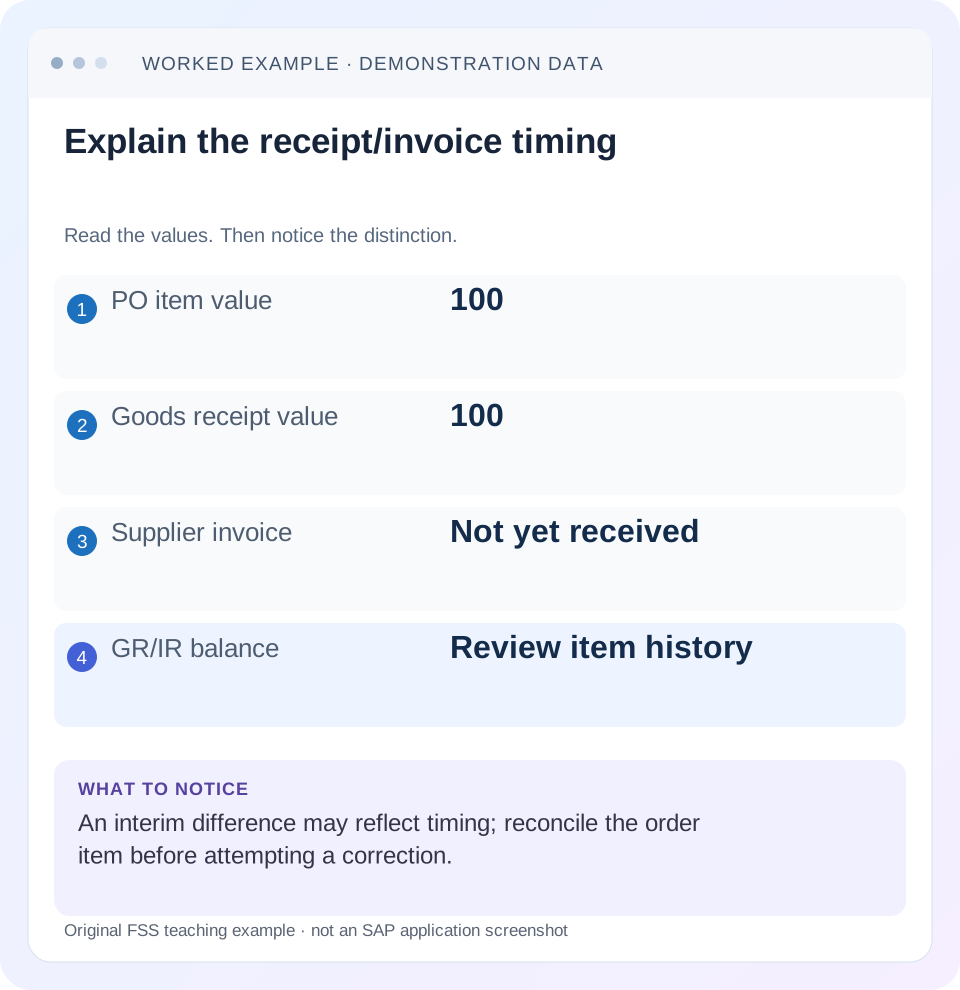
Read the example values
- PO item value
- 100
- Goods receipt value
- 100
- Supplier invoice
- Not yet received
- GR/IR balance
- Review item history
Words you’ll meet in this guide
- Posting
- Recording a financial entry.
- General ledger
- The main collection of financial accounts.
- Open item
- An accounting entry still needing matching or settlement.
- Company code
- An organizational unit used for separate financial accounts.
- Accounting document
- A record of a financial entry with a header and individual account lines.
- HANA
- SAP’s database platform.
- FI
- Financial Accounting: the SAP area for financial postings and reporting.
Preview the practical steps
SEE THE CONNECTION
See it in a simple example.
A small example to make the idea concrete.
Reconcile received components against invoices
A factory has received more components than its supplier has invoiced, leaving a GR/IR position that needs an item-level explanation.
Reconcile the purchase-order item before clearing the account
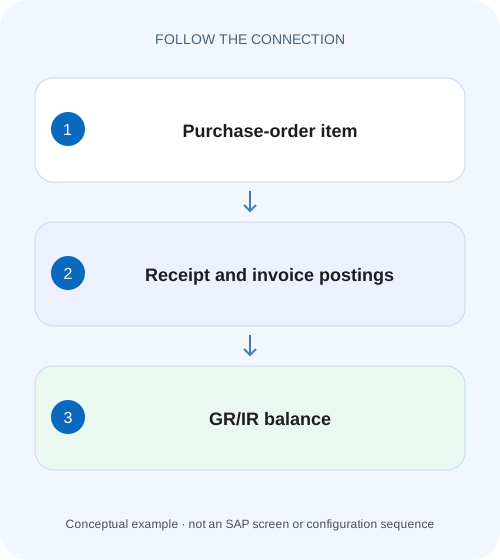
GR/IR connects relevant goods-receipt and invoice-receipt accounting in procurement.
Understand the receipt and invoice accounting relationship
In a simple valuated stock receipt, inventory is debited and GR/IR credited.
Worked case: 80 received, 50 invoiced at 10 per piece
Fictional PO4500001000/item 10 orders 100 PC at 10 EUR each.
Reconcile received components against invoices
A factory has received more components than its supplier has invoiced, leaving a GR/IR position that needs an item-level explanation.
Reconcile receipts, invoices and reversals for the same PO item and units before proposing clearing.
| Reader | Business question | Evidence to carry forward |
|---|---|---|
| Manufacturing finance, controlling and purchasing teams | Reconcile received components against invoices | Reconcile receipts, invoices and reversals for the same PO item and units before proposing clearing. |
01 Reconcile the purchase-order item before clearing the account
GR/IR connects relevant goods-receipt and invoice-receipt accounting in procurement. A balance can reflect a genuine timing difference, quantity mismatch, value difference or incomplete matching. Start with the purchase order and item behind the amount. An account-wide zero can conceal unrelated debit and credit cases that should not be matched together. [1] [2]
This guide is for FI/MM accountants, buyers and support analysts in SAP ERP or supported S/4HANA processes. It uses a standard stock-item example, not every service, account-assigned or special-stock process. Classic automatic clearing and extended open-item management have different supported capabilities. You need authorized PO history, receipt/invoice and accounting-item display. All figures are illustrative and exclude tax, exchange and delivery costs initially.
02 Understand the receipt and invoice accounting relationship
In a simple valuated stock receipt, inventory is debited and GR/IR credited. A later invoice can debit GR/IR and credit the supplier, with any applicable differences handled under the valuation design. The sequence and price/quantity context matter. Do not treat the supplier liability as a second GR/IR credit to add to the same account. [1] [2]
SAP’s FI-GL guidance distinguishes updating postings for the same PO/item from actually marking eligible open items cleared. Its referenced classic process analyzes the PO/item group and clears suitable zero groups; unresolved or unassignable items remain open. An offsetting posting can therefore reduce the balance without immediately proving completion of the clearing lifecycle.
03 Worked case: 80 received, 50 invoiced at 10 per piece
Fictional PO4500001000/item 10 orders 100 PC at 10 EUR each. Net goods receipts are 80 PC, valued 800 under the declared simple basis. The invoice covers50 PC and 500 EUR. Assume standard stock accounting with no price difference and all relevant events included. The receipt produces GR/IR credit 800 and the invoice GR/IR debit 500.
The resulting GR/IR credit balance is 300, corresponding to 30 received pieces not yet invoiced on this simplified basis. Ordered-but-not-received 20 pieces are a separate operational difference; they do not create another 200 GR/IR credit in the declared timeline. Keep ordered, received and invoiced quantities separate.
| Event | Quantity | GR/IR debit | GR/IR credit |
|---|---|---|---|
| PO order | 100 PC | No posting asserted | No posting asserted |
| Net goods receipt | 80 PC | 0 | 800 |
| Invoice receipt | 50 PC | 500 | 0 |
| Difference | 30 PC received not invoiced | Net credit 300 | Timing/mismatch to explain |
| Order less received | 20 PC | Separate open delivery question | Not an extra GR/IR posting |
04 Add reversals and returns with their source relationships
If10 of the 80 received pieces are reversed under the supported process, the net receipt becomes 70 and the simple GR/IR credit basis becomes 700. Against the same 500 invoice, the difference is 200. Retain the reversal’s link to the original receipt; do not simply drop a negative row because it makes the total less familiar.
If an invoice is reversed, recalculate its signed effect separately from receipt quantity. A return, subsequent debit or service adjustment may follow different valuation and document relationships. Identify the actual event category before assigning a sign or multiplying by the original PO price. The original simple model must be extended when its assumptions change.
05 Quantity agreement does not guarantee value agreement
Suppose80 PC is both received and invoiced but the invoice price or conditions differ from the receipt basis. Quantity now agrees, yet accounting can include price or other differences under the valuation process. Inspect actual invoice and accounting lines rather than predicting the GR/IR amount from quantity alone.
Align units, price units, currency and valuation basis. Ten boxes and ten pieces cannot be compared without the maintained conversion. A PO price per 100 units cannot be multiplied as if it were per 1. Delivery costs and foreign exchange introduce further accounting branches. Resolve these bases before declaring the account balance an unexplained write-off.
06 Classify the unresolved business event
For the original 300 credit, determine whether another invoice is expected, an invoice exists but is not posted, receipt quantity is wrong, or another correction is needed. The balance’s sign helps describe the accounting position but does not identify the commercial cause by itself.
Ask the responsible purchasing/receiving/AP team for a concrete reference and next event. “Supplier will invoice remaining 30 PC” is an explanation to verify, while “clear300 because it is old” is not. If no further event is expected, use the approved GR/IR maintenance/closing process for the actual scenario after the quantity and value evidence is reconciled. Age alone is not authorization for a financial adjustment.
07 Distinguish operational reconciliation from accounting clearing
Reconciliation explains whether receipt, invoice and expected future events agree. Clearing records a valid offsetting relationship among eligible accounting items. A zero PO-item amount may still require the supported clearing run; a nonzero item can remain legitimately open while its future invoice is expected. [1] [3] [4]
Current S/4HANA reconciliation applications can combine procurement and accounting information and support exception processing. Extended open-item management has its own automatic-clearing job and grouping options. Do not assume a classic F.13 instruction applies unchanged to every extended account. Identify the installed account-management design and supported application first.
08 A practical PO-item investigation
Build one signed timeline that both MM and FI can recognize. Keep receipt quantities and invoice quantities in separate columns.
Confirm item identity
Record PO/item, material/service, supplier, plant, company and observation time.
Expected observation: All evidence concerns4500001000/item 10.
Reconstruct net receipts
List receipts and corrections with quantities, units and source references.
Expected observation: Original example yields80 PC, not simply the sum of positive rows.
Reconstruct invoice evidence
List posted invoices/corrections, quantities, currency and actual accounting references.
Expected observation: 50 PC/500 is distinguished from payment status.
Bridge quantities and values
Calculate80−50=30 PC and 800 credit−500 debit=300 credit under the stated basis.
Expected observation: Each residual has a defined interpretation.
Choose the supported next process
Verify expected future event or approved correction, then appropriate reconciliation/clearing route.
Expected observation: A balance reduction follows the actual business explanation.
09 Preserve PO/item grouping in automatic clearing
The reviewed classic GR/IR guidance analyzes purchase-order number and item. Current extended-OIM documentation describes sort-key-based grouping and explicit PO/item selection, and cautions that alternative clearing criteria can lead to inter-PO matching. Use the documented capability for the account type rather than broadening groups to manufacture zero. [1] [4]
For example, PO/item 10 credit 300 and unrelated PO/item 20 debit 300 give an account zero but do not establish that either procurement case is complete. Keep them separate until legitimate source evidence and the supported design justify a relationship. A smaller open-item list produced by crossing unrelated items is not a successful purchasing reconciliation.
10 Troubleshoot the first unexplained event or basis
A diagnostic handover should say whether the unresolved difference is quantity, value, missing source event or clearing state. Those lead to different actions.
| Observation | Check | Next evidence |
|---|---|---|
| Receipt80, invoice 50 | Expected remaining invoice | Supplier invoice/remittance and intake status |
| Receipt quantity too high | Reversals/returns and units | Signed material-document chain |
| Quantities agree, amount differs | Price/unit/currency/conditions | Invoice and accounting line basis |
| Zero PO-item amount, rows open | Clearing lifecycle and grouping | Supported run and actual clearing reference |
| Account zero, two PO items nonzero | PO/item identity | Unrelated cases must remain explained |
| Classic run unavailable for account | Open-item-management type | Use supported extended/reconciliation process |
11 Verify positive, negative and boundary cases
The positive worksheet check reproduces receipt 800 credit less invoice 500 debit equals 300 credit and 30 PC received-not-invoiced. Then add a legitimate remaining 30 PC invoice at the declared same basis and reconcile the zero group and supported clearing evidence separately.
A negative test offsets the 300 with an unrelated PO item and rejects it as proof of completion. A boundary test reverses10 received pieces and recalculates200, preserving references. Another aligns quantity but changes the invoice basis and requires actual valuation lines rather than assumed price multiplication. These are proposed exercises; no receipt, invoice, maintenance adjustment or clearing was executed for this lesson.
12 Keep payment and closing presentation outside the simple bridge
An invoice in PO history can remain blocked, open or unpaid. GR/IR reconciliation does not establish supplier bank settlement. Trace accounting payment/clearing evidence separately when the business question concerns cash. A payment block does not itself explain a missing goods receipt.
Year-end reporting can also require classification or adjustment of goods received not invoiced and invoiced not received under the actual accounting policy and supported closing process. The tutorial’s300 bridge identifies source evidence; it does not prescribe a statutory presentation or journal. Preserve the reconciliation and the approved closing treatment as separate evidence.
13 Assign an owner and next event to each residual
For the original 300 credit, record whether AP expects a supplier invoice for 30 PC, receiving must correct a receipt, or purchasing is obtaining a commercial resolution. Include the actual reference and expected follow-up date where known. This is more useful than assigning every aged balance to finance with no source question.
If AP says the remaining invoice already exists, locate its posted, parked or intake state and PO/item mapping. If receiving says all goods were returned, locate the signed return/correction documents instead of assuming the original 80 still applies. If purchasing confirms no further event is expected, preserve that decision for the supported maintenance review.
Revisit the same item after the next event and update both quantity and accounting bridges. A status note that says “resolved” is incomplete if the remaining open amount, resulting correction reference and actual clearing state are not checked. This closes the practical loop from unexplained residual to a specific verified outcome.
14 Frequently asked questions
Does an open GR/IR item mean an error? It can represent timing or an unresolved case; inspect the PO/item chain. Does receipt minus invoice always equal the accounting balance? Only under the stated simple value assumptions; actual pricing, currencies and valuation can add branches. Does a zero account prove each PO is complete? No.
Can a completion indicator replace reconciliation? Inspect actual documents and supported process effects; a label is not a universal clearing rule. Use PO-history guidance for event reconstruction, OBYC guidance for account functions and F.13 guidance for eligible grouping, while keeping extended-OIM capabilities specific to the installed account design.
Related services and next steps
Primary sources
Found this useful?
Share this guide with your network, or leave a like.
Your like is saved in this browser.