FS10N versus FAGLB03: Understand the balance view before comparing reports
A manufacturer's finance team compares two account-balance views while preparing a plant-related reconciliation.

Source review:
START HERE · NO PRIOR TOPIC KNOWLEDGE NEEDED
What it is. Why it matters.
A balance report summarizes account values for selected periods. FS10N and FAGLB03 belong to different relevant classic reporting contexts, so selections and ledger coverage must match before comparison.
Completely new to SAP?
Manufacturers use SAP to connect work such as buying components, recording inventory, planning production, shipping equipment and accounting for costs. SAP S/4HANA is an enterprise resource planning system: it connects these activities through shared business data.
Financial Accounting records business events as accounting documents. An account groups relevant amounts; individual entries explain how the total arose.
A transaction code, or t-code, is a shortcut to a task in classic SAP GUI. Fiori apps provide another way to work. Names and screens depend on the product and release; you do not need a live system to learn the concepts in this guide.

Scope and source-review notes
Scope and evidence
Source review by FAST SAP SOLUTIONS® editorial. This badge describes our editorial review; it does not represent SAP certification or independent endorsement.
Classic FI balance displays FS10N and New G/L FAGLB03 using ERP references. S/4HANA reporting and ledger availability depend on the installed accounting design.
Reviewed relevant official SAP indexed documentation excerpts on 14 November 2026. Examples, identifiers, amounts and expected observations are illustrative; no customer SAP execution was performed. Transaction availability, labels and results depend on the installed release, deployment and local configuration.
A MANUFACTURING EXAMPLE
Compare factory account balances consistently
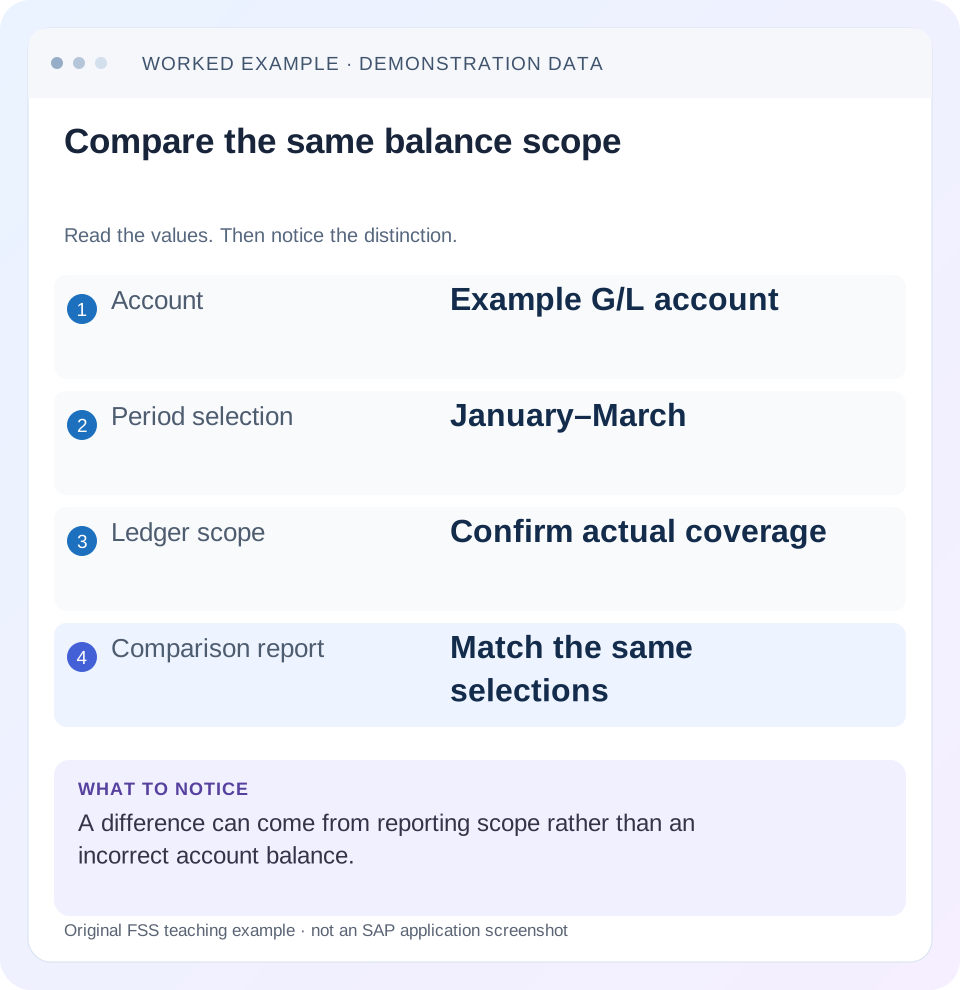
Compare the same balance scope
Read the example values
- Account
- Example G/L account
- Period selection
- January–March
- Ledger scope
- Confirm actual coverage
- Comparison report
- Match the same selections
Words you’ll meet in this guide
- Posting
- Recording a financial entry.
- General ledger
- The main collection of financial accounts.
- Open item
- An accounting entry still needing matching or settlement.
- Company code
- An organizational unit used for separate financial accounts.
- Accounting document
- A record of a financial entry with a header and individual account lines.
- HANA
- SAP’s database platform.
- FI
- Financial Accounting: the SAP area for financial postings and reporting.
Preview the practical steps
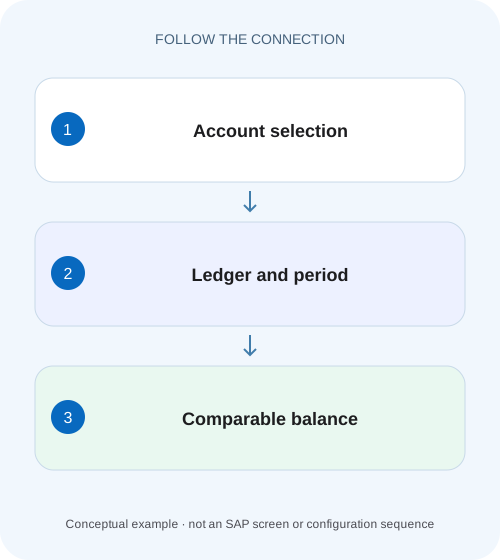
SEE THE CONNECTION
See it in a simple example.
A small example to make the idea concrete.
Compare factory account balances consistently
A manufacturer's finance team compares two account-balance views while preparing a plant-related reconciliation.
Identify the accounting view before comparing balances
FS10N is associated with classic G/L account analysis; FAGLB03 is associated with New G/L balance display.
Distinguish opening balance, movement and cumulative balance
An opening balance represents the carried-forward starting position.
Worked case: a 10,000 opening balance and three months of movements
Fictional balance-sheet account G100 in company 1000 opens with debit 10,000 EUR.
Compare factory account balances consistently
A manufacturer's finance team compares two account-balance views while preparing a plant-related reconciliation.
Align company code, fiscal year, ledger and reporting scope before treating a different total as a posting error.
| Reader | Business question | Evidence to carry forward |
|---|---|---|
| Manufacturing finance, controlling and purchasing teams | Compare factory account balances consistently | Align company code, fiscal year, ledger and reporting scope before treating a different total as a posting error. |
01 Identify the accounting view before comparing balances
FS10N is associated with classic G/L account analysis; FAGLB03 is associated with New G/L balance display. Their names do not establish that every selection, ledger or currency is equivalent. Before comparing two totals, record the accounting design and the supported report in the installed system, then define the same account, entity, time and currency scope. [1] [2]
This guide is for FI accountants and analysts reading classic ERP or supported S/4HANA balances. The reviewed conversion reference explains historical classic/New G/L mapping; it is not a current implementation recipe. You need authorized balance, line-item and document display. The example uses a fictional balance-sheet account in one currency with no special-period or foreign-exchange complications until they are introduced explicitly.
02 Distinguish opening balance, movement and cumulative balance
An opening balance represents the carried-forward starting position. A period movement represents activity in that period. A cumulative balance combines the starting position with movements through a selected point. These numbers can all appear in a balance display but answer different questions. A label such as “March balance” needs clarification before arithmetic.
For a debit-positive worksheet convention, beginning balance plus debits minus credits gives the ending balance. A liability account may appear credit-positive in another report, so preserve the display convention. Do not subtract a credit twice because the export already represents it as negative. Establish the report’s debit/credit and cumulative columns before comparing with a spreadsheet.
03 Worked case: a 10,000 opening balance and three months of movements
Fictional balance-sheet account G100 in company 1000 opens with debit 10,000 EUR. January has debits 3,000 and credits 1,000; February debits 500 and credits 1,500; March debits 2,000 and credits 500. There are no other postings. Under the declared debit-positive convention, the period movements are +2,000, −1,000 and +1,500.
The cumulative balances are 12,000 after January, 11,000 after February and 12,500 after March. January–March net movement is 2,500, not 12,500. A current-year line-item sum can therefore differ from the ending balance by the 10,000 opening amount without any missing current-year posting.
| Position | Debits | Credits | Net movement | Cumulative balance |
|---|---|---|---|---|
| Opening | Not current-year activity | Not current-year activity | Opening 10,000 | 10,000 |
| January | 3,000 | 1,000 | +2,000 | 12,000 |
| February | 500 | 1,500 | −1,000 | 11,000 |
| March | 2,000 | 500 | +1,500 | 12,500 |
| Q1 total | 5,500 | 3,000 | +2,500 | 12,500 including opening |
04 Ledger scope can explain a genuine difference
In ledger-aware accounting, identify the ledger or ledger group and relevant valuation basis. A leading-ledger balance and a different accounting-principle ledger can intentionally contain different adjustments. Do not expect equality merely because company code and G/L account match.
Suppose a declared separate-ledger adjustment adds 700 debit to G100 in March. The example’s 12,500 basis and the adjusted 13,200 basis answer different ledger questions. Trace the 700 adjustment and its ledger scope before declaring either report wrong. Use the supported ledger-specific line-item/document display to confirm the relationship; a generic entry-view screenshot may not show every ledger-specific representation.
05 Currencies are part of the balance identity
A balance in company-code currency, another ledger currency or a translated display currency is not the same measure. Record currency type, currency key and any report translation settings. Equal currency names alone may still leave a difference in rate date or valuation basis for a translated report.
For G100, 12,500 EUR can be compared directly only with another EUR amount on the same accounting basis. If a report presents USD, retain its supported translation context and reconcile conversion separately. Do not alter a journal or exchange rate to make two different reporting currencies display the same numeral. Use the foreign-currency lesson when the unexplained difference begins with conversion inputs.
06 Understand the carryforward question at year-end
SAP documents different carryforward treatment for balance-sheet and P&L accounts: balance-sheet balances continue on the relevant account, while P&L balances are carried to retained earnings under the configured design. A zero opening on an expense account can therefore be expected even when the prior year had expense activity. [3] [4]
The retained-earnings opening can include prior closing balance plus the carried P&L result. It need not equal only the previous retained-earnings closing balance. The reviewed support guidance also explains that carryforward is not represented as ordinary posting documents that can simply be found by summing current-year line items. Inspect the actual carryforward status and accounting setup for the applicable architecture.
07 Reconcile one period before the whole fiscal year
Choose March in the example. Reconstruct 2,000 debit less 500 credit = 1,500 movement, then bridge February’s 11,000 to March’s 12,500. This isolates whether the discrepancy concerns current movement or the starting position. If March movement agrees but ending balance differs by 10,000, investigate opening/cumulative selection rather than March invoices. [5]
For an actual difference, drill to the supported line-item view and match representative document identities. Keep entry view versus ledger view clear. SAP’s document-display guidance describes ledger-specific lines and possible splitting/additional items. A different line count does not automatically mean that the balance contains duplicate economic events.
08 A practical balance-comparison sequence
Build a short comparison specification before exporting reports. It should be possible for another analyst to rerun the same question.
Identify both reports
Record transaction/app, account, company, year, ledger and currency basis.
Expected observation: The two totals have explicit identities.
Name the figure being compared
Choose period debit/credit movement, net movement or cumulative balance including opening.
Expected observation: 2,500 Q1 movement is distinguished from 12,500 closing.
Bridge the periods
Reconstruct opening plus signed monthly movements using consistent precision and signs.
Expected observation: The worksheet reaches the expected cumulative amount.
Drill to the first divergent period
Match underlying documents in the supported view and inspect filters.
Expected observation: The difference is tied to items or opening scope.
Inspect carryforward if required
For a year boundary, check account type, retained-earnings treatment and actual carryforward evidence.
Expected observation: An expected opening treatment is separated from an incomplete process.
09 Troubleshoot totals without creating balancing journals
An unexplained difference is an investigation result, not an amount to post. Establish whether it belongs to selection, starting balance, movement, currency or ledger before proposing a correction.
| Observation | Check | Reasoning |
|---|---|---|
| Difference equals opening balance | Cumulative versus current-year movement | Line-item activity can exclude carryforward |
| Only one ledger differs | Ledger adjustment documents | Different valuation scope may be intentional |
| Expense account opens at zero | P&L carryforward treatment | Result moves to retained earnings |
| Retained earnings opening exceeds old closing | P&L result carried forward | Opening contains more than prior account closing |
| Monthly movements agree; cumulative differs | Starting balance and period range | Do not search only current-month invoices |
| Small conversion difference | Currency precision and conversion history | Inspect the specific process before adjustment |
10 Verification exercises with expected observations
The positive worksheet test reconstructs Q1 movement 5,500 − 3,000 = 2,500 and closing 10,000 + 2,500 = 12,500. Check each monthly bridge so a hidden sign error cannot cancel another. In an authorized training report, compare the same basis and inspect representative underlying items.
The negative test compares Q1 movement 2,500 with closing 12,500 and identifies the missing opening component. A boundary test adds the declared separate-ledger 700 adjustment and explains 13,200 only in that scope. Another replaces G100 with a P&L account and asks where the prior-year result carries. These are proposed checks, not a certification of a financial balance or customer-system execution.
11 Write a bridge that an accountant can review
A useful result reads: “For company 1000/G100/FY2026 on the stated EUR ledger basis, opening debit 10,000 plus Q1 debit 5,500 less credit 3,000 gives 12,500. The comparison extract’s 2,500 is current-year movement, so the 10,000 difference is opening scope.” Each number has a role.
If a real mismatch remains, preserve both report selections, the bridge, the first differing period and representative documents. Record whether carryforward and ledger-specific adjustments were reviewed. Do not write “FS10N wrong” or “FAGLB03 wrong” before identifying the accounting view and the unsupported relationship.
12 Compare the debit and credit columns before the net
A net movement can agree while its composition differs. Suppose one report includes an extra erroneous debit 400 and an extra credit 400. Its March net movement still equals 1,500, but the gross debit and credit activity differs from the declared 2,000 and 500. Reconcile both sides when the question concerns turnover, source completeness or reversal activity. Net equality can hide offsetting errors.
A useful period worksheet contains opening, gross debits, gross credits, net movement and closing, with each source report column mapped explicitly. For a correction period, also identify original/reversal pairs so an expected increase in gross activity is not mistaken for another economic expense. If the report uses signed amount rather than separate debit/credit columns, document that transformation before comparing.
For G100, the baseline March columns are debit 2,000, credit 500, movement1,500 and closing12,500. If the alternative shows debit 2,400 and credit 900, the net bridge still works, but the extra400 pair needs document evidence. It might be an expected reversal/reposting chain or an unrelated defect. The balance display alone cannot decide which. Drill to the added items, preserve their references and explain the business events before proposing another journal.
13 Frequently asked questions
Can FS10N and FAGLB03 always be compared directly? Confirm architecture and selections; the transaction mapping alone does not establish equivalent scope. Why can a balance exceed current-year line items? Opening carryforward or report population can explain it. Why does a P&L account start at zero? Its carryforward treatment differs from a balance-sheet account under the documented design.
Does a zero balance mean all items are cleared? No; use the open-item lesson for that distinction. Does a ledger-view extra line prove duplication? No; inspect its generated role and ledger context. Use line-item and FB03 guidance to turn a headline difference into a reproducible document-level explanation.
Retain the exact selection variant with the reconciliation.
Related services and next steps
Primary sources
- Roles for Transactions Utilized by Financial Shared Services | SAP Help Portal
- Conversion Guide for SAP S/4HANA 1511 | SAP Help Portal
- Balance carried forward differs from previous year-end | SAP Help Portal
- Customizing Attributes of General Ledger Accounts | SAP Learning
- Document Display | SAP Help Portal
Found this useful?
Share this guide with your network, or leave a like.
Your like is saved in this browser.