SAP reconciliation accounts: Understand the subledger connection
A manufacturer reconciles supplier balances to the general ledger and needs to understand the subledger connection.

Source review:
START HERE · NO PRIOR TOPIC KNOWLEDGE NEEDED
What it is. Why it matters.
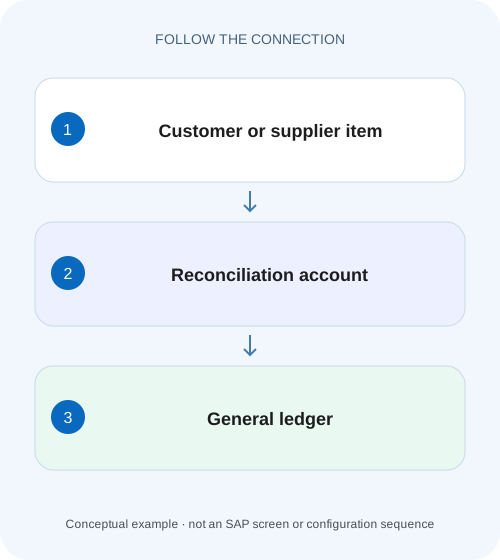
A subledger holds customer or supplier detail. A reconciliation account links that detail to the general ledger, which is the company’s main set of accounting accounts.
Completely new to SAP?
Manufacturers use SAP to connect work such as buying components, recording inventory, planning production, shipping equipment and accounting for costs. SAP S/4HANA is an enterprise resource planning system: it connects these activities through shared business data.
Financial Accounting records business events as accounting documents. An account groups relevant amounts; individual entries explain how the total arose.
A transaction code, or t-code, is a shortcut to a task in classic SAP GUI. Fiori apps provide another way to work. Names and screens depend on the product and release; you do not need a live system to learn the concepts in this guide.

Scope and source-review notes
Scope and evidence
Source review by FAST SAP SOLUTIONS® editorial. This badge describes our editorial review; it does not represent SAP certification or independent endorsement.
Conceptual guide using the linked SAP product documentation. Confirm the product, release, deployment model and customer configuration before applying operational details. Historical or product-specific references support the concept; they do not establish universal screen paths or settings.
Reviewed relevant official SAP indexed documentation excerpts on 14 November 2026. Examples, identifiers, amounts and expected observations are illustrative; no customer SAP execution was performed. Transaction availability, labels and results depend on the installed release, deployment and local configuration.
A MANUFACTURING EXAMPLE
Connect supplier detail with the factory ledger
Detail and ledger representation
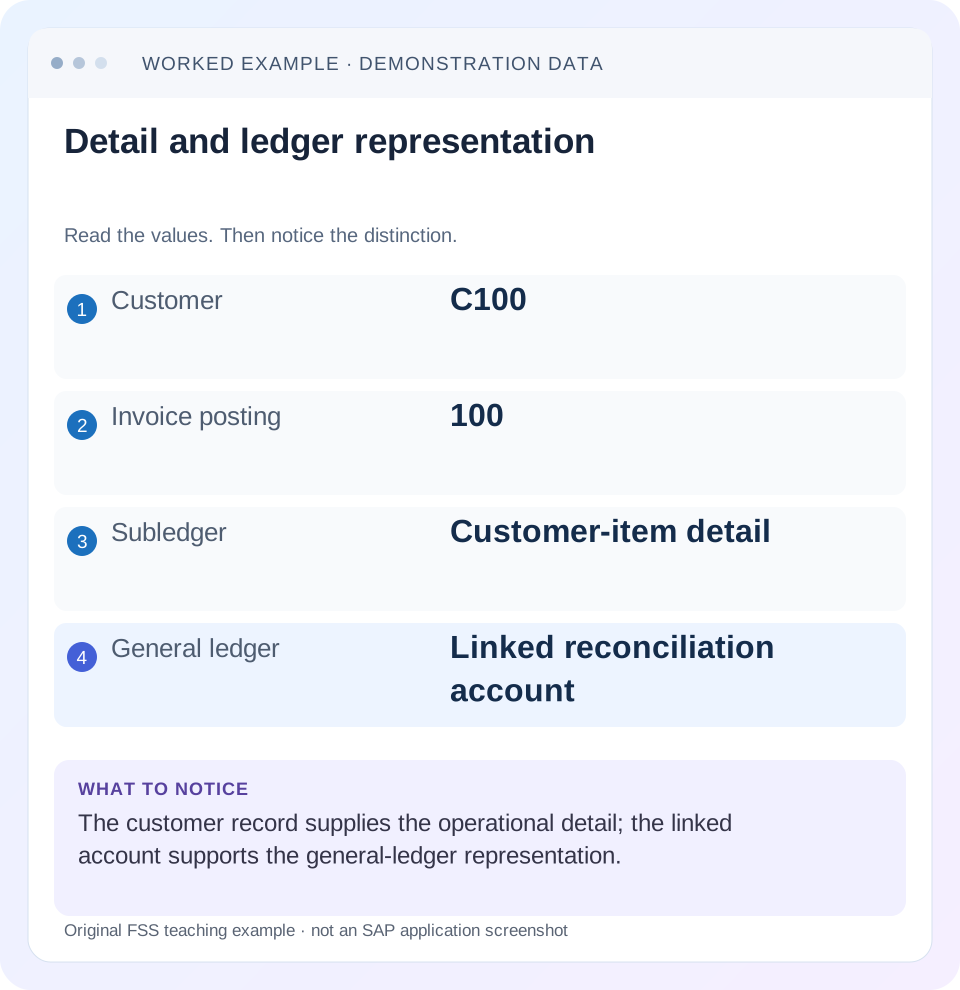
Read the example values
- Customer
- C100
- Invoice posting
- 100
- Subledger
- Customer-item detail
- General ledger
- Linked reconciliation account
Words you’ll meet in this guide
- Posting
- Recording a financial entry.
- General ledger
- The main collection of financial accounts.
- Open item
- An accounting entry still needing matching or settlement.
- Company code
- An organizational unit used for separate financial accounts.
- Accounting document
- A record of a financial entry with a header and individual account lines.
- HANA
- SAP’s database platform.
- FI
- Financial Accounting: the SAP area for financial postings and reporting.
Preview the practical steps
SEE THE CONNECTION
See it in a simple example.
A small example to make the idea concrete.
Connect supplier detail with the factory ledger
A manufacturer reconciles supplier balances to the general ledger and needs to understand the subledger connection.
The reconciliation account connects detail with the general ledger
A reconciliation account is the G/L connection for an applicable subledger.
Understand the two sides of the connection
The subledger preserves operational identity: which customer owes an invoice or which supplier should be paid, and how its items are cleared.
Worked case: two customers explain one receivables account
Fictional customers C100 and C200 use ordinary receivables reconciliation account AR100 in company 1000.
Connect supplier detail with the factory ledger
A manufacturer reconciles supplier balances to the general ledger and needs to understand the subledger connection.
Compare the relevant account assignments and document evidence without treating the reconciliation account as a substitute for individual supplier items.
| Reader | Business question | Evidence to carry forward |
|---|---|---|
| Manufacturing finance, controlling and purchasing teams | Connect supplier detail with the factory ledger | Compare the relevant account assignments and document evidence without treating the reconciliation account as a substitute for individual supplier items. |
01 The reconciliation account connects detail with the general ledger
A reconciliation account is the G/L connection for an applicable subledger. When an ordinary customer or supplier transaction is posted through its subledger account, SAP automatically updates the corresponding G/L reconciliation representation. The customer/supplier item and the G/L amount are related views of one accounting event, not two separate obligations. [1] [2]
This guide is for FI learners, payables/receivables analysts and support teams using SAP ERP or supported S/4HANA accounting. It focuses on ordinary customer/supplier reconciliation; Asset Accounting and Contract Accounting have their own determination details. You need authorized master, document and report display. The examples use one company code, currency and simple postings with no tax or special G/L until explicitly introduced.
02 Understand the two sides of the connection
The subledger preserves operational identity: which customer owes an invoice or which supplier should be paid, and how its items are cleared. The G/L reconciliation account supports financial reporting across the relevant subledger population. The master-data relationship and transaction context determine which account is used. [1] [2]
SAP documents the G/L account’s reconciliation-account type and the assignment in the relevant subledger master. A customer-type reconciliation account is not interchangeable with a supplier-type account merely because both are balance-sheet accounts. Inspect the actual account type and company-code data rather than relying on an account description.
03 Worked case: two customers explain one receivables account
Fictional customers C100 and C200 use ordinary receivables reconciliation account AR100 in company 1000. C100 has invoice debit 1,000 and payment credit 700; C200 has invoice debit 600 and no offset. Assume all relevant ordinary items are included in one currency and there are no other postings. Their net balances are 300 and 600.
The corresponding reconciliation-account balance is debit 900 on the declared scope:1,000−700+600. It is not zero simply because the overall accounting document balances. The offsetting revenue/bank entries belong elsewhere in the complete ledger. A reconciliation compares the related subledger population with the relevant G/L account, not the reconciliation account alone with zero.
| Customer | Invoices | Offsets | Net balance |
|---|---|---|---|
| C100 | Debit1,000 | Credit700 | Debit300 |
| C200 | Debit600 | 0 | Debit600 |
| AR100 corresponding population | Debit1,600 | Credit700 | Debit900 |
| Complete ledger | Includes other accounts | Includes other accounts | Separate balancing question |
04 Do not post another 900 to reproduce the summary
The automatic connection means the G/L representation is created through the subledger process. Entering another manual900 to AR100 would not be a harmless summary update. The reviewed classic FI documentation states that reconciliation accounts cannot be posted manually in the ordinary procedure. [1]
If a comparison appears out of balance, first align scope and source evidence. A manual G/L offset can make one report look equal while breaking the connection to customer detail or bypassing supported controls. Use the appropriate source/subledger correction process if a genuine posting is wrong. A technical restriction on direct entry protects the relationship; it is not an invitation to choose another account temporarily.
05 Compare equal populations before diagnosing integration
A G/L account can summarize many customers or suppliers. Comparing AR100’s900 with C100 alone’s300 leaves a legitimate600 difference explained by C200. A company-wide G/L report and one customer-item list are therefore not equivalent reconciliation scopes.
Write the included company codes, subledger accounts, reconciliation accounts, fiscal/key-date basis, currency type and item categories. Also distinguish current open-item exposure from all posted activity or a cumulative G/L balance. If the subledger report is historical, apply the same temporal question. A cleared invoice can remain part of historical activity while no longer contributing to current open exposure.
06 Master changes do not rewrite every historical document
Inspect the reconciliation-account assignment actually used by a posted document. A current supplier or customer master can point to a different account from the one used earlier, depending on approved changes and supported behavior. Do not assume all old balances migrated merely because the current master shows a new number.
For a proposed account reassignment, review the supported process, open-item implications and financial reconciliation with the accounting owner. Treat it as a controlled master/accounting change. The immediate support task is to identify where existing items were posted and why, not to change the master until the report happens to match.
07 Special G/L and alternative accounts create another scope branch
SAP documents separate account determination for special G/L transactions using account type, special G/L indicator and reconciliation-account context. Down payments or other special transactions can therefore be represented in alternative accounts under the configured process. A normal receivables-account total need not include every type of customer-related balance. [3]
If C100 also has an illustrative down-payment-related100 in a supported alternative account, do not force it into AR100’s ordinary 900 bridge without stating the expanded scope. Identify the special indicator, actual account and business event, then reconcile that population separately or in an explicitly combined report. A customer relationship alone does not mean every related amount posts to one G/L account.
08 Investigate the connection with one representative posting
Follow one invoice before exporting an entire subledger. A traceable document establishes the actual relationship in your system.
Display the subledger master
Read customer/supplier identity, company-code data and relevant reconciliation assignment.
Expected observation: The intended ordinary account is observed.
Display the posted document
Record complete identity, subledger item, amount/currency and actual reconciliation representation.
Expected observation: The document shows which account was actually used.
Define report scope
List all relevant customers/suppliers and account categories on the same date/currency basis.
Expected observation: C100 and C200 explain AR100 together.
Reconstruct the bridge
Sum invoices and offsets by actual account relationship, including corrections and special-account branches.
Expected observation: The ordinary example reaches debit 900.
Investigate only the residual
Identify specific missing/excluded items or genuine accounting inconsistencies before correction.
Expected observation: A proposed action has a document-supported cause.
09 Troubleshoot a reconciliation difference
A summary difference is a starting point. Work down to specific account relationships, dates and documents rather than assuming automatic integration failed.
| Observation | Check | Explanation to test |
|---|---|---|
| AR100900 versus C100300 | Customer population | C200 contributes600 |
| Master points elsewhere than old document | Change timeline and posted account | Current assignment differs from historical use |
| Customer total includes down payment | Special G/L/alternative account | Different account population |
| Direct G/L posting rejected | Reconciliation-account type | Ordinary entry must use the subledger |
| Open-item sum differs from activity report | Status/key date versus cumulative basis | Different temporal question |
| Only one currency differs | Currency type and conversion | Amounts are not yet comparable |
10 Keep clearing in the subledger context
A customer invoice’s clearing relationship belongs to the relevant customer items. A G/L balance display alone cannot tell which invoice was matched with which payment or credit. Use the subledger line-item and document references to establish that lifecycle.
In the example, C100’s300 balance can arise from a partial-payment trail or a residual-item trail. Both can contribute the same net amount to the G/L while exposing different open items. Reconciliation-account equality therefore does not prove that the intended invoices were cleared correctly. Verify the business matching relationship separately when the incident concerns allocation of payments.
11 Verify positive, negative and boundary cases
The positive worksheet test reconstructs C100300 plus C200600 equals AR100900, with one representative invoice traced to the actual G/L representation. Check the same company/date/currency basis. A negative test compares only C100 with all-customer AR100 and explains the 600 scope difference without posting anything.
A boundary test introduces a supported special G/L100 in a separate account and requires an explicit expanded reconciliation. Another changes current master data in a training scenario and inspects whether historical documents actually change; do not infer that result in advance. Finally, verify that an ordinary direct G/L posting to a reconciliation account is not treated as a valid repair route. These are proposed checks, not executed financial postings.
12 Write a handover that preserves both identities
A clear result reads: “AR100 debit 900 is explained by C100 debit 300 and C200 debit 600 on the stated ordinary-item EUR basis. C100’s1,000 invoice and 700 offset were traced; special transactions were excluded and reviewed separately.” Include actual protected document references and observation date in a real case.
If a genuine discrepancy remains, name the first unsupported item/account relationship and the reports used. Do not describe an unexplained residual as a required adjustment until the accounting owner determines its cause and supported treatment. After correction, rerun the same bridge and verify the affected subledger items, not only the G/L headline.
13 Use a transaction bridge when balances agree but users disagree
Suppose AR100 still shows 900, but C100 has an additional erroneous100 invoice and an unrelated100 credit. The net bridge can still agree while the operational detail is wrong. Reconciliation-account equality is a control over the stated aggregation, not proof that every invoice, customer assignment or clearing relationship is valid.
For an item-level complaint, inspect gross debits and credits and their source references. Separate genuine invoices, payments, credit memos, reversals and other supported entries. A100 debit and 100 credit may be a valid reversal chain, a valid commercial reduction or two unrelated errors. Their identical net effect does not identify which.
A useful review therefore has two acceptance layers: the selected subledger population sums to the matching G/L basis, and representative or disputed business events have the intended identity and lifecycle. In the worked case, establish both the 900 aggregate and why C100 owes 300 while C200 owes 600. This prevents a technically reconciled summary from being presented as a complete commercial audit.
14 Frequently asked questions
Is a reconciliation account the same as a customer or supplier? No; it is the G/L connection for the relevant population. Must it always be zero? No; its balance reflects the related subledger on the defined scope. Does a new master assignment move old documents? Establish the actual supported process and posted evidence.
Can one subledger use several reconciliation accounts? SAP documents one or more accounts and special/alternative determination; inspect the actual design. Use line-item guidance for operational detail, balance guidance for cumulative scope and partial/residual guidance when the account balance agrees but the open-item trail surprises users.
Related services and next steps
Primary sources
Found this useful?
Share this guide with your network, or leave a like.
Your like is saved in this browser.