SAP purchase contract versus scheduling agreement: Two outline agreements
A production buyer needs recurring motor deliveries and must choose between a purchase contract and dated schedule lines under a scheduling agreement.

Source review:
START HERE · NO PRIOR TOPIC KNOWLEDGE NEEDED
What it is. Why it matters.
A purchasing contract sets agreed conditions for later purchases. A scheduling agreement uses delivery schedules for planned quantities and dates; they organize ongoing supplier relationships differently.
Completely new to SAP?
Manufacturers use SAP to connect work such as buying components, recording inventory, planning production, shipping equipment and accounting for costs. SAP S/4HANA is an enterprise resource planning system: it connects these activities through shared business data.
Materials Management supports purchasing and inventory. A request, order, goods receipt and supplier invoice describe separate events, each with its own record and status.
A transaction code, or t-code, is a shortcut to a task in classic SAP GUI. Fiori apps provide another way to work. Names and screens depend on the product and release; you do not need a live system to learn the concepts in this guide.

Scope and source-review notes
Scope and evidence
Source review by FAST SAP SOLUTIONS® editorial. This badge describes our editorial review; it does not represent SAP certification or independent endorsement.
Classic purchasing outline-agreement concepts in ERP and supported S/4HANA. Agreement types, release documentation, central procurement, planning and output features vary by installed process and edition.
Reviewed the cited official SAP indexed documentation excerpts on 14 November 2026. Direct Help Portal opens did not consistently expose readable page text. This is documentation-based teaching, not customer-system execution. All document identifiers, quantities and outcomes in the worked case are illustrative; installed release, edition, configuration and authorizations require local verification.
A MANUFACTURING EXAMPLE
Plan recurring component deliveries
Two ways to organize repeat supply
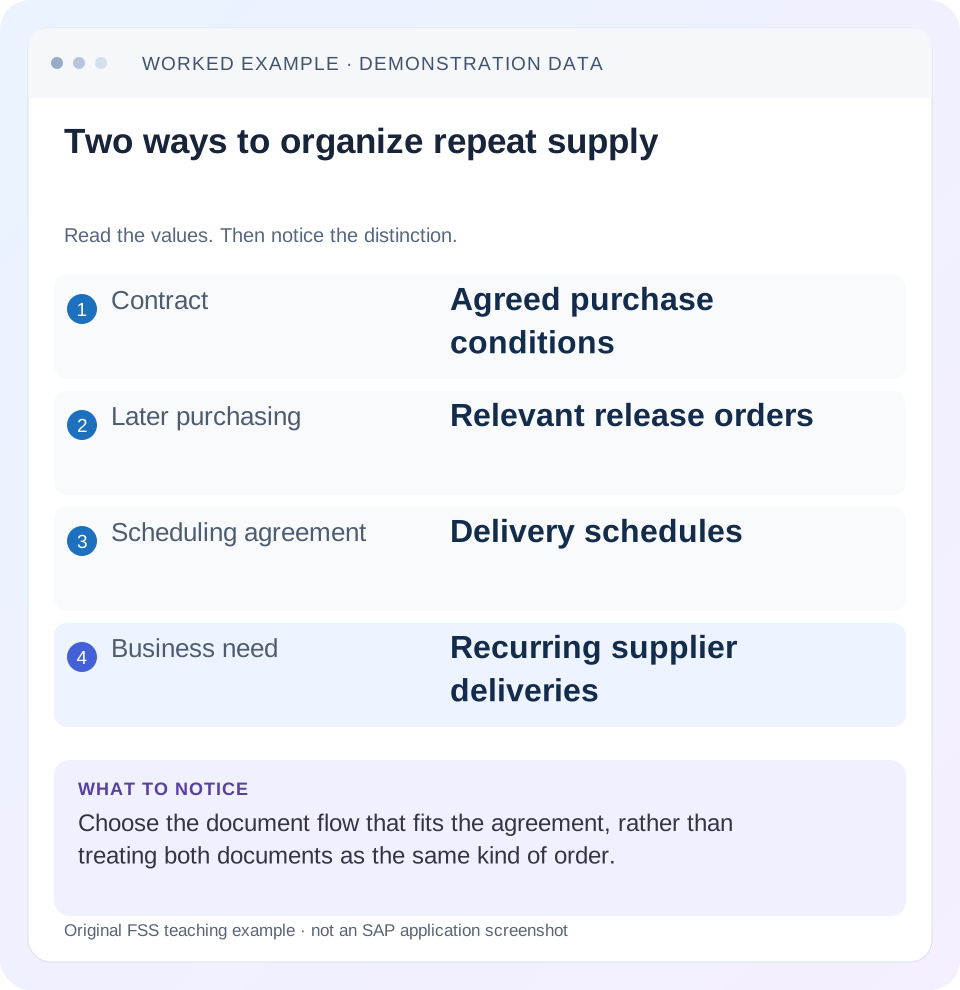
Read the example values
- Contract
- Agreed purchase conditions
- Later purchasing
- Relevant release orders
- Scheduling agreement
- Delivery schedules
- Business need
- Recurring supplier deliveries
Words you’ll meet in this guide
- Material
- A product or supply item managed in SAP.
- Plant
- An organizational unit for relevant logistics operations.
- Goods receipt
- A recorded receipt of goods in a business process.
- Purchase order
- A purchasing document requesting goods or services from a supplier or supplying plant.
- Invoice
- A supplier’s bill for goods or services.
- HANA
- SAP’s database platform.
Preview the practical steps
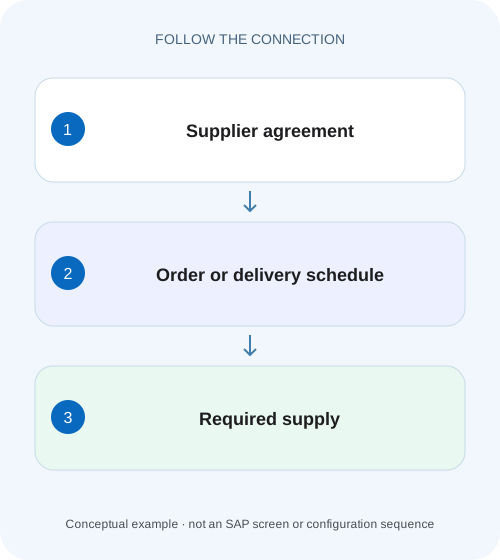
SEE THE CONNECTION
See it in a simple example.
A small example to make the idea concrete.
Plan recurring component deliveries
A production buyer needs recurring motor deliveries and must choose between a purchase contract and dated schedule lines under a scheduling agreement.
Choose the follow-on document, not just the agreement name
A purchase contract and a scheduling agreement are both outline-agreement approaches, but their operational follow-on structures differ.
Scope and prerequisites
The guide uses classic ERP purchasing documentation and supported S/4HANA outline-agreement concepts.
Understand the contract relationship
In the documented contract approach, the agreement establishes material or purchasing conditions over its defined scope and validity.
Plan recurring component deliveries
A production buyer needs recurring motor deliveries and must choose between a purchase contract and dated schedule lines under a scheduling agreement.
Compare the intended release process, delivery dates and supplier commitment in the documented agreement rather than deciding from the agreement name alone.
| Reader | Business question | Evidence to carry forward |
|---|---|---|
| Manufacturing buyers and purchasing managers | Plan recurring component deliveries | Compare the intended release process, delivery dates and supplier commitment in the documented agreement rather than deciding from the agreement name alone. |
01 Choose the follow-on document, not just the agreement name
A purchase contract and a scheduling agreement are both outline-agreement approaches, but their operational follow-on structures differ. A contract provides the agreement context for later release purchase orders. A scheduling agreement uses delivery schedules containing quantities and dates. Finding an agreement number is therefore only the start of determining what the supplier is being asked to deliver. [1]
The word “release” creates an additional trap. In purchasing it can refer to a supplier-facing order or schedule against an outline agreement, or to internal approval. An approved agreement, a contract release order and a scheduling-agreement release are different business evidence. This tutorial follows one recurring-supply requirement through the two alternatives.
02 Scope and prerequisites
The guide uses classic ERP purchasing documentation and supported S/4HANA outline-agreement concepts. Central procurement contracts, Ariba contracts, scheduling-agreement integration and industry-specific release documentation add separate scope. Document types, approval controls, output and planning integration must be verified in the installed edition.
Collect supplier, material, plant, agreement/item, validity and the intended delivery arrangement. Obtain display access to the outline agreement, referenced orders or delivery schedules and supplier-output evidence. Training changes require an authorized process. You should already understand a basic PO item; no particular transaction layout is assumed here.
Before comparing alternatives, write the business requirement: whether buyers call off individual needs, whether supply follows a changing date/quantity schedule and which information the supplier must receive. Neither document is universally preferable.
03 Understand the contract relationship
In the documented contract approach, the agreement establishes material or purchasing conditions over its defined scope and validity. A release order is a purchase order referring to that contract. Its item provides the actual ordered quantity and delivery context. An unused contract does not prove that a supplier has received an instruction for a particular shipment. [1] [2]
The contract reference matters for condition use and agreement consumption/reporting. A separately created PO with similar prices may not be the intended contract release order. Inspect the actual item reference rather than assuming the agreement was used because the supplier and material match.
Quantity and value contract designs answer different target questions. When monitoring usage, establish the actual agreement type and basis before comparing a quantity total with a monetary target. Currency and unit context remain necessary even when a report uses the word “released.”
04 Understand the scheduling-agreement relationship
A scheduling agreement organizes recurring supply through delivery schedule lines. Each relevant line carries a date and quantity context. The planner’s question becomes which schedule is currently valid and which version or release has been communicated, rather than which new PO must be created for every requirement. [2] [3]
SAP’s documented procurement comparison describes scheduling agreements for regular material delivered to an exact time schedule. The agreement still establishes the supplier/material/basic conditions; the schedule provides the operational timing. Schedule maintenance and supplier communication are separate observations. Saving a changed line does not establish that the supplier received the new requirement.
Some processes use release documentation and rolling schedules. Verify the actual agreement/release design before predicting the supplier’s view. A local schedule display, a generated release and a successfully transmitted output can represent different stages.
05 Worked case: one hundred units in two deliveries
A fictional plant needs 100 units of PART-R over two dates: forty on 20 November and sixty on 27 November. Under a contract approach, the buyer creates the appropriate referenced purchase order or release orders describing those quantities and dates. The contract number alone is not the receiving instruction.
Under a scheduling-agreement approach, the relevant agreement item has delivery schedule quantities of forty and sixty on the two dates. The supported schedule/release/output process communicates the requirement. Creating an additional ordinary PO for the same hundred units would risk duplicate demand unless the business deliberately replaces or changes the earlier commitment through its approved process.
Assume the supplier confirms the first forty and delivers them. The receipt belongs to the actual purchasing reference used by the selected flow. Do not combine forty received against the contract’s release PO and another forty expected in the scheduling agreement as though the two alternatives were one actual scenario.
| Question | Contract approach | Scheduling-agreement approach |
|---|---|---|
| Agreement context | Contract item | Scheduling-agreement item |
| 40 due 20 November | Referenced release PO schedule/item | 40-unit delivery schedule line |
| 60 due 27 November | Referenced release PO schedule/item | 60-unit delivery schedule line |
| Supplier instruction evidence | PO/output and reference | Schedule/release/output context |
| Receipt investigation | Actual release PO item | Actual agreement schedule context |
06 Trace the intended flow in sequence
Select the flow actually used in the system before changing documents. Treat the table above as alternatives, not instructions to build both.
Identify the agreement and item
Confirm document category, supplier/material, organizational scope, validity and agreement target basis.
Expected observation: The outline agreement type and intended use are established.
Find the operational requirement
For a contract, inspect actual referenced order items. For a scheduling agreement, inspect the relevant dated schedule and release context.
Expected observation: The forty/sixty requirement is supported by the correct follow-on evidence.
Separate approval from communication
Review internal approval status and supplier-output processing independently. Capture versions or references where provided.
Expected observation: Approval is not mistaken for proof of supplier receipt.
Follow receipt history
Match the forty-unit receipt to the actual purchasing item and date/quantity context. Include reversals.
Expected observation: The supply event belongs to one coherent document flow.
07 When dates or quantities change
Suppose the second sixty-unit requirement moves from 27 November to 30 November. In the contract alternative, establish which referenced order or schedule is changed and how the supplier receives the revised instruction. In the scheduling-agreement alternative, inspect the changed delivery schedule and the applicable release/output sequence.
Retain the previous and current requirement evidence when investigating a dispute. The supplier may be acting on an earlier communicated version. A current local display alone cannot establish what was sent last week. Compare generation time, output result and the supplier’s reference.
If the business cancels the final sixty, distinguish removing expected supply from reversing goods already received. A future requirement change cannot erase the first forty-unit receipt or any invoice relationship. Update the expectation through the approved process and retain the historical document chain.
08 Monitoring agreement usage without mixing measures
For a contract, verify which release-order items actually refer to the agreement and which quantities/values count toward the intended usage measure. For a scheduling agreement, inspect the relevant scheduled, delivered and communicated quantities in their own definitions. A scheduled amount, a received amount and a cumulative figure can cover different periods.
In the fictional case, forty received and sixty still planned describes the simplified timeline. It does not prove the agreement’s overall target has exactly sixty remaining if other items, periods or releases are involved. Establish the reporting selection and target basis before making that conclusion.
Align units and currency. A contract price per hundred pieces and a receipt in boxes require a documented bridge. The existence of an agreement does not remove ordinary unit, price and organizational checks.
09 Troubleshooting decisions
The most useful diagnostic question is which document or communication stage is missing. Creating another order before answering it can turn an unclear instruction into duplicate supply.
| Observation | Question | Next evidence |
|---|---|---|
| Agreement exists, supplier has no instruction | Was the follow-on order/schedule communicated? | Referenced PO or schedule/release/output |
| PO price matches but contract usage absent | Does the actual item reference the contract? | Item agreement reference and usage selection |
| Schedule correct locally, supplier uses old date | Which version reached the supplier? | Release/output history and supplier reference |
| Document says released | Internal approval or supplier call-off? | Exact status field and process context |
| Receipt missing from expected list | Which purchasing reference was received? | Material document and actual item history |
| Target consumption looks inconsistent | Quantity, value or cumulative basis? | Agreement type, unit/currency and report definition |
10 Common mistakes in recurring-supply work
Do not treat an outline agreement as an unrestricted promise that every future request is automatically approved and communicated. Internal controls and supplier communication remain part of the actual process. SAP explicitly distinguishes approval from release-order terminology. [1] [4]
Do not create a fresh PO to compensate for uncertain schedule output without reconciling the existing requirement. Both documents might reach the supplier. First determine whether the original output failed, was pending or was already received.
Do not evaluate agreement performance with only header totals. Work at the relevant item, validity and delivery context. A different material or plant can explain a perfectly valid difference between a header impression and the shipment being investigated.
11 Verification exercises
For a positive check, choose one alternative and reconstruct the full hundred-unit requirement: forty and sixty on the stated dates, one agreement context, the actual operational document and its communication evidence. Follow the first forty-unit receipt and explain the remaining expected shipment under the simplified assumptions.
For a negative check, remove the agreement reference from the contract PO in a worksheet. Explain why matching supplier and price no longer prove release-order linkage. For the scheduling alternative, retain the local changed schedule but remove communication evidence; supplier awareness is then unproven.
For boundary checks, test a validity-edge requirement, a canceled future schedule and a partial receipt with a reversal in an authorized training design. Record actual behavior and restrictions. A successful save is only one checkpoint; agreement linkage, approval, communication and receipt must each be verified.
12 Questions that keep terminology clear
Is a contract release the same as PO approval? No. Specify whether “release” refers to the referenced order/call-off or the internal authorization step. Can the supplier deliver from the agreement header alone? Establish the actual communicated order or schedule required by your process.
Does a scheduling agreement remove purchasing controls? No. It organizes recurring supply differently and still depends on the configured approval, planning and output design.
A useful handover names the agreement type, item, forty/sixty dates, actual follow-on reference, current approval and last successful supplier communication. Continue with source-list selection, purchasing worklists and PO history to investigate how the agreement was chosen and how deliveries were recorded.
Related services and next steps
Primary sources
Found this useful?
Share this guide with your network, or leave a like.
Your like is saved in this browser.