Purchasing info record versus source list: Price context and source eligibility
A component buyer finds purchasing price information for one supplier while a future plant requirement needs an eligible source on a different date.

Source review:
START HERE · NO PRIOR TOPIC KNOWLEDGE NEEDED
What it is. Why it matters.
A purchasing info record stores relevant supplier-material purchasing information. A source list identifies sourcing eligibility for a material and period, so price context and permitted supply are separate ideas.
Completely new to SAP?
Manufacturers use SAP to connect work such as buying components, recording inventory, planning production, shipping equipment and accounting for costs. SAP S/4HANA is an enterprise resource planning system: it connects these activities through shared business data.
Materials Management supports purchasing and inventory. A request, order, goods receipt and supplier invoice describe separate events, each with its own record and status.
A transaction code, or t-code, is a shortcut to a task in classic SAP GUI. Fiori apps provide another way to work. Names and screens depend on the product and release; you do not need a live system to learn the concepts in this guide.

Scope and source-review notes
Scope and evidence
Source review by FAST SAP SOLUTIONS® editorial. This badge describes our editorial review; it does not represent SAP certification or independent endorsement.
Classic purchasing info records/source lists and current S/4HANA planning-source documentation. Manual sourcing, MRP, quotas, central procurement and procurement categories require their specific installed rules.
Reviewed the cited official SAP indexed documentation excerpts on 14 November 2026. Direct Help Portal opens did not consistently expose readable page text. This is documentation-based teaching, not customer-system execution. All document identifiers, quantities and outcomes in the worked case are illustrative; installed release, edition, configuration and authorizations require local verification.
A MANUFACTURING EXAMPLE
Check the source for a future requirement
Price context versus eligibility
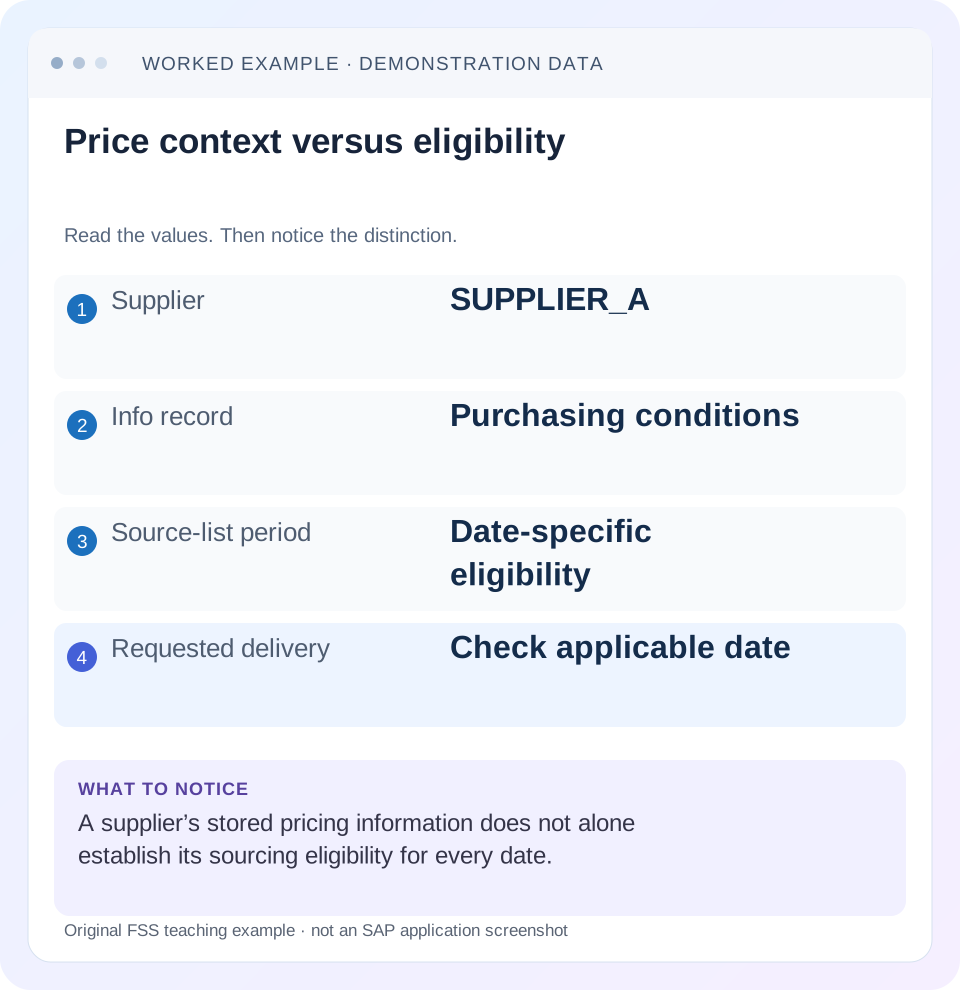
Read the example values
- Supplier
- SUPPLIER_A
- Info record
- Purchasing conditions
- Source-list period
- Date-specific eligibility
- Requested delivery
- Check applicable date
Words you’ll meet in this guide
- Material
- A product or supply item managed in SAP.
- Plant
- An organizational unit for relevant logistics operations.
- Goods receipt
- A recorded receipt of goods in a business process.
- Purchase order
- A purchasing document requesting goods or services from a supplier or supplying plant.
- Invoice
- A supplier’s bill for goods or services.
- HANA
- SAP’s database platform.
- MRP
- Material requirements planning: comparing demand with supply to propose what is needed.
Preview the practical steps
SEE THE CONNECTION
See it in a simple example.
A small example to make the idea concrete.
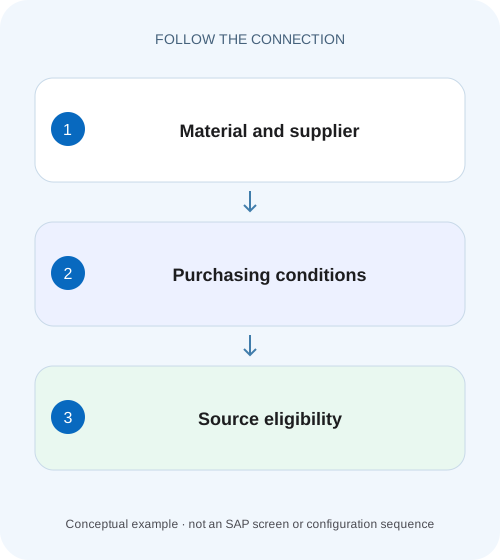
Check the source for a future requirement
A component buyer finds purchasing price information for one supplier while a future plant requirement needs an eligible source on a different date.
Price context and source eligibility are separate questions
A purchasing info record provides supplier/material purchasing information, including conditions in its applicable organizational context.
Scope and prerequisites
The guide concerns classic purchasing master data and the cited S/4HANA external-procurement source-determination documentation.
What the info record contributes
SAP documents an info record as purchasing information for a particular supplier/material relationship, with data such as conditions, lead time and tolerances at purchasing-organization or plant context.
Check the source for a future requirement
A component buyer finds purchasing price information for one supplier while a future plant requirement needs an eligible source on a different date.
Compare purchasing data, source-list validity and requirement date; a familiar supplier price does not establish source eligibility.
| Reader | Business question | Evidence to carry forward |
|---|---|---|
| Manufacturing buyers and purchasing managers | Check the source for a future requirement | Compare purchasing data, source-list validity and requirement date; a familiar supplier price does not establish source eligibility. |
01 Price context and source eligibility are separate questions
A purchasing info record provides supplier/material purchasing information, including conditions in its applicable organizational context. A source list controls source-related validity and other sourcing attributes for the relevant material context. A visible price does not prove that the supplier must be selected for every requested date or procurement process. [1] [2]
This tutorial investigates why SUPPLIER_A has a valid-looking price but is not selected for a particular requirement. The goal is to distinguish missing pricing, date eligibility, blocks and the sourcing procedure actually being executed. That distinction prevents an analyst from changing a commercial condition to solve what is really a source-selection issue.
02 Scope and prerequisites
The guide concerns classic purchasing master data and the cited S/4HANA external-procurement source-determination documentation. Planning-run source determination, manual source assignment and automatic PO generation can use different controls. Ariba sourcing events, quota arrangements and central procurement require their own analysis; no universal source-priority algorithm is implied here.
Collect material, supplier, plant, purchasing organization, procurement type, requirement delivery date and the function that attempted selection. Obtain authorized display access to the info record, source list, relevant agreement and requirement. Proposed changes and source-determination tests belong in a training process with an agreed eligible-source policy.
Write the specific symptom first: “SUPPLIER_A is absent for delivery on 5 December at plant P100 during this planning run.” That is far more testable than “the info record is not working.”
03 What the info record contributes
SAP documents an info record as purchasing information for a particular supplier/material relationship, with data such as conditions, lead time and tolerances at purchasing-organization or plant context. Its procurement category matters: standard, consignment and subcontracting relationships should not be treated as interchangeable just because the supplier and material match. [1]
Inspect the actual condition validity, currency, order unit and price unit. A record can exist while the relevant condition or organizational segment does not fit the intended purchase. A supplier’s price of 50 per box is not comparable with another supplier’s 5 per piece until conversion is established.
The info record is not itself an instruction to receive goods. It supports purchasing decisions and document proposals. The actual PO or agreement schedule and its communicated requirements remain separate evidence.
04 What the source list contributes
The source list provides source-related entries with validity periods and controls in the relevant material/plant context. It can refer to suppliers and outline agreements and can carry blocking or planning relevance according to the supported process. Check the entry itself rather than assuming that the existence of an info record automatically creates the intended source-list control. [2] [3]
SAP’s current external-procurement source-determination reference explicitly considers sources valid for the requisition delivery date and explains how source-list blocking/MRP information participates in that planning context. This date is not interchangeable with today’s date or the PO creation date.
A source can therefore have useful commercial data and still be ineligible for the tested requirement. Conversely, an eligible source does not prove every price and document field has the desired value.
05 Worked case: November source, December requirement
Fictional material PART-S is needed at plant P100. SUPPLIER_A has a standard info record in purchasing organization O100 with an illustrative price of 5 per PC covering the commercial date range relevant to the test. A source-list entry allows the intended source through 30 November. The requisition delivery date is 5 December.
In the stated planning-source scenario, the source-list period does not cover the requirement date. The reason to investigate is eligibility timing, not the mere absence of a price. A screenshot showing the 5-per-piece condition cannot prove that the December source rule is satisfied.
If purchasing intentionally renews the source to cover December through the approved master-data process, repeat the same requirement test and inspect the result. If A still is not selected, investigate remaining controls and competing sources. Extending a date is not a guarantee that every independent source-determination condition has been met.
For the date test, retain both the condition validity and source-list validity as separate worksheet columns. They can overlap differently, so a single column called valid would hide which control the analyst actually checked.
| Input | Observed value | Reasoning |
|---|---|---|
| Material/plant | PART-S / P100 | Requirement context |
| Info record | A / standard / O100 | Purchasing relationship exists |
| Price basis | 5 per PC | Commercial context, not sole eligibility proof |
| Source-list end | 30 November | Does not cover 5 December |
| Delivery requirement | 5 December | Relevant date in this planning example |
| Next investigation | Approved eligibility period | Do not change price to solve date scope |
06 Investigate the requirement before master data
Confirm the delivery date actually used by source determination. A planner may describe a requirement as “November demand” while lead-time scheduling or a document field gives a December delivery date. Read the recorded requirement, not only the business shorthand.
Check plant and purchasing organization, including whether a plant-specific or broader info record is involved. Establish the procurement category and any outline-agreement reference. A valid standard source does not necessarily substitute for the intended subcontracting arrangement.
Retain the exact process used to test selection. A manually entered supplier accepted in a PO does not prove that the planning run will automatically select it. Different observations can be consistent because they answer different sourcing questions.
07 A practical comparison sequence
The sequence below produces a compact explanation of what was eligible, what commercial data existed and what was actually selected.
Capture the attempted selection
Record PART-S, P100, O100, procurement category, 5 December delivery and the planning/manual function used.
Expected observation: The process and required scope are explicit.
Read the info-record context
Inspect supplier/material, organization, category, conditions and unit basis.
Expected observation: The relevant purchasing relationship is distinguished from unrelated data.
Read the source-list period and controls
Compare validity with 5 December and inspect applicable block/planning/agreement attributes.
Expected observation: A date or eligibility mismatch is identified independently of price.
Repeat one controlled test
After an approved correction, run the same supported sourcing scenario and inspect selected source plus resulting document.
Expected observation: A changed proposal is tied to the intended rule and scope.
08 Multiple sources require a complete selection explanation
Suppose SUPPLIER_B has an eligible December source and an illustrative price of 5.50 per PC. The fact that A is cheaper does not establish that A must win. Source eligibility, agreement context, quota or other active sourcing controls may decide which candidates participate. Read the actual procedure rather than assuming a universal lowest-price rule.
If both sources appear valid, compare their complete scope and active controls. A fixed-source designation or an outline-agreement reference can be meaningful in the supported process. Do not remove a competing entry simply to make the preferred supplier appear until the business sourcing policy is understood.
For a result explanation, distinguish candidate existence, eligibility and final selection. Those are useful stages for support evidence even when the system’s internal algorithm is more complex than the simplified two-supplier worksheet.
09 Troubleshooting decisions
A useful branch names the mismatched context. “Recreate the info record” is rarely a sound first response to a source-selection problem.
| Observation | Check first | Next evidence |
|---|---|---|
| Price exists, supplier absent | Requirement date and source eligibility | Source list and actual sourcing function |
| Source eligible, price unexpected | Commercial organization/unit/validity | Actual item pricing and info-record conditions |
| Manual PO works, MRP differs | Different sourcing procedures | Planning relevance and installed algorithm |
| Same supplier works at another plant | Plant-specific source/context | Both plants’ relevant records |
| Agreement not used | Actual agreement reference and validity | Source-list entry and agreement item |
| Two valid sources, unexpected choice | Other active selection controls | Quota/fixed/source procedure evidence |
10 Common mistakes and safe corrections
Do not edit a price condition to make a source eligible for a date. It changes commercial data while leaving the actual validity or blocking reason unresolved. Conversely, changing source-list eligibility does not certify that the price is correct.
Do not extend every entry to a far-future date merely to remove errors. Source validity can encode an approved supplier relationship and risk decision. Record why the source is authorized for the new period.
Do not test only with today’s date. Use the actual delivery date, particularly around validity boundaries. Also avoid cloning a source-list entry from another plant without reviewing its agreement, organization and planning controls.
11 Verification exercises for the case
For the positive check, choose a requirement comfortably inside the approved source-list period and verify the actual supported selection behavior. Confirm the proposed supplier and the purchasing document’s commercial basis; selection and pricing are separate acceptance conditions.
For the negative check, use the 5 December requirement while the entry ends on 30 November. Explain why the displayed price alone cannot prove eligibility. Then block the intended source in a worksheet and identify which question must be answered before it is considered again.
For boundary checks, test the last valid date, the next date and a requirement in another plant. Include two competing sources and an agreement-based source if relevant. Record actual outcomes and the installed algorithm; these are proposed tests, not customer-system results.
12 Questions and the final sourcing explanation
Does an info record automatically mean the supplier is permitted for all dates? No. Review the applicable source controls and sourcing process. Is the source list a price list? No. It represents sourcing context and controls, while conditions need their own review.
Can I prove MRP behavior by manually entering a supplier? No. Test the actual planning/source-determination scenario with its relevant data.
For this example, hand over: “A has commercial info-record data for PART-S/O100, but the P100 source-list period ends 30 November and does not cover the 5 December delivery in the tested planning scenario. Purchasing must confirm the intended December source.” Continue with outline agreements and requisition display to follow the selected source into the actual procurement document.
Related services and next steps
Primary sources
Found this useful?
Share this guide with your network, or leave a like.
Your like is saved in this browser.