SAP MRP proposes an unexpected quantity? Check lot sizing and rounding
MRP proposes more bought-in components than the planner's visible shortage, and purchasing needs to understand the quantity before ordering.

Source review:
START HERE · NO PRIOR TOPIC KNOWLEDGE NEEDED
What it is. Why it matters.
Material requirements planning proposes supply quantities. Lot sizing sets how demand is grouped, while rounding adjusts quantities to supported increments, such as pack sizes.
Completely new to SAP?
Manufacturers use SAP to connect work such as buying components, recording inventory, planning production, shipping equipment and accounting for costs. SAP S/4HANA is an enterprise resource planning system: it connects these activities through shared business data.
Production Planning determines what to make or procure and when. Product definitions, supply proposals and execution orders connect demand with factory work.
A transaction code, or t-code, is a shortcut to a task in classic SAP GUI. Fiori apps provide another way to work. Names and screens depend on the product and release; you do not need a live system to learn the concepts in this guide.

Scope and source-review notes
Scope and evidence
Source review by FAST SAP SOLUTIONS® editorial. This badge describes our editorial review; it does not represent SAP certification or independent endorsement.
SAP ERP/S/4HANA MRP procurement-quantity calculation. Worked arithmetic isolates simple lot-for-lot and rounding assumptions;profiles,period grouping,scrap and split behavior require actual configured sequencing.
Documentation review on 14 November 2026 used the official SAP sources listed below, including indexed excerpts where full text was unavailable. Scope and availability depend on the stated product, release and configuration. All document references, quantities, dates and outcomes in worked cases are illustrative; no customer SAP system or tenant was accessed and the proposed exercises were not executed.
A MANUFACTURING EXAMPLE
Explain a component procurement proposal
Why a proposal became 30
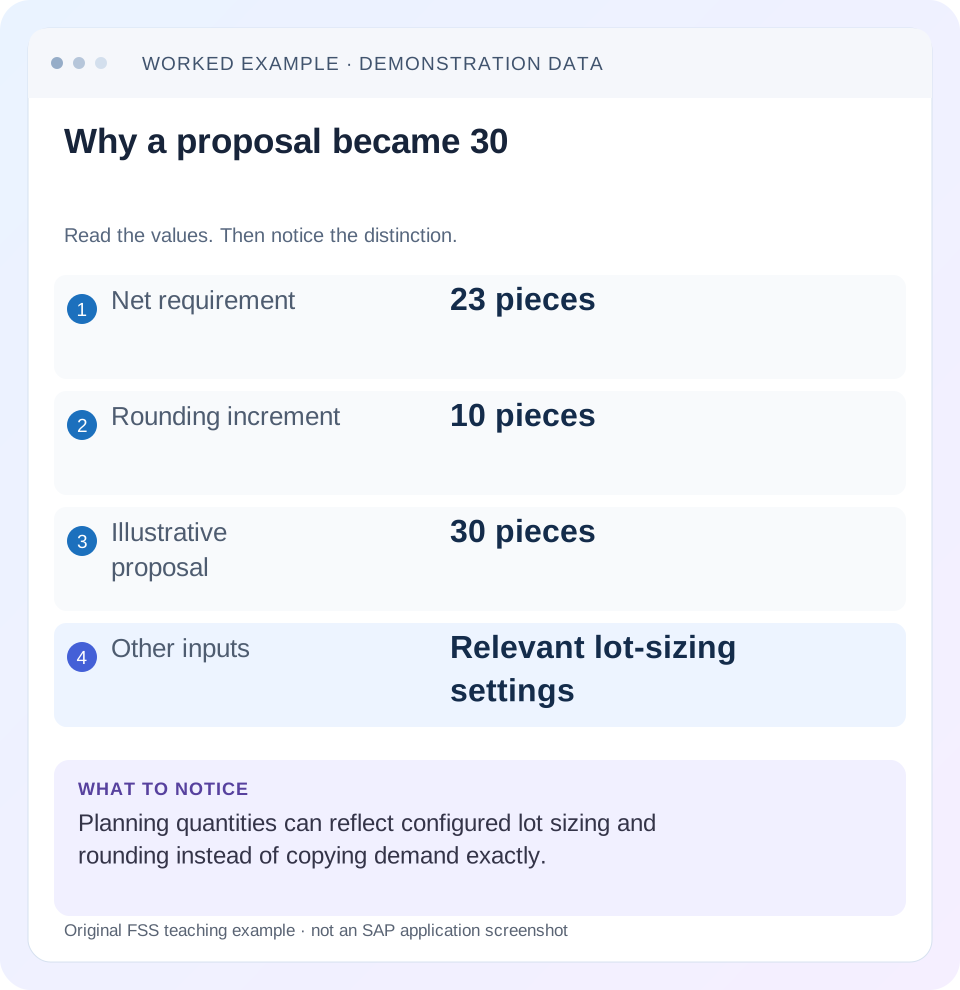
Read the example values
- Net requirement
- 23 pieces
- Rounding increment
- 10 pieces
- Illustrative proposal
- 30 pieces
- Other inputs
- Relevant lot-sizing settings
Words you’ll meet in this guide
- BOM
- Bill of materials, the components needed for a product.
- Routing
- A description of manufacturing work operations.
- MRP
- Material requirements planning, which compares demand and supply.
- Confirmation
- A record of relevant production progress or completed work.
Preview the practical steps
SEE THE CONNECTION
See it in a simple example.
A small example to make the idea concrete.
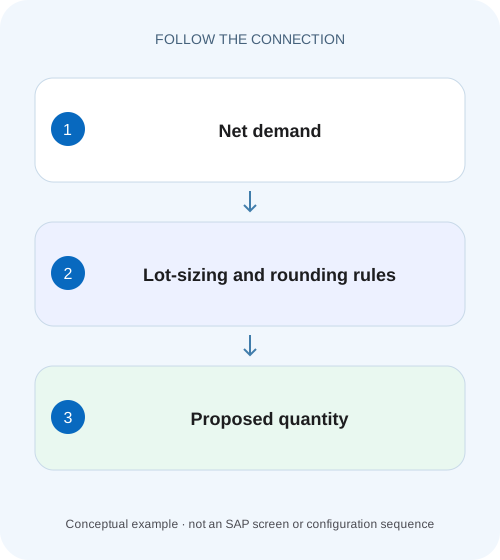
Explain a component procurement proposal
MRP proposes more bought-in components than the planner's visible shortage, and purchasing needs to understand the quantity before ordering.
A shortage is an input, not necessarily the proposed quantity
MRP first determines uncovered requirements under the planning procedure.
Understand the calculation stages
SAP describes shortage determination followed by lot-size calculation, with restrictions such as minimum/maximum lot size and rounding value/profile.
Work the basic rounding fixture
Assume a net shortage of 23 PC, lot-for-lot calculation, no scrap, no minimum/maximum restriction and rounding up to multiples of 10 PC.
Explain a component procurement proposal
MRP proposes more bought-in components than the planner's visible shortage, and purchasing needs to understand the quantity before ordering.
Compare the requirement with the configured lot-sizing and rounding inputs rather than editing the proposal to match the shortage by eye.
| Reader | Business question | Evidence to carry forward |
|---|---|---|
| Production planners and shop-floor application teams | Explain a component procurement proposal | Compare the requirement with the configured lot-sizing and rounding inputs rather than editing the proposal to match the shortage by eye. |
01 A shortage is an input, not necessarily the proposed quantity
MRP first determines uncovered requirements under the planning procedure. Lot sizing and additional quantity rules then determine procurement. A 23-PC shortage can legitimately produce a 30-PC proposal with a 10-PC rounding increment. The 7-PC excess is not automatically a planning error; it can be the intended packaging or procurement policy.
This guide is for MRP controllers and production/procurement planners who can read material planning settings and proposal details. You need material, plant/MRP area, date, unit, shortage, existing receipts and lot-size inputs. The examples are illustrative, not a recommendation that larger orders are commercially optimal.
02 Understand the calculation stages
SAP describes shortage determination followed by lot-size calculation, with restrictions such as minimum/maximum lot size and rounding value/profile. Its documented flow also accounts for scrap and distinguishes procurement quantity from estimated yield. Read the actual combination; one numeric field rarely explains every result. [1]
Lot-for-lot, period grouping and fixed-lot policies answer different replenishment questions. A period procedure can combine several requirements before rounding; a fixed lot may create repeated lots rather than one exact shortage quantity. Identify the assigned procedure and its configuration before applying simple arithmetic from another material.
03 Work the basic rounding fixture
Assume a net shortage of 23 PC, lot-for-lot calculation, no scrap, no minimum/maximum restriction and rounding up to multiples of 10 PC. The smallest permitted multiple covering 23 is 30. For 18 PC the result is 20; for 20 it remains 20; for 21 it becomes 30.
These boundary checks are useful because an incorrect rounding interpretation often appears only just above a multiple. Rounding to the nearest multiple would make 23 become 20 and leave 3 uncovered; the fixture explicitly requires rounding up. Use the actual SAP rule rather than a spreadsheet's default rounding function.
| Shortage | Smallest covering multiple of 10 | Excess over shortage |
|---|---|---|
| 18 PC | 20 PC | 2 PC |
| 20 PC | 20 PC | 0 PC |
| 21 PC | 30 PC | 9 PC |
| 23 PC | 30 PC | 7 PC |
| 30 PC | 30 PC | 0 PC |
04 Add minimum and grouping one at a time
With the same 23-PC shortage, a minimum lot of 50 PC can dominate the simple result under an applicable design. A weekly grouping of 23 PC Monday and 12 PC Thursday can produce a 35-PC grouped need before a 10-PC rounding rule yields 40. Those are different input populations, not conflicting answers to the same unchanged calculation.
Treat these as isolated teaching variants. Real combinations of minimum, maximum, fixed size and rounding can have configured sequencing and split behavior. When the observed result differs, inspect that documented sequence instead of trying all arithmetic orders until one happens to match.
05 Distinguish order quantity from expected yield
SAP's published procurement examples show that scrap and rounding can cause order quantity and estimated yield to differ. That distinction explains why a planned-order quantity may not equal its expected receipt in a planning display. Preserve both values and their labels. [2]
For an original simplified fixture, assume the approved calculation determines 40 PC procurement quantity and 1 PC expected scrap, leaving 39 PC estimated yield. The supply available to cover demand is 39 under those assumptions, not 40 good units. Do not generalize a single percentage formula to every scrap setting: assembly scrap, component scrap and rounding details need their specific documented interpretation.
06 Inspect the material and proposal in sequence
Start with current stock/requirements evidence to establish the shortage, then review quantity policy. If the shortage itself is wrong, lot-size analysis cannot fix its source. Compare settings applicable at planning time when investigating an older proposal.
Establish net need
Reconcile requirements, eligible stock/receipts, date and planning segment.
Expected observation: 23 PC is a justified shortage.
Read quantity controls
Inspect procedure, minimum, maximum, rounding value/profile and relevant scrap inputs.
Expected observation: A 10-PC multiple is the actual rule.
Reconstruct grouping and sequence
Separate grouped need, lot size, procurement quantity and expected yield.
Expected observation: 30 PC follows the simple fixture.
Compare proposal details
Read quantity, unit, date, firming and any split receipts/exceptions.
Expected observation: The observed proposal is explained without overwriting it.
07 Check units and pack-size assumptions
A rounding value in the material's planning unit must be compared with the proposal's actual unit. If the supplier sells cartons of 10 PC, confirm the maintained unit conversion instead of assuming an increment 10 means 10 cartons. A fixed-factor quantity difference can be a unit issue rather than lot sizing.
Also distinguish order price unit from procurement quantity. A price quoted per 100 pieces does not mean a proposal must be 100 pieces. Keep quantity, unit conversion and price basis in separate columns when reconciling a purchasing-oriented example.
08 Troubleshoot quantity surprises
A proposal larger than a shortage can be correct; an unexplained proposal can also reveal duplicated demand, missing receipts, wrong scope or stale firmed supply. Do not stop at the first lot-size field that produces a plausible number.
| Observation | Main question | Next evidence |
|---|---|---|
| 23 shortage,30 proposal | Rounding increment? | Actual value/profile and unit |
| Several dates combined | Period grouping? | Procedure and grouped requirements |
| Many equal proposals | Fixed lot or maximum split? | Procedure and proposal details |
| Order quantity differs from receipt | Scrap/yield? | Labeled procurement, yield and scrap values |
| Quantity differs by carton factor | Unit conversion? | Base/order unit and conversion |
| Old proposal ignores new setting | Firmed or not replanned? | Planning run and firming state |
09 Avoid forcing a proposal to match shortage
Reducing 30 to 23 may violate a pack-size agreement or production policy. Conversely, accepting every excess merely because “MRP calculated it”can hide poor settings. First explain the result, then evaluate whether the policy still fits lead time, storage and procurement constraints.
If the policy changes, test a controlled material/population and compare before/after quantity and date behavior. Review existing firmed proposals separately. A master-data change does not prove every already-created purchase or production commitment automatically adopted it.
10 Verify positive, negative and boundary outcomes
The positive fixture expects 23→30 with the stated 10-PC increment. The negative check removes rounding and expects 23 only when no other rule changes it. The boundary checks 20→20 and 21→30 detect an off-by-one or nearest-rounding misunderstanding.
Add a second requirement date to test grouping and a separate unit conversion to test packaging interpretation. For scrap scenarios, verify both order quantity and expected yield, not only one total. Record actual runtime observations in the authorized system; the article supplies predicted learning outcomes, not execution claims.
11 Reconcile projected excess after the rounded proposal
For the 23-PC shortage and 30-PC proposal, write a short inventory projection: opening eligible stock 0, new receipt 30, issue 23, closing projected excess 7. That 7 is the consequence of the stated rounding policy. If the next relevant requirement is another 7 within the planning context, the excess may cover it; do not create a new receipt merely because the second requirement has its own document number.
Now change the shortage to 31 with the same 10-PC increment. The smallest covering multiple is 40, leaving 9. Compare 29→30,30→30 and 31→40. These neighboring cases are more revealing than testing only 23, because they expose whether the actual rule rounds up, groups dates or applies another restriction.
If a supplier sells boxes of 10 PC, the 30-PC proposal corresponds to 3 boxes under that conversion. If the displayed proposal is 30 boxes, the business quantity is 300 PC. Keep base quantity and order unit on the worksheet. A correct numeric multiple in the wrong unit can be ten times the intended supply.
12 Isolate maximum-size and firming branches before changing policy
Suppose the planning owner adds an illustrative maximum lot constraint 25 PC while the rounding increment remains 10. Do not assume a single universal answer such as 25,30 or two equal lots. The combination can require splitting or other procedure-specific handling. Read the actual lot-sizing configuration and inspect all resulting receipt proposals, then reconcile their total and dates against the shortage.
This is an important negative test: the policy inputs can be individually plausible yet conflict at the proposed lot boundary. A planner should identify the conflict before forcing a manual quantity. Record the configured procedure and observed split/exception behavior so the procurement owner can decide whether the policy should change.
For a separate firming variant, keep an existing 30-PC proposal protected and change rounding to 5. The fact that the old proposal remains 30 does not prove the new rule was ignored; 30 is already a multiple of 5, and protection may prevent automatic change. Use a deliberately discriminating shortage and an unprotected fixture to test the revised policy.
For a historical incident, retain the settings used at the relevant run. Today's material master may show 5 while the proposal was created with 10. Compare run time, proposal identity and change evidence before explaining it as current behavior. A later edit does not retroactively establish which inputs produced the earlier quantity.
Close with both policy and arithmetic: the selected population had 23 uncovered PC; lot-for-lot grouping and 10-PC upward rounding produced 30; the 7-PC excess is expected under that policy; units and existing receipts reconcile. If the business rejects that excess, review the procurement policy explicitly instead of rewriting the requirement to fit the desired purchase amount.
13 Questions and handover
Why did MRP propose more than demand? Establish shortage, then quantity policy. Does maximum lot size always mean one capped proposal? Inspect configured split/procedure behavior. Can rounding solve a wrong shortage? It changes procurement quantity, not the underlying demand/receipt evidence.
A useful explanation names material, scope, unit, shortage, grouping, lot rule, rounding and resulting procurement/yield values. Continue with MRP type for trigger logic, planning time fence for protected proposals, and MD04 versus MRP list for observation-time differences.
Related services and next steps
Primary sources
Found this useful?
Share this guide with your network, or leave a like.
Your like is saved in this browser.