SAP QM dynamic modification: Why the inspection stage changed
Incoming quality sees a different inspection stage for a component supplier and needs to explain why the sampling expectation changed.

Source review:
START HERE · NO PRIOR TOPIC KNOWLEDGE NEEDED
What it is. Why it matters.
Dynamic modification adjusts inspection effort using configured rules and inspection history. A quality level stores relevant history or stage information so repeated inspections need not always use identical sampling.
Completely new to SAP?
Manufacturers use SAP to connect work such as buying components, recording inventory, planning production, shipping equipment and accounting for costs. SAP S/4HANA is an enterprise resource planning system: it connects these activities through shared business data.
Quality Management defines and records inspections. The planned check, the measured result and the final decision serve different purposes, and any stock movement needs its own evidence.
A transaction code, or t-code, is a shortcut to a task in classic SAP GUI. Fiori apps provide another way to work. Names and screens depend on the product and release; you do not need a live system to learn the concepts in this guide.

Scope and source-review notes
Scope and evidence
Source review by FAST SAP SOLUTIONS® editorial. This badge describes our editorial review; it does not represent SAP certification or independent endorsement.
SAP ERP/S/4HANA QM dynamic modification at supported inspection-type,lot or characteristic levels. Stage counts,sample sizes and transitions below are invented policy examples,not SAP defaults or a statistical inspection recommendation.
Documentation review on 14 November 2026 used the official SAP sources listed below, including indexed excerpts where full text was unavailable. Scope and availability depend on the stated product, release and configuration. All document references, quantities, dates and outcomes in worked cases are illustrative; no customer SAP system or tenant was accessed and the proposed exercises were not executed.
A MANUFACTURING EXAMPLE
Explain a supplier-lot inspection change
History explains the next inspection stage
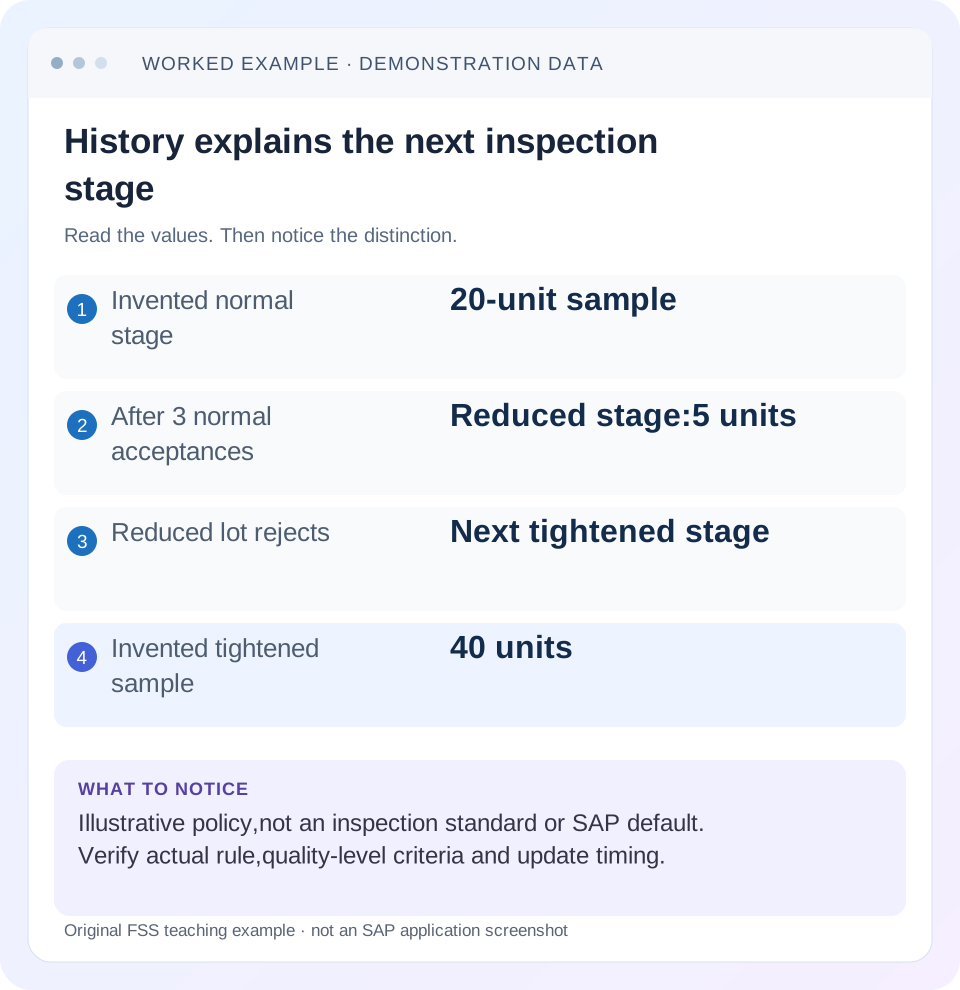
Read the example values
- Invented normal stage
- 20-unit sample
- After 3 normal acceptances
- Reduced stage:5 units
- Reduced lot rejects
- Next tightened stage
- Invented tightened sample
- 40 units
Words you’ll meet in this guide
- Inspection lot
- A record grouping a quality inspection task.
- Characteristic
- Something to inspect, such as length or color.
- Usage decision
- The recorded conclusion about an inspection lot.
- Stock posting
- A recorded inventory change under a supported goods-movement process.
Preview the practical steps
SEE THE CONNECTION
See it in a simple example.
A small example to make the idea concrete.
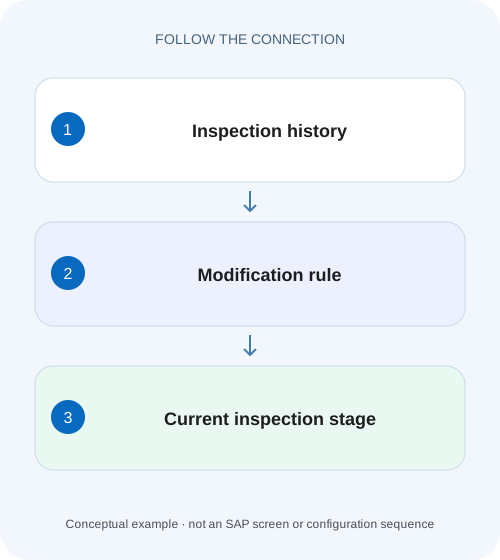
Explain a supplier-lot inspection change
Incoming quality sees a different inspection stage for a component supplier and needs to explain why the sampling expectation changed.
A changed sample can reflect inspection history
Dynamic modification changes inspection scope according to a defined rule and accumulated quality history.
Separate rule, quality level and sampling procedure
SAP describes dynamic modification as stage-based scope variation driven by past valuations reflected in a quality level.
Understand the modification level and criteria
SAP documents supported modification at inspection-type, lot or characteristic level under different prerequisites.
Explain a supplier-lot inspection change
Incoming quality sees a different inspection stage for a component supplier and needs to explain why the sampling expectation changed.
Read the relevant quality-level history and dynamic-modification context rather than deciding from one inspection lot alone.
| Reader | Business question | Evidence to carry forward |
|---|---|---|
| Factory quality and maintenance teams | Explain a supplier-lot inspection change | Read the relevant quality-level history and dynamic-modification context rather than deciding from one inspection lot alone. |
01 A changed sample can reflect inspection history
Dynamic modification changes inspection scope according to a defined rule and accumulated quality history. A lot requiring a larger sample may be following a rejection-driven tightened stage rather than suffering a sample-calculation defect. Inspect the rule, current quality level and update timing before editing the lot or resetting history.
This tutorial is for quality planners and support analysts who can display inspection setup, plan characteristics, sampling procedure, dynamic-modification rule and quality-level history. You need the material, plant, relevant business relationship and lot sequence. The example is a fictional incoming-component process; actual quality policy requires the organization's approved statistical and process design.
02 Separate rule, quality level and sampling procedure
SAP describes dynamic modification as stage-based scope variation driven by past valuations reflected in a quality level. The dynamic-modification rule defines stage behavior; the quality level carries the current historical state; the sampling procedure and, where used, sampling scheme determine the sample for that stage and lot size. [1]
A rule is therefore not the same as the quality level. Two business contexts can use the same rule but have different history and current stages. Likewise, a stage name such as“reduced”does not by itself specify a universal number of pieces. Read the actual sampling assignment and lot population.
03 Understand the modification level and criteria
SAP documents supported modification at inspection-type, lot or characteristic level under different prerequisites. Relevant criteria can distinguish histories by business context. Establish which level applies before comparing two lots; one characteristic can follow a different scope from another when the design allows it. [1]
For supplier quality, do not assume material alone identifies the history. Inspect the configured criteria and actual quality-level key in your landscape. Otherwise, a rejection for one supplier relationship can be wrongly used to explain another supplier's lot, or two independent histories can appear inconsistent simply because the material number matches.
04 Work an illustrative stage progression
Define an invented policy: N normal sample 20; R reduced sample 5; T tightened sample 40. After three accepted normal inspections, the next relevant lot moves to R. A rejection moves the next applicable state to T. Assume modification occurs at usage decision and all lots in the fixture share the same quality-level context.
L4 uses reduced scope because the previous accepted history reached the configured condition. L5 uses tightened scope because L4 rejected. Changing L5's sample from 40 to 5 would conceal the intended response to rejection. If the actual result differs, inspect rule assignment, history key and timing before blaming arithmetic.
| Lot | Stage/sample used | Valuation | Expected next state under invented policy |
|---|---|---|---|
| L1 | N /20 | Accept | N, one acceptance |
| L2 | N /20 | Accept | N, two acceptances |
| L3 | N /20 | Accept | R threshold reached |
| L4 | R /5 | Reject | T |
| L5 | T /40 | Not yet decided | Follow rule's T transitions |
05 Inspect update timing and concurrent lots
SAP states that quality-level updates can occur at lot creation or usage decision depending on the rule. This timing matters when several lots exist at once. A later-created lot may have selected a stage before an earlier lot's rejection was decided, so sequential lot numbers do not guarantee sequential completed history. [1]
Write creation and usage-decision timestamps separately. If L5 was created before L4's rejecting decision, its stage may require a different explanation than the simple sequential table. Do not retroactively assume every existing lot automatically receives the newest stage; inspect the actual lot specification and supported update behavior.
06 Read the documented rule fields
SAP's QDR1 creation guidance names header settings for modification time, reset period and blocking, and stage settings for severity, skip, initial stage and OK/not-OK transitions. Use those concepts to read the existing rule. Creating another rule is not necessary merely to inspect why a stage changed. [2]
A reset period can affect history after inactivity, while an initial stage defines the starting state. A skip is a defined inspection-scope outcome, not proof that goods are automatically fit for every use. Interpret each setting with the actual inspection/stock process rather than reducing the whole mechanism to“three good lots means no inspection.”
07 Investigate a surprising stage in sequence
Start from the affected lot and trace backward. This gives a concrete reason for the current scope and avoids editing a shared rule based on one screenshot.
Record the lot's actual specification
Capture stage, sample, procedure, creation time and modification level.
Expected observation: L5's 40-piece scope is explicit.
Identify the history context
Inspect the configured quality-level criteria and actual relationship key.
Expected observation: The compared lots share the intended history.
Read the assigned rule
Compare initial/reset/timing and OK/not-OK transitions.
Expected observation: N→R→T follows a defined policy.
Reconstruct prior decisions
Compare creation/decision order and relevant valuations.
Expected observation: L4 rejection is established before attributing L5's stage.
Verify future behavior
Use an authorized fixture with known history and sampling.
Expected observation: The next lot follows the approved rule.
08 Troubleshoot stage and sample differences separately
A correct stage can still produce an unexpected sample if the sampling procedure, scheme, lot quantity or severity is wrong. A correct sample calculation can use the wrong history state. Diagnose these layers separately.
| Observation | Question | Next evidence |
|---|---|---|
| T stage after rejection | Expected not-OK transition? | Rule and prior valuation |
| Same material, different stages | Different history criteria? | Quality-level keys |
| Stage correct, sample wrong | Sampling assignment/quantity? | Procedure, scheme and lot size |
| No stage change after decision | Timing or threshold? | Update setting and actual counts |
| History restarts after inactivity | Reset period? | Rule and elapsed dates |
| One characteristic differs | Characteristic-level modification? | Plan header and characteristic rules |
09 Preserve history during correction
Do not reset quality history solely to obtain less inspection effort. If history is wrong because a valuation or assignment was erroneous, follow the approved correction process and assess existing lots separately. The cause, history repair and lot-specification consequences must remain traceable.
Before changing a shared rule, identify its consumers and test both acceptance and rejection branches. A change that reduces sample size on normal acceptance can also alter the response after failure. Keep the approved policy and actual configuration in the change record so the next reviewer can explain the new behavior.
10 Verify positive, negative and timing boundaries
The positive fixture follows L1–L3 acceptance to reduced L4, then rejection to tightened L5. A negative case changes only the history context and verifies it does not incorrectly inherit another relationship's outcomes. A timing boundary creates L5 before L4's decision and documents the stage actually selected under the configured update time.
Test the reset-period boundary and a lot-size change separately. Record sample and characteristic valuation, not just the stage name. These are proposed learning checks, no lots or quality levels were changed. Invented 20/5/40 sample sizes must not be copied as an inspection standard.
11 Inspect the quality-level record through the documented applications
SAP identifies Manage Quality Levels F2914 and Display Quality Level QDL3 as access routes to quality-level data in the documented scope. Open the relevant record using the actual quality-level criteria, then compare its current stage with the lot's assigned stage. The migration reference notes that these views do not expose every sequence/task-list-node detail, so a missing field there should be treated as a display limitation rather than proof that the relationship is absent. [3]
For the five-lot fixture, write one row per lot with creation time, decision time, rule, quality-level context, stage used, sample and valuation. Mark the event that actually updates the quality level under the configured timing. This record lets another planner see why L4 selected reduced scope and whether L5 existed before or after L4's rejection.
If the current quality level is tightened but an already created L5 still shows reduced scope, do not automatically label the record corrupt. Compare its creation/assignment time and the documented lot-update behavior. The current future-inspection state and a previously prepared lot specification can be different pieces of evidence.
12 Test history context and reset behavior without inventing a sampling policy
Create two illustrative supplier relationships S_A and S_B for the same material and plant, only if those criteria are part of the actual design. Let S_A complete the three accepted lots needed by the invented rule, while S_B has one accepted lot. The intended test is whether each quality-level context follows its own configured history. It does not establish that supplier is always a mandatory criterion in every implementation.
If S_B unexpectedly reaches reduced scope, inspect the actual key and modification level before changing the rule. The configured history may be deliberately shared more broadly, or the analyst may have selected the wrong record. Resolve that design question first; otherwise a rule edit can alter both relationships while leaving the incorrect assumption untouched.
For a reset-period test, use dates immediately before and after the rule's actual maintained inactivity boundary. Record the prior stage and expected initial/reset outcome according to that rule. Do not invent a standard number of days or assume that reset always means normal inspection. The QDR1-defined initial stage and reset settings provide the relevant context.
After a rule correction, test an acceptance branch, a rejection branch and a skip-related branch where applicable. Inspect the current lot's required sample and the quality level used for future lots separately. A change that successfully reduces one sample can still mishandle rejection or reset progression. The practical completion criterion is an explainable sequence across those branches, with the approved policy preserved and no manual history reset used merely to avoid inspection effort.
13 Questions and related lessons
Does a smaller sample mean a defect was fixed? It reflects policy/history, not direct proof of product quality. Is the rule the quality level? No, rule and accumulated state differ. Can two lots use one rule but different stages? Yes, history context and timing can differ.
Close with rule, criteria, quality-level context, lot timeline, stage and sample evidence. Continue with sampling procedures for sample determination, inspection plans for assignment validity, and results/defects for the evidence feeding quality decisions.
Related services and next steps
Primary sources
Found this useful?
Share this guide with your network, or leave a like.
Your like is saved in this browser.