SAP master inspection characteristics: Reuse a quality definition deliberately
A manufacturer measures the same shaft diameter in two inspection plans and wants consistent meaning without losing each plan's actual specification context.

Source review:
START HERE · NO PRIOR TOPIC KNOWLEDGE NEEDED
What it is. Why it matters.
An inspection characteristic defines what will be checked, such as length or color. A master inspection characteristic provides a reusable definition so similar inspections can use consistent rules.
Completely new to SAP?
Manufacturers use SAP to connect work such as buying components, recording inventory, planning production, shipping equipment and accounting for costs. SAP S/4HANA is an enterprise resource planning system: it connects these activities through shared business data.
Quality Management defines and records inspections. The planned check, the measured result and the final decision serve different purposes, and any stock movement needs its own evidence.
A transaction code, or t-code, is a shortcut to a task in classic SAP GUI. Fiori apps provide another way to work. Names and screens depend on the product and release; you do not need a live system to learn the concepts in this guide.

Scope and source-review notes
Scope and evidence
Source review by FAST SAP SOLUTIONS® editorial. This badge describes our editorial review; it does not represent SAP certification or independent endorsement.
SAP ERP/S/4HANA QM master inspection characteristics and task-list consumption. Reference/copy behavior depends on characteristic completeness/versioning and consumer type;recipe/material-specification examples are not universalized.
Documentation review on 14 November 2026 used the official SAP sources listed below, including indexed excerpts where full text was unavailable. Scope and availability depend on the stated product, release and configuration. All document references, quantities, dates and outcomes in worked cases are illustrative; no customer SAP system or tenant was accessed and the proposed exercises were not executed.
A MANUFACTURING EXAMPLE
Reuse a component measurement definition
Reuse the quality definition
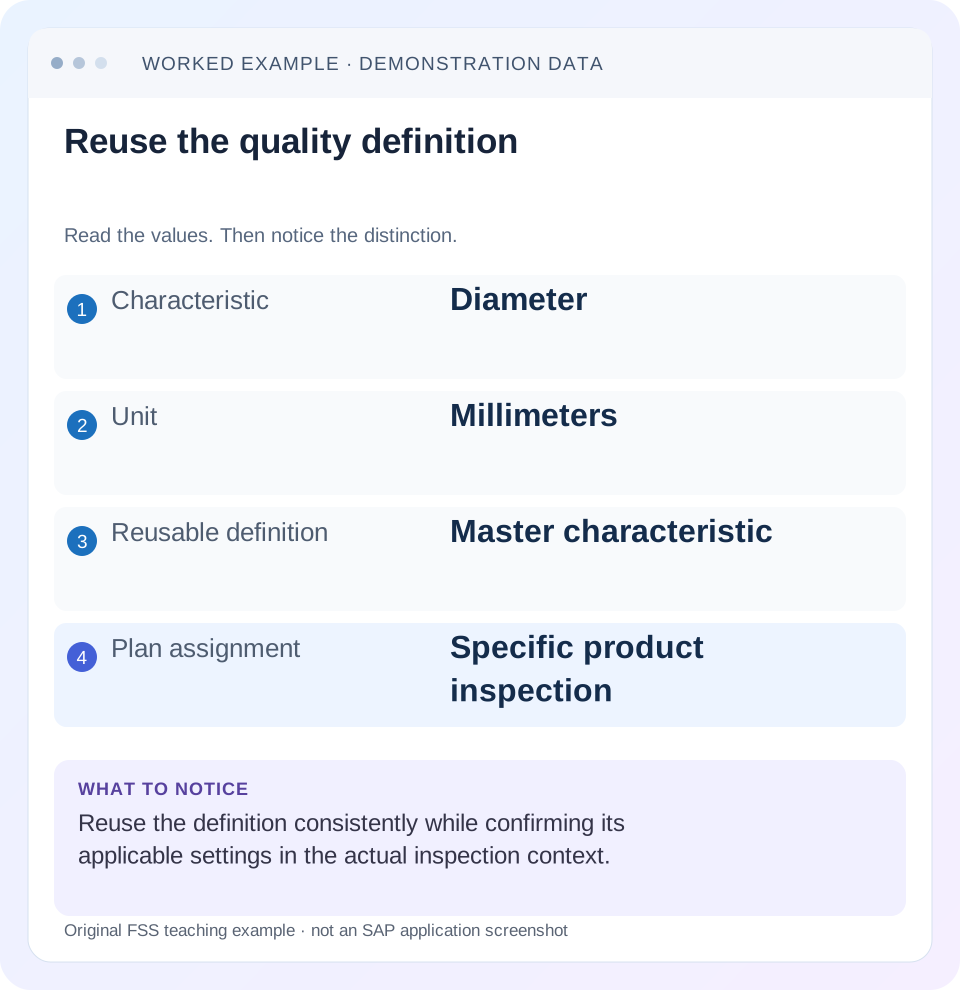
Read the example values
- Characteristic
- Diameter
- Unit
- Millimeters
- Reusable definition
- Master characteristic
- Plan assignment
- Specific product inspection
Words you’ll meet in this guide
- Inspection lot
- A record grouping a quality inspection task.
- Characteristic
- Something to inspect, such as length or color.
- Usage decision
- The recorded conclusion about an inspection lot.
- Stock posting
- A recorded inventory change under a supported goods-movement process.
Preview the practical steps
SEE THE CONNECTION
See it in a simple example.
A small example to make the idea concrete.
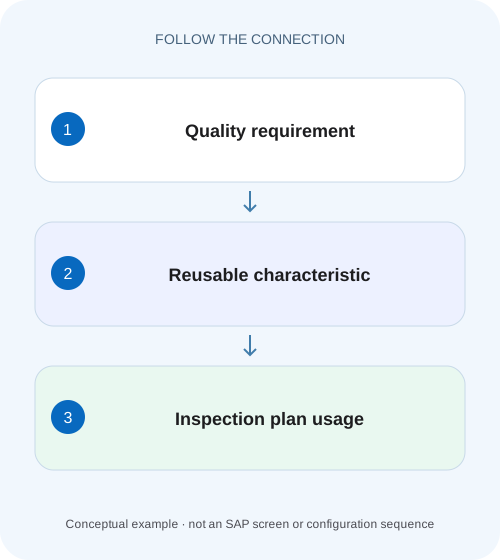
Reuse a component measurement definition
A manufacturer measures the same shaft diameter in two inspection plans and wants consistent meaning without losing each plan's actual specification context.
Standardize meaning before reusing a characteristic
A master inspection characteristic provides a reusable quality definition, such as diameter in millimeters or a coded surface assessment.
Separate master definition, plan characteristic and lot specification
The MIC is reusable master data.
Understand reference versus copy deliberately
SAP distinguishes reference characteristics, complete copy models and incomplete copy models, with different permitted reuse.
Reuse a component measurement definition
A manufacturer measures the same shaft diameter in two inspection plans and wants consistent meaning without losing each plan's actual specification context.
Compare the master characteristic reference and plan-level settings before assuming the two inspections use identical limits.
| Reader | Business question | Evidence to carry forward |
|---|---|---|
| Factory quality and maintenance teams | Reuse a component measurement definition | Compare the master characteristic reference and plan-level settings before assuming the two inspections use identical limits. |
01 Standardize meaning before reusing a characteristic
A master inspection characteristic provides a reusable quality definition, such as diameter in millimeters or a coded surface assessment. Reuse only works when consumers agree on the inspected property, unit, method and control meaning. Two records both called“diameter”can still represent different measurement positions or specifications.
This guide is for quality planners maintaining MICs and inspection plans. You need the MIC identity/plant/version where relevant, release/validity, consumer operation and reuse mode. The fixture uses a fictional 10-mm part. It is not a product specification or a recommendation to change tolerances without quality approval.
02 Separate master definition, plan characteristic and lot specification
The MIC is reusable master data. The plan characteristic places a check in a particular inspection operation with its applicable context. The lot specification is the definition actually used for an inspection. Reading today's MIC does not by itself establish what an earlier lot required.
SAP documents both referencing and copying MICs into inspection characteristics to standardize planning. It also describes prerequisites such as an operation/control key allowing inspection characteristics and released supporting master data. A released MIC alone does not make every consuming plan or lot ready for results recording. [1]
03 Understand reference versus copy deliberately
SAP distinguishes reference characteristics, complete copy models and incomplete copy models, with different permitted reuse. A copied characteristic can become independently maintained in its consumer; it should not be assumed to retain the same ongoing relationship as a reference. Inspect the actual relationship rather than deciding from matching short texts. [2]
Reference reuse centralizes relevant attributes under its supported rules, but it does not mean every field in every consumer is freely editable or that every old lot retroactively changes. Identify the consumer type and version/effectivity behavior before predicting propagation. A shared master correction and a local exception are different governance decisions.
04 Work a two-plan diameter example
Suppose MIC DIA_10 defines a quantitative diameter check in mm. Plan A references it; Plan B uses an independent copied characteristic derived from it. Both initially carry illustrative limits 9.90–10.10 mm. The quality team approves a future definition 9.95–10.05 mm effective 1 December under the chosen version/change process.
Do not promise propagation from this conceptual table. Verify the actual master/plan/lot relationships in the installed system. If Plan B remains 9.90–10.10, it may be behaving correctly as an independent copy; the issue could be a missing governed local update, not a broken reference mechanism.
| Object | Relationship | Question after approved future change |
|---|---|---|
| MIC DIA_10 | Shared definition | Which version/effective date changed? |
| Plan A | Reference | Which attributes/version does it resolve? |
| Plan B | Independent copy | Was a separate local update intended? |
| November lot | Existing inspection specification | What limits were actually assigned then? |
| December test lot | New selection | Does it receive the approved intended limits? |
05 Inspect control indicators and supporting objects
A quantitative definition needs more than two limits. Review unit, decimal interpretation, result-recording controls, required characteristic behavior, sampling and valuation context as relevant. A qualitative MIC may depend on selected sets/codes rather than numeric tolerances. Copying a short text does not recreate these dependencies.
Supporting method or sampling master data can have its own release/validity conditions. If a plan cannot use the MIC, read the actual message and prerequisite. Do not create a duplicate MIC merely because the existing one is not eligible under the current mode or version.
06 Use where-used context before a shared change
SAP's MIC maintenance guidance provides usage/navigation concepts for related quality objects. Review actual consumers and distinguish references from copies. A change intended for one material can affect multiple plans when the design uses shared references, while copied consumers may require separate review. [2]
For DIA_10, inventory the materials/operations that rely on the same measurement meaning. If one product needs a genuinely different location or method, consider whether a separate definition or local specification is appropriate under the quality model. Avoid silently broadening a shared characteristic's meaning until it becomes ambiguous.
07 Investigate reuse in sequence
Start with one affected plan and lot, then compare the master. This avoids editing the global definition based on a consumer whose attributes were independently copied years earlier.
Identify the actual characteristic
Record lot, operation, characteristic number, unit and assigned limits.
Expected observation: The November inspection context is explicit.
Inspect plan reuse
Determine reference versus copy and the MIC/version identity.
Expected observation: Plan A and B have different relationships.
Review master applicability
Read completeness, release, validity and supporting method/data.
Expected observation: The approved future definition is eligible as intended.
Inspect consumers
Identify which references/copies need governed review.
Expected observation: Change scope is deliberate.
Verify a new representative lot
Compare assigned specifications and result-entry behavior.
Expected observation: December behavior matches the approved design.
08 Troubleshoot similar-looking definitions
Matching descriptions are weak evidence. Compare IDs, versions, units, methods and reuse relationships before deciding that two checks are duplicates.
| Observation | Main question | Next evidence |
|---|---|---|
| Plan differs from MIC | Independent copy or version? | Consumer relationship and identity |
| MIC cannot be selected | Completeness/release/eligibility? | Master status and actual message |
| Old lot keeps old limits | Existing specification state? | Lot assignment and change timeline |
| Same name, different results | Different measurement meaning? | Unit, method, position and controls |
| Shared change affects extra plans | Unreviewed references? | Where-used population |
| Copied text language unexpected | Copy creation context? | Actual consumer text/history |
09 Keep localization and historical specifications explicit
SAP support content documents language behavior differing between copy and reference scenarios. When the visible characteristic text differs by consumer or creation context, inspect the reuse path before assuming the numeric definition changed. Text presentation and specification values are separate evidence.
Preserve the approved specification associated with results already recorded. A newer MIC version does not justify reinterpreting a November 9.92-mm result under December's narrower limits without the required quality process. Historical results must remain explainable using the specification actually applicable to that inspection.
10 Verify reference, copy and date-boundary cases
The positive test creates a representative new lot using the intended December method and checks unit, limits and recording controls. The negative control uses the independent copy and confirms it does not silently acquire an unintended shared change. The boundary test compares 30 November and 1 December under the actual version-selection rules.
Enter a permitted representative value and an out-of-range value in an authorized fixture and inspect characteristic valuation. Verify the whole inspection process separately; MIC reuse does not itself accept a lot. These are proposed tests, no master data or inspection results were changed.
11 Use the contextual MIC display to inspect more than the short text
SAP's Display Master Inspection Characteristic app F2219 documents plant, version, status, characteristic type, limits/tolerances, texts, inspection methods, catalogs and control indicators. Use that field set as an investigation sheet. A display that shows DIA_10 in the correct plant but another version can explain a consumer difference without any defect in the numerical measurement. [4]
For the quantitative example, record target/limits, unit, inspection-scope and sample-related controls, results confirmation and documentation requirements as actually supported. For a qualitative characteristic, record the attribute/catalog context instead of looking for numeric limits. The app's documented navigation labels vary across editions, so follow the installed display route rather than assuming that one classic transaction number has an identical role in every source. [4]
Compare Plan A's reference and Plan B's copied values against that sheet. Mark which fields are inherited/referenced, which are local and which were copied at creation. Do not infer continuous synchronization from a matching master-characteristic number displayed as historical context. The actual reuse relationship determines the change analysis.
12 Verify a shared tolerance revision with unchanged controls
Use the approved December revision as one controlled variable. Test 9.92 mm,10.00 mm and 10.08 mm under the old 9.90–10.10 range and the new 9.95–10.05 range. The center value remains inside both; the outer two are inside the old range and outside the new. This gives a discriminating fixture without changing units or measurement method simultaneously.
For Plan A, inspect which version/effective definition a new December lot actually receives. For Plan B, verify the intended independent-copy policy. If its limits should remain old, confirm that explicitly; if the quality team also approved a local change, record that separate update. The same test values make both outcomes explainable without assuming that one consumer is broken.
Keep an unchanged characteristic, such as an approved surface code check, as a regression control in the same plan. A tolerance revision should not accidentally alter its selected set, sampling or required-result controls. Also verify that the resulting lot still has the intended number of required characteristics and that technicians can record the expected evidence.
For a local exception, describe why its meaning differs. A separate measurement position or test method can justify another definition; an accidental copy with a slightly different name merely creates governance debt. Review existing consumers before creating a new MIC, and retain the chosen reference/copy mode in the plan documentation.
Close the revision with master identity/version, affected consumers, applicable date, test values, assigned lot specifications and unchanged-control results. That evidence explains what was standardized and what deliberately remained local. It is stronger than declaring completion because the MIC saved successfully or because every plan now displays the same short description.
13 Keep texts and numerical specifications as separate review evidence
When a language-dependent text differs, compare the MIC identity, version and numerical/control attributes before assuming the quality definition changed. Record the consumer creation context and reuse mode with the observed text. A translated description can improve usability, but it must not conceal a different measurement position, unit or approved tolerance.
14 Questions and related lessons
Should every diameter check share one MIC? Only when its meaning and required behavior are truly reusable. Does copy mean continuous synchronization? Inspect the chosen reuse mode; do not assume it. Does a current master prove an earlier lot's limits? Read that lot's specification.
Close with MIC/version, consumer relationship, plan/lot context, approved change and verified outcomes. Continue with qualitative/quantitative characteristics for result design, QP03 for plan applicability, and sampling for the inspection effort and valuation context.
Related services and next steps
Primary sources
Found this useful?
Share this guide with your network, or leave a like.
Your like is saved in this browser.