SAP QM sampling procedures: Define the inspection sample before execution
A supplier sends a component lot, and the receiving team asks why quality inspects a sample rather than every piece.

Source review:
START HERE · NO PRIOR TOPIC KNOWLEDGE NEEDED
What it is. Why it matters.
A sampling procedure defines how the inspection sample is determined under relevant rules. It connects the inspection population with the amount of checking needed.
Completely new to SAP?
Manufacturers use SAP to connect work such as buying components, recording inventory, planning production, shipping equipment and accounting for costs. SAP S/4HANA is an enterprise resource planning system: it connects these activities through shared business data.
Quality Management defines and records inspections. The planned check, the measured result and the final decision serve different purposes, and any stock movement needs its own evidence.
A transaction code, or t-code, is a shortcut to a task in classic SAP GUI. Fiori apps provide another way to work. Names and screens depend on the product and release; you do not need a live system to learn the concepts in this guide.

Scope and source-review notes
Scope and evidence
Source review by FAST SAP SOLUTIONS® editorial. This badge describes our editorial review; it does not represent SAP certification or independent endorsement.
SAP ERP/S/4HANA core QM sampling procedures,not EWM inspection-rule sampling. Fixed,percentage and scheme examples are illustrative;statistical standards,AQL policy,rounding and supported valuation modes require approved design.
Documentation review on 14 November 2026 used the official SAP sources listed below, including indexed excerpts where full text was unavailable. Scope and availability depend on the stated product, release and configuration. All document references, quantities, dates and outcomes in worked cases are illustrative; no customer SAP system or tenant was accessed and the proposed exercises were not executed.
A MANUFACTURING EXAMPLE
Explain an incoming-component sample
The same sample count can come from different rules
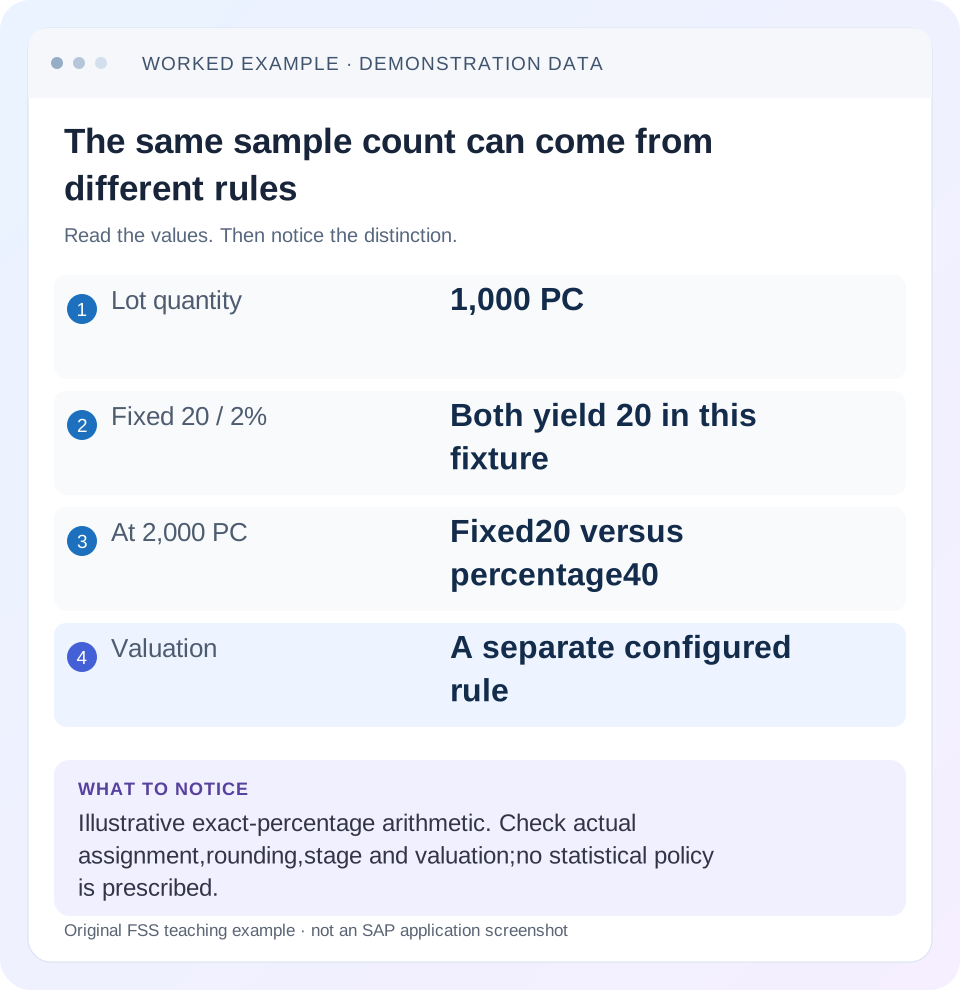
Read the example values
- Lot quantity
- 1,000 PC
- Fixed 20 / 2%
- Both yield 20 in this fixture
- At 2,000 PC
- Fixed20 versus percentage40
- Valuation
- A separate configured rule
Words you’ll meet in this guide
- Inspection lot
- A record grouping a quality inspection task.
- Characteristic
- Something to inspect, such as length or color.
- Usage decision
- The recorded conclusion about an inspection lot.
- Stock posting
- A recorded inventory change under a supported goods-movement process.
- EWM
- Extended Warehouse Management: SAP’s application for warehouse processes.
Preview the practical steps
SEE THE CONNECTION
See it in a simple example.
A small example to make the idea concrete.
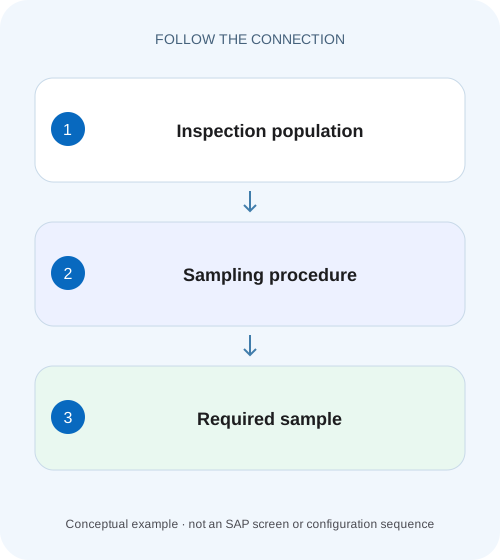
Explain an incoming-component sample
A supplier sends a component lot, and the receiving team asks why quality inspects a sample rather than every piece.
Sample size is a planned rule, not the count inspected so far
A sampling procedure defines how the required sample is calculated and how the characteristic/sample is valuated.
Understand sampling type and valuation mode
SAP defines sampling procedures through sampling type and valuation mode.
Distinguish assignment paths
In core QM, SAP documents characteristic-level use in task lists or material specifications, with additional supported no-task-list assignment paths through material inspection setup/configuration.
Explain an incoming-component sample
A supplier sends a component lot, and the receiving team asks why quality inspects a sample rather than every piece.
Work from the applicable sampling procedure and stated lot assumptions before inferring the actual inspection quantity.
| Reader | Business question | Evidence to carry forward |
|---|---|---|
| Factory quality and maintenance teams | Explain an incoming-component sample | Work from the applicable sampling procedure and stated lot assumptions before inferring the actual inspection quantity. |
01 Sample size is a planned rule, not the count inspected so far
A sampling procedure defines how the required sample is calculated and how the characteristic/sample is valuated. A1,000-PC lot and a 20-PC sample represent different populations. Inspecting 10 pieces does not make 10 the required sample merely because those are the results currently entered.
This tutorial is for quality planners and technicians investigating sample determination. You need lot quantity, unit, characteristic, assigned procedure, sampling type, valuation mode and any scheme/severity/AQL context. The numbers are teaching fixtures, not a statistical recommendation or an industry sampling standard.
02 Understand sampling type and valuation mode
SAP defines sampling procedures through sampling type and valuation mode. Sampling types include fixed sample,100% inspection, percentage and use of a sampling scheme in applicable processes. Valuation defines how acceptance/rejection is determined. Sample determination and decision logic are connected but distinct. [1]
A fixed 20-piece sample can use different valuation rules from another 20-piece sample. Conversely, the same attributive rule can apply to different sample sizes. Read both parts of the procedure before explaining why a characteristic accepted or rejected. The procedure's name is not enough.
03 Distinguish assignment paths
In core QM, SAP documents characteristic-level use in task lists or material specifications, with additional supported no-task-list assignment paths through material inspection setup/configuration. Find the path actually used by the lot. A procedure assigned in an unrelated inspection plan does not control a lot using another specification source. [1]
The old source list included an EWM sampling-procedure reference. EWM inspection rules have their own model, and this tutorial keeps them separate. When a warehouse-integrated process is involved, establish which system determines the sample and which inspection object is being processed before applying core-QM assumptions.
04 Work fixed, percentage and full inspection examples
Use a fictional 1,000-PC lot. Under a fixed sample 20, the required sample is 20 subject to the actual procedure rules. Under an illustrative 2% procedure with no rounding ambiguity,1,000×0.02 also gives 20. Under 100% inspection, the population is 1,000. Identical sample counts in the first two cases do not make their rules equivalent.
At 2,000 PC, the fixed and percentage rules diverge. That is a useful diagnostic test when users claim two procedures are interchangeable because both once produced 20. For small lots or nonintegral percentage results, do not invent a rounding rule; inspect the actual sample-determination settings and resulting lot specification.
| Lot quantity | Fixed 20 fixture | 2% fixture | 100% fixture |
|---|---|---|---|
| 1,000 PC | 20 | 20 | 1,000 |
| 2,000 PC | 20 | 40 | 2,000 |
| 500 PC | 20 | 10 | 500 |
| Small/nonintegral boundary | Read supported constraints | Read rounding/minimum rules | Confirm unit/population |
05 Work an attributive valuation without prescribing policy
Assume an approved illustrative sample plan requires 20 units and accepts at most one nonconforming unit. One failed unit meets that invented acceptance-number condition; two do not. This simplified fixture demonstrates a count comparison, not a recommendation that one defect in 20 is acceptable for any real product.
SAP's valuation-mode guidance distinguishes nonconforming units from defects and describes comparing the relevant count with an acceptance number in attributive inspection. One unit can have several defects. If one scratched unit also has a diameter failure, it remains one nonconforming unit but may have two defect records. Use the count basis required by the actual valuation mode. [2]
06 Inspect the documented procedure display
SAP's Display Sampling Procedure app exposes sampling type, valuation mode, sample-determination rule and additional severity/AQL information in its documented scope. Use those fields to explain the assigned procedure. Do not change the procedure merely because the resulting inspection effort is inconvenient. [3]
For a scheme-based process, inspect the lot-size band, inspection severity and relevant AQL selection under the approved scheme. A stage change can legitimately change the selected sample even when lot quantity remains 1,000. Follow dynamic-modification history separately instead of treating the sampling procedure as an isolated fixed number.
07 Trace sample determination in sequence
Start from the lot's assigned characteristic and actual required sample, then work backward through the procedure. This distinguishes current specification from later master-data changes.
Capture population and characteristic
Record 1,000 PC, unit, lot/operation/characteristic and specification source.
Expected observation: The inspection population is explicit.
Read assigned procedure
Compare sampling type, valuation mode and determination parameters.
Expected observation: Fixed 20 and 2% are distinguished.
Read scheme/stage context
Where applicable, inspect severity, AQL, lot-size band and modification stage.
Expected observation: The selected plan is reproducible.
Compare required versus recorded sample
Count results using the required recording basis.
Expected observation: 10 entered does not falsely complete 20 required.
Inspect valuation
Compare actual count/value with the configured rule.
Expected observation: Acceptance is explained separately from sample size.
08 Diagnose unexpected sample sizes
A different lot quantity, procedure, stage, specification date or inspection-point context can change sample determination. Preserve the lot's actual assignment instead of reading only today's plan and assuming it was always used.
| Observation | Main question | Next evidence |
|---|---|---|
| 1,000 lot requires 40, not 20 | Different procedure/stage? | Assigned rule, severity and scheme |
| Two lots same size, different sample | History or specification context? | Dynamic stage and plan version |
| 10 results entered, still incomplete | Required sample 20? | Required/recorded counts and controls |
| One unit, two defects, rejection surprising | Count basis wrong? | Nonconforming-unit versus defect mode |
| Small lot sample unexpected | Minimum/rounding/constraints? | Actual determination rule |
| Procedure unavailable in plan | Usage/inspection-point restriction? | Procedure indicators and plan context |
09 Keep inspection points and sample management explicit
SAP documents inspection-point-related settings and usage restrictions for sampling procedures. A procedure suitable for one inspection-point/sample-management context may not be eligible in another. Read the relevant indicators before copying the procedure to a new plan. [1]
Also distinguish physical samples, partial samples and characteristic sample requirements where the process uses them. Summing every characteristic's requested count can overstate the number of distinct physical units if the same pieces support several nondestructive checks. Conversely, destructive testing can require additional material. Use the approved sampling design rather than one generic addition rule.
10 Verify size, count and valuation boundaries
The positive fixture reproduces 1,000→20 for both fixed 20 and 2%, then 2,000→20 versus 40 to demonstrate their difference. The negative check leaves only 10 of 20 required results and confirms the actual completion behavior. A valuation boundary compares one versus two nonconforming units under the invented acceptance-number 1 rule.
Add a nonintegral percentage case, for example 33 PC at 2%, and inspect the documented rounding/minimum outcome rather than supplying an assumed answer. These are proposed tests, no statistical policy or sample procedure was changed. Record actual values and messages in an authorized fixture.
11 Read the procedure display and the lot assignment together
Open the documented Display Sampling Procedure app F2255 where it is available and record sampling type, valuation mode, sample-determination rule and applicable severity/AQL information. Then compare the procedure actually assigned to the lot characteristic. A correct master procedure cannot explain a lot that selected another plan or retained an earlier specification. [3]
For the fixed 20 fixture, record the fixed size 20 and the actual valuation parameters separately. For the 2% fixture, record the percentage and any supported minimum/rounding controls. For a scheme-based procedure, record the selected scheme, lot-size band, severity and relevant approved AQL context. This makes the calculation reproducible without copying a sample count from another lot.
If the procedure is not eligible for the intended plan, inspect usage/inspection-point restrictions rather than creating a duplicate with the same name. The cited core-QM documentation describes those relationships. A procedure designed for a different point/sample-management context can be a valid record and still be unsuitable here. [1]
12 Separate physical sampling effort from characteristic sample counts
Suppose a lot requires 20 units for a nondestructive diameter check and the same 20 units for visual inspection. That does not automatically mean 40 distinct pieces must be drawn. If both approved checks use the same physical units, the effort is two observations on 20 units. The plan's sample-management design must preserve that relationship where relevant.
Now add an illustrative destructive test requiring 5 separate pieces that cannot be returned to available stock. The population drawn or consumed can differ from the simple 20-unit nondestructive sample. Do not infer the inventory effect from the sum of characteristic counts alone. Review sample drawing, destructive indicators and stock-posting context under the actual process.
For a valuation test, use 20 inspected units with one unit carrying two defects. Under a nonconforming-unit basis, the count is 1; under a defect basis, it is 2. If the invented acceptance number is 1, the two counting rules can reach different conclusions. This is a deliberate demonstration of rule semantics, not a recommendation to choose whichever mode accepts the lot.
At a lot-size boundary, hold severity/AQL constant and compare quantities on either side of the actual scheme band. Then hold quantity constant and change the approved stage/severity through a controlled history fixture. These tests isolate population and history influences instead of changing several inputs and guessing which caused the larger sample.
For a nonintegral percentage case 33×2%=0.66, the expected whole-unit sample must come from the procedure's documented determination/rounding rules. Record the actual result and applicable minimum. A spreadsheet that rounds 0.66 to 1 can be a hypothesis, but it is not SAP execution evidence. Finish the review with required sample, physical-unit interpretation, recorded count and valuation basis reconciled for the same lot.
13 Questions and related lessons
Does a procedure define only sample count? It also includes valuation information. Is AQL a guarantee that every lot has that defect rate? Do not infer product quality guarantees from a planning parameter. Can inspectors reduce the sample to finish faster? Required scope follows the approved specification and exception process.
Close with lot population, procedure, type, valuation, scheme/stage, required/recorded sample and decision evidence. Continue with dynamic modification for stage changes, results/defects for count basis, and QP03 for the assignment and validity that selected the procedure.
Related services and next steps
Primary sources
Found this useful?
Share this guide with your network, or leave a like.
Your like is saved in this browser.