SAP BTP destination connects, but the app fails: What to check next
A manufacturer's BTP destination test succeeds while the operational app fails against a more specific backend resource.

Source review:
START HERE · NO PRIOR TOPIC KNOWLEDGE NEEDED
What it is. Why it matters.
A BTP destination stores connection settings for another service. Testing that destination and calling it from a deployed application can exercise different authentication and routing contexts.
Completely new to SAP?
Manufacturers use SAP to connect work such as buying components, recording inventory, planning production, shipping equipment and accounting for costs. SAP S/4HANA is an enterprise resource planning system: it connects these activities through shared business data.
SAP Business Technology Platform, or BTP, provides cloud services for applications, data and integration. A connection needs a route, an identity and permission to perform the intended task.
A transaction code, or t-code, is a shortcut to a task in classic SAP GUI. Fiori apps provide another way to work. Names and screens depend on the product and release; you do not need a live system to learn the concepts in this guide.

Scope and source-review notes
Scope and evidence
Source review by FAST SAP SOLUTIONS® editorial. This badge describes our editorial review; it does not represent SAP certification or independent endorsement.
SAP BTP HTTP destination and application-router concepts. Cloud Foundry/multi-cloud and Neo documentation are identified separately; check the behavior for your environment and authentication flow.
Documentation review on 14 November 2026 using official SAP sources and indexed official excerpts where full Help text was unavailable. Scope and service or release differences are explained in the lesson. All datasets, requests and checks are illustrative; no customer SAP runtime execution or measured results are claimed.
A MANUFACTURING EXAMPLE
Explain a factory app failure after a destination test
Compare the actual call path
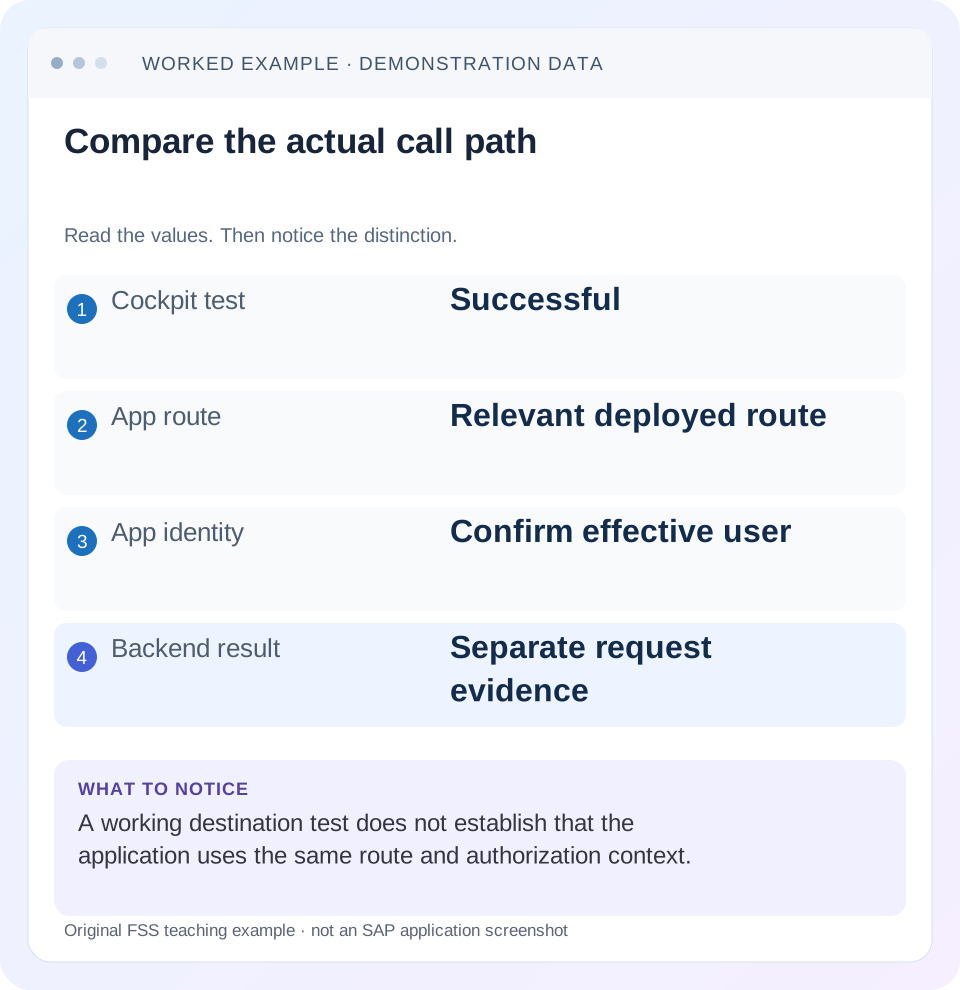
Read the example values
- Cockpit test
- Successful
- App route
- Relevant deployed route
- App identity
- Confirm effective user
- Backend result
- Separate request evidence
Words you’ll meet in this guide
- Backend
- The service or system doing the work behind an interface.
- Destination
- Named connection settings for another service.
- Credential
- Access information used to prove an identity.
- Subaccount
- A BTP scope for applications, services and access settings.
- BTP
- SAP Business Technology Platform: cloud services for applications, data and integration.
- API
- A defined interface through which programs exchange data or request actions.
- HTTP
- The request-and-response protocol used by web applications and APIs.
Preview the practical steps
SEE THE CONNECTION
See it in a simple example.
A small example to make the idea concrete.
Explain a factory app failure after a destination test
A manufacturer's BTP destination test succeeds while the operational app fails against a more specific backend resource.
A destination diagnostic and an application call test different paths
A successful destination check does not prove that a deployed application resolves the same destination, rewrites the same resource path or uses the same identity.
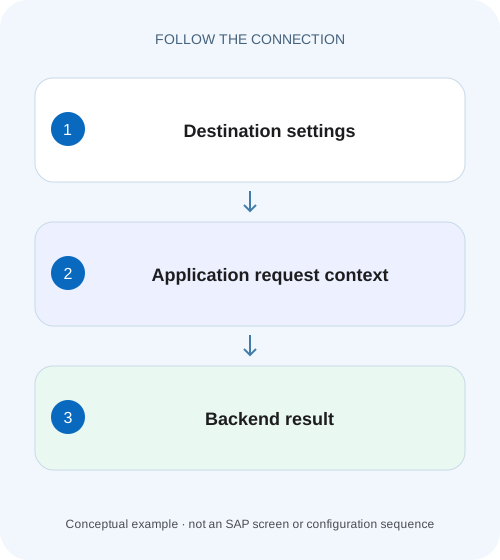
Draw the complete request path
The user’s request reaches an application route, which selects and rewrites a backend path.
Worked case: a reachable base endpoint, a broken application resource
Imagine destination orders-backend with illustrative base endpoint https://orders.example.invalid.
Explain a factory app failure after a destination test
A manufacturer's BTP destination test succeeds while the operational app fails against a more specific backend resource.
Compare the application's actual path, identity and authorization context before declaring the whole connection proven.
| Reader | Business question | Evidence to carry forward |
|---|---|---|
| SAP developers and application teams supporting manufacturers | Explain a factory app failure after a destination test | Compare the application's actual path, identity and authorization context before declaring the whole connection proven. |
01 A destination diagnostic and an application call test different paths
A successful destination check does not prove that a deployed application resolves the same destination, rewrites the same resource path or uses the same identity. Compare the actual failing request with the diagnostic and locate the first differing boundary. SAP’s Neo availability-check documentation explicitly limits what its check proves; its exact behavior should not be generalized to every current BTP destination consumer. [1] [2]
This tutorial is for developers investigating HTTP destinations consumed by an application router or another supported BTP application. You need the destination context, deployed application configuration, browser or client request evidence and a permitted harmless backend read. Cloud Foundry, managed-router and Neo contexts differ. The worked path and destination names are fictional and do not imply a standard SAP backend API.
02 Draw the complete request path
The user’s request reaches an application route, which selects and rewrites a backend path. The consumer resolves a destination in its supported scope, obtains connection and authentication information and reaches the remote endpoint through the configured proxy path. The backend then authenticates and authorizes the operation and returns a business response.
A cockpit diagnostic may exercise only part of that chain. It does not necessarily use the browser user, the app’s route or the same resource. Write each boundary as a row in the investigation record. Then attach evidence to the row it actually proves. This makes a green connection check useful without stretching it into proof of an entire application workflow.
03 Worked case: a reachable base endpoint, a broken application resource
Imagine destination orders-backend with illustrative base endpoint https://orders.example.invalid. The diagnostic succeeds. The UI calls GET /api/orders/4711 through a router. The deployed route rewrites it to /v1/order/4711, but the backend contract expects /v1/orders/4711 with a plural resource segment. The backend returns 404 for the app call even though the base endpoint is reachable.
The destination is not necessarily wrong. Compare the rewritten request with the published backend resource and confirm the exact receiver identity. Fixing the target path can repair this case without changing credentials, proxy type or the destination URL. Conversely, if the route references another destination, a correct rewrite still reaches the wrong system.
Keep the backend spelling defect distinct from an authorization defect. After the plural path is corrected, the next response could be 403 because the intended user lacks access to order 4711. Record that as a newly visible later boundary rather than reverting the correct path fix. Conversely, a 200 carrying an application rejection still needs business-response handling. The request ledger should retain the sequence of observations so a reviewer can see which boundary each change resolved.
| Observation | What it supports | What remains unproven |
|---|---|---|
| Destination check succeeds | Diagnostic reached its tested endpoint | App route, identity and resource |
| Router selects orders-backend | Destination reference is selected | Correct rewritten path |
| GET /v1/order/4711 returns 404 | Receiver answered that request | Existence of intended plural resource |
| GET /v1/orders/4711 returns known order | Intended read works in this context | Write permissions or every user |
04 Capture the actual browser or client request
In browser developer tools, identify the network request for the backend operation, not merely the page navigation. Record method, path with relevant sanitized query, status, content type and a safe response excerpt. Include the user context and timestamp. A JavaScript error such as unexpected token in JSON can be caused by receiving HTML from a login or UI fallback.
Preserve the request before changing configuration. If the browser never sends the expected request, investigate the client’s request construction and application state first. If it sends the request but receives a login redirect, inspect authentication context. If it receives a backend business error, keep that error rather than reducing every failure to “destination not working.”
05 Confirm the deployed route and destination resolution source
For an application router, compare the selected source expression, target rewrite and destination name in the deployed xs-app.json. SAP documents that destination names referenced by routing configuration must correspond to the configured destinations. Evaluate first-match behavior and any method restrictions. A broad earlier route may select a different destination before the intended route is considered. [2] [3]
Next establish where this consumer resolves destination configuration. A subaccount destination, an application environment definition and a service-managed destination source can differ by supported scenario. Do not assume that editing a similarly named cockpit entry updates the configuration actually used by the application. Record subaccount, app version and the non-secret resolved destination identity.
06 Calculate the final resource rather than guessing from the base URL
Write down incoming URL, selected capture groups, route target and destination base. Under the fictional defect, /api/orders/4711 becomes /v1/order/4711. That exact request explains the 404. Compare slash boundaries and service-root prefixes so the path is neither duplicated nor omitted. A base URL ending in /v1 plus a target also beginning /v1 may produce another mismatch depending on the consumer’s composition rules.
Include query strings in route regression tests because SAP’s application-router source regular expression can include query parameters. A pattern that matches a bare numeric item path may behave differently when the app adds a projection or filter. Check the supported router’s actual forwarding behavior and the backend’s query contract rather than testing only an address typed manually into a browser. [3]
07 Compare the effective caller and authentication flow
A destination can use technical authentication, a user-dependent token flow or another supported mechanism. Establish which one the app is designed to use and who the backend sees. A cockpit diagnostic or administrator’s direct call may not represent a normal user. A read that succeeds for one user can fail for another because their application roles or backend permissions differ.
Inspect non-secret metadata and sanitized error provenance. Do not copy bearer tokens, passwords or binding credentials into the incident record. If token exchange is part of the documented setup, verify its prerequisites and error boundary. An authentication failure before the backend call is different from a backend 403 after identity establishment. Disabling route authentication hides that distinction while changing the security contract.
08 Check service bindings and on-premise connectivity only where applicable
If the consumer uses Destination or Connectivity service, verify the supported service setup and binding for that runtime. The destination definition itself does not create every required application relationship. SAP’s application-router guide describes Connectivity service integration for on-premise access and the corresponding proxy requirements. [2]
For OnPremise, compare selected Cloud Connector location, destination virtual host/port, internal system mapping and resource exposure. A successful connector connection does not prove the required URL path is allowed. Do not switch ProxyType to Internet to bypass a denied tunnel path. That changes the topology and may fail to exercise the same protected backend at all.
09 Use a layered decision table after each observation
Choose one boundary to repair based on the first mismatch. Changing route, destination, authentication and connector exposure together makes the cause difficult to review and can introduce unrelated behavior. Keep a known harmless read as the common comparison across supported tests.
| Symptom | Boundary to inspect | Useful evidence |
|---|---|---|
| Destination not found in app | Resolution scope | App bindings, destination name and context |
| HTML instead of JSON | Router fallback or authentication | Selected route, redirects and content type |
| 404 for one operation | Resource rewrite or backend API | Final path and published contract |
| 401 or 403 | Identity/authentication/authorization | Actual caller and error source |
| On-premise resource denied | Connector access control | Location, virtual mapping and exact resource path |
| 200 with rejected business action | Business response handling | Response fields and receiver document lookup |
10 Verify through the same consumer and user context
After correcting the plural resource path, repeat GET /api/orders/4711 through the deployed application with the intended authorized user. Confirm the returned order identity and business content. A direct backend test can support diagnosis but does not replace this acceptance check because it omits the router and destination-resolution path.
For a negative check, request an unknown harmless order fixture and confirm the expected backend response rather than a generic UI page. For a boundary check, test the collection endpoint and a query-bearing item request if the application uses them. Preserve neighboring route behavior so a narrow correction does not divert another service.
Also test an identity that intentionally lacks the required operation in an authorized development setup. Its failure should remain attributable to authorization. A repair that makes every user succeed by removing protection does not preserve the intended contract. For writes, reconcile previous outcomes before replaying because a failed browser response does not prove the backend made no change.
11 Compare environments with a reproducible evidence bundle
If development works and production fails, compare artifact version, deployed route, destination source, endpoint, authentication flow, service bindings and connector context. Identical destination display names do not establish identical configuration. Include observation times because a destination edit or credential rotation can change the evidence between screenshots.
Build the handoff around one request: expected receiver and resource, actual selected route, resolved destination, effective identity, response and correction. Another developer should be able to explain the failure without opening a secret payload. The related route-order, binding and connector lessons develop each later boundary when the ledger identifies it as the first mismatch.
12 Questions that prevent another green-check dead end
Can I ignore the destination check? No. It is useful evidence within its documented scope. Keep it alongside the actual application call and say what each tested.
Why does a direct backend read work? It may use another identity, resource path or network path. Compare those values explicitly before treating it as a contradiction.
What proves completion? The intended operation succeeds through the actual deployed consumer and user context, while negative and neighboring-path behavior remains correct. If documentation was reviewed but no runtime request was executed, report that limit rather than claiming an application repair.
Related services and next steps
Primary sources
Found this useful?
Share this guide with your network, or leave a like.
Your like is saved in this browser.