SAP OData V2 change-set failed? Collect the right evidence first
A manufacturer's application sends several related OData V2 changes, but one invalid operation causes the grouped request to fail.

Source review:
START HERE · NO PRIOR TOPIC KNOWLEDGE NEEDED
What it is. Why it matters.
An OData V2 change set groups supported write operations within a batch request. A batch response can contain a failed change set even if the outer HTTP exchange was delivered.
Completely new to SAP?
Manufacturers use SAP to connect work such as buying components, recording inventory, planning production, shipping equipment and accounting for costs. SAP S/4HANA is an enterprise resource planning system: it connects these activities through shared business data.
An API lets one program use another program’s data or operations. OData defines conventions for doing this over HTTP, including reading entities and sending supported updates.
A transaction code, or t-code, is a shortcut to a task in classic SAP GUI. Fiori apps provide another way to work. Names and screens depend on the product and release; you do not need a live system to learn the concepts in this guide.

Scope and source-review notes
Scope and evidence
Source review by FAST SAP SOLUTIONS® editorial. This badge describes our editorial review; it does not represent SAP certification or independent endorsement.
SAP Gateway OData V2 batch/changeset diagnostics in ABAP landscapes. Classic provider-method details require matching SAP_GWFND release/support package; public-cloud and other service frameworks have different supported tools.
Primary documentation reviewed on 14 November 2026 using readable full text and official indexed excerpts. OData V2 batch specification read as full text; SAP Gateway logs, traces, batch and API indexed excerpts reviewed. No multipart request, SAP transaction or rollback test was executed.
A MANUFACTURING EXAMPLE
Investigate a grouped manufacturing update
Read the inner response
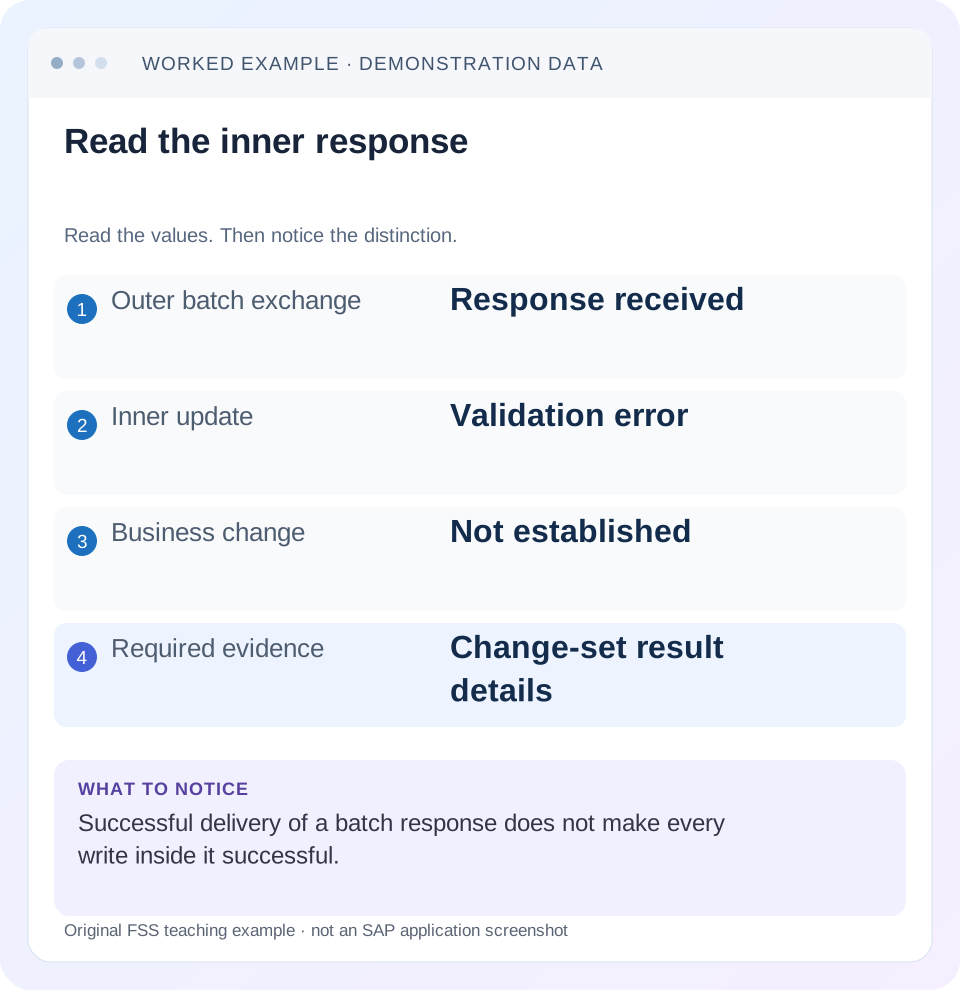
Read the example values
- Outer batch exchange
- Response received
- Inner update
- Validation error
- Business change
- Not established
- Required evidence
- Change-set result details
Words you’ll meet in this guide
- HTTP
- The request-and-response protocol used by web services.
- Entity
- A business-data type or record exposed by a service.
- Status code
- A numeric summary of an HTTP response.
- ABAP
- SAP’s programming language for business applications.
- RAP
- ABAP RESTful Application Programming Model: a way to build business objects and services.
- OData
- A standard for reading and updating data through a web API.
- API
- A defined interface through which programs exchange data or request actions.
- BAPI
- Business Application Programming Interface: an SAP interface for a business operation.
- ETag
- A resource-version identifier used in checks that can prevent overwriting a concurrent change.
- CSRF
- Cross-Site Request Forgery. A CSRF token helps a service reject unwanted cross-site write requests.
Preview the practical steps
SEE THE CONNECTION
See it in a simple example.
A small example to make the idea concrete.
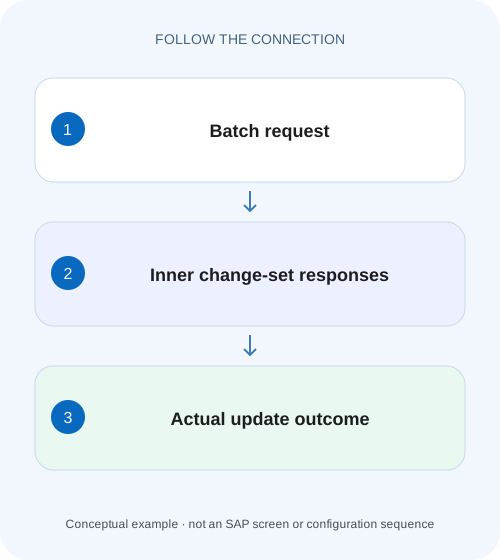
Investigate a grouped manufacturing update
A manufacturer's application sends several related OData V2 changes, but one invalid operation causes the grouped request to fail.
Read the failed changeset, then reconcile its business outcome
An OData V2 $batch response can arrive successfully while a changeset inside it fails.
Scope the Gateway implementation and diagnostic tools
The operational steps target SAP Gateway OData V2 services in ABAP landscapes with supported diagnostic transactions.
Worked case: valid O100 and invalid O200 in one changeset
O100 begins with Quantity 10 and O200 with Quantity 20.
Investigate a grouped manufacturing update
A manufacturer's application sends several related OData V2 changes, but one invalid operation causes the grouped request to fail.
Read each operation's response and the documented changeset boundary before reporting that the apparently valid item was saved.
| Reader | Business question | Evidence to carry forward |
|---|---|---|
| SAP developers and application teams supporting manufacturers | Investigate a grouped manufacturing update | Read each operation's response and the documented changeset boundary before reporting that the apparently valid item was saved. |
01 Read the failed changeset, then reconcile its business outcome
An OData V2 $batch response can arrive successfully while a changeset inside it fails. Inspect the multipart body, identify the affected changeset and read its actual error before reporting Save success or retrying the operation. A transport envelope is not a transaction result. [1] [4]
A changeset is an atomic group of supported modifying operations: all apply or none apply. A batch can contain several changesets, so its business outcome can include separate successes and failures. This tutorial uses two order updates to explain grouping, provider support, transaction ownership, Gateway correlation and a controlled rollback verification.
02 Scope the Gateway implementation and diagnostic tools
The operational steps target SAP Gateway OData V2 services in ABAP landscapes with supported diagnostic transactions. Confirm SAP_GWFND release/support package, service version and embedded or separate hub deployment. A classic Gateway data-provider implementation, RAP exposure and a public-cloud API can have different supported implementation and diagnostic paths. [2] [4] [5]
The provider-method discussion applies to the documented /IWBEP/IF_MGW_APPL_SRV_RUNTIME contract. It is not an instruction to add those methods to every service framework. Use disposable authorized test data for writes and keep the client protocol/model version explicit. All requests, messages and values below are illustrative, not captured customer traffic.
03 Worked case: valid O100 and invalid O200 in one changeset
O100 begins with Quantity 10 and O200 with Quantity 20. One changeset requests O100=12 and O200=-1. The fixture business rule requires nonnegative quantities, so the group must fail and both persisted quantities remain 10 and 20. If O100 becomes 12 while O200 stays 20, the provider has not honored the intended all-or-nothing contract.
A separate changeset for O300=6 from 5 has its own outcome. If its response reports success and the persisted read confirms 6, do not tell the user that every change in the batch rolled back because the O100/O200 group failed. Record each changeset's expected scope and observed persisted identities.
| Grouping | Requested values | Expected persisted result |
|---|---|---|
| One changeset: O100/O200 | 12 and-1 | 10 and 20; entire group rejected |
| Same group after correction | 12 and 21 | 12 and 21 if accepted |
| Separate O300 changeset | 5→6 | Independent outcome; inspect its response |
| Lost response | Unknown to client | Reconcile actual records before retry |
04 Inspect MIME boundaries and the failing inner response
A V2 batch is a multipart/mixed request to $batch. Each changeset is another multipart unit, and each embedded HTTP operation has its own request line and payload. The response can contain a single error for the failed changeset rather than one failed response for every operation. A parser expecting a uniform per-operation success array can miss that structure. [1]
The structural example omits transport/authentication headers and uses a provider-supported MERGE convention. It is not a complete executable request. Check the actual client output, boundary delimiters and blank-line framing rather than reconstructing production traffic by hand. Prefer the supported client library to build multipart payloads.
POST /service/$batch
Content-Type: multipart/mixed; boundary=batch_demo

--batch_demo
Content-Type: multipart/mixed; boundary=changeset_orders

--changeset_orders
Content-Type: application/http
Content-Transfer-Encoding: binary
Content-ID: 1

MERGE Orders('O100') HTTP/1.1
Content-Type: application/json

{"Quantity":12}
--changeset_orders
Content-Type: application/http
Content-Transfer-Encoding: binary
Content-ID: 2

MERGE Orders('O200') HTTP/1.1
Content-Type: application/json

{"Quantity":-1}
--changeset_orders--
--batch_demo--
05 Check grouping before debugging individual entity methods
Compare the client groupId, changeset assignment and actual emitted multipart body. In UI5 V2, a batch group and a changeset are different configuration concepts. Two requests sent together are not necessarily in one atomic changeset. Conversely, a provider that supports a standalone update can still reject two operations grouped together.
The V2 protocol excludes retrieve requests from a changeset and does not permit nested changesets. Operations within a changeset are not a general procedural sequence to exploit by assumed order. For create-and-reference scenarios, the protocol defines Content-ID references within the same changeset, but provider support and navigation contract still need verification. Do not replace supported dependencies with guessed generated keys. [1]
06 Verify that the provider supports multiple operations
The classic Gateway runtime documentation describes a default changeset-begin implementation allowing one operation to protect consistency. An application needing multiple operations must implement the supported handling and preserve transaction semantics. An error such as changeset not supported can therefore indicate a provider capability boundary, not an invalid quantity payload. [4] [5]
Compare the grouped two-update case with standalone fixture updates only to isolate that boundary. Standalone success does not validate the grouped contract. Review the installed framework's documented methods and release support, including deferred whole-changeset processing where applicable. Do not simply suppress the capability exception while leaving commit behavior and response mapping undefined.
07 Keep commits under the supported changeset lifecycle
The provider must preserve one logical unit of work for the changeset. The Gateway references warn against COMMIT WORK or ROLLBACK WORK during multi-operation processing, including called code that performs those operations. A reused BAPI wrapper that commits immediately can invalidate rollback even if the data-provider method contains no explicit commit. [4] [5]
Inspect the full call chain and documented release-specific end-of-changeset behavior. The API reference distinguishes supported lifecycle phases; do not reduce it to a blanket instruction to add a commit after every entity update. In the O100/O200 fixture, the negative test is decisive: O100 must remain 10 when O200 fails. A success-only test cannot detect an early committed partial result.
08 Correlate the failed operation with Gateway and backend logs
Capture timestamp with timezone, service/version, system/client, user, outer and inner statuses, sanitized error body and available transaction identifier. Match that record in /IWFND/ERROR_LOG for the hub role and /IWBEP/ERROR_LOG for the backend as applicable. In an embedded deployment those roles may share a system. [2]
Compare service/resource and execution context before selecting a log entry. If a dump occurred, follow the matched backend context to ST22 rather than assuming the latest dump belongs to this batch. If no entry matches, check route, client, user mapping and time selection before assigning a backend cause. A CSRF rejection before service processing needs a different correction from a business validation failure inside the changeset.
09 Use narrow traces and controlled reproduction when needed
If retained logs do not show enough detail, use the supported Gateway payload/performance tracing tools for the affected test user or request scope. Secure logging can intentionally omit payload information. Collect only the evidence needed to confirm grouping, headers or response behavior and stop tracing after the controlled reproduction. [3]
Build the smallest failing fixture: two known orders, two updates, one harmless invalid quantity and one intended atomic changeset. Reproduce through the relevant client path, because a manually executed standalone request bypasses grouping. Preserve original evidence and reconcile existing writes before replay. A trace tool's replay facility does not make an uncertain business operation safe to repeat.
10 Troubleshoot the first failed boundary
Use the actual inner status and error message to choose the next investigation. Token refreshes, cache clearing and global logging changes cannot repair every changeset failure.
| Observation | Boundary | Next evidence |
|---|---|---|
| Outer response received; inner 400 | Business/request validation | Error body and mapped operation |
| Malformed multipart rejection | Envelope/framing | Boundary/header/body structure |
| Only grouped calls fail | Provider multi-operation support | Changeset-begin contract and release |
| First update persists after second fails | Atomicity broken | Commit/rollback call chain |
| 403 with CSRF validation text | Token/session protection | Fetch/write context before service logic |
| 412 for one target | Optimistic concurrency | ETag and current record |
| Separate changeset succeeds | Independent transaction result | Per-group persisted reread |
| Timeout with no final response | Outcome uncertain | Business-state reconciliation |
11 Verify rollback, corrected success and independent outcomes
Run the negative case first in a controlled test system: O100=12/O200=-1 in one changeset should fail, with persisted values still 10/20. Correct the second value to 21 and rerun from the known initial state; both should persist as 12/21 after successful operation responses. Verify unrelated properties remain unchanged.
For boundaries, test one operation, two operations, an empty/no-change Save and separate changesets. Include a stale ETag and a deliberately rejected payload so the client correctly presents the failure. If a separate O300 changeset is reported successful, verify its own state independently. Inspect unique record identities, not only response counts. These are proposed checks, with no SAP writes executed for this article.
12 Handle partial and uncertain outcomes in the UI
On rejection, keep a useful edit/correction flow and show the actual service message. Avoid closing the dialog with a generic Saved toast because the outer batch completed. When separate changesets have mixed outcomes, explain which records saved and which need correction without resubmitting already completed non-idempotent actions.
For a lost response, reread supported business state and use the service's correlation/idempotency contract before retrying. A complete support handoff includes grouping diagram, fixture values, sanitized inner response, matched log context and persisted before/after observations. The key question is not whether a batch was sent, but which atomic units were accepted, rejected or remain uncertain.
13 Frequently asked questions
Is the whole batch atomic? The atomic unit described here is a changeset; several changesets can have different outcomes. [1]
Does a single failed changeset return one error or many? The V2 protocol permits a single failure response representing the entire changeset. Parse the actual multipart structure. [1]
Can I place GET inside the changeset to verify a write? The V2 protocol excludes retrieve requests from changesets. Use a supported subsequent read and the correct transaction interpretation. [1]
Why does each update work alone? Grouped processing adds provider capability and transaction requirements that standalone requests do not test.
What proves the fix? Both the deliberate rollback case and corrected all-success case produce the expected persisted business state, with accurate client messages.
Related services and next steps
Primary sources
Found this useful?
Share this guide with your network, or leave a like.
Your like is saved in this browser.