SAP production order TECO: Clarify logistical completion before changing status
A production team wants to technically complete an assembly order while some logistical and financial questions remain open.

Source review:
START HERE · NO PRIOR TOPIC KNOWLEDGE NEEDED
What it is. Why it matters.
Technical completion, often shown as TECO, is a production-order status for logistical completion under the supported process. It is distinct from every financial or administrative closure activity.
Completely new to SAP?
Manufacturers use SAP to connect work such as buying components, recording inventory, planning production, shipping equipment and accounting for costs. SAP S/4HANA is an enterprise resource planning system: it connects these activities through shared business data.
Production Planning determines what to make or procure and when. Product definitions, supply proposals and execution orders connect demand with factory work.
A transaction code, or t-code, is a shortcut to a task in classic SAP GUI. Fiori apps provide another way to work. Names and screens depend on the product and release; you do not need a live system to learn the concepts in this guide.

Scope and source-review notes
Scope and evidence
Source review by FAST SAP SOLUTIONS® editorial. This badge describes our editorial review; it does not represent SAP certification or independent endorsement.
SAP ERP/S/4HANA discrete production-order technical completion,with current Schedule Technical Completion Run for Orders documentation. Individual/bulk actions,allowed subsequent postings and reversal behavior depend on release and order controls.
Documentation review on 14 November 2026 used the official SAP sources listed below, including indexed excerpts where full text was unavailable. Scope and availability depend on the stated product, release and configuration. All document references, quantities, dates and outcomes in worked cases are illustrative; no customer SAP system or tenant was accessed and the proposed exercises were not executed.
A MANUFACTURING EXAMPLE
Review completion of an assembly order
Logistics and finance may differ
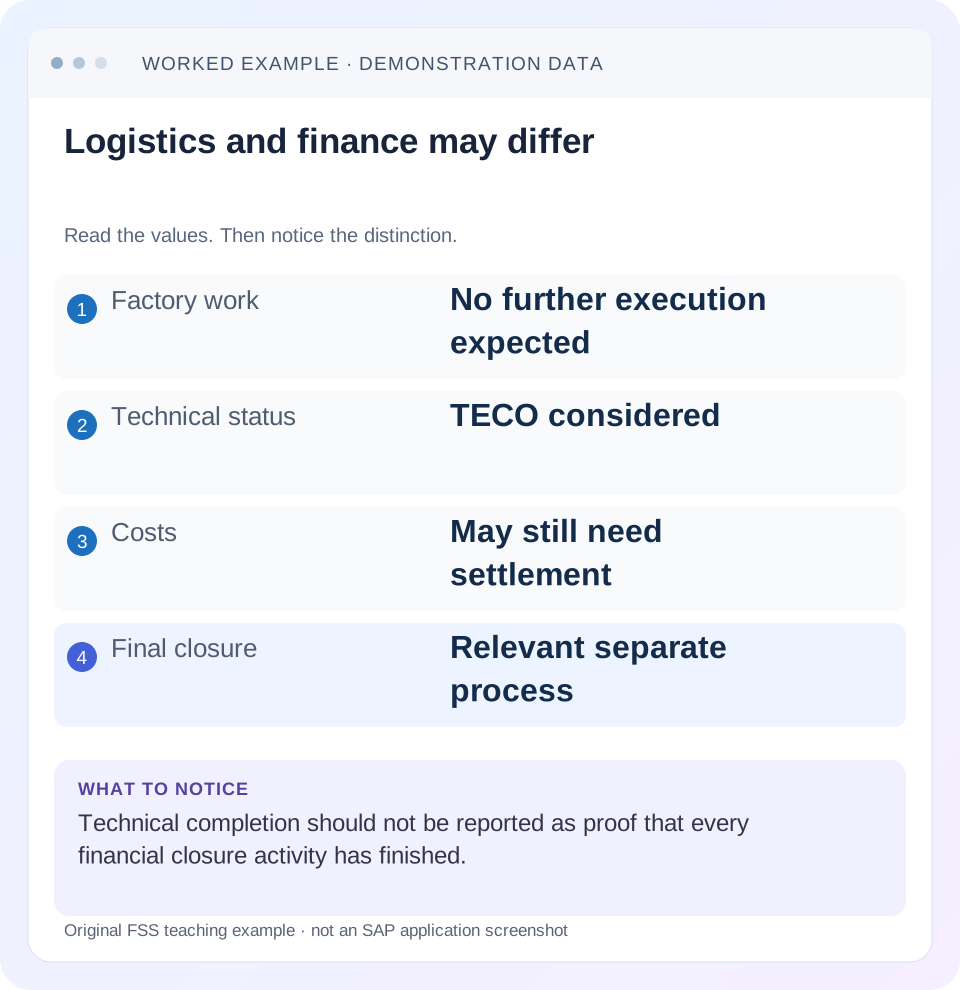
Read the example values
- Factory work
- No further execution expected
- Technical status
- TECO considered
- Costs
- May still need settlement
- Final closure
- Relevant separate process
Words you’ll meet in this guide
- BOM
- Bill of materials, the components needed for a product.
- Routing
- A description of manufacturing work operations.
- MRP
- Material requirements planning, which compares demand and supply.
- Confirmation
- A record of relevant production progress or completed work.
- TECO
- Technical completion: a processing status used for relevant orders.
Preview the practical steps
SEE THE CONNECTION
See it in a simple example.
A small example to make the idea concrete.
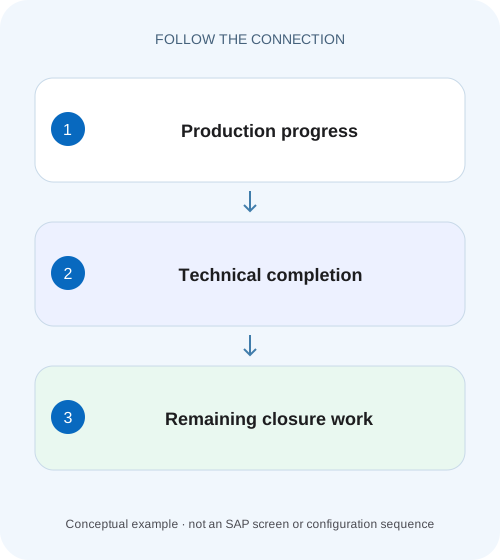
Review completion of an assembly order
A production team wants to technically complete an assembly order while some logistical and financial questions remain open.
TECO is a logistical decision with remaining obligations
Technical completion ends an order from a logistical viewpoint under the supported process.
Understand the documented purpose
SAP's completion-run documentation describes ending one or multiple production orders logistically, including premature stoppage or work that cannot continue as required.
Work a deliberately stopped order
Suppose P900 planned 100 PC.
Review completion of an assembly order
A production team wants to technically complete an assembly order while some logistical and financial questions remain open.
Check the order's execution evidence and the documented consequences of TECO before using status as a substitute for reconciliation.
| Reader | Business question | Evidence to carry forward |
|---|---|---|
| Production planners and shop-floor application teams | Review completion of an assembly order | Check the order's execution evidence and the documented consequences of TECO before using status as a substitute for reconciliation. |
01 TECO is a logistical decision with remaining obligations
Technical completion ends an order from a logistical viewpoint under the supported process. It can be appropriate when production is finished or deliberately stopped early and open planning requirements should no longer drive work. It does not prove that all costs are settled, all quality work is complete or every administrative closure step has occurred.
This guide is for production planners and support analysts reviewing an order or completion-job population. You need actual execution, remaining quantity, component/capacity requirements, material documents and the responsible production decision. The examples are fictional; no status change or completion job was executed.
02 Understand the documented purpose
SAP's completion-run documentation describes ending one or multiple production orders logistically, including premature stoppage or work that cannot continue as required. It specifically discusses open reservations and capacities. That makes TECO a business-state transition, not merely a way to remove untidy rows from an order list. [1]
A partially produced order can therefore be a legitimate completion candidate if the remaining scope is intentionally abandoned. Conversely, a fully confirmed order can still require material or other follow-up before the local process considers technical completion appropriate. Review evidence and policy rather than one quantity/status shortcut.
03 Work a deliberately stopped order
Suppose P900 planned 100 PC. It produced and received 80 PC, and the production owner decides that the remaining 20 will not be made on this order. Component C1 had an illustrative 200-PC requirement at 2 per assembly; 160 PC were actually issued. There are 40 PC of unconsumed planned component demand associated with the abandoned quantity, assuming no other factors.
The 20-PC shortfall is not hidden by TECO; it is explained as deliberately discontinued scope. If demand still requires 20 more, the planner must review its coverage through the appropriate planning process. Completing P900 does not manufacture the missing quantity or automatically prove a replacement order is needed in every scenario.
| Evidence | Quantity/state | Decision relevance |
|---|---|---|
| Planned finished quantity | 100 PC | Original scope |
| Actual finished receipt | 80 PC | Posted output |
| Abandoned scope | 20 PC | Explicit business decision required |
| C1 planned/issued | 200 /160 PC | 40 PC open planning demand to review |
| Remaining resource demand | Actual order-specific value | Review logistical release effect |
| Financial costs | Actual debits/credits | Separate settlement/closure follow-up |
04 Check actual quantities before selecting completion
Read net goods issues and receipts including reversals, not only confirmation totals. A confirmation can record 80 good while receipt is 70, or a receipt can be reversed after an earlier review. Establish the actual material state and any pending/error movements before closing the logistical expectation.
For C1, distinguish unconsumed requirement from unused material physically staged near the line. Removing a reservation requirement is not a physical return posting. If stock needs to be returned or corrected, follow the material process with its own documents. Do not use TECO as a substitute for inventory reconciliation.
05 Review remaining operations and capacities
Identify operations that remain open and whether the remaining work is genuinely cancelled, completed or transferred. A supervisor's“we are done”must be translated into explicit scope and references. Quality inspection, rework or external processing can have separate documents and responsibilities.
Read the actual capacity requirements before and after the supported transition in a fixture. The documented logistical purpose does not justify promising that every downstream planning application instantly reflects the same state without its own refresh or integration processing. Verify the affected consumer when capacity relief is the business reason.
06 Inspect job selection and exclusions
The cited completion-job app supports scheduling, monitoring and cancelling jobs. Its documented exclusions include locked, closed and already technically completed orders, even if those statuses appear in selection criteria. Review the actual selected and processed population rather than assuming every input order changed. [1]
Use a bounded candidate list with reasons. A date cutoff alone can include an old order whose remaining production is still required. Preserve selected IDs, approval context and job result details. A completed batch job can contain skipped or failed objects; reconcile them individually instead of declaring universal success from the aggregate state.
07 Follow a decision-and-verification sequence
Start with the business reason, then read evidence, then assess the transition. This order makes the action concrete and reviewable and prevents completion from becoming an automatic reaction to a crowded worklist.
State the logistical decision
For P900, record that 20 PC are deliberately not continuing on this order.
Expected observation: The shortfall has an owner and reason.
Reconcile execution/materials
Compare confirmations, net receipts/issues and pending movements.
Expected observation: 80 received and 160 C1 issued are supported.
Review open requirements
Inspect reservations, operations and capacity affected by stopping.
Expected observation: 40 C1 planned demand is distinguished from physical stock.
Apply the appropriate completion process
Use the installed individual/job action for the approved population.
Expected observation: Resulting status and exceptions are recorded.
Verify remaining obligations
Recheck logistics plus quality, inventory and accounting follow-up.
Expected observation: Completion is described with its actual limits.
08 Troubleshoot completion surprises
A skipped order, a remaining cost balance and a continued demand shortage are different outcomes. Diagnose them through their own evidence rather than repeatedly triggering TECO.
| Observation | Main question | Next evidence |
|---|---|---|
| Order skipped by job | Excluded status or selection? | Job/object result and actual status |
| Shortage remains after TECO | Demand still needs supply? | Current planning elements and abandoned scope |
| Physical material still at line | Reservation versus stock movement? | Actual stock/return documents |
| Costs remain | Settlement/late postings? | Cost detail, rule and accounting period |
| Quality work outstanding | Separate inspection lifecycle? | Inspection lot and required actions |
| Status changed, response unclear | First action committed? | Current order state before retry |
09 Avoid equating TECO with every final state
Technical completion, financial settlement, closure and deletion/archive eligibility are distinct concepts. An order can be TECO with unsettled costs or later accounting adjustments under applicable controls. Do not report“fully closed”unless the relevant states and obligations were actually verified.
The reverse is also true: an order with no net financial balance may still have open logistical work. One report's zero does not decide the production lifecycle. Keep operational and financial owners aligned through references and explicit remaining tasks rather than forcing a single status label to represent both.
10 Verify positive, negative and partial cases
The positive case deliberately stops P900 at 80 of 100 and checks the logistical state/open-requirement effects under the installed process. The negative control keeps a comparable order active because its remaining 20 are still required. A boundary case uses an already-TECO or locked order in a training completion-job selection and inspects the documented skip outcome.
Also test a pending material movement before completion and define how it must be resolved. Verify stock and cost effects separately from status. These are proposed tests, no production completion was performed, and the article does not assert universal permission for subsequent goods movements or status reversal.
11 Prepare a candidate-level completion record before scheduling a job
Create a candidate worksheet with order, material/plant, original quantity, net receipt, remaining execution scope, reason to stop, open reservations/capacity and remaining follow-up. For P900, record 100 planned,80 received,20 deliberately abandoned. Include a second order P901 whose remaining 20 are still required as an explicit excluded control.
Use the completion-job application's actual selection and retain the resulting candidate/processed/skipped population. The reviewed documentation excludes locked, closed and already-TECO orders. A selection containing ten IDs does not guarantee ten transitions. Reconcile each exception with its state rather than broadening the job filters and running again without understanding the first result. [1]
For a permitted small test, verify one eligible candidate and one excluded-status candidate before considering a larger population. Capture the job reference and object-level result. The operational approval concerns concrete orders and reasons, not simply a transaction name or an old-date cutoff.
12 Verify logistical relief and the still-required supply separately
After the supported transition, inspect P900's actual open requirements and capacity evidence. The original C1 requirement 200 with 160 issued leaves 40 of planned scope to review. TECO's logistical effect is not a goods return of 40 from the line; it changes order/planning expectations under the process. Any physically staged unused material requires its own inventory handling and document evidence.
If valid demand still requires 100 finished units while P900 provided 80, the 20 demand gap remains a planning question. Completing the order can remove the expectation of further output from it, but does not decide whether demand is cancelled, covered by another receipt or requires replacement production. Reconcile current elements and business intent before adding a new 20-PC order.
For a cost variant, assume P900 has 1,600 EUR actual debits and 1,500 settlement credits. Its 100 EUR residual does not prove TECO failed; it identifies financial follow-up. Conversely, zero net cost does not prove the open 20 units should be abandoned. Keep logistical decision, inventory reconciliation and accounting result in separate columns.
For verification, compare before/after status, open planning requirements, capacity picture, net receipts/issues and cost follow-up. Include a deliberately unfinished required operation as a negative candidate: it should remain outside completion scope unless the business explicitly stops it. These controls prevent a cleanup job from turning real unfinished work into an unexplained status.
If the action response is unclear, read the current order/job result before retrying. An already completed order and an unprocessed order need different next actions. Preserve both the original approval and the observed outcome so another planner can distinguish a committed transition from a missing response without guessing.
13 Questions and related lessons
Does TECO mean 100% produced? It can represent deliberate early termination. Does it settle costs? Inspect settlement separately. Can it replace a component return? No, a planning requirement and a physical posting are different. Should a timed-out action be retried immediately? Read the actual order and job result first.
Close with order, reason, planned/actual/abandoned quantities, affected requirements, resulting state and remaining owners. Continue with CO03 for evidence, COOIS for candidate selection, and MD04/MRP-list comparison for the planning impact of changed logistical supply.
Related services and next steps
Primary sources
Found this useful?
Share this guide with your network, or leave a like.
Your like is saved in this browser.