SAP credit memo versus billing cancellation: Keep the correction trail clear
A manufacturer needs to distinguish canceling an incorrect billing document from issuing a value correction for a customer claim.

Source review:
START HERE · NO PRIOR TOPIC KNOWLEDGE NEEDED
What it is. Why it matters.
A credit memo reduces a customer charge through a credit process. Billing cancellation cancels a relevant billing document, preserving a different correction relationship.
Completely new to SAP?
Manufacturers use SAP to connect work such as buying components, recording inventory, planning production, shipping equipment and accounting for costs. SAP S/4HANA is an enterprise resource planning system: it connects these activities through shared business data.
Sales and Distribution connects customer orders, logistics and billing. Each stage has its own documents, quantities and status, so one stage’s success does not prove the whole sale is complete.
A transaction code, or t-code, is a shortcut to a task in classic SAP GUI. Fiori apps provide another way to work. Names and screens depend on the product and release; you do not need a live system to learn the concepts in this guide.

Scope and source-review notes
Scope and evidence
Source review by FAST SAP SOLUTIONS® editorial. This badge describes our editorial review; it does not represent SAP certification or independent endorsement.
SD invoice cancellation and credit-memo concepts for sales and finance support. SAP ERP and S/4HANA Cloud references support the document relationships; installed edition, localization, tax/eDocument rules and accounting state govern actual permitted correction procedures.
Documentation review on 14 November 2026 used the available official SAP indexed excerpts; several SAP Help pages returned no readable full text. The worked case and proposed checks are original illustrative teaching material, not execution evidence from a customer SAP system. Exact fields, permitted actions and behavior must be confirmed against the installed product, release and configuration.
A MANUFACTURING EXAMPLE
Correct an equipment invoice deliberately
Equal net value, different trails
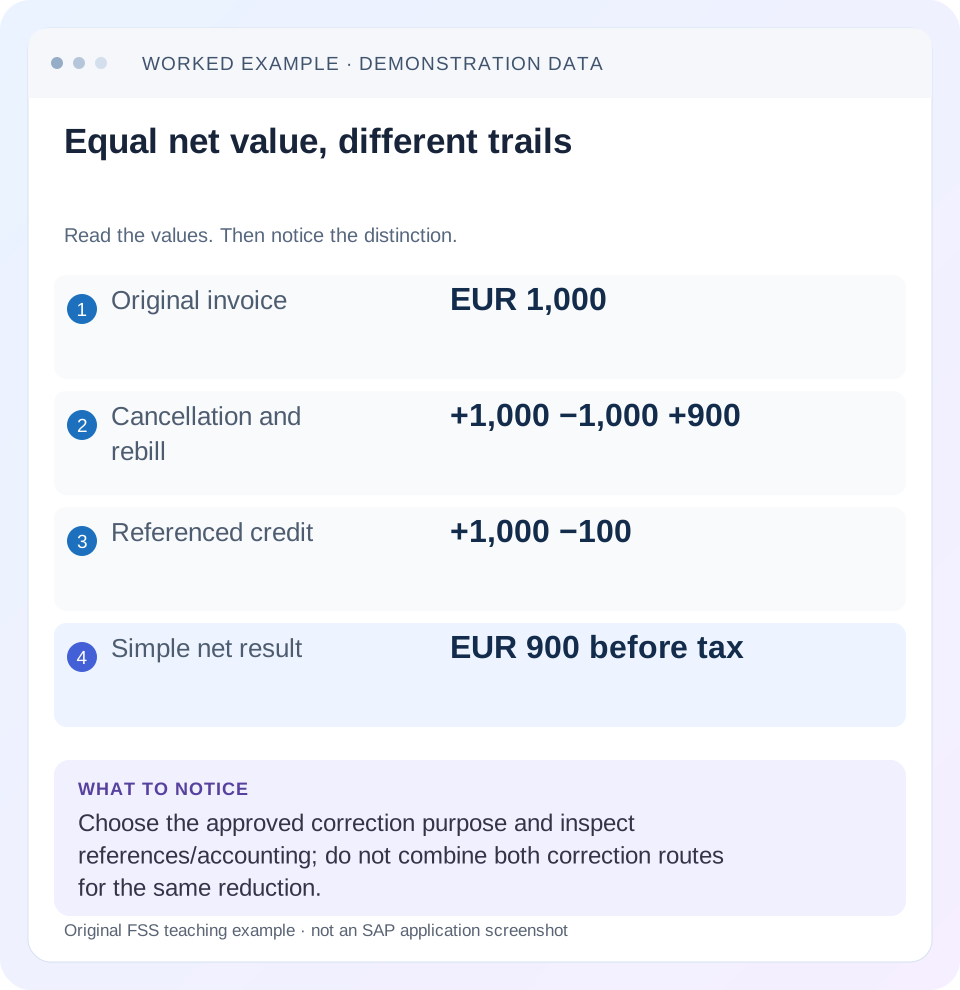
Read the example values
- Original invoice
- EUR 1,000
- Cancellation and rebill
- +1,000 −1,000 +900
- Referenced credit
- +1,000 −100
- Simple net result
- EUR 900 before tax
Words you’ll meet in this guide
- Sales order
- A record of a customer’s order.
- Delivery
- A document organizing goods to be sent.
- Billing
- The process that creates a customer charge.
- HANA
- SAP’s database platform.
Preview the practical steps
SEE THE CONNECTION
See it in a simple example.
A small example to make the idea concrete.
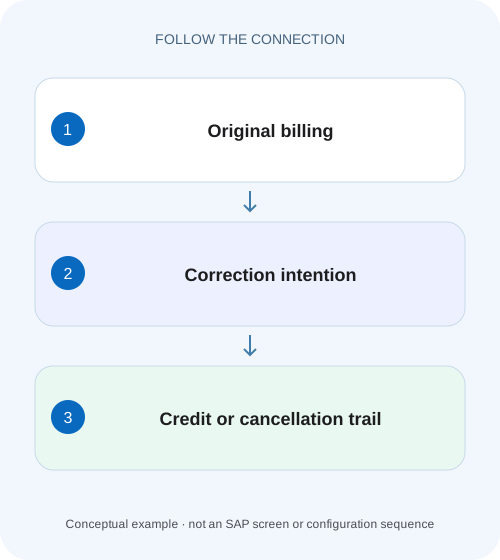
Correct an equipment invoice deliberately
A manufacturer needs to distinguish canceling an incorrect billing document from issuing a value correction for a customer claim.
Choose the correction purpose before the document type
Use a cancellation when the supported business process must nullify the original billing document and potentially rebill its reference correctly.
Audience, prerequisites and process limits
This lesson is for SD billing analysts and finance owners.
Worked original invoice
Our fictional delivery 80000123 contains 10 PC.
Correct an equipment invoice deliberately
A manufacturer needs to distinguish canceling an incorrect billing document from issuing a value correction for a customer claim.
Trace the original invoice and intended correction before selecting the follow-on document.
| Reader | Business question | Evidence to carry forward |
|---|---|---|
| Equipment and component sales, dispatch and customer-service teams | Correct an equipment invoice deliberately | Trace the original invoice and intended correction before selecting the follow-on document. |
01 Choose the correction purpose before the document type
Use a cancellation when the supported business process must nullify the original billing document and potentially rebill its reference correctly. Use the applicable credit-memo process for an approved credit adjustment, such as a price allowance or claim, while retaining the intended reference and approval trail.
SAP documents that cancellation creates a cancellation document and reopens the billed reference for billing in the described process. It also documents credit memos based on requests or existing invoices in supported applications. Equal net amounts do not make those document chains equivalent: the original invoice's state, correction reason and next permitted action differ. [1] [3]
02 Audience, prerequisites and process limits
This lesson is for SD billing analysts and finance owners. Obtain the original invoice/item, reference document, accounting-transfer state, customer communication and approved correction objective. Confirm whether payment, clearing or electronic reporting has already occurred through the relevant supported displays.
The examples illustrate document reasoning, not a jurisdiction-specific correction rule. Country tax/eDocument obligations and local finance procedures can constrain cancellation, dates and communication. SAP ERP, S/4HANA on-premise and Public Edition also expose different applications and restrictions. Use the actual edition's documented correction procedure and authorized business decision before creating customer-facing documents.
03 Worked original invoice
Our fictional delivery 80000123 contains 10 PC. Invoice INV-A bills those 10 PC at EUR 100 net each, or EUR 1,000 before tax. A review establishes that the agreed net price was EUR 90 per PC. The desired economic charge is therefore EUR 900, a EUR 100 reduction.
Two possible training chains can reach EUR 900 net: cancel INV-A for EUR 1,000 and create corrected INV-B for EUR 900, or retain INV-A and issue an approved EUR 100 credit adjustment. Which route is valid depends on the business and applicable correction policy, not on the arithmetic alone.
| Route | Signed net documents | Result |
|---|---|---|
| Cancellation and rebill | +1,000 −1,000 +900 | EUR 900 |
| Referenced credit | +1,000 −100 | EUR 900 |
| Both corrections accidentally applied | +1,000 −1,000 −100 +900 | EUR 800: excess reduction |
04 Reason through the cancellation chain
In the cancellation route, CAN-A references INV-A and offsets its billing effect under the supported process. The original delivery becomes available for billing again in the documented scenario, allowing corrected billing from the appropriate reference. The original invoice and cancellation remain visible as history. [1]
The simplified signed net calculation is +1,000 −1,000 +900 = EUR 900 after INV-B. Before replacement, the chain is net zero for this simplified charge. That temporary zero is not proof that goods returned to stock or that the customer was refunded. Billing correction, physical movement and payment settlement are separate processes.
05 Reason through a credit-adjustment chain
In the credit route, INV-A remains the original EUR 1,000 invoice and CM-A represents the approved EUR 100 reduction. A supported credit memo request can provide a review/release stage before billing, while applicable applications also support invoice references. Preserve the original item relationship and reason. [3] [4]
The simplified signed net calculation is +1,000 −100 = EUR 900. The credit quantity/value design must match the approved claim. A EUR 10 reduction per unit across 10 PC is a price allowance; it is not necessarily a return of one physical unit just because both produce EUR 100 in this simple example. Do not distort quantity to mimic a value correction.
06 Inspect accounting-transfer state before assuming an offset
SAP's S/4HANA Cloud cancellation documentation distinguishes invoices already posted to financial accounting from those not yet posted. In the posted case, the corresponding cancellation posting is needed to offset the accounting entry. In the documented unposted case, cancellation status can be set without journal entries being created. [2]
That distinction prevents a common overclaim: the existence of a cancellation billing document alone does not prove that finance has the complete intended offset. Inspect the actual original/cancellation accounting evidence under the installed process. Likewise, a credit memo's existence does not establish customer payment or automatic settlement of the original open item.
07 Establish the original reference and correction scope
Trace INV-A to its delivery/order item and inspect whether the correction concerns all items or a subset. Confirm quantities, unit, currency, pricing basis and prior credits/cancellations. A header amount can conceal one unaffected item and one incorrect item.
If another credit of EUR 40 already exists for the same price issue, a new EUR 100 credit would reduce the simplified charge to EUR 860. The remaining intended adjustment would be EUR 60 if the prior credit validly covers the same correction. Establish the reason and reference of earlier corrections before computing a balance; equal amounts do not prove they address the same claim.
08 Preserve approval and reason rather than creating an unrelated negative value
The correction record should explain why EUR 100 is owed back, which original item it concerns and who approved it. Use the supported request/reference process for the actual application. SAP documents the request procedure as a way to use an order-processing release process for credits. [4]
A free-text note and an unrelated negative invoice can make reconciliation harder even if the grand total looks right. Retain the document-flow relationships and approved reason. If copied pricing or tax differs from expectation, inspect the relevant pricing/date rules rather than forcing a final number without understanding its components.
09 Reconcile customer communication and electronic status
Determine which original output was sent and what correction communication the approved process requires. A cancellation in SAP does not recall an email or remove a PDF already received by the customer. A replacement invoice can also create confusion if its relation to the original is not clear.
Where electronic invoicing/reporting applies, inspect the applicable localization process and its accepted/canceled/corrected states. Do not assume that changing SD status completes the external legal/reporting trail. Keep that review tied to the actual company and jurisdiction, rather than transplanting another country's cancellation instructions.
10 Prevent duplicate replacement or credit creation
Before any create/retry action, inspect document flow for an existing cancellation, replacement invoice or credit memo. A timeout can leave the user uncertain after a document has already been saved. Repeating the action without reconciliation can create an extra correction.
For the cancellation route, verify whether INV-B already bills the reopened reference. For the credit route, total only the relevant approved correction chain in consistent currency and signs. If the remaining economic effect is unclear, stop the creation decision and resolve the references. The right recovery is based on persisted state, not on whether the last screen returned success.
| Observation | Check before action |
|---|---|
| Invoice already canceled | Existing cancellation and replacement |
| Prior credit exists | Reason/reference and remaining adjustment |
| Original unposted | Documented cancellation accounting branch |
| Customer already paid | Separate settlement/refund process |
| Output/eDocument already sent | Applicable correction communication/reporting trail |
11 Verify both document chain and financial result
For cancellation, inspect INV-A, CAN-A and INV-B with their reference/status and accounting evidence. Confirm the corrected 10-PC price and EUR 900 simplified net value. For a credit, inspect INV-A and CM-A, confirm EUR 100 approved adjustment and the expected EUR 900 net charge before tax in the fixture.
Then reconcile relevant tax, currency, posting periods and open-item/settlement effects using the actual finance process. The tutorial's net arithmetic does not validate those dimensions. A positive business result needs the correct customer, item, reason and accounting trail, not only a matching total.
12 Positive, negative and boundary exercises
A positive paper exercise computes both valid illustrative net chains and explains why their histories differ. A negative exercise creates both CAN-A and CM-A for the same full correction plus INV-B: +1,000 −1,000 −100 +900 = EUR 800, exposing an extra reduction.
A boundary exercise uses an invoice never transferred to accounting. The learner should inspect the documented cancellation posting branch rather than demand a nonexistent original journal entry. Another fixture shows a fully paid invoice; the learner must separate billing correction from the finance settlement/refund decision. No productive cancellation or credit is required to learn these distinctions.
Build a correction ledger before choosing the final action: original item, approved reduction reason, prior related credits, cancellation state, replacement state and the expected remaining economic charge. For the fixture, that charge is EUR 900 before tax, but the ledger should also state whether the original invoice remains valid or is nullified. Two trails with equal arithmetic can still tell different legal and customer-facing stories.
For a controlled test, compare document references as well as signed values. A EUR 100 credit against another invoice does not explain INV-A’s overcharge. Similarly, a EUR 900 replacement linked to an unrelated delivery does not complete the intended cancellation/rebill chain. These identity checks catch corrections that match the spreadsheet total while leaving the original source incorrectly billed or the wrong customer affected.
For an amount-only trap, show a EUR 100 credit whose reference is correct but whose reason covers damaged goods rather than the omitted price allowance. It cannot automatically be deducted from the remaining price correction merely because both amounts are EUR 100. Review whether the business approved separate claims or one superseding adjustment. The correction ledger should preserve reason and item scope as well as signed value. This prevents under-crediting a legitimate separate claim or double-crediting the same issue, and keeps the invoice trail understandable when several corrections accumulate over time.
13 Questions and a useful correction handoff
Does a credit memo necessarily mean goods were returned? No; value adjustments can have other reasons. Does cancellation reverse goods issue? It is a separate billing process. Does a cancellation document always imply a new accounting offset exists? Inspect the original posting state and the documented branch.
A useful handoff states original invoice/item, approved purpose, current posting/communication state, prior corrections, chosen supported route and expected quantity/value result. For the fixture: “10-PC invoice overcharged by EUR 100 net; prior corrections checked; approved credit or cancellation/rebill route to be recorded; final EUR 900 charge and accounting chain to verify.” That makes the decision reviewable without equating arithmetic with authorization.
Related services and next steps
Primary sources
Found this useful?
Share this guide with your network, or leave a like.
Your like is saved in this browser.