Return order versus credit memo request: Separate goods flow from value correction
A component customer raises a complaint, and the manufacturer must decide whether goods will return or only value will be corrected.

Source review:
START HERE · NO PRIOR TOPIC KNOWLEDGE NEEDED
What it is. Why it matters.
A return order organizes a goods-return process. A credit memo request starts a value-correction request, so physical goods and financial adjustments may follow different paths.
Completely new to SAP?
Manufacturers use SAP to connect work such as buying components, recording inventory, planning production, shipping equipment and accounting for costs. SAP S/4HANA is an enterprise resource planning system: it connects these activities through shared business data.
Sales and Distribution connects customer orders, logistics and billing. Each stage has its own documents, quantities and status, so one stage’s success does not prove the whole sale is complete.
A transaction code, or t-code, is a shortcut to a task in classic SAP GUI. Fiori apps provide another way to work. Names and screens depend on the product and release; you do not need a live system to learn the concepts in this guide.

Scope and source-review notes
Scope and evidence
Source review by FAST SAP SOLUTIONS® editorial. This badge describes our editorial review; it does not represent SAP certification or independent endorsement.
SD complaints, customer returns and credit requests for returns clerks, sales and finance support. Current S/4HANA Cloud customer-return documentation illustrates inspection/refund capabilities; classic ERP/CRM integration and on-premise processes require their own supported configuration and document flow.
Documentation review on 14 November 2026 used the available official SAP indexed excerpts; several SAP Help pages returned no readable full text. The worked case and proposed checks are original illustrative teaching material, not execution evidence from a customer SAP system. Exact fields, permitted actions and behavior must be confirmed against the installed product, release and configuration.
A MANUFACTURING EXAMPLE
Separate a faulty component return from compensation
Reconcile return and credit separately
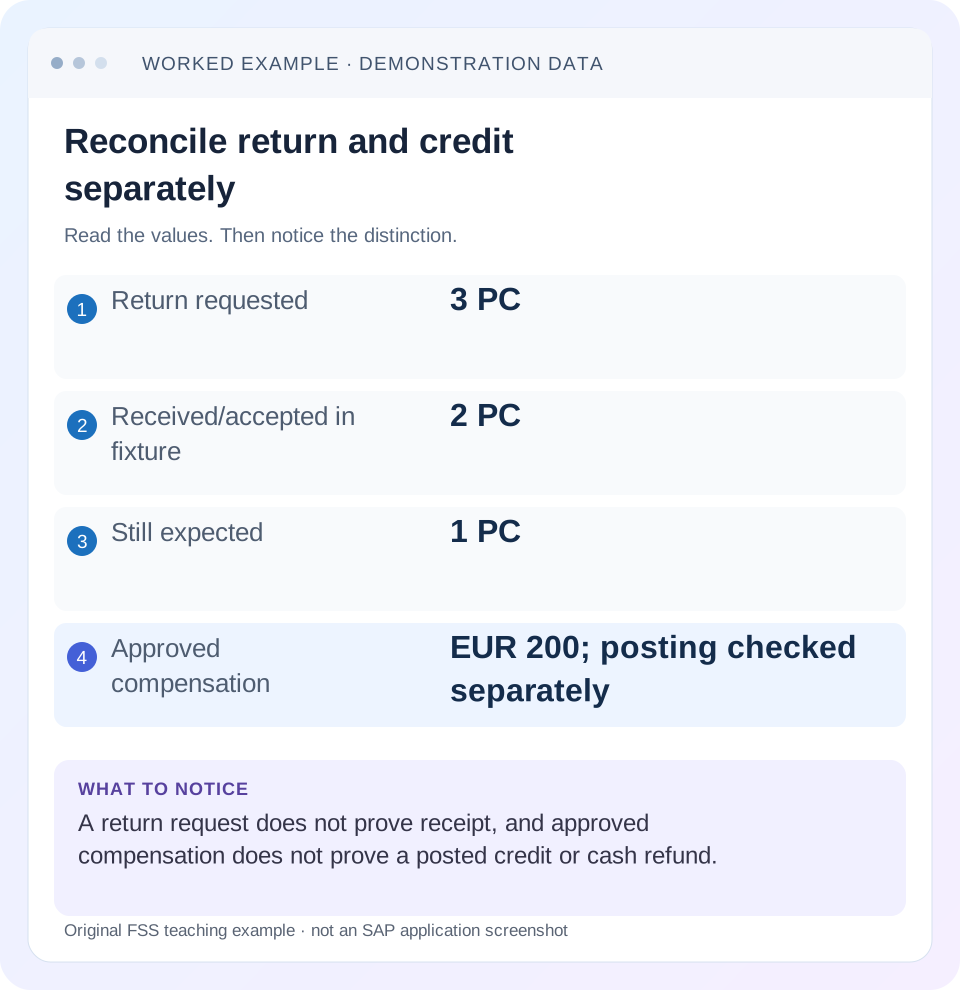
Read the example values
- Return requested
- 3 PC
- Received/accepted in fixture
- 2 PC
- Still expected
- 1 PC
- Approved compensation
- EUR 200; posting checked separately
Words you’ll meet in this guide
- Sales order
- A record of a customer’s order.
- Delivery
- A document organizing goods to be sent.
- Billing
- The process that creates a customer charge.
- EWM
- Extended Warehouse Management: SAP’s application for warehouse processes.
Preview the practical steps
SEE THE CONNECTION
See it in a simple example.
A small example to make the idea concrete.
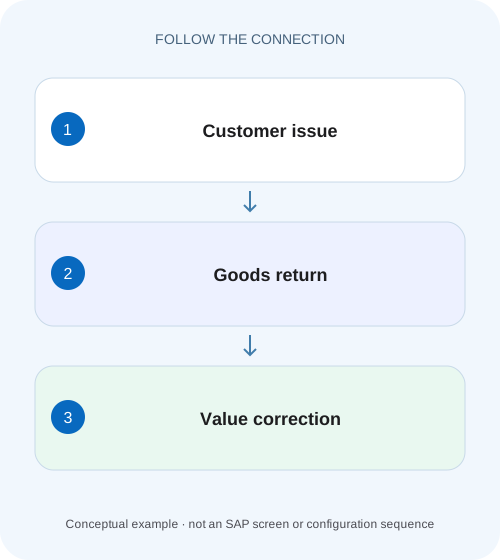
Separate a faulty component return from compensation
A component customer raises a complaint, and the manufacturer must decide whether goods will return or only value will be corrected.
Goods coming back and credit being granted are separate decisions
A returns process organizes goods coming back and their logistical handling.
Audience and prerequisites
This tutorial is for returns/refund clerks, SD support, warehouse receiving and finance.
Worked sale and two alternative complaint intentions
Our fictional invoice INV-A bills 10 PC at EUR 100 net per PC, or EUR 1,000 before tax.
Separate a faulty component return from compensation
A component customer raises a complaint, and the manufacturer must decide whether goods will return or only value will be corrected.
Keep the physical-return intention and financial-correction intention explicit before creating follow-on documents.
| Reader | Business question | Evidence to carry forward |
|---|---|---|
| Equipment and component sales, dispatch and customer-service teams | Separate a faulty component return from compensation | Keep the physical-return intention and financial-correction intention explicit before creating follow-on documents. |
01 Goods coming back and credit being granted are separate decisions
A returns process organizes goods coming back and their logistical handling. A credit memo request asks for a financial credit and can be appropriate without any goods movement, for example when an agreed discount was omitted. A request is an intermediate document or decision record, not proof that credit was posted or cash refunded.
SAP documents credit memo requests for customer claims and customer-return processes with inspection, logistical follow-up and compensation options. A returned product can lead to a credit, replacement or another approved outcome. Start with what happened physically and commercially, then select the supported process rather than using one document type for every complaint. [1] [2]
02 Audience and prerequisites
This tutorial is for returns/refund clerks, SD support, warehouse receiving and finance. Obtain the original order/invoice item, complaint reason, quantity/unit, goods location, expected return quantity and existing return/credit documents. Establish which application owns the process and who may approve compensation.
The worked ledgers are process reasoning, not a universal SAP document-type recipe. Advanced Returns Management, EWM integration, counter returns and classic SD returns differ. Current Public Edition documentation names apps such as Manage Customer Returns - Version 2 and Enter Inspection Results - From Warehouse; those capabilities should not be assumed in every older ERP installation.
03 Worked sale and two alternative complaint intentions
Our fictional invoice INV-A bills 10 PC at EUR 100 net per PC, or EUR 1,000 before tax. In case A, the customer reports 3 damaged PC and is instructed through the approved process to return them. Only 2 PC have arrived at the warehouse when support investigates; the third remains outstanding.
Case B is an alternative fixture for the same original values: the customer keeps all 10 PC, but an agreed 5-percent discount was omitted. The intended value adjustment is EUR 50, leaving EUR 950 net before tax. Creating a physical return in case B would record an event that did not happen. Do not apply both example corrections to the same complaint unless the business actually approved two distinct reasons.
| Measure | Case A damaged return | Case B omitted discount |
|---|---|---|
| Original sale | 10 PC; EUR 1,000 | 10 PC; EUR 1,000 |
| Physical intention | Return 3 PC | Keep all 10 PC |
| Observed return receipt | 2 PC | No return intended |
| Approved illustrative correction | EUR 200 for 2 accepted PC | EUR 50 discount |
| Outstanding question | Remaining 1 PC and credit state | Credit-request/billing state |
04 Separate the requested return from physical receipt
For case A, the expected return quantity is 3 PC, received quantity is 2 PC and outstanding return is 1 PC. The original shipped quantity was 10 PC; a simple physical balance leaves 8 PC outside the warehouse at this point, including the 1 PC still expected back. Those measures answer different questions.
A return order or authorization can record an intention before goods arrive. It does not prove receipt, inspection or available stock. Inspect the actual return delivery/receipt documents and item units. If a carrier reference says three boxes arrived, establish the quantity/unit inside them before comparing with 3 PC. Do not infer the receipt quantity from the complaint text alone.
05 Inspect the goods before assuming their stock disposition
Current customer-return documentation describes inspection and logistical follow-up based on inspection results. Receiving damaged goods does not necessarily mean they are immediately available for normal sale. The supported process can lead to different stock handling, repair, supplier return or other activities. [2]
For the fixture, record 2 PC received and their inspection result independently from stock usability. If one is accepted for a particular follow-up and one requires further review, retain that split in the business ledger and use the installed process's supported handling. Do not move stock into an unrestricted category merely to make the receipt and credit totals match.
06 Keep the compensation decision independent of quantity received
Suppose the approved case A decision grants full credit for the 2 inspected PC already accepted, while the remaining 1 PC awaits receipt/review. The illustrative approved credit is 2 × EUR 100 = EUR 200 before tax. The remaining potential EUR 100 is not yet an approved or posted credit merely because the return request originally named 3 PC.
The actual application may implement staged compensation through supported inspection splits, refund controls or another configured process. Use that documented mechanism rather than inventing manual document surgery. Also recognize supported business exceptions: some processes allow immediate compensation before inspection, while others require inspection first. Record the actual approved control and its meaning. [3]
07 A credit memo request is not the credit memo
Inspect the credit request's reference, reason, quantity/value and approval/block state. Then trace any resulting credit memo and its accounting transfer. A request for EUR 300 and a posted credit of EUR 200 can coexist while a remaining decision is unresolved; the references and process state must explain the difference.
For case B, the request should represent the approved EUR 50 omitted-discount correction, using the actual supported pricing/value mechanism. Do not fake a one-unit goods return because EUR 50 happens to equal another unit value in a different example. Preserve the commercial reason so the financial correction remains understandable after the physical-sale quantity stays 10 PC.
08 Trace references instead of creating parallel complaint chains
Start from INV-A/item and inspect existing return orders, deliveries, inspection/refund records, credit requests and credit memos. Preserve which documents address the same complaint. A second complaint created after a timeout may duplicate an existing chain rather than repair a missing one.
Current SAP credit-request references can copy relevant data from preceding documents in supported applications/APIs. Copying helps identity, but the copied quantity/value still needs review for the actual claim. Confirm original item and customer, prior related credits and remaining approved amount. Equal totals against the wrong invoice do not settle the correct complaint. [4]
09 Reconcile goods and value using two ledgers
The logistics ledger records requested, received, inspected and follow-up quantities. The financial ledger records requested credit, approved compensation, created credit memo and accounting/settlement state. Join them through references, not by assuming the numbers must always be equal at the same moment.
For case A,2 received and EUR 200 approved can be consistent under the stated full-credit decision. If only a request exists, posted credit can still be zero. If the credit memo is posted, the simplified original EUR 1,000 charge becomes EUR 800 before tax; that does not prove money was refunded. Payment/clearing is a later finance question.
| Logistics measure | Quantity | Financial measure | Amount/state |
|---|---|---|---|
| Expected return | 3 PC | Potential full-unit value | EUR 300; not automatic approval |
| Received/accepted in fixture | 2 PC | Approved compensation | EUR 200 |
| Still expected | 1 PC | Remaining decision | EUR 100 potential; unapproved |
| Actual credit posting | Verify separately | Simplified net if EUR 200 posted | EUR 800 before tax |
10 Choose the next action from the missing state
If goods are expected but not received, investigate the return shipment/reference rather than issuing a duplicate credit request. If goods are received but inspection is pending, follow the receiving/inspection process. If compensation is approved but no credit memo exists, inspect billing eligibility, blocks and the relevant creation outcome.
If a credit memo exists but finance cannot find its effect, inspect accounting-transfer state and document identity. If cash refund is the question, inspect the finance settlement process. Each handoff should name the exact missing state. “Return complete” is too broad when logistics is finished but compensation or payment remains open.
| Observed gap | Next evidence |
|---|---|
| Expected goods missing | Return shipment and receipt references |
| Received, not inspected | Inspection and follow-up state |
| Approved, no credit memo | Block, eligibility and billing outcome |
| Credit exists, no finance effect | Accounting-transfer reference/status |
| Credit posted, no cash | Settlement/refund evidence |
11 Avoid cancellation as an unexamined substitute
A valid original shipment followed by a customer return is different from an invoice created in error. Billing cancellation and a returns credit preserve different histories. Similarly, direct goods-issue reversal for an accidental posting is not automatically the right representation of goods that genuinely left and later returned.
Choose the supported correction according to the actual event, original document state and applicable finance/localization process. A credit's economic reduction does not automatically satisfy every cancellation prerequisite elsewhere. Preserve the original sale and follow-on relationships so warehouse stock and customer receivables can be explained together without pretending the original event never occurred.
12 Practical reconciliation worksheet and action sequence
Record INV-A/item, original 10 PC/EUR 1,000, complaintA expected 3 PC, actual receipt 2 PC, outstanding 1 PC, inspection evidence, approved EUR 200 and actual credit/accounting references. Confirm every quantity's unit. Then identify the unresolved state and its owner before any further document creation.
For case B, use a separate worksheet line: all 10 PC retained, omitted discount 5 percent, approved EUR 50 and supported credit-request status. If both reasons truly exist in a real case, preserve separate reason/reference lines and reconcile the combined approved financial effect. The worksheet should explain what each correction covers so no one grants the same allowance twice.
13 Positive, negative and boundary checks
A positive paper exercise for case A finds 2 PC received,1 outstanding and an approved EUR 200 compensation decision. The learner should not report 3 PC received or EUR 300 posted. A negative exercise for case B creates no logistics documents and expects only the approved value-correction path.
A boundary fixture grants an approved replacement instead of a credit. The learner should verify replacement fulfillment and avoid also assuming a cash refund. Another fixture contains a posted EUR 200 credit but no payment; the correct conclusion is financial credit established, cash settlement unproven. In an authorized training system, verify actual document identities and statuses separately from these illustrative expected results.
14 Questions and a useful complaint handoff
Does every credit need a physical return? No; an omitted discount is a documented credit-request example. Does a return order prove goods arrived? Inspect receipt evidence. Does receipt prove credit approval? Inspect the compensation decision. Does a credit memo prove refund payment? Inspect accounting and settlement.
A useful note says: “INV-A 10 PC/EUR 1,000; case A return expected 3, received/inspected 2, remaining 1 outstanding. EUR 200 approved under the recorded decision; credit-memo/accounting state named separately.” This gives warehouse, sales and finance one reconciled story while retaining the distinction between intention, physical handling and financial completion.
Related services and next steps
Primary sources
Found this useful?
Share this guide with your network, or leave a like.
Your like is saved in this browser.