Cannot reverse SAP goods issue? Check the delivery billing state
A machinery manufacturer needs to correct goods issue for a delivery that already has downstream billing evidence.

Source review:
START HERE · NO PRIOR TOPIC KNOWLEDGE NEEDED
What it is. Why it matters.
Goods issue records goods leaving stock in the delivery process. A reversal corrects that movement, but related billing and document status can constrain the allowed correction path.
Completely new to SAP?
Manufacturers use SAP to connect work such as buying components, recording inventory, planning production, shipping equipment and accounting for costs. SAP S/4HANA is an enterprise resource planning system: it connects these activities through shared business data.
Sales and Distribution connects customer orders, logistics and billing. Each stage has its own documents, quantities and status, so one stage’s success does not prove the whole sale is complete.
A transaction code, or t-code, is a shortcut to a task in classic SAP GUI. Fiori apps provide another way to work. Names and screens depend on the product and release; you do not need a live system to learn the concepts in this guide.

Scope and source-review notes
Scope and evidence
Source review by FAST SAP SOLUTIONS® editorial. This badge describes our editorial review; it does not represent SAP certification or independent endorsement.
Classic LE Shipping reversal in S/4HANA on-premise Delivery Management. The cited procedure is not a universal EWM/decentralized warehouse or public-cloud correction route. Finance, warehouse integration, movement types and physical-shipment state determine the actual supported process.
Documentation review on 14 November 2026 used the available official SAP indexed excerpts; several SAP Help pages returned no readable full text. The worked case and proposed checks are original illustrative teaching material, not execution evidence from a customer SAP system. Exact fields, permitted actions and behavior must be confirmed against the installed product, release and configuration.
A MANUFACTURING EXAMPLE
Investigate a dispatched equipment correction
Partial billing still matters
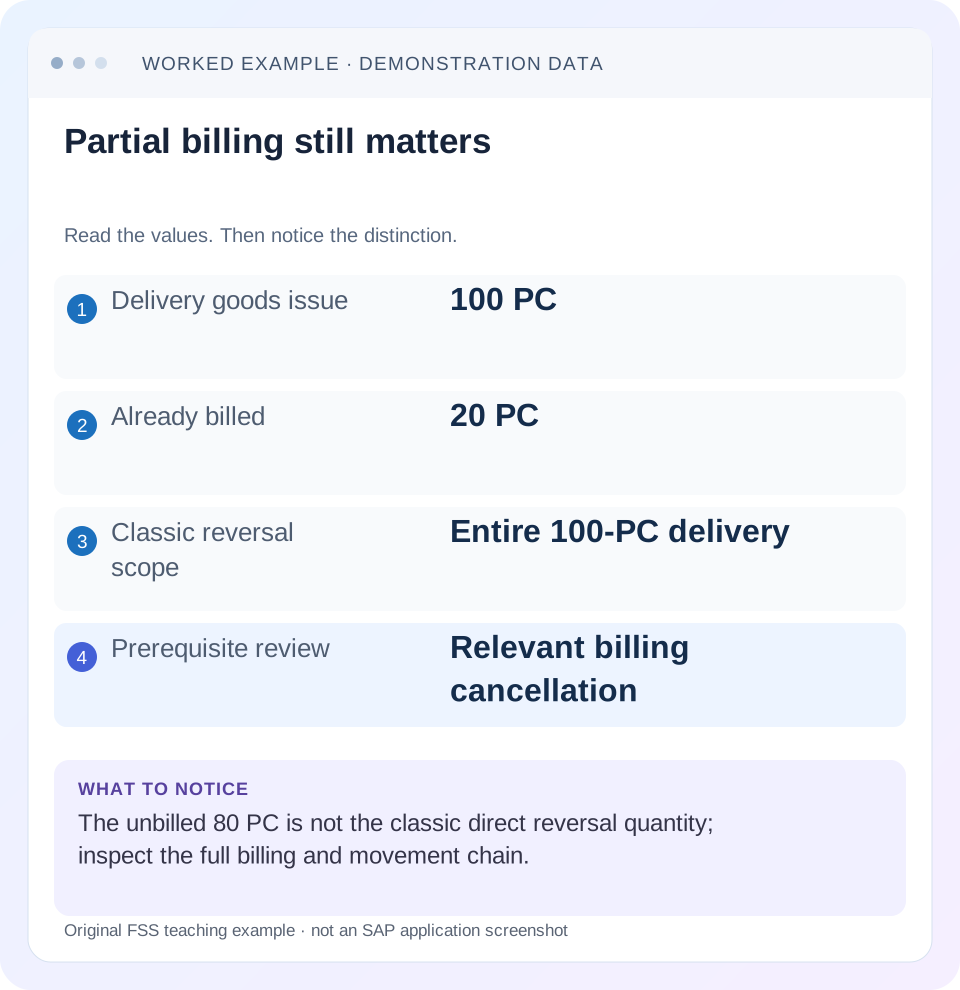
Read the example values
- Delivery goods issue
- 100 PC
- Already billed
- 20 PC
- Classic reversal scope
- Entire 100-PC delivery
- Prerequisite review
- Relevant billing cancellation
Words you’ll meet in this guide
- Sales order
- A record of a customer’s order.
- Delivery
- A document organizing goods to be sent.
- Billing
- The process that creates a customer charge.
- HANA
- SAP’s database platform.
- EWM
- Extended Warehouse Management: SAP’s application for warehouse processes.
Preview the practical steps
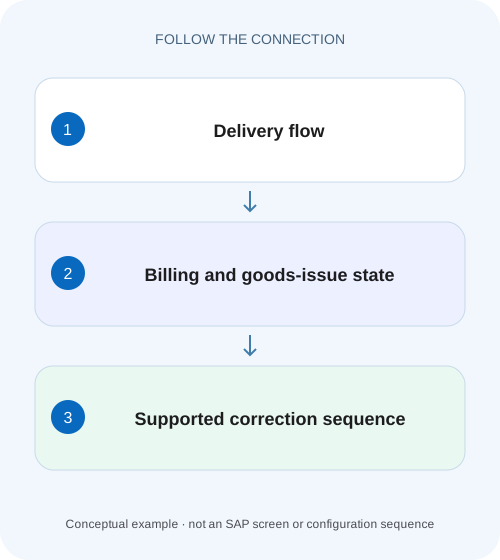
SEE THE CONNECTION
See it in a simple example.
A small example to make the idea concrete.
Investigate a dispatched equipment correction
A machinery manufacturer needs to correct goods issue for a delivery that already has downstream billing evidence.
Even partial billing can block the classic reversal
For the classic LE process documented by SAP, goods-issue reversal for an already partly or fully billed delivery requires the billing document to be canceled first.
Audience and prerequisites
This tutorial is for shipping, SD billing, finance and Basis/application support working on a coordinated correction.
Worked chain: all 100 issued, only 20 billed
Our fictional delivery 80000123 contains 100 PC of one material.
Investigate a dispatched equipment correction
A machinery manufacturer needs to correct goods issue for a delivery that already has downstream billing evidence.
Inspect the complete document chain before attempting to reverse the logistical posting in isolation.
| Reader | Business question | Evidence to carry forward |
|---|---|---|
| Equipment and component sales, dispatch and customer-service teams | Investigate a dispatched equipment correction | Inspect the complete document chain before attempting to reverse the logistical posting in isolation. |
01 Even partial billing can block the classic reversal
For the classic LE process documented by SAP, goods-issue reversal for an already partly or fully billed delivery requires the billing document to be canceled first. A small partial invoice can therefore matter even when most delivery quantity remains unbilled. Inspect actual document flow before deciding that the error is a stock problem. [1]
Goods-issue reversal creates a cancellation document for the original movement. It does not simply edit the delivery quantity. The documented classic operation applies to the entire delivery, so a business request to correct only a subset needs its appropriate supported process rather than an assumed partial reversal. [1]
02 Audience and prerequisites
This tutorial is for shipping, SD billing, finance and Basis/application support working on a coordinated correction. Obtain the delivery/item, original goods-issue reference, exact reversal message, existing billing/cancellation references and the physical shipment situation. Begin with permitted displays and the business decision about what is actually wrong.
The tutorial's procedure scope is classic LE Shipping in the cited S/4HANA on-premise documentation. EWM and decentralized warehouse integrations have their own ownership and checks. Do not transplant the classic reversal action into another warehouse design. A documented prerequisite is a diagnostic explanation, not authority to cancel a customer invoice or reverse a real shipment.
03 Worked chain: all 100 issued, only 20 billed
Our fictional delivery 80000123 contains 100 PC of one material. Goods issue GI-A was posted for all 100 PC. A supported partial-billing training process has already produced invoice INV-A for 20 PC at EUR 50 net per PC, or EUR 1,000 before tax. The remaining 80 PC are not billed.
The warehouse reports that goods issue was posted accidentally before the intended physical dispatch. They request reversal of the delivery's goods issue. Even though 80 PC remain unbilled, the 20-PC invoice means the delivery is partly billed. Under the classic documented prerequisite, that billing state must be addressed before direct goods-issue reversal can proceed.
| Measure | Quantity/value | Interpretation |
|---|---|---|
| Delivery goods issue | 100 PC | Entire classic reversal scope |
| Billed quantity | 20 PC | Partly billed prerequisite applies |
| Unbilled quantity | 80 PC | Not the direct reversal quantity |
| Invoice net value | EUR 1,000 | Sales value, distinct from stock valuation |
04 Establish the physical and system correction objective
Ask whether goods are still at the warehouse, have left the site, were received by the customer or are now returning. An accidental posting before dispatch and an actual customer return are different business events. The system correction should represent the real event and the approved process.
If goods genuinely left and are coming back, a returns process may be appropriate under the business design. If only the system posting was premature, direct reversal may fit the documented classic use case. Do not use whichever route clears an error fastest; the resulting stock location, valuation and customer-credit trail must describe what happened.
05 Read the whole delivery document flow
Inspect the original order, delivery, goods-issue document and all relevant billing documents, including cancellations. Record item identities and quantities. A missing invoice printout is not evidence of no billing, and a user remembering only the largest invoice can miss a small earlier partial invoice.
For the fixture, identify GI-A 100 PC and INV-A 20 PC explicitly. If other invoices exist, establish their relationships too. If an invoice is already canceled, confirm the actual cancellation status/accounting context rather than subtracting its value informally. The reversal investigation needs the delivery's current supported billing state, not only a signed spreadsheet total.
06 Review the billing correction with its owner
When the classic prerequisite requires cancellation, the SD/finance owner must review the original invoice, accounting transfer, customer communication and applicable tax/eDocument process. Cancellation creates its own related document; it is not deletion of the invoice history. [3]
An approved credit allowance is not automatically equivalent to canceling the billing document for this prerequisite. A credit can correct economic value while leaving a different original billing relationship. Use the actual documented cancellation/reversal design. If the business cannot cancel the invoice under its process, escalate the correction-route question with the complete chain rather than bypassing the check.
07 Understand whole-delivery quantity and valuation effects
SAP documents that the reversal cancellation adopts quantities and valuation from the original goods issue and makes corresponding stock postings. In the classic scope, it reverses the entire delivery rather than only its unbilled 80 PC. Billing quantity and goods-issue quantity are different balances. [1]
For illustrative stock arithmetic, suppose stock was 300 PC before GI-A. Issuing 100 leaves 200; reversing that 100 restores 300, assuming no other movements in this simplified fixture. If the original movement's illustrative inventory value effect was EUR 2,000, its reversing effect offsets that original valuation according to the supported posting. The EUR 1,000 invoice value is a separate sales value, not the inventory valuation to use for reversal.
| Event | Signed quantity | Stock |
|---|---|---|
| Opening | 300 PC | 300 PC |
| GI-A | −100 PC | 200 PC |
| GI cancellation | +100 PC | 300 PC |
| Other movements | None in fixture | Real cases must reconcile them |
08 Check technical prerequisites without inventing movement rules
The cited goods-issue reversal documentation requires a reversal movement type to be defined for the goods-issue movement. For customer-defined movement types, the relevant configured assignment matters. Inspect the actual movement and documented reversal relationship with the responsible logistics owner. [1]
Do not derive a reversal movement code by arithmetic or directly edit inventory documents to bypass delivery processing. Posting period, warehouse/integration state and other process checks can add constraints. Preserve the exact remaining error after billing state is addressed so the next correction targets the actual prerequisite rather than the original assumption.
09 Use the supported process and inspect its result log
SAP's classic Reverse Goods Issue procedure describes selecting eligible deliveries by criteria such as route, goods-issue date and shipping point, then executing the supported cancellation/reversal with a result log. Use the installed application's documented procedure only after the business correction and prerequisites are established. [2]
Keep the selection narrowly tied to the approved delivery population. A list action can affect several deliveries, so verify selection identity before execution in a training or authorized business process. If a result is unclear, inspect the generated reversal log and document flow before repeating. A timeout does not prove that no cancellation document exists.
10 Verify the delivery, movement and stock together
After an authorized reversal, inspect the cancellation document linked to GI-A, its 100-PC quantity and relevant valuation relationship. SAP documents resetting the delivery's goods-movement status and requirements in the classic process. Confirm the actual status in your release and the stock result for the correct plant/location/unit. [1]
Do not stop at a success message. Reconcile any other stock movements during the interval, relevant accounting evidence and the actual warehouse state. If stock appears higher than expected, check duplicate or unrelated movements before posting a new issue. If goods still physically left, the correction may be technically complete but operationally wrong and needs business reconciliation.
11 Reconcile what becomes open after the correction
The cancellation of billing can reopen the source for billing in the documented billing process, while goods-issue reversal changes the delivery's execution state. These are separate reopened conditions. Make clear whether the delivery will be corrected and reissued, replaced through a supported process or held pending another business decision.
Do not let the canceled invoice reappear in a normal billing run while the logistics correction remains unresolved. Inspect the actual eligibility/status and agreed operational controls. Likewise, do not recreate a delivery merely because the original now has an earlier status. Preserve the original/cancellation references so subsequent processing can explain the entire history.
12 Troubleshoot the remaining failure branches
If reversal is still rejected after an approved billing correction, compare all related billing/cancellation states and the exact new message. If the movement is already reversed, inspect the existing cancellation rather than attempting another one. If only a subset needs physical correction, return to the supported partial-return or correction process instead of assuming classic full-delivery reversal is suitable.
If the warehouse is EWM-controlled, identify which system owns the permitted cancellation action and status synchronization. A backend delivery view alone may not describe the execution prerequisite. If a posting period or movement assignment is the blocker, resolve that through the responsible logistics/finance process with the original document evidence intact.
| Observation | Next evidence |
|---|---|
| Partly billed | Billing/cancellation chain and owner decision |
| Billing canceled, new error | Exact remaining prerequisite |
| Cancellation already exists | Current movement and delivery state |
| Only partial quantity needs correction | Supported returns/correction route |
| EWM controls execution | Warehouse-owned cancellation and synchronization |
13 Positive, negative and boundary exercises
A positive paper fixture has a 100-PC GI and no billing, plus valid classic prerequisites. The learner should predict a 100-PC cancellation and matching stock reversal. A negative fixture adds the 20-PC invoice: the billing prerequisite remains despite 80 PC unbilled. A boundary fixture asks to reverse only 10 PC; the learner should reject that assumption for the documented entire-delivery operation.
Add a separate fixture in which goods physically returned after valid shipment. The learner should identify the returns-process question rather than treat it as an accidental-posting reversal automatically. For real authorized testing, compare original and cancellation document identities, quantity/value effects and delivery/warehouse states. All examples here are documentation-based, not customer execution evidence.
14 Questions and a useful correction record
Does a partial invoice matter? Yes, in this classic documented reversal scope. Does a credit memo necessarily satisfy the cancellation prerequisite? Verify the actual billing state and supported relationship; equal net value is not equivalent history. Does reversing goods issue itself cancel billing or recall a shipment? Those are separate processes.
A useful record names delivery 80000123, GI-A 100 PC, INV-A 20 PC, physical goods state, approved billing action, supported warehouse route and verified reversal result. It should also state the next intended delivery/billing state. That makes the correction understandable to logistics and finance while preventing the unbilled 80-PC balance from being mistaken for the permitted reversal quantity.
Related services and next steps
Primary sources
Found this useful?
Share this guide with your network, or leave a like.
Your like is saved in this browser.